
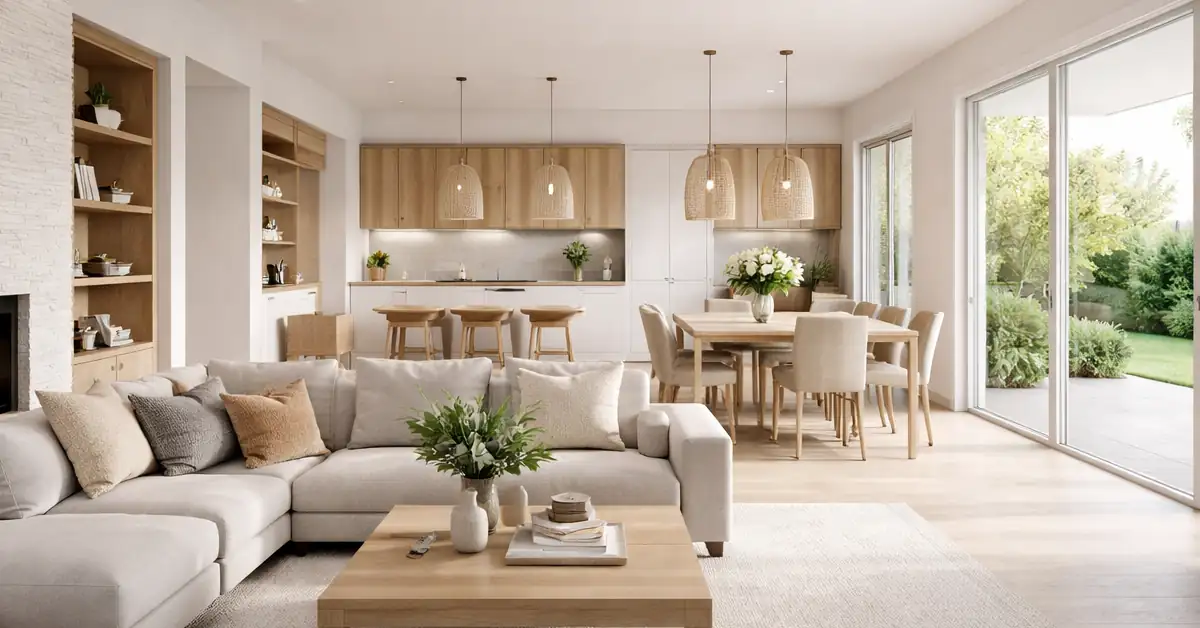
Plan a 1 floor house design that feels bigger, flows better, and stays practical for years.
A lot of one-story homes look perfect online.
Then people move in.
And the problems start.
The laundry is too far away. The bedroom hears every kitchen sound. The living room looks open, but not comfortable. The home is “pretty,” yet daily life feels strangely hard.
Here’s the thing: a good 1 floor house design is not really about drawing rooms. It’s about shaping a day. I’m writing this from the perspective of helping absolute beginners, because that’s where most guides fail. They show you styles. They don’t teach you how to live inside the plan.
How to plan a 1 floor house design around real life
The real question behind this search
Most people are not secretly asking, “Which elevation looks modern?” They are asking, “Will this home still feel easy, calm, and practical after the excitement wears off?” That lines up with what buyers and homeowners keep bringing up: future accessibility, laundry placement, storage, privacy, sound, and daily movement through the house.
That is why a smart 1 floor house design starts with routines, not Pinterest boards.
Ask yourself:
- Where do shoes, bags, and groceries land?
- Do kids need quiet sleeping zones?
- Do you work from home?
- Do you want guests near or far from bedrooms?
- Can someone live comfortably here after surgery or with bad knees?
Honestly, this is the work that saves you later.
The #1 mistake: designing rooms before designing routines
Many plans fail because people size spaces before they understand movement. One architect discussion put it bluntly: floor plans often lock in bad decisions when people treat the plan itself as the design tool instead of starting with how the house should work. The same thread kept surfacing the same pain points: weak storage, bad window strategy, too many bathrooms, scattered plumbing, and laundry that sits far from where clothes are actually used.
A simple rule helps: map your walking before you map your walls.
Think of your home like a daily route:
- You enter.
- You drop things.
- You cook.
- You clean.
- You rest.
- You sleep.
If that route feels clumsy on paper, it will feel clumsy in real life too.
A made-up but realistic example
Take a fictional couple, Sarah and Luis. They want a three-bedroom single-story home. At first, they ask for a huge open kitchen-living area. Sounds great. But when they walk through a normal Tuesday, they realize three things: one person starts work early, one takes calls from home, and both hate seeing laundry baskets in the main living space.
So they change the plan.
They keep the main area open, but place a small study near the entry, the laundry close to bedrooms, and a mudroom between garage and kitchen. Same house size. Better life.
That is what good 1 floor house design does. It reduces friction.
The layout choices that matter most
Open plan vs zoned plan
Open plans are popular for a reason. They can make a home feel bright, social, and flexible. But open is not always better. Sometimes it just means noise travels farther and storage gets harder to hide.
| Layout choice | Best for | Watch out for |
|---|---|---|
| Open plan | Families who cook, talk, and gather in one shared zone | Noise, clutter, fewer private corners |
| Lightly zoned plan | People who want connection without full exposure | Needs careful sightlines |
| Split-bedroom plan | Privacy, guests, older kids, multigenerational living | Can increase hallway space if overdone |
A strong 1 floor house design often lands in the middle: open where life is shared, separated where life needs quiet.
Split-bedroom layouts for privacy
One-story homes can lose privacy fast if every bedroom opens off the main living area. Homebuyer discussions often mention this exact issue, especially when the primary bedroom sits close to the kitchen or family room. At the same time, people who compare one-story and two-story homes often say privacy is the main reason they hesitate to go single-level.
A split-bedroom layout solves a lot:
- Primary bedroom on one side
- Secondary bedrooms on the other
- Shared living spaces in the center
It is simple. It works.
Storage, laundry, and mess zones
This is where many beautiful plans quietly fail.
Recent NAHB reporting says buyers still strongly want practical features like a laundry room, walk-in pantry, garage storage, and a full bath on the main level. In a related 2024 construction snapshot, most new single-family homes had first-floor laundry connections, and among age-restricted homes that number was even higher.
That tells you something important: storage and utility are not boring extras. They are central to livability.
In practice, I’d group these together:
- Mudroom or drop zone near entry
- Pantry near kitchen
- Laundry close to bedrooms
- Linen storage near baths
- Cleaning closet where you actually need it
A home feels calmer when the mess has somewhere to go.
Common mistake: too many bathrooms, too little useful storage
One professional discussion on home-design regrets made a sharp point: too many bathrooms add cleaning and cost, while too little storage creates daily frustration. That same conversation also mentioned tiny closets and weak bathroom storage as issues people regret after move-in.
So before adding “just one more powder room,” ask a harder question:
Would this square footage serve me better as:
- a linen closet,
- a walk-in pantry,
- a better laundry room,
- or a real entry drop zone?
Often, the answer is yes.
How to make a one-story home feel bigger
Light, orientation, and window placement
The U.S. Department of Energy points to window location, shading, insulation, air sealing, and thermal mass as key parts of passive solar design. In simple terms, where you place windows changes how bright, comfortable, and energy-aware your home feels. South-facing glass can help with winter sun in the right design, especially when paired with shading and materials that store heat.
That does not mean “add giant glass everywhere.”
Forum discussions on design regrets warn that bad window decisions can create overheating, bugs, weak ventilation logic, and rooms that look dramatic in a showroom but work badly in daily life.
So do this instead:
- Put daylight where you spend time
- Protect privacy in bedrooms and baths
- Think about views and furniture walls
- Plan for screens, shade, and climate
Indoor-outdoor connection that actually helps
A one-story house can feel much larger when interior spaces borrow from patios, porches, and yards. That is not just a design trend. NAHB’s 2024 buyer-preference reporting says patios and other outdoor features remain among the most wanted home features.
The trick is to make the connection useful, not decorative.
A sliding door off the dining area that opens to a shaded patio? Useful.
A giant folding wall that looks dramatic but invites bugs, heat, glare, and furniture problems? Maybe not. People bring up that exact regret in design discussions.
Myth-busting: open concept is not always the best answer
This myth needs to go.
A fully open 1 floor house design is not automatically more spacious. Sometimes a well-placed partial wall, cased opening, or ceiling shift makes the home feel more organized and more expensive.
Looks good. Lives badly. That happens a lot with overly open plans.
What actually makes a one-story home feel bigger?
- clean sightlines,
- natural light,
- good ceiling strategy,
- less visual clutter,
- and fewer awkward circulation paths.
Design for comfort now and later
Why future-proofing matters more than most people think
AARP’s lifelong-home example highlights one-story living as a practical format for flexibility over time. NAHB’s aging-in-place checklist also recommends main living on a single story, a full bath on the main level, reduced steps, at least one no-step entry, and wider, well-lit circulation.
That sounds serious because it is serious.
But it does not need to look medical.
Accessibility basics without making the home feel clinical
NAHB’s checklist suggests hallways at least 36 inches wide, doors with at least 32 inches of clear width, and 5-foot turning spaces in main living areas, kitchens, bedrooms, and bathrooms. In 2025, NAHB also reported that requests for aging-in-place features had significantly or somewhat increased over the previous five years, with grab bars, curbless showers, higher toilets, and wider doorways among the most common projects.
A beginner-friendly takeaway:
- Make one entrance step-free
- Keep a full bath on the main level
- Avoid tight hall bends
- Design at least one shower for easy access later
- Put laundry on the same level as daily living
That is not overplanning. That is smart planning.
How I would future-proof a one-story plan from day one
If I were sketching a practical 1 floor house design today, I would do five things:
- Put the primary bedroom away from the loudest shared spaces.
- Keep laundry close to bedrooms.
- Add one no-step entry if site conditions allow.
- Make at least one bathroom easy to adapt later.
- Create a flexible room that can be an office, guest room, or care space.
Small moves. Big payoff.
Budget trade-offs nobody explains well
Where to spend more
Spend more on the parts that are hard to fix later:
- layout,
- window placement,
- storage planning,
- insulation and air sealing,
- and bathroom usability.
That matches current buyer priorities better than overspending on flashy extras. NAHB’s 2024 reporting says buyers have moved toward “better, not bigger” homes, with desired size around 2,070 square feet and strong interest in practical features, energy efficiency, and personalization.
Where to stay simple
Save money on things that are easy to upgrade later:
- decorative lights,
- backsplash style,
- some hardware,
- paint,
- trend-driven finishes.
A calm, simple shell ages better anyway.
Downsides of one-story homes you should know
To stay objective, a one-story home is not perfect.
People comparing one-story and two-story homes repeatedly point out a few trade-offs: less separation between quiet and active zones, a larger footprint on the lot, and sometimes less privacy if the layout is weak. Some also prefer upstairs sleeping, or like two-story homes because they give more retreat space.
So yes, a 1 floor house design can be the right answer.
But only if you plan it well.
A practical pre-design checklist
Before you approve any layout, check this:
- Can groceries move in easily?
- Is there a real drop zone?
- Is laundry close to bedrooms?
- Are bedrooms protected from living-room noise?
- Is there enough storage for cleaning tools, linens, and pantry overflow?
- Does daylight reach the rooms that need it most?
- Can someone use this home comfortably after injury, illness, or age-related changes?
- Does the outdoor space connect to daily life, not just photos?
Print that. Use it.
Frequently Asked Questions (FAQs)
Is a 1 floor house design cheaper to build?
Sometimes, but not always. Some sources selling one-story plans emphasize affordability and easier maintenance, but that is too broad on its own. The smarter answer is this: cost depends on your footprint, site, structure, finishes, and how efficiently the plan is arranged. A well-planned smaller one-story home can be very cost-effective, but a sprawling one can get expensive fast.
What is the best layout for privacy in a one-story home?
A split-bedroom layout is usually the safest answer. Put shared living spaces in the middle and sleeping spaces apart. That reduces noise and makes guests, kids, and parents feel less on top of each other.
How many bedrooms work best in a single-story house?
Three bedrooms is often the sweet spot for many households because it balances flexibility and footprint. But the real answer depends on your life. One flexible room may be more valuable than one extra tiny bedroom.
Is open concept good for a one-story home?
Yes, when used carefully. No, when used everywhere. Partial zoning often works better than total openness because it preserves light and connection without giving up privacy, storage walls, and acoustic control.
How do I future-proof a one-story house?
Keep main living on one level, include a full bath on the main level, reduce steps, widen circulation where possible, and make at least one bathroom easier to adapt. Those ideas align closely with NAHB aging-in-place guidance and with the way more owners and remodelers are thinking now.
Conclusion
A good 1 floor house design is not the one with the flashiest rendering.
It is the one that makes ordinary days feel easier.
That means better walking paths, better privacy, better storage, better light, and a plan that still works when life changes. The current search results mostly show styles and selling points. The better approach is simpler: design around the life you already know you live.
So here is your next step.
Take one sheet of paper and sketch your day before you sketch your walls. Mark where you enter, drop things, cook, work, wash, rest, and sleep. That little exercise will improve your plan more than ten random inspiration photos ever will.