
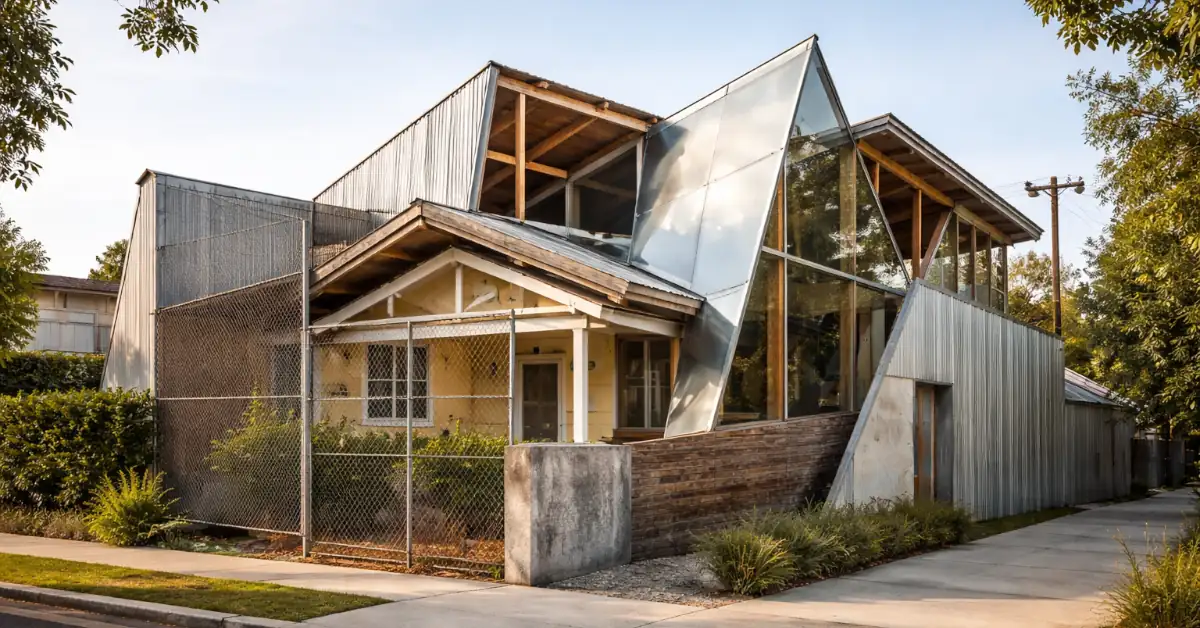
A quiet street. A modest old bungalow. Then suddenly: chain-link fence, angled glass, corrugated metal, raw framing, sharp edges. It looks almost like a house caught halfway between a sketch and a demolition. That shock is exactly why the Frank Gehry house still matters.
I’m writing this from a beginner’s point of view, because that’s where most articles fail. They tell you the house is “deconstructivist” and move on. But most readers are thinking something much simpler: What am I looking at, and why is it famous?
Here’s the thing. The famous Frank Gehry house is not important because it is big. It is important because it turned a normal domestic building into an argument about what architecture could be. Small house. Big shock.
Which Frank Gehry house are people actually searching for?
Most people searching Frank Gehry house mean the Santa Monica residence Gehry began transforming after he and Berta Gehry bought a pink bungalow in 1977. The original house dated to about 1920, and Gehry reworked it in 1978, then updated it again in the early 1990s.
But there is a second source of confusion. In 2019, design media also featured Gehry’s later Santa Monica home, a much larger and more refined project developed with his son Sam Gehry. That later house is real, important, and beautiful—but it is not the same building as the famous 1978 landmark most people mean when they search the term.
| Which house? | What it is | Why people confuse it |
|---|---|---|
| 1978 Santa Monica residence | Gehry’s famous remodel of an existing bungalow | This is the iconic one most articles mean |
| 1991–92 update | Later changes to the same famous house | Many articles mention it only briefly |
| 2019 Santa Monica home | A later, separate Gehry family home | Newer magazine coverage makes readers think it is the same house |
That distinction matters because the early Frank Gehry house is the rebellious experiment, while the later one shows a more mature and comfortable version of some of Gehry’s ideas.
What did Gehry actually do to his own home?
He did not simply bulldoze the old house and start over. That is the first mistake people make. Gehry kept the conventional house and built around it, letting parts of the older structure remain visible while new layers pushed, cut, tilted, and wrapped around it. Britannica describes it as stripping the house down to its frame and building a new chain-link and corrugated-steel frame around it.
This is why people often describe the Frank Gehry house as a “house around a house.” You are seeing old and new at the same time. You are seeing domestic comfort and visual disruption at the same time. Honestly, that double reading is the whole point.
The material choices were just as important as the shape. Gehry used plywood, glass, corrugated metal, chain-link fencing, and exposed framing—materials many people associated more with hardware stores, construction sites, and everyday Los Angeles landscapes than with a celebrated architect’s home.
That looked wrong. Deliberately wrong. And because it looked wrong, it forced people to ask whether “good architecture” had to look polished, finished, and expensive.
Common mistake: thinking the house is random chaos
A lot of criticism of Gehry, both in public debate and in architecture forums, comes down to this: people see irregular forms and assume there is no logic. The same criticism shows up repeatedly in discussions about his broader work—confusing layouts, unusual shapes, and doubts about usefulness.
But the early Frank Gehry house is better understood as controlled tension. Old versus new. Raw versus finished. Familiar versus strange. It is not random. It is staged conflict.
Why the Frank Gehry house mattered so much
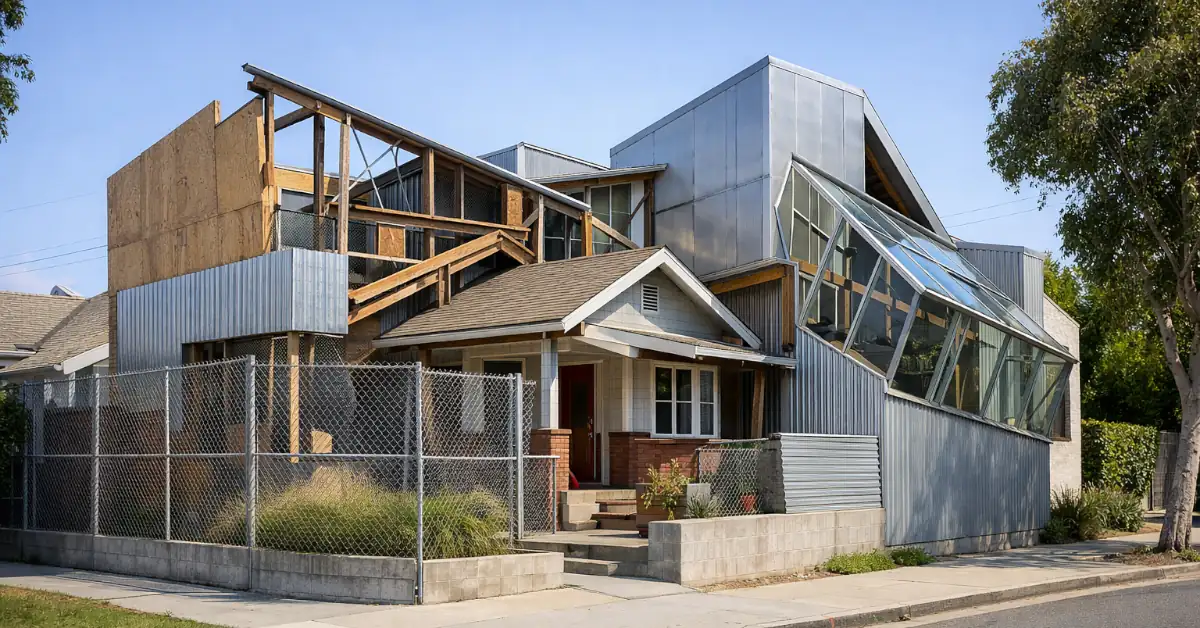
The house mattered because it became a turning point in Gehry’s own career and in late-20th-century residential architecture. LA Conservancy calls it immensely influential in the development of deconstructivism and in changing modern ideas about art, architecture, and everyday life.
It also mattered because people reacted so strongly to it. Neighbors were upset. The project was controversial. ArchEyes notes protests, angry responses, and even attempts to challenge it legally, while the Conservancy says the house frustrated some neighbors precisely because it felt unfinished on purpose.
That controversy is part of the story, not a side note. The Frank Gehry house made architecture visible to people who normally would not talk about architecture at all. They may have hated it. But they noticed it.
Myth-busting: “cheap materials” did not mean “cheap thinking”
People still assume that because Gehry used modest or industrial materials, the project was just provocation. That reading misses the intelligence of the move. ThoughtCo explains that Gehry was experimenting with materials already common in California and using them to test how raw, ordinary elements could produce a new architectural language.
In other words, the materials were not a shortcut. They were the message.
And the profession eventually recognized that. In 2012, the house received the AIA Twenty-Five Year Award, an honor given to buildings that have proved their long-term design significance. That matters because it means the Frank Gehry house was not just a moment of shock. It endured.
How to read the house like a beginner
The easiest way to understand the Frank Gehry house is to stop asking whether it is pretty and start asking what layers you are seeing.
A simple analogy
Think of it like a drawing where the rough pencil lines were never erased. Most houses hide the process. This one shows the process and the object together. It is like seeing the sketch and the finished drawing at the same time.
A 5-step walkthrough
- Find the old house first. Look for the conventional bungalow shape inside the disruption.
- Notice what stays visible. Gehry did not fully erase the past. He framed it.
- Look at the materials. Ask why a fence, plywood, and corrugated metal appear where you expect smooth, polite finishes.
- Watch the openings. Tilted glass and awkward-looking edges are doing visual work, not just decoration.
- Read the mood. Does it feel stable? Exposed? Half-built? If yes, Gehry has already made his point.
That is the trick I use. Not “Do I like it?” First ask, “What tension is this house staging?”
What most people still get wrong
One common claim is that the Frank Gehry house is unfinished. A better way to say it is that it performs unfinishedness. LA Conservancy notes that it creates a sense of being perpetually under construction, and that effect is central to its identity.
Another claim is that it must be unlivable. That is harder to answer neatly, because the criticism is partly subjective. Online discussions about Gehry often raise concerns about odd layouts and maintainability, but Gehry and his family did live with the house for decades, and later renovations made it more open and comfortable for changing family needs.
A third mistake is assuming the house is only about style. It is also about authorship, risk, and freedom. Because it was his own home, Gehry had unusual room to experiment without pleasing a conventional client. That gave the project the feel of a full-scale design laboratory.
A simple case study
Take Maya, a first-year design student. She sees the house and says, “It looks broken.” Fair reaction. Then she learns to separate the older bungalow from the newer shell, notices how ordinary materials are used in unexpected ways, and realizes the project is asking her to question what counts as finished, tasteful, or valuable. Same house. Better reading.
That is why the Frank Gehry house still teaches so well. You do not need to love it. You just need to learn how to look.
Can you visit the Frank Gehry house?
Not as a normal public attraction. LA Conservancy lists it as a private residence and explicitly says do not disturb.
So if your real question is practical, here is the honest answer:
- You can study it through reputable articles, archival photos, and architectural analysis.
- You should not treat it like an open museum.
- Respect matters, especially because its fame does not cancel its residential status.
If I were studying the Frank Gehry house for a class or article, I would compare three things: the old bungalow, the 1978 intervention, and the later adjustments. That gives you a far better understanding than staring at one dramatic exterior shot.
Frequently Asked Questions (FAQs)
What did Frank Gehry do to his own home?
He remodeled a conventional Santa Monica bungalow by stripping much of it down, then wrapping it in new layers of chain-link, glass, corrugated metal, plywood, and exposed framing, while still leaving parts of the old house visible.
Where is the Frank Gehry house?
The famous house is in Santa Monica, California, at 1002 22nd Street.
Is the Frank Gehry house the same as the house in the 2019 magazine features?
Usually, no. The famous landmark is the earlier Santa Monica residence from 1978, later updated in the early 1990s. The widely shared 2019 features often refer to Gehry’s later, separate Santa Monica home.
Is the house really de-constructivist?
It is often described that way, and LA Conservancy explicitly places it in that tradition. But the more useful beginner-level point is this: the house makes order look unstable, mixes fragments and contrasts, and turns a normal home into a deliberate visual disruption.
Can you go inside the Frank Gehry house?
Not as a casual visitor. It is a private residence, and respectful distance is expected.
How is Gehry pronounced?
In English, Gehry is pronounced roughly like “GARY.”
Conclusion
The best way to understand the Frank Gehry house is not to ask whether it is beautiful in the usual sense. Ask what it is doing. It is taking an ordinary home and turning it into a visible argument about materials, process, and architectural rules.
That is why it lasted. That is why people still debate it. And that is why this small Santa Monica project matters almost as much as Gehry’s giant museums and concert halls.
Pick one photo of the house today and try the 5-step reading method above. You will see more on the second look than you did on the first.