
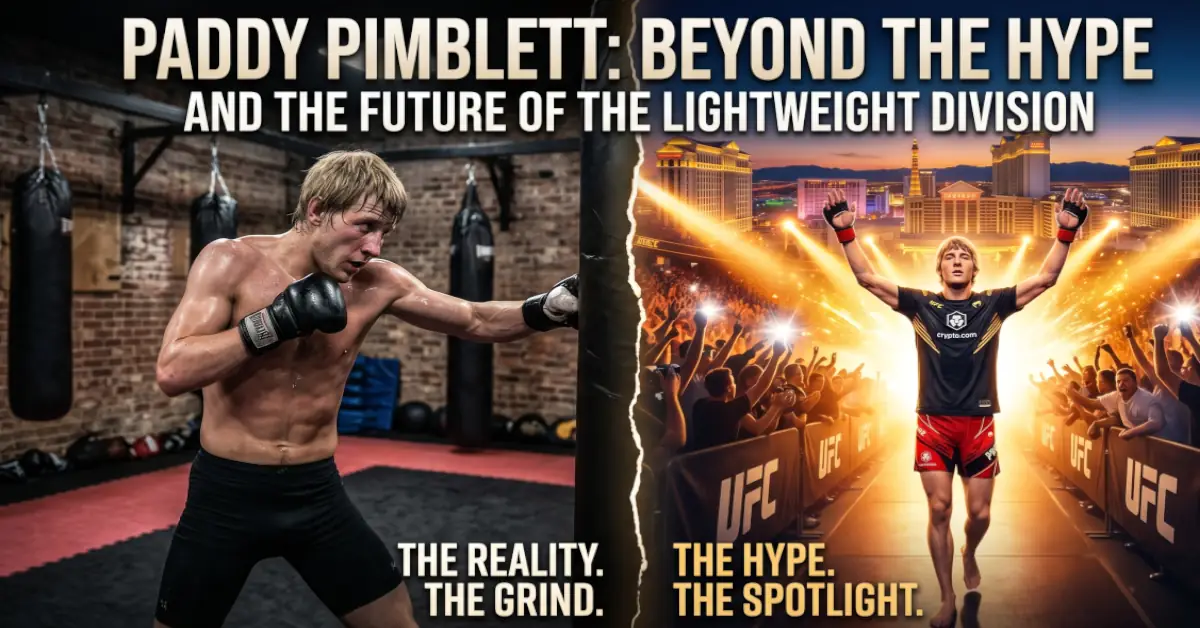
In the high-stakes theater of the Ultimate Fighting Championship (UFC), few names ignite as much polarized debate as Paddy “The Baddy” Pimblett. From the moment the Scouse sensation stepped into the Octagon, the narrative has been a tug-of-war between his undeniable supernova star power and the skeptical scrutiny of technical purists.
But as the dust settles on his most recent performances, the question has shifted. It is no longer just about whether Paddy can sell out an arena—we know he can. The question is: Can he survive the shark tank of the 155-pound division?
The Anatomy of the Hype: More Than Just a Haircut
To understand the future of the lightweight division, one must first understand the “Paddy Phenomenon.” MMA has seen plenty of “hype trains,” but Pimblett represents a unique fusion of old-school regional loyalty and modern-day viral marketing.
The McGregor Comparisons
Every charismatic European fighter is eventually saddled with the “Next Conor McGregor” label. While Pimblett has been vocal about carving his own path, the similarities in their business impact are striking. Like McGregor, Paddy possesses:
A Geographic Stronghold: Liverpool is to Paddy what Dublin was to Conor.
Viral Soundbites: His post-fight speeches on mental health and his unapologetic personality have built a fan base that transcends the “hardcore” MMA demographic.
The “It” Factor: An intangible ability to make every fight feel like an event.
However, hype is a double-edged sword. In a division as historically deep as lightweight—home to legends like Khabib Nurmagomedov and current kings like Islam Makhachev—personality only gets you so far before the cage door closes.
Technical Audit: The Reality Behind the “Baddy”
To project Paddy’s future, we must look past the walkouts and the “Baddy” dance. Stylistically, Pimblett is a fascinating puzzle of high-level grappling and high-risk striking.
The Grappling: A World-Class Floor
If there is one area where the hype is grounded in reality, it is Paddy’s Brazilian Jiu-Jitsu (BJJ). Pimblett isn’t just a “submission guy”; he is a finisher.
Transition Speed: His ability to move from a takedown attempt to a back-take is among the best in the division’s unranked and lower-ranked tiers.
Submission Versatility: Whether it’s a rear-naked choke or a triangle, his hips are active and his pressure is constant.
The “King” Green Statement: His first-round submission of Bobby “King” Green was a watershed moment. It proved that against a seasoned, elite-level veteran with excellent takedown defense, Paddy’s grappling is a legitimate threat.
The Striking: Living on the Edge
This is where the skeptics find their ammunition. Paddy’s striking style is, to put it bluntly, dangerous—for him.
Chins and Defense: He famously fights with his chin in the air and his hands low. In his early UFC outings against Luigi Vendramini and Jordan Leavitt, he was touched early.
The Jared Gordon Controversy: The unanimous decision win over Jared Gordon was a wake-up call. Many observers felt Gordon’s fundamental boxing and clinch work exposed a gap in Paddy’s defensive shell.
Development: We are seeing evolution. Against Tony Ferguson and Bobby Green, Paddy showed more patience and a better understanding of range, but the question remains: How will that chin hold up against the division’s biggest power hitters?
The Lightweight Landscape: The 155-lb Shark Tank
The UFC Lightweight division is widely considered the most talent-dense category in combat sports. To become a champion here, you don’t just need to be good; you need to be a polymath of violence.
The Current Hierarchy
The Elite (Top 5): Islam Makhachev, Arman Tsarukyan, Charles Oliveira, Justin Gaethje, Dustin Poirier.
The Gatekeepers: Michael Chandler, Beneil Dariush.
The Rising Guard: Dan Hooker, Mateusz Gamrot, Renato Moicano.
Where Does Paddy Fit?
Currently ranked in the Top 15, Paddy is entering the “Gauntlet.” The difference between the #15 rank and the #5 rank in the lightweight division is a chasm wider than in almost any other weight class.
If we look at a stylistic matchup with someone like Mateusz Gamrot, the technical hurdles become clear. Gamrot’s relentless wrestling and “chain” grappling would force Paddy to fight off his back for 15 or 25 minutes—a tall order for anyone.
Conversely, a fight with Renato Moicano would be a grapple-heavy fan favorite. Both are elite on the ground and massive personalities. This is the type of matchmaking that the UFC will likely favor: high-stakes, high-visibility fights that allow Paddy to climb while providing “Money Fight” value.
The Business of Matchmaking: The “Slow Burn” Strategy
The UFC is a business, and Paddy Pimblett is a blue-chip asset. Protecting that asset while testing his ceiling is a delicate dance performed by Dana White and the UFC matchmakers.
Strategic Growth
The UFC has been criticized for “protecting” Paddy, but from a promoter’s perspective, it is simply smart business. You don’t throw a prospect into the deep end until they’ve learned to breathe under pressure.
Phase 1: The Crowd Pleasers (Vendramini, Vargas, Leavitt).
Phase 2: The Legend Test (Tony Ferguson).
Phase 3: The Ranked Entry (Bobby Green).
Phase 4 (The Future): The Top 10 Clash.
The “O’Malley” Blueprint
Sean O’Malley provided the blueprint for this. He was dismissed as a “hype train” for years until he faced Petr Yan. He won a razor-thin decision, proved he belonged, and eventually became champion. Paddy is currently on the “O’Malley Track.”
The Intangibles: Mentality and Weight Management
One cannot discuss Paddy’s future without addressing his “off-season.” Paddy’s penchant for ballooning in weight between fights has become a meme, but it has real physiological consequences.
Metabolic Stress: Constant 40–50 lb weight cuts are taxing on the kidneys and the cardiovascular system. As he ages and the competition gets tougher, these cuts will become harder.
Professionalism: To beat the likes of Islam Makhachev, one must be a 365-day athlete. We are seeing a more “mature” Paddy in recent months, staying closer to his fighting weight, which suggests he is taking the “Future Champ” goal seriously.
Prediction: Hype or Heir to the Throne?
So, what is the ceiling for Paddy “The Baddy”?
The Ceiling: A Top 5 mainstay and perennial title contender. His grappling is good enough to nullify 80% of the division. If his striking defense improves by even 15–20%, he becomes a nightmare matchup for anybody who isn’t a world-class wrestler.
The Floor: A “New Age” Donald Cerrone. A fighter who is always in fun fights, remains a massive star, but ultimately falls short against the absolute elite “specialists” at the top of the mountain.
Who is Next?
The most logical next step for Paddy is a matchup with someone like Dan Hooker or Renato Moicano.
Hooker would test his chin and his ability to deal with a long, world-class kickboxer.
Moicano would test his “Scouse BJJ” against elite Brazilian ground-game pedigree.
Conclusion: The Era of the “Baddy”
Whether you love him or loathe him, Paddy Pimblett is the shot of adrenaline the lightweight division needed. He has brought a new audience to the sport and has shown a level of resilience that his detractors didn’t expect.
In the future of the 155-pound division, titles are won by inches, but stars are made by moments. Paddy has the moments; now he just needs the inches. As he moves into the Top 10, the “hype” will inevitably die down, replaced by a much more interesting reality: a dangerous, evolving martial artist who is just beginning to realize his potential.
The lightweight division hasn’t seen the last of the “Baddy”—in fact, the real work is just beginning.