
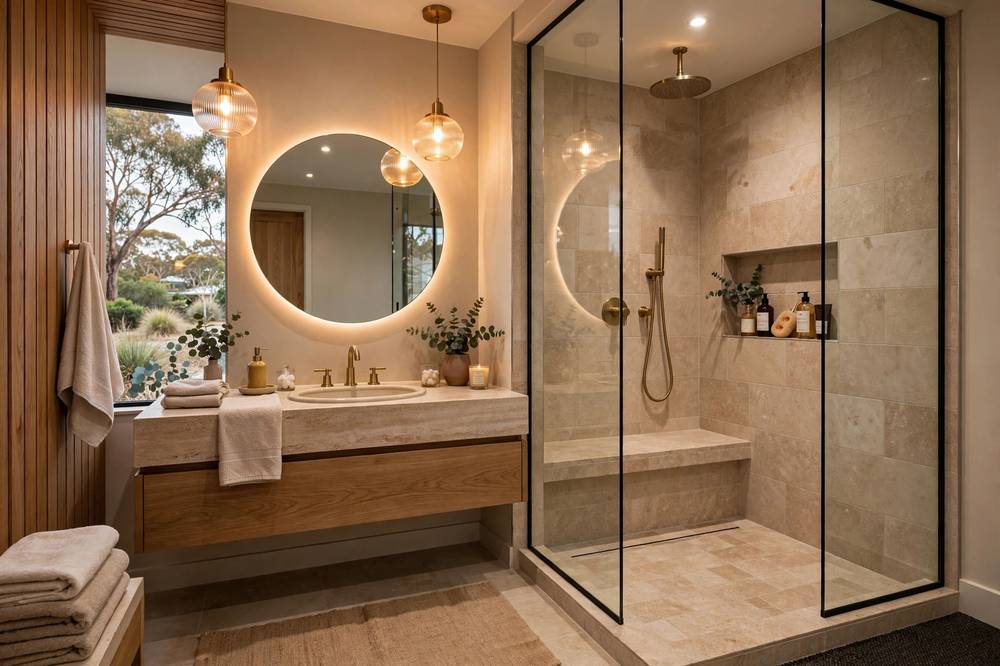
The bathroom is the most expensive room in the house per square metre, and it’s not because of the tiles. It’s everything hiding underneath them: waterproofing, drainage, plumbing and the licensed trades required to get all of it right. If you’re trying to work out the bathroom renovation cost per square metre in Australia, industry guides put the 2026 range at roughly $2,300 to $6,000 per square metre, with the Housing Industry Association putting the national average for a full renovation near $26,000.
That range is wide for good reasons. A cosmetic refresh and a full strip-out with relocated plumbing are entirely different jobs. This guide breaks down real 2026 prices by renovation tier and bathroom size, shows where every dollar goes, compares Sydney, Melbourne and Brisbane, and shares practical ways to spend less without cutting the corners that actually matter.
Average Bathroom Renovation Cost Per Square Metre in 2026
Australian cost guides agree on three broad tiers for a full renovation, plus a lighter cosmetic option if the bones of your bathroom are sound:
| Renovation tier | What’s included | 2026 cost range |
| Cosmetic refresh | Paint, new tapware, vanity, mirror; same layout, waterproofing intact | $5,000 – $15,000 |
| Budget full renovation | Basic re-tile, new fixtures, same layout | $12,000 – $20,000 |
| Mid-range renovation | Full strip-out, quality tiles, semi-frameless shower screen, new vanity and toilet | $20,000 – $45,000 |
| Premium renovation | Layout changed, plumbing relocated, custom joinery, freestanding bath | $45,000 – $90,000 |
| Luxury | Smart technology, imported tiles, designer lighting, bespoke joinery | $90,000+ |
Not all bathrooms cost the same per square metre, either. Here’s the odd bit: smaller bathrooms usually cost *more* per square metre than larger ones, because fixed costs like waterproofing, plumbing rough-in and electrical are spread across fewer square metres:
| Bathroom type | Typical size | Average total cost | Cost per m² |
| Powder room (toilet and basin) | 2–3 m² | $6,000 – $14,000 | $3,000 – $4,700 |
| Ensuite | 3–5 m² | $15,000 – $30,000 | $3,500 – $6,000 |
| Standard bathroom | 4–6 m² | $20,000 – $35,000 | $3,000 – $6,000 |
| Family bathroom | 6–9 m² | $22,000 – $38,000 | $2,500 – $4,200 |
| Large master ensuite | 9–14 m² | $35,000 – $65,000 | $2,200 – $4,600 |
So a per-square-metre figure is best used as a sanity check on your quotes, not as the quote itself.
Where the Money Goes: A Line-by-Line Breakdown
Take a typical 6m² family bathroom renovated to a mid-range spec. Here’s how a $24,000 project can break down:
| Line item | Indicative cost |
| Demolition and strip-out | $1,500 |
| Plumbing (rough-in and fit-off) | $5,000 |
| Electrical (lights, exhaust fan, power points) | $2,000 |
| Waterproofing to AS 3740 | $1,200 |
| Tiling (labour and materials) | $6,500 |
| Fixtures: vanity, toilet, bath, shower screen, tapware | $6,800 |
| Painting and finishing | $1,000 |
| **Total** | **$24,000** |
The trade rates behind those numbers are worth knowing, because they explain why bathroom quotes add up so fast. Plumbers typically charge $70–$150 per hour with a $60–$100 call-out fee; a toilet installation runs around $1,200, tap installation about $300 and bath fitting from $350. Tiling labour sits between $30 and $120 per square metre (about $60 on average), while the tiles themselves range from $35–$130/m² for floor tiles to $20–$160/m² for wall tiles — before you add the premium for mosaics, large-format tiles or fiddly cut-outs.
Then there’s the line that decides everything that comes after it: waterproofing. Under Australian Standard AS 3740, waterproofing a wet area is mandatory and must be done by a licensed applicator with documentation. It’s the single most common reason bathrooms fail years later, and fixing it means ripping up tiles and screed to get back to it. If one quote comes in far cheaper than the others, the waterproofing line is the first thing to interrogate.
To put a bathroom in the context of a bigger project, our renovation costs guide for 2026 shows how bathroom spending stacks up against kitchens, extensions and full-house renovations.
Factors Affecting the Cost of a Bathroom Renovation
Layout changes and plumbing relocation
This is the biggest single cost lever. Keeping the toilet, shower and basin where they are avoids re-running drainage and water lines through the slab or subfloor. Move the toilet across the room and you’re paying for new drainage, possible slab cutting and extra waterproofing — easily several thousand dollars for one decision.
Bathroom size and the per-square-metre paradox
A powder room can cost $3,000–$4,700 per square metre while a large master ensuite lands at $2,200–$4,600/m², even with better fixtures. The fixed costs — waterproofing the floor and shower recess, the plumbing rough-in, the electrician’s day rate — barely change with room size. Budget by total project cost first and use the per-metre rate only as a cross-check.
Tiles, fixtures and tapware choices
Fixtures are where personal taste meets the budget. A $600 toilet and a $2,000 designer toilet both flush. Floor-to-ceiling tiling, natural stone, imported feature tiles and freestanding baths all look spectacular and all push the number up. Mid-range fixtures from established Australian brands are usually the sweet spot for value.
Waterproofing and what’s behind the walls
Strip-outs routinely uncover water damage, rotten framing or non-compliant past work. A responsible builder allows for remediation; a cheap quote often doesn’t. A 10–15 per cent contingency is not pessimism — it’s how bathroom renovations actually go in houses more than twenty years old.
Labour and licensed trades
You cannot legally DIY waterproofing, electrical work or plumbing connections in Australia — all three need licensed tradespeople. That protects you, but it also means labour is a fixed, non-negotiable chunk of every quote. In busy markets, good tilers and plumbers book out weeks ahead and price accordingly.
Bathroom Renovation Costs by City
Sydney consistently runs 15–25 per cent above the national average, Melbourne sits close to it, and Brisbane generally comes in a touch lower — though strong demand is narrowing the gaps.
Sydney
Expect $3,000–$6,500 per square metre for a full renovation in Sydney, with mid-range projects commonly landing between $25,000 and $55,000. Trade demand is relentless, parking and access on tight inner-city blocks adds to labour time, and older housing stock means more hidden damage behind the tiles.
Melbourne
Melbourne tracks near the national average: roughly $2,500–$5,000/m², with most full renovations falling between $20,000 and $40,000. Competition among bathroom specialists is healthy, which keeps quotes honest — get three itemised ones and you’ll quickly see the fair range for your job.
Brisbane
Brisbane is typically the most affordable of the three capitals at around $2,300–$4,500/m², with mid-range renovations often landing between $18,000 and $35,000. That said, demand is strong: the Housing Industry Association expects renovation activity to stay a major feature of the housing landscape through 2026, with Queensland’s population growth pushing more homeowners to upgrade rather than move (HIA housing outlook).
Money-Saving Tips for Your Bathroom Renovation
- Keep the existing layout. This is the number-one saving. Moving the toilet, shower or basin triggers plumbing, drainage and waterproofing costs that dwarf what you save on fixtures.
- Be smart with tiles. Standard-size tiles with simple layouts keep labour down — every mosaic sheet, diagonal cut and niche adds tiler hours. Save feature tiles for one splashback wall, not the whole room.
- Choose mid-range fixtures. The performance gap between a $600 vanity and a $2,500 one is mostly cosmetic. Put the money into waterproofing and tiling, which you can’t see but can’t afford to get wrong.
- DIY the safe parts. Demolition, painting, mirror hanging and accessories are fair game if you’re handy. Leave waterproofing, plumbing and electrical to the licensed trades — it’s the law, and it’s also just sensible.
- Hunt end-of-line and ex-display stock. Tile shops and bathroom retailers regularly clear discontinued lines at 30–50 per cent off. The catch is limited quantities, so buy everything you need in one go.
- Get three itemised quotes and interrogate outliers. If one quote is dramatically cheaper, ask exactly what’s in the waterproofing line. That’s where corners get cut.
- Plan the budget before you fall in love with fixtures. Run your numbers through our free renovation tools first, then go shopping with a ceiling already set.
Frequently Asked Questions
How much does a small bathroom renovation cost in Australia?
A small 4–5m² bathroom typically costs $15,000–$30,000 for a proper full renovation in 2026. Because fixed costs like waterproofing and plumbing don’t shrink with the room, small bathrooms run higher per square metre — often $3,000–$6,000/m².
What is the most expensive part of a bathroom renovation?
Usually it’s the combination of plumbing, tiling and labour, which together can make up half or more of the total. The most *critical* part is waterproofing — it’s a smaller line item, but it’s the one that determines whether the bathroom lasts twenty years or five.
Can I DIY any of my bathroom renovation?
Yes — demolition, painting, hanging mirrors and fitting accessories are all fine to do yourself. But waterproofing, electrical work and plumbing connections must be done by licensed professionals under Australian law, and waterproofing needs documented compliance with AS 3740.
How long does a bathroom renovation take?
A straightforward full renovation usually takes two to four weeks once work starts. Add time if you’re changing the layout, waiting on custom joinery or imported tiles, or if the strip-out uncovers damage that needs repair.
Does a bathroom renovation add value to your home?
Yes — bathrooms are consistently among the highest-return renovations, alongside kitchens. The rule of thumb is not to overcapitalise: keep the spend in proportion to your suburb’s price ceiling. Our renovation costs guide for 2026 has more on what different projects return.