
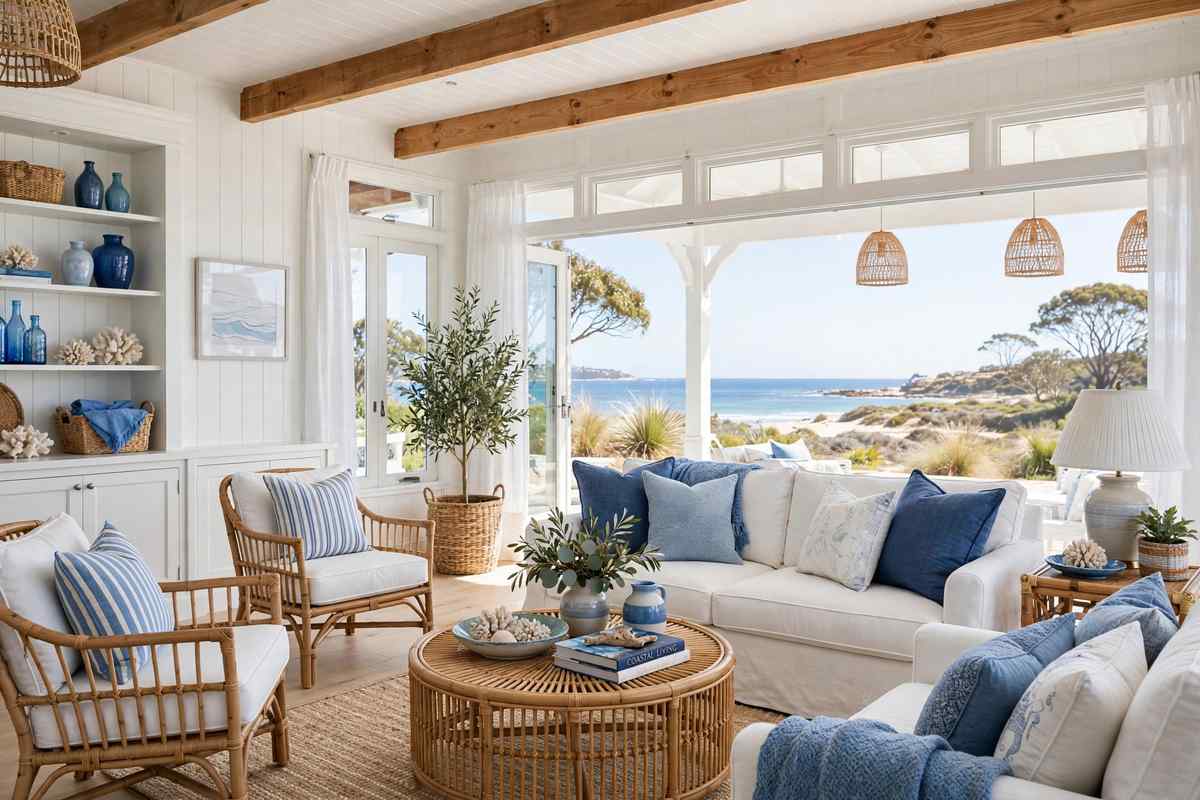
Perth is Australia’s most isolated capital — and its design scene has grown up with a character all its own. Big skies, the Indian Ocean, the famous Fremantle Doctor and a love of outdoor living shape how homes here look and feel. If you’re looking for interior designers in Perth, you’ll find a market that’s more relaxed than Sydney but increasingly sophisticated. Here’s what they charge in 2026, the styles that define the city, and how to hire well.
How Much Does an Interior Designer Cost in Perth?
Perth sits comfortably in the national mid-range. Most Perth interior designers charge $150–$220 per hour excluding GST (2026) — around or just above the $200 national average, well below Sydney’s $275 but on par with or slightly above Brisbane.
Typical Perth pricing:
Initial consultation: $150–$350 for 1–2 hours, often including a written summary of recommendations.
Single room: $1,200–$5,000. Perth’s generous room sizes (blocks are bigger here) can mean more furniture to specify, which nudges fees up.
Full home: $6,000–$18,000 in design fees for apartments and standard houses; $18,000–$45,000 for large family homes and coastal renovations.
Interior decorators charge $70–$160 per hour in Perth, with room styling packages from $1,000–$4,000.
Why Perth offers good value
Perth’s design market is less saturated than the east coast, which cuts both ways: fewer designers to choose from, but those operating here tend to be experienced generalists who handle everything from space planning to styling. Hourly rates are fair, and the city’s strong new-build market means many designers are fluent in working with builders from day one — often the cheapest point to involve them.
Popular Interior Design Styles in Perth
Hamptons coastal is Perth’s dominant style, and nowhere does it better. In Cottesloe, Mosman Park, Sorrento and City Beach, the formula is perfected: weatherboard-look exteriors, shaker cabinetry, marble or stone benchtops, linen upholstery and blue-white palettes that mirror the ocean. Perth’s clear light and big blocks give the style room to breathe.
Modern coastal — Hamptons’ relaxed sibling — suits newer suburbs: whitewashed timbers, rattan, jute, and sea-glass colours without the formality.
Mid-century revival is strong in suburbs like City Beach, Floreat and Mount Lawley, where 1960s–70s homes are being restored rather than demolished. Warm timbers (blackbutt is a local favourite), terrazzo, breeze blocks and earthy palettes honour the era while updating comfort.
Contemporary Australian defines the new-build market — open plans, high ceilings, indoor-outdoor flow, and material palettes drawn from the WA landscape: eucalyptus greens, warm timbers, sunset oranges and limestone tones.
Scandi-Japandi has a quiet following among apartment dwellers in Subiaco, Leederville and Fremantle — calm, natural and well-suited to smaller footprints.
Perth’s Homes: What Designers Work With Here
Coastal Hamptons homes (Cottesloe, Sorrento, Mosman Park, Swanbourne) are Perth’s prestige stock — large blocks, ocean aspects, alfresco areas the size of living rooms. The design brief is almost always indoor-outdoor flow: stacking doors, outdoor kitchens, pools integrated into the entertaining zone. The Fremantle Doctor (the afternoon sea breeze) is a design tool — orient openings to catch it and the house cools itself.
Mid-century homes (City Beach, Floreat, Dianella) come with raked ceilings, face brick and great bones. Designers restore rather than gut: refinishing timber, reinstating breeze blocks, updating kitchens with era-sympathetic joinery.
New builds (Ellenbrook, Baldivis, Alkimos, Treeby) dominate the growth corridors. Double brick is still common in WA, which gives excellent thermal mass — designers leverage it with passive solar planning. The challenge is personalising project-builder plans: better entries, functional laundries, alfresco areas that actually connect to the house.
Character cottages (Fremantle, Subiaco, Mount Hawthorn) offer limestone walls, jarrah floors and verandahs. Updates respect the heritage streetscape while opening up dark interiors — skylights, internal courtyards and rear extensions in sympathetic materials.
Apartments (Perth CBD, South Perth, Scarborough) are a growing market as downsizers trade houses for views. Storage and multipurpose spaces are the recurring briefs.
The climate factor: Perth’s Mediterranean climate — hot dry summers, mild wet winters — is a designer’s gift. Deep eaves shade summer sun while admitting winter warmth. Thermal mass (double brick, concrete floors) smooths temperature swings. Outdoor living isn’t seasonal here; it’s year-round, so alfresco areas get the same design attention as interiors. Water-wise planting and light-coloured roofs are increasingly standard.
How to Choose the Right Interior Designer in Perth
1. Look for new-build experience. Perth builds more new homes per capita than any other capital. A designer who can read a builder’s plans, coordinate with the site supervisor and time selections to construction stages will save you real money.
2. Ask about outdoor living. If your designer treats the alfresco as an afterthought, they’re not designing for Perth. It should be in the brief from day one — orientation, shading, kitchen access, lighting.
3. Check their supplier network. Perth’s isolation means lead times on furniture and materials run longer than the east coast. Designers with established local suppliers (and realistic timelines) prevent nasty surprises.
4. Discuss budget honestly. Perth benchmarks for 2026: a proper kitchen renovation $28,000–$55,000; a bathroom $18,000–$32,000; a full-home furnishing package $30,000–$80,000+. Your designer should reality-check these against your brief.
5. Meet on site. Perth designers will usually do the first consultation at your home — the block orientation, existing light and outlook shape everything. Anyone quoting without seeing the site is guessing.
6. Consider the whole project. Many Perth designers offer design-and-styling packages covering architecture through to the final cushion. Bundling is often cheaper than hiring separately.
Our [kitchen renovation cost guide](https://ntdesigns.com.au/kitchen-renovation-cost/) covers WA pricing, and the [free renovation calculators](https://ntdesigns.com.au/renovation-tools/) help you model costs before you start.
The Design Process: What Happens After You Hire
Brief and site visit (weeks 1–2). The designer walks your block, noting orientation, views, existing trees and — in Perth — exactly how the Fremantle Doctor moves across the site. For new builds, this happens alongside the builder’s plans; for renovations, it starts with a full measure and photo survey.
Concept design (weeks 3–6). Floor plan options, mood boards and a materials direction. In Perth, the alfresco should appear in the very first concepts, not as an afterthought — its orientation, shading and connection to the kitchen determine how the whole house lives. For coastal homes, concepts also address salt-air durability of materials and finishes.
Design development (weeks 7–12). The concept hardens into detailed plans, elevations, joinery drawings, lighting layouts and a complete finishes schedule. If you’re building new, this stage runs in parallel with the builder’s construction documentation — your designer and the builder’s draftsperson should be talking to each other, not working in silos.
Selections and pre-start (weeks 10–16). WA builders run formal selections appointments — tiles, tapware, colours, electrical. Having your designer in the room (or preparing you beforehand) prevents the classic pre-start panic where rushed choices get locked in. This is where independent design advice pays for itself many times over.
Construction and styling (months 5–14). Site visits at slab, plate height, lock-up and fit-off catch issues while they’re cheap to fix. Final styling — furniture placement, art hanging, objects — is the last 5% that delivers 50% of the visual impact. Allow a defects liability period after handover; good designers help you compile the list.
Questions to Ask Before You Hire
– How many Perth homes like mine have you completed recently?
– How do you design for our climate — summer heat, the Fremantle Doctor, outdoor living?
– What’s included in your fee? What costs extra?
– How do you coordinate with builders during construction?
– What are realistic lead times for furniture and materials in Perth?
– Can I see a recent finished project in person?
– How do you handle it if costs start running over?
Frequently Asked Questions
How much does an interior designer cost in Perth?
Perth interior designers typically charge $150–$220 per hour excluding GST (2026). Decorators charge $70–$160 per hour. Full-home design fees range from $6,000–$45,000 depending on the home’s size and the project’s complexity.
Is Hamptons style overdone in Perth?
It’s popular, not overdone — but execution matters. The best Perth Hamptons homes adapt the style to the WA landscape with local materials and genuine indoor-outdoor flow. Poor imitations feel like a catalogue. A good designer personalises the look rather than copying it.
How important is outdoor living in Perth home design?
Essential. Perth’s climate supports year-round outdoor living, and well-designed alfresco areas effectively add a room to the house. Budget 10–15% of your renovation spend on outdoor spaces — they deliver disproportionate lifestyle and resale value here.
How long does a design project take in Perth?
Single rooms: 6–10 weeks. Full homes: 3–5 months for design and documentation. New builds should engage a designer before or during the planning stage — retrofitting design after construction starts is expensive. Allow extra time for furniture lead times given Perth’s distance from east-coast suppliers.
Do Perth designers handle both design and styling?
Many do — the Perth market favours full-service designers who take a project from floor plans through to final styling. This is efficient and often cheaper than splitting design and decoration between two people.
What’s the best time of year to renovate in Perth?
Autumn and winter are ideal — mild, dry weather suits construction, and trades are often more available than in the spring/summer rush. Design work can happen anytime, but starting design in summer means building through the pleasant cooler months.