
Adelaide doesn’t shout about its design scene — but those in the know rate it highly. Grand bluestone villas, charming workers’ cottages, leafy eastern suburbs and some of Australia’s most liveable streetscapes give interior designers in Adelaide remarkable material to work with. Add genuinely affordable pricing by capital-city standards, and hiring a designer here is one of the country’s better-value moves. Here’s what they cost in 2026, which styles suit the city’s homes, and how to choose well.
How Much Does an Interior Designer Cost in Adelaide?
Adelaide is among Australia’s most affordable capitals for design services. Most Adelaide interior designers charge $140–$200 per hour excluding GST (2026) — at or just below the $200 national average, and well under Sydney ($275) and Melbourne ($210).
What Adelaide homeowners typically pay:
Initial consultation: $120–$300 for 1–2 hours. Several Adelaide designers offer fixed-price “design rescue” sessions — a walk-through with actionable recommendations.
Single room: $1,000–$4,000. Adelaide’s generous room proportions in villas and bungalows can mean more furnishing budget, but design fees stay modest.
Full home: $5,000–$12,000 for apartments and cottages; $12,000–$35,000 for villas and larger family homes.
Interior decorators charge $60–$140 per hour in Adelaide — among the lowest capital-city rates in the country — with room packages from $800–$3,000.
Adelaide’s value equation
Lower fees don’t mean lower standards. Adelaide’s design community is tight-knit and highly referral-driven, which keeps quality high. Your dollar stretches further here: a full-home design fee that buys a single-room package in Sydney covers an entire villa refresh in Unley. For renovators, that margin can be redirected into better materials or an extra room.
Popular Interior Design Styles in Adelaide
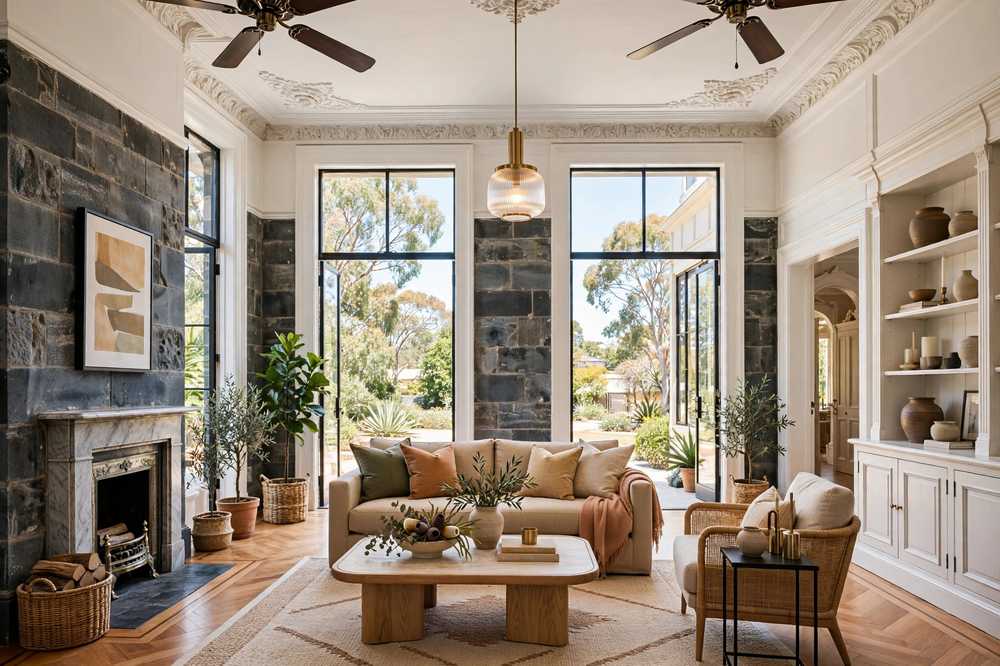
Heritage-contemporary is Adelaide’s defining approach — honouring bluestone, sandstone, leadlight and ornate ceilings while inserting modern kitchens, bathrooms and open living behind them. The city’s best renovations feel inevitable: clearly old, clearly new, completely harmonious.
Modern coastal suits the seaside suburbs (Glenelg, Henley Beach, Brighton) — whitewashed timbers, linen, rattan and ocean palettes, relaxed rather than resort-tacky.
Scandi-Australian is popular in the inner south and west — North Adelaide apartments, Goodwood cottages — where light timbers, soft neutrals and tactile fabrics warm up smaller footprints.
Mid-century modern thrives in suburbs like Colonel Light Gardens (Australia’s first garden suburb) and the Mitcham Hills, where post-war homes are being lovingly restored with era-appropriate palettes and materials.
Contemporary classic — tailored, calm, quietly luxurious — dominates new builds in areas like Bowden, Lightsview and the Mawson Lakes corridor.
Wine-country rustic is a uniquely Adelaide Hills flavour: stone, recycled timber, leather and deep greens in homes around Stirling, Aldgate and Hahndorf that blur the line between house and landscape.
Adelaide’s Homes: What Designers Work With Here
Bluestone and sandstone villas (North Adelaide, Norwood, Unley, Unley Park, Parkside) are the city’s crown jewels — circa 1890–1920, with high ceilings, ornate fireplaces, tessellated verandah tiles and bullnose roofs. The classic renovation opens up the rear while preserving the formal front rooms. Designers who know these homes understand lime mortar, rising damp, and why you never paint sandstone. Character overlays in these suburbs are strict — facades stay, interiors transform.
Workers’ cottages and bungalows (Goodwood, Mile End, Thebarton, Prospect) offer smaller footprints with big potential. The standard move: open the kitchen to living, add a rear extension or deck, and lift everything with light and storage. These are Adelaide’s best-value renovations — modest spend, dramatic change.
Interwar bungalows (Colonel Light Gardens, Kings Park, Hawthorn) bring sweeping roofs, verandahs on masonry piers and lovely proportions. Updates respect the roofline while modernising services and layouts.
New builds and townhouses (Bowden, Tonsley, Oakden) cater to downsizers and first buyers. Compact but well-planned, they benefit most from storage design, lighting plans and furnishing — decorator territory as much as designer.
Adelaide Hills homes (Stirling, Crafers, Aldgate) deal with sloping blocks, bushfire overlays and spectacular outlooks. Designers balance view-maximising glass with BAL (bushfire attack level) requirements — a genuine specialist skill.
The climate factor: Adelaide runs hotter and drier than any other southern capital. Summer heatwaves demand serious passive design: shaded western glass, thermal mass, cross-ventilation and cool material palettes. Winters are mild but chilly mornings reward heated floors in bathrooms and good window coverings. A designer who specifies dark roofs and unshaded western windows in Adelaide hasn’t been paying attention.
How to Choose the Right Interior Designer in Adelaide
1. Heritage experience is non-negotiable for period homes. Bluestone repointing, damp management, leadlight restoration, sympathetic extensions — ask for completed villa projects and drive past one if you can.
2. Use the consultation. Adelaide’s affordable consult rates ($120–$300) make it cheap to interview two or three designers before committing. Pay for their time; the advice alone is worth it.
3. Talk money early and specifically. Adelaide benchmarks for 2026: kitchen renovation $25,000–$50,000; bathroom $15,000–$28,000; full villa refresh (design + decorating) $40,000–$100,000 all-in. If the numbers don’t add up, a good designer says so.
4. Check council smarts. Character overlays in Unley, Norwood Payneham & St Peters and Adelaide City are detailed and strictly enforced. Your designer should know the local development plan, not learn it on your project.
5. Ask about staging for sale. Adelaide’s prestige market (Unley Park, Medindie, Toorak Gardens) rewards presentation highly. Some designers specialise in pre-sale styling that consistently lifts results — worth asking about even if you’re staying.
6. Go local for trades. Adelaide designers with deep trade benches — reliable painters, tilers, cabinetmakers — are worth their weight. Ask who they’d use for your job and why.
Our [kitchen renovation cost guide](https://ntdesigns.com.au/kitchen-renovation-cost/) includes South Australian pricing, and the [free renovation calculators](https://ntdesigns.com.au/renovation-tools/) let you test budgets before engaging a designer.
The Design Process: What Happens After You Hire
Brief and heritage check (weeks 1–2). The designer measures your home and researches its heritage status — character overlay, contributory listing, any previous approvals. For villas in Unley or Norwood, this homework shapes everything that follows. A good designer will also flag likely damp or structural issues for specialist inspection before design begins.
Concept development (weeks 3–6). You’ll review floor plan options, mood boards and a materials palette. For period homes, concepts typically show two approaches: a faithful restoration direction and a bolder contemporary insertion — with honest cost differences between them. This is the moment to be decisive; late changes cascade through documentation and approvals.
Documentation (weeks 7–12). Detailed plans, elevations, joinery and lighting drawings, finishes schedules. Villa renovations need careful detailing around existing fabric — how new meets old at every junction. Thin documentation is the number one cause of builder variations, so judge your designer partly on the thickness of this package.
Council approval (overlapping, 2–4 months). In character areas, development applications need heritage statements and careful presentation. Experienced Adelaide designers know what Unley and Norwood Payneham assessors want to see, which shortens the process meaningfully.
Construction and styling (months 5–12). Bluestone and sandstone work is slow, skilled labour — allow realistic timeframes. Expect milestone inspections, a pre-completion walkthrough and a final styling day. Keep 10% contingency; 100-year-old walls keep secrets.
Questions to Ask Before You Hire
– How many villas or period homes have you completed in Adelaide?
– How do you handle character overlay requirements in my council area?
– What’s your fee structure — and what isn’t included?
– How do you design for Adelaide’s hot, dry summers?
– Can I see material and finishes samples before ordering?
– Which trades do you work with regularly?
– What’s your availability — when could my project start?
Frequently Asked Questions
How much does an interior designer cost in Adelaide?
Adelaide interior designers typically charge $140–$200 per hour excluding GST (2026) — among the most affordable capital-city rates in Australia. Decorators charge $60–$140 per hour. Full-home design fees range from $5,000–$35,000 depending on the home.
Do I need a heritage specialist for a Norwood or Unley villa?
Yes. Bluestone and sandstone villas have specific needs — damp, mortar, structural quirks, strict character overlays — that generalist designers can mishandle. Look for a portfolio of completed villa renovations in the eastern suburbs.
How does Adelaide’s climate affect design decisions?
Hot, dry summers drive everything: shade western glass, use thermal mass, plan cross-ventilation, choose heat-reflective colours. Good passive design can cut cooling costs dramatically. Winters are mild — focus spending on summer comfort.
How long does a villa renovation take in Adelaide?
Design and documentation: 2–4 months. Council approval in character areas: 2–4 months (run concurrently where possible). Construction: 4–8 months for major renovations. Total: 8–14 months from first meeting to moving back in.
Is it cheaper to renovate in Adelaide than Sydney or Melbourne?
Generally yes — both design fees and construction costs run 15–25% lower than Sydney. Trades are more available, and the absence of Sydney-style site constraints (tiny access, harbour logistics) keeps builds simpler.
Can a designer help me buy furniture only, without renovating?
Absolutely — that’s decorator territory, and Adelaide’s decorator rates ($60–$140/hr) make it very accessible. Many offer “furniture packages” with floor plans, shopping lists and trade-discounted sourcing for $2,000–$8,000 depending on how many rooms.