
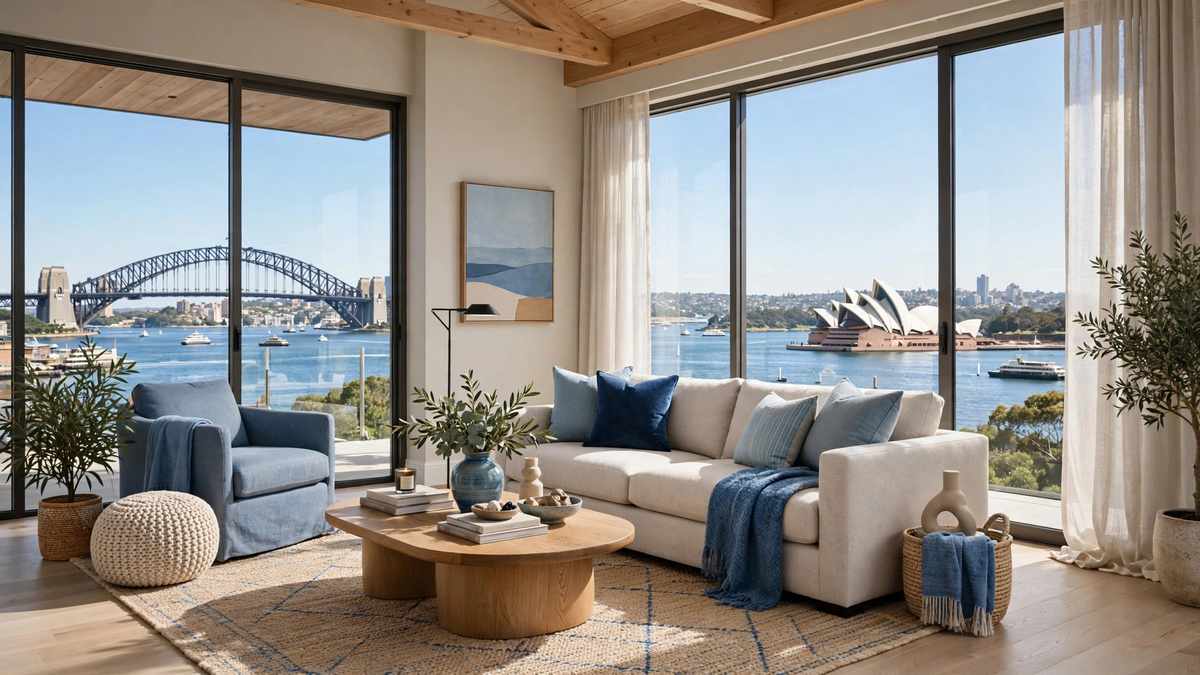
Finding good interior designers in Sydney can feel overwhelming. The city has everything from one-person studios in Surry Hills to large firms handling harbourfront mansions in Vaucluse — and their prices, styles and ways of working vary enormously. This guide breaks down what Sydney designers actually charge in 2026, which styles suit the city’s homes, and how to pick someone who’ll get your place right the first time.
How Much Does an Interior Designer Cost in Sydney?
Sydney is Australia’s most expensive city to hire a designer, and the numbers reflect it. According to 2026 industry data, Sydney interior designers charge an average of $275 per hour (excluding GST) — well above the national average of around $200 per hour.
But hourly rates only tell part of the story. Here’s what Sydney homeowners typically pay:
Consultation only: $250–$500 for an initial 1–2 hour session. Many designers credit this against the project fee if you go ahead.
Single room design: $1,500–$6,000 depending on the room. Kitchens and bathrooms sit at the top end because they involve joinery, plumbing and electrical coordination.
Full apartment (2-bed): $8,000–$20,000 for design fees alone (not including furniture or construction).
Whole house: $20,000–$60,000+ for a typical Sydney family home. Luxury projects in the eastern suburbs can push design fees past $100,000.
Interior decorators (styling and furnishings only, no structural work) charge less — usually $80–$200 per hour in Sydney, or $1,500–$5,000 per room as a package.
Designer vs decorator: which do you need?
This is the question that trips up most people. An interior decorator works with the surface of your rooms — furniture, rugs, curtains, paint colours, art and styling. If your walls, kitchen and bathroom are staying where they are, a decorator is often all you need.
An interior designer works with the architecture — floor plans, joinery design, lighting layouts, material selections and the documentation that builders actually build from. If you’re moving walls, renovating a kitchen or bathroom, or rewiring, you need a designer. The higher fee covers drawing sets and trade coordination, not just taste.
A practical test: if anything is being demolished, built or rewired, hire a designer. If it’s purely furniture and finishes, a decorator will do the job for less.
Popular Interior Design Styles in Sydney
Sydney’s design scene has a distinct flavour shaped by the harbour, the light and the city’s mix of heritage terraces and glass towers.
Contemporary coastal remains the city’s signature. Think light oak floors, linen upholstery, soft whites and the odd hit of blue or green. It suits everything from Bondi apartments to Pittwater weekender — and it photographs beautifully, which matters in a city obsessed with real estate.
Modern Hamptons is huge in the eastern suburbs and lower north shore. Weatherboard-look cladding, shaker cabinetry, marble benchtops and classic blue-and-white palettes. It reads as timeless rather than trendy, which is why it holds its resale value.
European restraint is the 2026 direction for high-end Sydney homes. Harbour-facing properties in Mosman and Double Bay are embracing pared-back Parisian and southern French influences — herringbone oak floors, travertine vanities, tailored linen sofas and bronze detailing. The look is collected rather than decorated, and it never fights the view.
Industrial inner-city still works in converted warehouses around Alexandria, Redfern and Marrickville — exposed brick, black steel, concrete floors softened with timber and greenery.
Japandi (Japanese-Scandinavian fusion) has found a strong following among downsizers moving intoBarangaroo and North Sydney apartments. Clean lines, natural materials and calm palettes suit smaller footprints.
Sydney’s Homes: What Designers Work With Here
Sydney’s housing stock is unusually varied, and a good local designer understands the quirks of each type.
Victorian terraces (Paddington, Newtown, Balmain, Surry Hills, Glebe) are the city’s most recognisable homes — narrow, deep floor plans with ornate iron lacework and high ceilings. The classic challenge is bringing light into the middle of the house. Designers typically open up the rear, add skylights or voids, and use pale palettes to bounce light through. Heritage controls in many of these suburbs mean facade changes need council approval, so interiors do the heavy lifting.
Harbour-view apartments and houses (Mosman, Double Bay, Point Piper, Kirribilli) demand restraint. The view is the hero; everything else should support it. Designers favour low-profile furniture, minimal window treatments and palettes drawn from the water and sky.
New-build apartments (Green Square, Parramatta, Chatswood) often suffer from small bedrooms and limited storage. This is where space planning earns its fee — custom joinery, multipurpose furniture and clever zoning can make a 75sqm two-bedder live like 90sqm.
Federation and California bungalows (Strathfield, Haberfield, Killara) come with beautiful bones — leadlight windows, decorative ceilings, generous verandahs. The trick is updating kitchens and bathrooms without erasing the character. Designers who specialise in period homes know which details to keep and which to quietly modernise.
The climate factor: Sydney’s humidity and strong UV matter. Designers here specify fade-resistant fabrics, mould-resistant paint in bathrooms, and window treatments that handle westerly sun without cooking the room. Outdoor-indoor flow is non-negotiable — most briefs include the balcony, courtyard or terrace as usable living space.
How to Choose the Right Interior Designer in Sydney
With hundreds of designers across the city, here’s how to narrow it down.
1. Match their portfolio to your home. A designer brilliant at minimalist apartments may flounder with a Victorian terrace. Look for at least three past projects similar to yours — same era, similar size, similar budget.
2. Check they understand Sydney councils. Heritage overlays, complying development rules and strata by-laws can kill a design. Ask directly: “Have you worked in [your suburb] before?” A designer who’s navigated Inner West or Woollahra council approvals will save you months.
3. Be honest about budget early. Good designers will tell you if your budget doesn’t match your brief — and suggest where to compromise. Anyone who nods along to everything without discussing money is a red flag.
4. Understand the fee structure. Hourly ($275/hr average in Sydney), fixed fee per room, or a percentage of the build cost (typically 10–20%). Fixed fees give certainty; hourly suits small jobs. Get it in writing.
5. Ask about trade relationships. The best Sydney designers have trusted builders, joiners and electricians. This matters more than their Instagram following — a beautiful design is worthless if the trades can’t execute it.
6. Meet them in person (or video). You’ll work closely for weeks or months. If the chemistry feels off in the first meeting, it won’t improve.
For a rough sense of what the construction side might cost once your designer hands over the plans, our [kitchen renovation cost guide](https://ntdesigns.com.au/kitchen-renovation-cost/) breaks down Sydney pricing room by room. You can also play with the numbers yourself using our [free renovation calculators](https://ntdesigns.com.au/renovation-tools/).
Questions to Ask Before You Hire
– Can I see three projects similar to mine, with final costs?
– How do you charge, and what exactly is included?
– Who will be my day-to-day contact?
– How do you handle it if I don’t like a concept?
– What’s your typical timeline from brief to finished rooms?
– Do you take commissions from suppliers? (You want transparency here.)
– Have you worked with my council or strata before?
Frequently Asked Questions
How much does an interior designer charge per hour in Sydney?
Sydney interior designers charge an average of $275 per hour excluding GST (2026 data), the highest of any Australian capital. Decorators charge less, typically $80–$200 per hour. Most designers also offer fixed-fee packages for single rooms ($1,500–$6,000) and full homes.
Is it worth hiring an interior designer in Sydney?
For renovations involving kitchens, bathrooms or structural changes — yes. A designer’s documentation prevents expensive mistakes, and their trade discounts on furniture and materials often offset part of the fee. For simple furniture refreshes, an interior decorator is more cost-effective.
How long does an interior design project take in Sydney?
A single room takes 4–8 weeks from brief to completion. A full apartment is typically 3–6 months. Whole-house projects run 6–12 months, longer if council approval or structural work is involved. Add extra time if you’re in a heritage conservation area.
Do Sydney interior designers work with small apartments?
Absolutely — small-space design is one of Sydney’s biggest markets given apartment living in areas like Green Square, Rhodes and Chatswood. Many designers specialise in 50–90sqm apartments, focusing on custom joinery, storage and multipurpose layouts.
What’s the difference between an interior designer and a decorator in NSW?
In NSW there’s no legal distinction in the title — anyone can call themselves either. The practical difference is scope: designers handle spatial planning, joinery, lighting and documentation for construction; decorators handle furniture, colour and styling. For structural work, look for a designer with formal qualifications and construction experience.
Can an interior designer increase my Sydney property’s value?
Well-executed design consistently helps Sydney properties sell faster and often above reserve, particularly in competitive markets like the inner west and eastern suburbs. Kitchens, bathrooms and street appeal deliver the strongest returns. Keep all receipts and before/after photos — buyers love seeing the transformation story.
Planning a renovation? Check our Australian Renovation Cost Database 2026 for current pricing, or explore our free renovation calculators to budget your project. For design inspiration, see the Sydney interior designers on Houzz.