
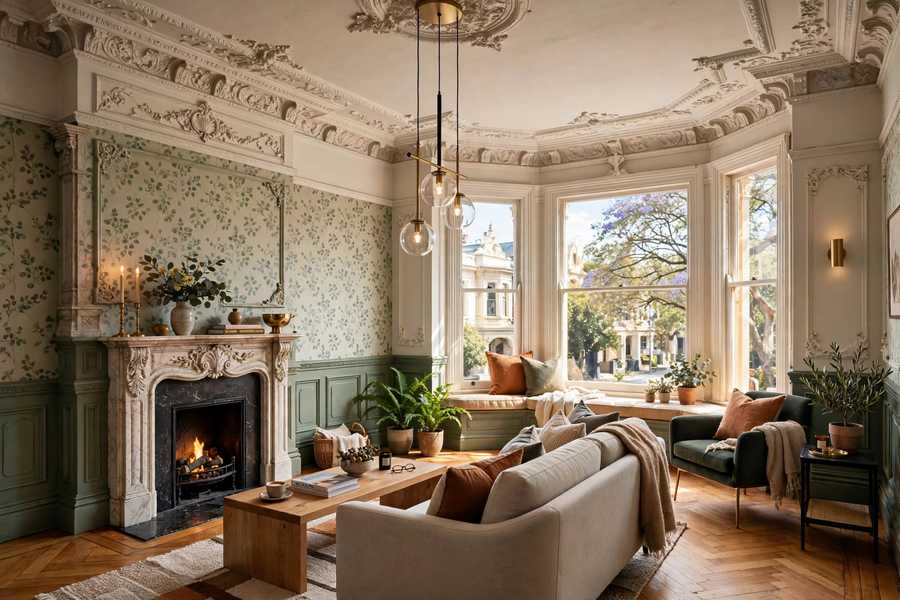
Melbourne might just be Australia’s most design-literate city. Between the Victorian terraces of the inner north, the Edwardian streetscapes of the east and a laneway culture that treats creativity as a civic duty, interior designers in Melbourne operate in a market with unusually high expectations. The good news: that competition keeps standards sharp and gives you plenty of choice. Here’s what designers cost in 2026, which styles suit Melbourne homes, and how to find the right fit.
How Much Does an Interior Designer Cost in Melbourne?
Melbourne sits in the middle of the national range — cheaper than Sydney, pricier than Brisbane. Industry data for 2026 puts the average Melbourne interior designer rate at $210 per hour (excluding GST), against a national average of about $200 per hour.
Typical Melbourne pricing looks like this:
Initial consultation: $200–$400 for 1–2 hours. Many designers apply this as a credit if you proceed to a full project.
Single room: $1,200–$5,000. Living rooms and bedrooms sit lower; kitchens and bathrooms higher because of the technical documentation involved.
Full apartment or townhouse: $6,000–$18,000 in design fees.
Whole house: $15,000–$50,000 for a standard family home. Heritage terrace renovations in Fitzroy or Carlton with structural work can push higher.
Interior decorators (furnishings and styling only) generally charge $80–$180 per hour in Melbourne, with room packages from around $1,200–$4,500.
Fixed fee vs hourly vs percentage
Melbourne designers use all three models. Hourly suits consultations and small refreshes. Fixed fees work when the scope is clear — one room, defined deliverables. Percentage of build cost (usually 10–15%) is common for full renovations, aligning the designer’s fee with the project’s scale. Ask for a written breakdown of what’s included at each stage so you’re comparing like with like.
Popular Interior Design Styles in Melbourne
Melbourne’s style is harder to pin down than Sydney’s — and locals like it that way. A few strong currents:
Modern heritage is Melbourne’s signature move: keeping the Victorian or Edwardian bones (cornices, fireplaces, leadlight) while inserting clean-lined contemporary living behind them. The classic inner-north formula is a period facade with a sharp rear extension in black cladding or raw concrete. Done well, it’s the best of both centuries.
Scandi-warm minimalism dominates new apartments in Southbank, Docklands and Footscray — pale timbers, soft neutrals, tactile fabrics. Melbourne’s grey winters make warmth a functional requirement, not just an aesthetic one.
Eclectic collector thrives in suburbs like Fitzroy, Brunswick and Northcote, where vintage finds, art and bold colour mix freely. Melbourne designers are less afraid of pattern and personality than their Sydney counterparts.
Industrial luxe suits converted warehouses in Collingwood and Richmond — polished concrete, steel-framed glazing and exposed services, softened with bouclé, travertine and warm lighting.
Contemporary Australian — open plans, indoor-outdoor flow, native material palettes — is the default for new builds in the growth corridors (Point Cook, Clyde North, Mickleham), where young families want practical, light-filled homes.
Melbourne’s Homes: What Designers Work With Here
Victorian terraces (Fitzroy, Carlton, Collingwood, Richmond, South Melbourne) are Melbourne’s icons — ornate parapets, iron lacework, narrow frontages and surprisingly deep floor plans. The eternal puzzle is light and flow: designers typically carve out rear extensions with north-facing glass, add internal courtyards or lightwells, and zone the long plan into distinct living areas. Heritage overlays are strict in these suburbs, so street facades stay while the back transforms.
Edwardian homes (Hawthorn, Kew, Camberwell, Balwyn, Surrey Hills) offer more breathing room — wider blocks, gabled facades, leadlight windows and simpler plasterwork. Side and rear extensions integrate more easily here. The design challenge is updating cellular room layouts for open-plan living without losing the home’s grace.
Federation and Queen Anne homes (Kew, Camberwell, Canterbury) bring terracotta roofs, bay windows and stained glass. Extensions need to respect roof pitches and materials, which is skilled work — choose a designer with heritage experience.
Post-war and mid-century homes (Beaumaris, Balwyn North, Ivanhoe) are having a renaissance. Original features like breeze-block walls, timber panelling and terrazzo are now assets. Designers lean into the era with warm timbers, earthy palettes and period-appropriate lighting.
New apartments and townhouses across the inner city and growth areas tend toward compact bedrooms and open living. Storage is the recurring complaint — Melbourne designers earn their keep with hallway joinery, under-stair storage and bedroom wardrobes that actually fit.
The climate factor: Melbourne’s four-seasons-in-a-day reputation is real. Good designers plan for cold, dark winters (layered lighting, warm textiles, heating zones) and hot northerly summers (cross-ventilation, external shading, thermal mass). Double glazing is increasingly standard in renovations, and north-facing living areas are prized.
How to Choose the Right Interior Designer in Melbourne
1. Look for period-home experience if you have one. A terrace or Edwardian renovation is a specialist skill — heritage controls, structural quirks, damp-proofing. Ask how many similar homes they’ve completed, not just designed.
2. Visit a finished project if you can. Melbourne designers often have completed homes they’ll show prospective clients (with the owner’s permission). Photos lie; standing in the space doesn’t.
3. Discuss budget with real numbers. Melbourne’s 2026 market: a quality kitchen renovation runs $30,000–$60,000; a bathroom $20,000–$35,000. If your designer won’t talk numbers, they’re not planning — they’re dreaming.
4. Check their documentation. Ask to see a sample drawing set or finishes schedule. Thin documentation means the builder guesses — and guesses cost money.
5. Understand the timeline. Melbourne’s good builders book out 3–6 months ahead. Your designer should sequence design, approvals and builder engagement realistically, not optimistically.
6. Trust the process, but verify. Mood boards and 3D renders are seductive. Insist on material samples you can touch and see in your home’s actual light before anything is ordered.
To sanity-check what the building work might cost after your designer finalises plans, see our [kitchen renovation cost guide](https://ntdesigns.com.au/kitchen-renovation-cost/) — Melbourne figures included. Our [free renovation calculators](https://ntdesigns.com.au/renovation-tools/) let you model budgets before you commit.
The Design Process: What Happens After You Hire
Knowing the process helps you judge whether a designer is organised — or winging it.
Brief and site measure (weeks 1–2). The designer visits your home, measures everything, photographs the details and digs into how you live: who cooks, where the kids dump school bags, whether you work from home. Good briefs take time; rushed ones produce generic designs.
Concept development (weeks 3–6). You’ll see mood boards, floor plan options and a preliminary materials palette. For terrace renovations, this stage usually includes two or three rear-extension concepts with different cost implications. Push back here — changes on paper are free; changes on site are not.
Design development and documentation (weeks 7–14). The chosen concept becomes construction-ready: detailed plans, elevations, joinery drawings, electrical and lighting layouts, and a finishes schedule specifying every material, colour and fixture. This documentation is what builders quote from — thin paperwork here means blowouts later.
Approvals (overlapping). If your project needs council or heritage approval, your designer (or their draftsperson) prepares the submission. In Yarra, Port Phillip and Stonnington, allow 2–4 months. Many designers start early builder conversations during this window so you’re not waiting twice.
Construction and styling (months 4–12). Some designers project-manage; others hand over and step back. Either way, expect site visits at key milestones — demolition, rough-in, joinery install — and a final styling day where furniture, art and objects land. The last 5% (styling, tweaks, defect fixes) takes disproportionate time; plan for it.
Questions to Ask Before You Hire
– How many homes like mine have you completed in the last two years?
– What’s included in your fee — and what costs extra?
– Do you project-manage trades, or hand over documentation only?
– How do you handle heritage overlay requirements in my suburb?
– Can I speak to two recent clients?
– What happens if the builder’s quote comes in over budget?
– Do you receive commissions or kickbacks from suppliers?
Frequently Asked Questions
How much do interior designers charge per hour in Melbourne?
Melbourne interior designers charge an average of $210 per hour excluding GST (2026 data). Decorators charge $80–$180 per hour. Fixed-fee options are common: $1,200–$5,000 per room, $6,000–$18,000 for a full apartment, and $15,000–$50,000+ for whole houses.
Are interior designers worth it for a Melbourne terrace renovation?
Yes — terraces are deceptively tricky. Narrow blocks, heritage overlays, party walls and light access all need professional resolution. A designer’s documentation typically saves more in avoided builder variations than the fee costs, especially on extensions.
How long does a full home design take in Melbourne?
Design alone (brief to construction-ready documentation) usually takes 8–16 weeks for a full home. Add 3–6 months for builder lead times and 4–9 months for construction. Heritage permits through councils like Yarra or Port Phillip can add 2–4 months.
Can a designer work within a tight budget in Melbourne?
Good designers are budget realists, not budget magicians. They’ll tell you what your money buys and where to spend vs save. For budgets under $10,000, consider a decorator or a designer consultation ($200–$400) with a detailed action plan you implement yourself.
Do I need council approval for interior changes in Melbourne?
Cosmetic interiors (paint, flooring, kitchens without structural change) generally don’t need approval. Structural work, extensions, and changes in heritage overlay areas do. Your designer should advise on what’s needed in your specific council area — this is a key reason to hire locally experienced designers.
What’s trending in Melbourne interiors for 2026?
Warm minimalism with natural stone and timber, curved furniture forms, heritage-meets-contemporary extensions, and a strong return to colour — deep greens, ochres and rich blues — after years of grey. Sustainable materials and Australian-made furniture are increasingly requested.