
Brisbane is having a moment. With the 2032 Olympics driving a construction boom and interstate migration reshaping the city’s suburbs, demand for interior designers in Brisbane has never been higher. But Brisbane isn’t Sydney or Melbourne with a tan — the subtropical climate, the beloved Queenslander and a distinct indoor-outdoor way of living mean local knowledge matters enormously. Here’s what designers charge in 2026, which styles work here, and how to choose well.
How Much Does an Interior Designer Cost in Brisbane?
Brisbane is kinder to budgets than the southern capitals. Industry data for 2026 shows Brisbane and Queensland designers typically charge less per hour than Sydney ($275) and Melbourne ($210) — most fall in the $150–$200 per hour range excluding GST, close to or just under the $200 national average.
What that means in practice:
Initial consultation: $150–$350 for 1–2 hours. Many Brisbane designers offer a walk-through consultation with a written recommendations list — excellent value if you’re DIY-ing parts of the project.
Single room: $1,000–$4,500. Queenslanders’ generous room sizes can push furnishing budgets up, but design fees stay reasonable.
Full home: $5,000–$15,000 in design fees for apartments and modest houses; $15,000–$40,000 for larger homes and Queenslander renovations.
Interior decorators (styling only) charge $70–$150 per hour in Brisbane, with room packages from $1,000–$3,500.
Where Brisbane saves you money
Two factors work in your favour. First, lower hourly rates than Sydney or Melbourne. Second, Brisbane’s renovation market is highly competitive thanks to the Olympics-driven building boom — more trades, more designers, sharper quotes. The flip side: the best designers and builders book out fast, so start conversations early.
Popular Interior Design Styles in Brisbane
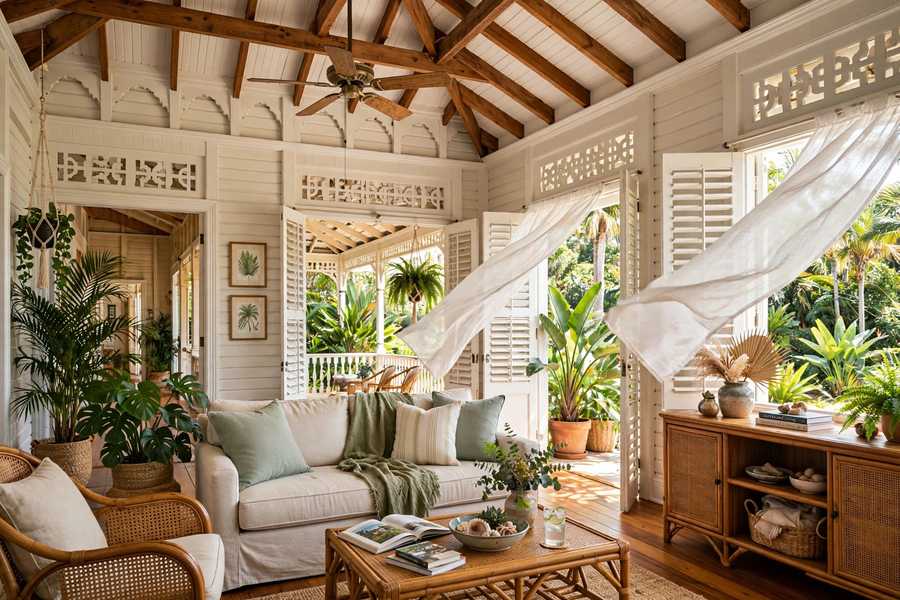
Hamptons-Queenslander fusion is Brisbane’s signature look — and it’s genuinely local, not imported. Crisp white weatherboards (or their modern equivalents), shaker cabinetry, plantation shutters and coastal blues, adapted to the Queenslander form with its verandahs and breezy planning. Done right, it’s timeless; done wrong, it’s a cliché. A good designer knows the difference.
Tropical modernism leans into the climate: louvres, breezeways, deep eaves, indoor plants as architecture, and materials that age gracefully in humidity — think spotted gum, terrazzo and honed concrete. This is the style winning architecture awards in Queensland right now.
Contemporary coastal — lighter and less formal than Hamptons — suits the bayside suburbs (Manly, Wynnum, Sandgate) and new builds. Whitewashed timbers, linen, rattan and sea-glass palettes.
Inner-city industrial works in converted warehouses around Fortitude Valley and Newstead: concrete, black steel and recycled timber warmed up with leather and greenery.
Retro Queenslander revival is a growing niche — owners restoring 1920s–40s Queenslanders with period-appropriate colours (deep greens, warm creams), restored hoop pine floors and vintage-look fixtures, while quietly upgrading kitchens and bathrooms behind the scenes.
Brisbane’s Homes: What Designers Work With Here
Queenslanders (New Farm, Paddington, Ashgrove, Clayfield, inner north) are the homes designers love most — and the ones that punish generic thinking. Raised on stumps with wide verandahs, VJ walls and soaring ceilings, they were engineered for airflow before air-conditioning existed. The design opportunity is enormous: enclose under the house for extra living, open verandahs into the plan, restore original hoop pine floors. The pitfalls are real too — lead paint, restumping needs, and character overlays that protect the streetscape. Always get a building and pest inspection before designing; stumps and ant caps can hide expensive surprises.
Post-war brick homes (Chermside, Stafford, Camp Hill) are Brisbane’s renovation workhorses — solid, affordable, and crying out for open-plan updates. Designers typically remove walls between kitchen and living, add north-facing glass, and lift the whole place with light palettes and timber floors.
New builds (North Lakes, Springfield, Rochedale) come with volume-builder floor plans that prioritise bedroom count over liveability. Designers are often brought in to fix what’s missing: proper entry sequences, functional laundries, outdoor rooms that connect to living areas.
Apartments (Newstead, West End, South Brisbane) skew toward investor-grade finishes. Owner-occupiers hire designers to add the warmth and storage the developer skipped — custom joinery, better lighting and real material palettes.
The climate factor: This is where Brisbane designers earn their fee. Subtropical design isn’t a vibe, it’s physics: orient living areas to catch breezes, shade north and west glass, specify mould-resistant finishes, and never, ever trap humid air in wall cavities. Ceiling fans in every bedroom, cross-ventilation over air-con where possible, and outdoor living treated as genuine rooms — not afterthoughts. A designer who doesn’t talk about airflow in the first meeting isn’t a Brisbane designer.
How to Choose the Right Interior Designer in Brisbane
1. Prioritise Queenslander experience if that’s your home. Raising, restumping, verandah enclosures, VJ walls — these are specialist skills. Ask for photos of completed Queenslander projects, not just renders.
2. Ask about their builder network. The Olympics boom means good builders are stretched. Designers with established trade relationships get your project scheduled; those without leave you cold-calling.
3. Check climate literacy. Ask: “How will this design handle a February heatwave and a humid March?” The answer should mention orientation, shading, ventilation and materials — not just ceiling fans and air-con.
4. Be upfront about budget. Brisbane’s sweet spot: $30,000–$50,000 renovates a kitchen properly; $15,000–$30,000 does a bathroom. If your designer won’t reality-check your budget, keep looking.
5. Consider a decorator for cosmetic work. Brisbane’s lower rates make decorators exceptional value for styling, colour and furniture — often $1,000–$3,500 per room.
6. Timing matters. Allow 3–6 months for design and documentation, then join the builder queue. Starting in autumn means construction through the drier winter months — a genuine Brisbane advantage.
Our [kitchen renovation cost guide](https://ntdesigns.com.au/kitchen-renovation-cost/) includes Queensland pricing bands, and the [free renovation calculators](https://ntdesigns.com.au/renovation-tools/) help you test budgets before engaging anyone.
The Design Process: What Happens After You Hire
Brief and site assessment (weeks 1–2). The designer measures your home, checks orientation and airflow, and — critically for Queenslanders — notes structural quirks like stump condition, VJ wall locations and verandah depths. A building and pest inspection should happen around now if it hasn’t already; designing around unknown stumps is asking for trouble.
Concept and climate testing (weeks 3–6). Concepts arrive with floor plans and a materials direction. In Brisbane, this is where the designer should be talking about more than looks: which rooms catch the breeze, where the western sun hits, how the verandah integrates. Ask to see the thinking, not just the pictures.
Documentation (weeks 7–12). Detailed drawings, joinery design, lighting and electrical plans, finishes schedules. For Queenslander renovations, documentation often includes restumping coordination and verandah enclosure details. This is the package builders quote from — completeness here is what separates smooth projects from variation hell.
Approvals and builder procurement (overlapping). Character overlay areas (New Farm, Paddington, Ashgrove) need council sign-off — allow 2–3 months. Meanwhile, get three builder quotes from the same documentation. In the current Olympics-driven market, the cheapest quote is rarely the best; check recent completed work and ask about their current pipeline.
Construction (months 5–12). Queensland’s wet season (roughly November–March) can delay external work, so smart scheduling puts roof and external work in the drier months. Expect fortnightly site updates from a full-service designer, milestone inspections, and a final styling pass. Keep a 10–15% contingency — old Queenslanders always hide something.
Questions to Ask Before You Hire
– How many Queenslanders (or homes like mine) have you finished in the last two years?
– How do you design for subtropical conditions — airflow, shading, humidity?
– What’s your fee structure, and what’s excluded?
– Which builders do you regularly work with?
– How do you handle the character overlay / council requirements in my suburb?
– What’s your current lead time from brief to finished design?
– Can I see material samples before anything is ordered?
Frequently Asked Questions
How much does an interior designer cost per hour in Brisbane?
Brisbane interior designers typically charge $150–$200 per hour excluding GST (2026), below Sydney ($275) and Melbourne ($210). Decorators charge $70–$150 per hour. Full-home design fees generally run $5,000–$40,000 depending on size and scope.
Do I need a designer familiar with Queenslanders?
Strongly recommended. Queenslanders have specific structural, heritage and climate considerations — stumps, VJ walls, verandahs, airflow — that generic designers mishandle. Look for a portfolio full of completed Queenslander projects.
How does Brisbane’s climate affect interior design choices?
Humidity drives material choices (mould-resistant paints, moisture-tolerant flooring), airflow drives planning (cross-ventilation, louvres, ceiling fans), and sun drives shading (deep eaves, external blinds on western glass). Good subtropical design cuts cooling costs noticeably.
How long does a renovation take in Brisbane?
Design and documentation: 2–4 months. Builder lead times are currently long due to Olympics-related demand — allow 3–6 months. Construction: 3–6 months for kitchens/bathrooms, 6–12 months for full homes. Building through winter avoids the wettest weather delays.
Is Hamptons style still popular in Brisbane?
Yes, but it’s evolving. The crisp white Hamptons-Queenslander fusion remains popular, while newer projects lean warmer — natural timbers, textural linens and softer coastal palettes. Dark timber accents are trending as a contrast to all-white schemes.
Can an interior designer help with a new build in Brisbane’s growth suburbs?
Absolutely — and it’s often where they add the most value. Volume-builder plans can be optimised with better zoning, storage, lighting and outdoor connections before construction starts, when changes are cheapest.