
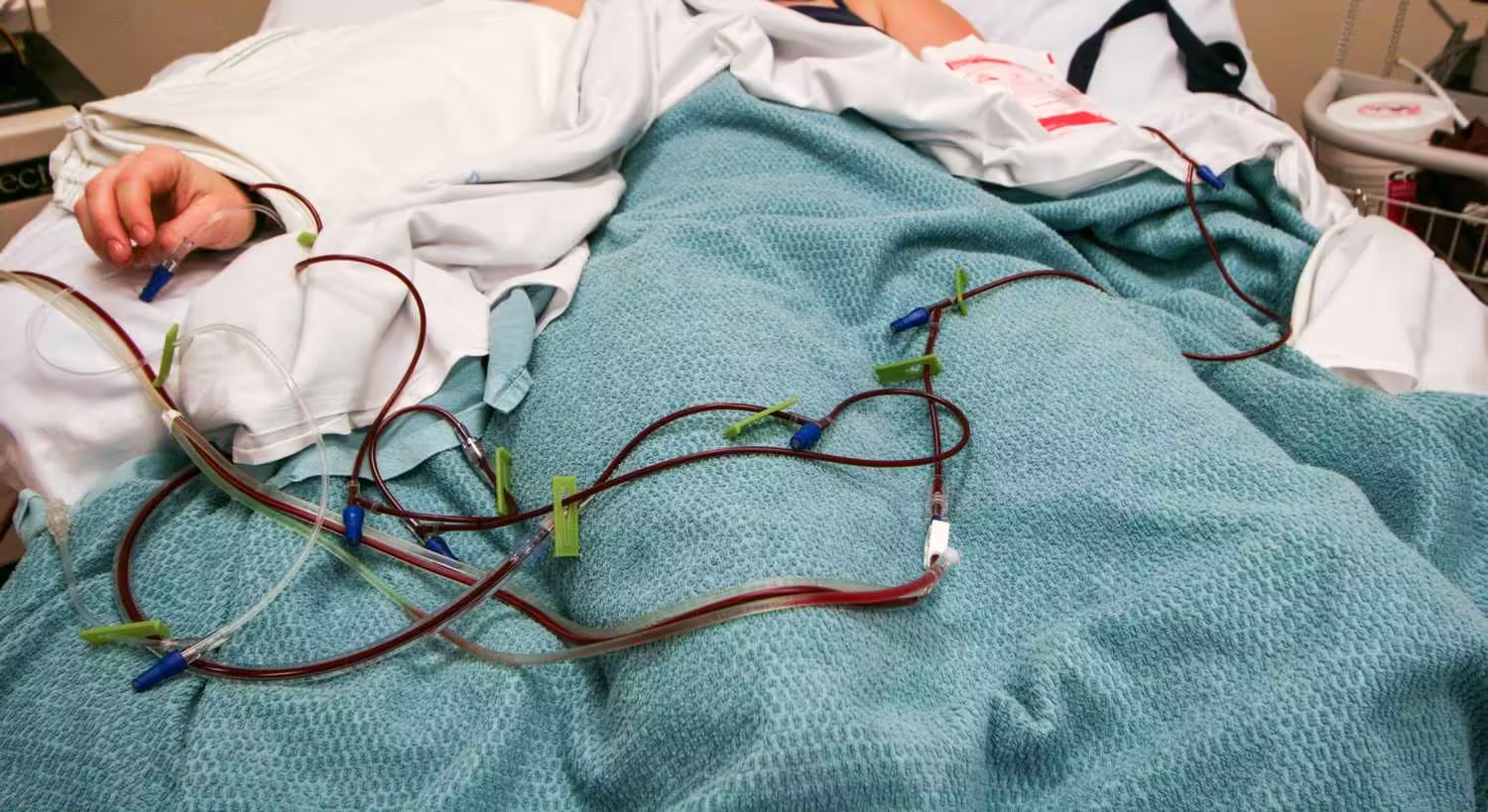
Bone marrow transplantation is a procedure used under certain conditions in patients suffering mainly from blood diseases such as leukaemia, certain types of lymphoma, aplastic anaemia, thalassaemia, sickle cell anaemia and certain congenital metabolic diseases or immunodeficiencies.
Although the term “bone marrow transplant” is used, it would actually be more accurate to speak of a transplant of haematopoietic stem cells (HSC), which are found in bone marrow but also, to a lesser extent, in peripheral blood and the umbilical cord.
As with other types of transplant, haematopoietic stem cell transplantation involves a process based not only on stabilising the patient’s state of health, but above all on finding a compatible sample from a donor (who could be the patient themselves), and infusing it into the recipient.
Let’s take a step-by-step look at how bone marrow transplantation works.
What Are Haematopoietic Stem Cells (HSC)?
Haematopoietic stem cells are immature, undifferentiated adult stem cells. What does this mean?
Stem cells are cells that do not yet have a specific function, but which can specialise and develop into around 200 types of body cells, including blood, nerve, muscle, heart, glandular and skin cells.
Because of their ability to reproduce at an extremely high rate and to differentiate into various cell lineages, they are defined as multipotent cells.
HSCs are mainly found in bone marrow, peripheral blood and the umbilical cord — more specifically in the blood present in the umbilical cord or placenta.
Where Do Haematopoietic Stem Cells Come From?
As explained above, stem cells are immature cells that have no specific function, but are capable of evolving, specialising and maturing.
As they mature, HSCs are transferred from bone marrow to peripheral blood, albeit in limited quantities.
The options available for collecting these cells are as follows:
- From bone marrow, which is found inside long bones and in the central part of flat bones, and is the production site for blood cells — that is, white blood cells, red blood cells and platelets;
- Peripheral blood, when stem cells mature and pass from the bone marrow into the bloodstream;
- Blood contained in the umbilical cord, voluntarily donated by the mother after the birth of her child.
How Are HSCs Collected?
As indicated, haematopoietic stem cells can be collected from three sites: bone marrow, peripheral blood and umbilical cord.
Bone Marrow Collection
The most effective, but considerably more invasive, method is bone marrow harvesting by repeated punctures of the pelvic bones.
Bone marrow harvesting is performed under anaesthetic (general or epidural), otherwise it would be very painful. It lasts around 30 to 45 minutes and does not cause any damage or impairment to the donor, although like all surgical procedures, it does present risks, linked both to the anaesthetic and to the occurrence of infections or haematomas at the harvesting site.
The donor is monitored for 48 hours after the procedure.
Generally, a quantity of marrow blood ranging from 700 to 1,000 ml is collected, which the bone marrow is able to replace in around 7 to 10 days.
Peripheral Blood Collection
Collecting haematopoietic stem cells from peripheral blood is undoubtedly preferable, as it is not at all invasive and is easier to perform, but it has one limitation: the quantity of HSC present in peripheral blood is very low.
For this reason, in the days prior to sampling, therapy is carried out — based on the administration of a growth factor called G-CSF (Granulocyte Colony-Stimulating Factor) — aimed at stimulating the bone marrow to promote the release of stem cells into the bloodstream.
Sampling is carried out using a procedure known as apheresis, which involves the use of a cell separator. In simple terms, blood is drawn from the donor and transported inside the cell separator, which separates the HSCs from the rest of the blood. The stem cells are then collected, while the blood is returned to the donor via the other arm.
As a rule, six 2–4 hour sessions are required over several days until a sufficient quantity of stem cells is obtained, which can be preserved by freezing.
The procedure is painless and does not require any form of anaesthesia.
Umbilical Cord Blood Collection
The final collection method is to use the blood contained in the umbilical cord, which the mother may decide to donate after childbirth for this purpose.
However, cord-derived stem cells are generally only used in children, as cord blood does not contain sufficient cells for adults.
Bone Marrow Transplant: How to Proceed
Let’s start by recalling that a bone marrow transplant in Turkey means replacing diseased or non-functioning bone marrow with healthy stem cells capable of regenerating all blood cells.
Before the transplant, however, the patient must undergo high-dose chemotherapy and/or radiotherapy (conditioning therapy), to destroy the diseased cells present and make way for the new cells that will be transplanted.
If the stem cells come from a donor, before the transplant, the recipient must take drugs to suppress the immune system (immunosuppressants) and prevent rejection.
At this stage, the stem cells can be infused into the patient, with a procedure similar to a blood transfusion. It takes around 2–3 weeks for the new cells to take root and begin to repopulate the bone marrow destroyed by chemotherapy/radiotherapy and produce new blood cells.
After the transplant, certain drugs are administered to prevent complications, and a period of hospitalisation of around 1 to 2 months is expected. Most patients who receive a bone marrow transplant take around a year to recover, and there are several bone marrow transplant centers in Turkey.
Frequently Asked Questions
What conditions are treated with a bone marrow transplant?
Bone marrow transplants are most commonly used for blood disorders such as leukaemia, certain lymphomas, aplastic anaemia, thalassaemia, sickle cell anaemia, and some congenital metabolic diseases or immunodeficiencies.
Is a bone marrow transplant the same as a stem cell transplant?
The terms are often used interchangeably. “Bone marrow transplant” traditionally describes the procedure, while “haematopoietic stem cell transplant” is more precise, since the transplanted material is haematopoietic stem cells collected from marrow, peripheral blood or umbilical cord.
How long does recovery take after a bone marrow transplant?
Recovery is gradual. Hospitalisation of around 1 to 2 months is typical after the procedure, and most patients take roughly a year to recover fully. Timelines vary widely between individuals.
Are there risks with bone marrow transplantation?
As with any major medical procedure, there are risks, including complications from conditioning therapy, infection, rejection and graft-versus-host disease. Patients are monitored closely and given medication to reduce these risks.
Disclaimer: This article is for general informational purposes only and is not medical advice. Bone marrow transplantation is a complex medical procedure with significant risks and must only be considered in consultation with qualified healthcare professionals. If you have concerns about your health, seek advice from your doctor.