
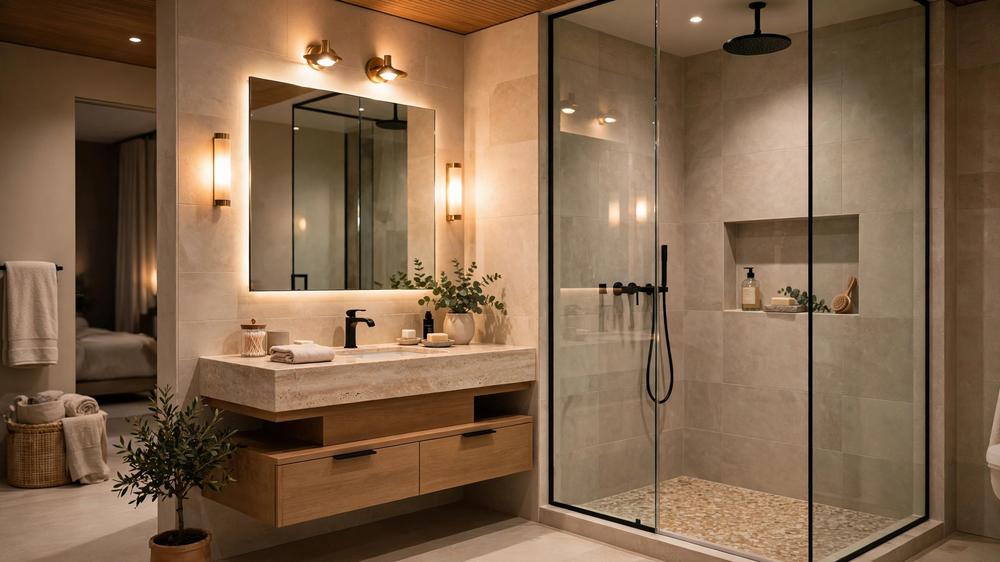
If you’re wondering what an ensuite renovation cost Australia homeowners are paying in 2026 looks like, the short answer is: most full ensuite renovations land between $14,000 and $25,000, with budget jobs under $12,000 and premium jobs past $30,000. The longer answer — what drives that range, where the money goes, and how to keep your project at the lower end — is what this guide is for.
An ensuite is the smallest bathroom in most homes, usually 3–4 square metres. That tempts people to assume it’ll be cheap to renovate — but the fixed costs (plumber, electrician, waterproofer, tiler, each making separate visits) are identical to a family bathroom, so the per-square-metre price can be higher than a bigger room.
Ensuite Renovation Cost in 2026: The Summary
Here’s where the market sits, based on current Australian trade pricing guides and HIA industry data (national average bathroom renovation spend around $26,000):
| Renovation level | Typical cost range | What you get |
| Budget / cosmetic refresh | $8,000 – $14,000 | New vanity, tapware, toilet and mirror; repaint; limited or no retiling; same layout |
| Mid-range full renovation | $14,000 – $25,000 | Full strip-out, new waterproofing, full retile, new fixtures, frameless shower screen |
| Premium / large ensuite | $25,000 – $40,000+ | Custom or semi-custom vanity, stone benchtops, designer tapware, layout changes, larger master ensuite |
These are planning ranges, not quotes — your suburb, trades and fixture choices will move the number. But as a rule of thumb, a straightforward ensuite with the plumbing staying where it is sits in the middle band, while a larger master ensuite with the layout redrawn pushes into premium territory.
If you’re comparing broader renovation budgets, our 2026 renovation costs guide puts ensuite spending alongside kitchens, bathrooms and extensions.
The Full Cost Breakdown
Where does the money actually go? Below is a realistic breakdown for a typical 3–5 m² ensuite with a full strip-out and the same layout, based on trade pricing data verified in October 2026 (GST included).
| Component | Typical range | Notes |
| Demolition and rubbish removal | $1,050 – $3,150 | Includes skip bin or tip runs |
| Plumbing rough-in and fit-off | $2,100 – $5,250 | Keeping pipes in place keeps this at the lower end |
| Waterproofing | $735 – $3,675 | Licensed waterproofer; mandatory under Australian Standards |
| Tiling (supply and lay, floor + walls) | $2,950 – $7,900 | Labour is the big cost here, not the tiles themselves |
| Vanity and basin (supply + install) | $525 – $3,675 | Flatpack at the low end; custom wall-hung at the high end |
| Toilet suite (supply + install) | $420 – $1,250 | Back-to-wall costs more than standard suites |
| Shower screen (frameless) and fittings | $840 – $2,625 | Framed or semi-framed screens cost less |
| Tapware and accessories | $600 – $1,800 | Mixers, towel rails, robe hooks, toilet roll holder |
| Electrical (lighting, exhaust fan) | $600 – $1,200 | Heat lamps and new circuits add to this |
| Total (mid-range) | ~$14,000 – $25,000 |
A few items deserve a closer look.
Demolition
$1,050–$3,150 covers labour, skip hire or tip fees, and getting a tiled bathroom back to bare studs. Older homes can hide corroded pipes or water damage — keep a 10–15% contingency for what demolition reveals.
Plumbing
Plumbing makes or breaks the budget. A fit-off (connecting fixtures to existing pipework) in the same positions is straightforward. Move the toilet and you may be coring through the slab to relocate the waste pipe — that single decision can add $2,000–$5,000. In a 3 m² ensuite there’s rarely a reason to shift plumbing, so this is the easiest saving you’ll make.
Waterproofing
Australian regulations require wet-area waterproofing to comply with AS 3740 — the shower area must be fully waterproofed, with shower walls treated to at least 1.8 metres above the finished floor and the rest of the room waterproofed at floors and wall junctions. A licensed waterproofer typically charges $735–$3,675 for an ensuite depending on extent.
A failed membrane is the most expensive problem a bathroom can develop — fixing leaks after tiling means pulling it all up and starting again. The official requirements are on the ABCB’s wet area waterproofing page, which sets out what the National Construction Code requires for wet areas in homes.
Tiling
Tiling is usually the single largest line item. Supply-and-lay for floor and walls runs $2,950–$7,900, and most of that is labour. The tile itself matters less than you’d think: a $30/m² ceramic looks brilliant when laid by a good tiler, while expensive stone laid badly looks worse than either.
To keep costs down: tile to 1.2 metres instead of floor-to-ceiling (paint the rest in wet-area paint), choose a simple stack-bond or offset layout over herringbone, and pick standard tile sizes that generate less wastage.
Fixtures: Vanity, Shower, Toilet
Fixtures are where budgets quietly double. A basic flatpack vanity starts around $500; a wall-hung unit with a stone benchtop runs into the thousands. Frameless shower screens look cleaner and cost $840–$2,625 installed, while a quality semi-framed screen does the same job for less. Toilet suites range from $420 to $1,250+ for back-to-wall models.
Choose the hero piece and economise elsewhere. In a small ensuite the vanity and shower screen dominate the eye — spend there, and a standard toilet and simple tapware won’t be noticed.
Labour
Labour is roughly half the total cost. You’ll need a plumber, an electrician, a waterproofer, a tiler and a carpenter or plasterer, each licensed and each making multiple visits. Trades charge per visit as much as per hour, so a small ensuite pays nearly the same trade bill as a family bathroom. Coordinating them yourself saves the project-management fee but costs you time — trades waiting on each other is where timelines blow out.
What Moves the Price Up (or Down)
Beyond the breakdown, these are the factors that decide whether your ensuite costs $14,000 or $30,000:
- Layout changes. Moving any fixture — especially the toilet — is the single biggest cost lever. Keep the layout and save $2,000–$5,000 immediately.
- Size. A 3 m² ensuite costs less than a 12 m² master ensuite in absolute terms but more per square metre, because fixed trade costs spread over less area.
- Tile extent and type. Floor-to-ceiling natural stone or terrazzo versus part-height ceramic is thousands of dollars apart.
- Fixture brands. Mid-range Australian brands are solid and well-supported for parts; European designer labels can double the fixtures line.
- Structural surprises. Water damage, corroded pipes, asbestos sheeting in pre-1990 homes — allow 10–15% contingency.
- Strata and access. Units add strata approvals, lift bookings, noise-hour restrictions and parking headaches for trades.
- Timeline. A 3–4 week renovation is standard for a full ensuite; backordered fixtures and trade delays are the usual culprits when it stretches to six.
Small Ensuite Layout Ideas
Most ensuites are 3 to 4 m², so the layout has to work hard. These ideas help tight ensuites feel bigger without structural work:
- Wall-hung vanity. Frees floor space and makes cleaning easier.
- Frameless or walk-in shower. Removes visual barriers and suits small rooms best.
- Large-format tiles, minimal grout lines. Less visual clutter, easier cleaning.
- A large mirror over the vanity. Bounces light and roughly doubles the perceived depth of the room.
- Recessed shaving cabinet or niches. Storage that doesn’t protrude.
- Sliding or cavity-slider door. A swinging door eats up to a square metre of floor space; a cavity slider returns it.
- Consistent colour palette. One floor-to-wall material story keeps small rooms calm rather than cramped.
If you’re not sure which direction suits your space, our interior design style quiz takes two minutes and helps narrow down finishes before you start buying fixtures.
Ensuite vs Main Bathroom: What’s Different?
Renovating an ensuite isn’t quite the same as renovating the family bathroom, and the differences matter for budgeting:
- Size. Ensuites are typically 3–4 m² versus 5–9 m² for a main bathroom. Material quantities are lower than a main bathroom, but trade visits cost the same — so expect a similar bill, roughly 20–30% less than a main bathroom of equivalent finish.
- No bath (usually). Most ensuites are shower-only, which removes the bath purchase and installation from the equation.
- Ventilation matters more. Ensuites are often internal rooms with no window. A quality exhaust fan ducted outside — not into the roof cavity — is essential to prevent mould.
- Resale angle. Buyers notice dated ensuites because the ensuite is seen every morning. Mid-range finishes with a clean, hotel-like feel tend to return well.
Renovation Cost Differences by City
Sydney
Sydney runs 10–20% above the national average, driven by higher trade rates, parking and access costs, and strong demand. A mid-range ensuite lands around $17,000–$28,000 in metro Sydney. Inner-city terraces and apartments cost more again thanks to access challenges and heritage overlays.
Melbourne
Melbourne tracks close to the national midpoint: a typical full ensuite renovation (3–5 m², full strip-out, same layout) ranges $15,750–$31,500 according to October 2026 trade data. Inner-suburb period homes can surprise with old plumbing and lath-and-plaster walls, so keep the contingency.
Brisbane
Brisbane sits at or just below the national midpoint — mid-range ensuites typically $14,000–$24,000. The humid climate makes ventilation and waterproofing even more important than in southern states, so don’t trim the exhaust fan or the membrane to save money.
Tips to Save Money on Your Ensuite Renovation
- Keep the layout. The single biggest saving. Don’t move the toilet, shower or vanity unless there’s a strong reason.
- Choose standard sizes. Off-the-shelf vanities, screens and suites avoid custom-made premiums.
- Tile part-height. Walls tiled to 1.2 metres with wet-area paint above look sharp and save hundreds in labour.
- Buy fixtures during sales. End-of-financial-year and Boxing Day sales at Australian retailers routinely cut 20–30% off tapware and vanities.
- Get three itemised quotes. Like-for-like quotes reveal who’s padding the labour line.
- Do the demolition yourself — the cosmetic strip-out only, and only if you know what you’re doing. Leave structural, electrical and plumbing work to the licensed trades.
- Plan with a calculator first. Run the numbers with our renovation cost tools so you walk into quotes with a realistic figure in your head.
Frequently Asked Questions
How much does an ensuite renovation cost in Australia in 2026?
Most full ensuite renovations cost between $14,000 and $25,000. Budget refreshes start around $8,000, and premium or large master ensuites can exceed $30,000–$40,000. The layout staying the same is the biggest factor keeping you at the lower end.
How long does an ensuite renovation take?
A straightforward ensuite renovation takes 3–4 weeks from demolition to completion. Layout changes, backordered fixtures and structural surprises can stretch it to 5–6 weeks.
Can I renovate an ensuite for under $10,000?
Yes, with a cosmetic refresh rather than a full renovation: new vanity, tapware, toilet, mirror, paint and possibly new floor tiles, keeping the existing wall tiles and waterproofing intact. Once you strip back to studs and re-waterproof, $10,000 becomes very difficult.
Do I need council approval to renovate my ensuite?
Generally no, if it’s a like-for-like renovation with no structural changes. You’ll need to check with your local council if you’re moving walls, altering plumbing significantly or changing drainage. Apartments and units also need strata approval regardless of scope.
Is waterproofing really that important in a small ensuite?
Yes — it’s arguably more important in a small ensuite than a big bathroom. Ensuites are often internal rooms with limited ventilation, so trapped moisture causes damage fast. Waterproofing is mandatory under the National Construction Code (AS 3740), must be done by a licensed waterproofer, and is the one line item you should never cut corners on.