
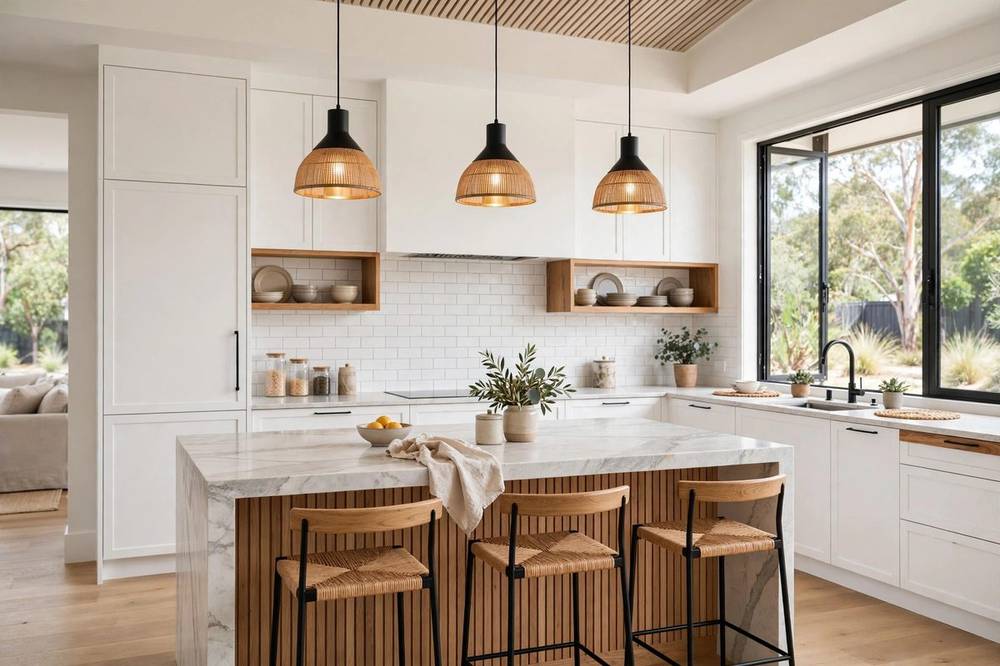
The short answer to “does kitchen renovation add value in Australia” is yes — the kitchen is still the single highest-impact room you can renovate when it comes to resale value. But the longer answer matters more, because a kitchen renovation that returns 75 cents on the dollar and one that returns 40 cents look identical in the planning stage. What separates them is how you spend, where you live, and what your street expects.
The Average ROI of a Kitchen Renovation in Australia
Let’s start with the numbers. Australian industry data consistently puts the average return on a mid-range kitchen renovation at 50 to 75 cents back for every dollar spent. A $30,000 kitchen reno might add $15,000 to $22,500 to your sale price. That’s not a profit — it’s a partial return.
Why is it partial? Because buyers pay for what the finished product looks like and how it functions, not for what it cost you to build. If your street’s median sale price caps what buyers will pay for your home, spending $60,000 on a kitchen in a $550,000-suburb house will not return $60,000. It can’t. The market ceiling decides.
The good news: kitchens consistently outperform every other room. Industry estimates rank typical ROI by room:
| Renovation | Typical spend (AU) | Estimated ROI |
| Mid-range kitchen renovation | $20,000–$40,000 | 50–75% |
| Cosmetic kitchen refresh (paint, handles, splashback) | $5,000–$10,000 | 70–90% |
| High-end luxury kitchen | $60,000–$100,000+ | 40–55% |
| Bathroom renovation (mid-range) | $15,000–$30,000 | 60–70% |
| Outdoor entertaining area | $10,000–$25,000 | 50–65% |
| Granny flat (compliant) | $120,000–$180,000 | 60–80%* |
*\*Granny flats add value largely through rental income, which is a different calculation to resale ROI.*
Two things jump out from this table. First, the cosmetic refresh beats the full rebuild on ROI almost every time. Second, the luxury end is where money gets destroyed — the more you overspend relative to your home’s value, the worse the return.
What Actually Adds the Most Value
Not all kitchen dollars are equal. Here’s where buyers notice — and where valuers give credit.
Layout and functionality
A better layout beats better finishes. If your renovation turns a cramped galley into an open-plan kitchen with an island, that changes how the whole house lives. Buyers and valuers notice space and flow far more than they notice whether the stone is Calacatta or engineered.
Open-plan kitchens connected to living and dining areas remain the strongest value driver in Australian homes, particularly in Sydney and Melbourne where indoor-outdoor flow is expected.
Stone benchtops
This is the one finish that genuinely moves the needle. In most Australian markets, stone benchtops (engineered stone or natural) are now the *expectation* in a renovated kitchen, not a luxury. Laminate benchtops in a “renovated” kitchen read as a half-done job and can actually work against you.
Quality appliances — but not over the top
A matching set of reputable appliances (think Bosch, Miele, or similar mid-to-premium brands) signals quality. But there’s a ceiling: a $12,000 French-door fridge and a $6,000 range cooker in a $700,000 home won’t return their cost. Match appliance quality to the home’s price point.
Storage
Soft-close drawers, a proper pantry (walk-in if space allows), and sensible cabinetry layout. Buyers open cupboards. Every time.
Natural light and connection to outdoors
A servery window to the alfresco area, a bigger window over the sink, or sliding doors that connect the kitchen to the deck — these Australian-specific touches add perceived value well beyond their cost.
What Doesn’t Add Value (Common Money Wasters)
This is the part most renovation articles skip. Knowing what *not* to do protects more money than any tip about what to do.
Over-capitalising on finishes
Marble benchtops, imported Italian tiles, and custom brass tapware in a home where the bathroom still has a 1990s fibreglass shower? Buyers see inconsistency, not luxury. Valuers compare your home to recent local sales, and those sales didn’t have $200/m² tiles.
Trendy colours that date fast
That sage-green cabinetry might look stunning on Instagram in 2026. In 2031, when you sell, it may read as “dated”. Neutral bases (white, warm grey, natural timber) with colour in easily changed elements (splashback, stools, pendant lights) hold value longer.
Removing a bedroom to enlarge the kitchen
Never do this. Bedroom count is one of the strongest price drivers in Australian property. A 4-bedroom home with a slightly smaller kitchen will almost always sell for more than a 3-bedroom home with a spectacular one.
DIY electrical and plumbing
Beyond the legal issues, unlicensed work is a red flag in pre-purchase building inspections. One flagged item can cost you the sale or trigger a price reduction far exceeding what you “saved”.
The $80,000 kitchen in a $600,000 home
The golden rule Australian valuers repeat: don’t spend more than 5–8% of your home’s value on a kitchen renovation if resale return matters to you. On a $600,000 home, that’s $30,000–$48,000. Above that, you’re renovating for your own enjoyment — which is fine, but call it what it is.
Kitchen Renovation ROI by City: Sydney, Melbourne, Brisbane
Location changes everything. The same $35,000 kitchen returns differently depending on the market.
Sydney
Sydney’s high property values mean the 5–8% rule gives you a bigger budget — $50,000–$80,000 on a million-dollar home is proportionate. But competition is fierce, and buyers in Sydney’s inner suburbs expect stone, quality appliances, and indoor-outdoor flow as standard. A dated kitchen in Sydney hurts more than anywhere else because buyer expectations are highest. Typical ROI: 55–75% for mid-range renovations; cosmetic refreshes in apartments can push higher because the entry cost is lower.
Melbourne
Melbourne buyers are design-literate — this is Australia’s café-culture capital, and kitchen aesthetics matter. Period homes in the inner north and east reward sympathetic renovations (think shaker cabinetry, butler’s pantries) that suit the home’s era. Over-modernising a Victorian terrace kitchen can actually *reduce* appeal. Typical ROI: 50–70%.
Brisbane
Brisbane’s market rewards indoor-outdoor integration more than any other city. A kitchen renovation that opens to the deck via a servery window or stacker doors adds disproportionate value here. Queenslander renovations need to respect the home’s character — louvres, VJ panelling, and timber tones photograph beautifully and sell well. Typical ROI: 50–70%, with outdoor-connected kitchens at the top of the range.
The pattern: in every city, the kitchens that return most are the ones that match what local buyers already want — not the ones that try to import a different city’s taste.
Cost vs Value: What to Budget in 2026
Use our [Australian Renovation Cost Database 2026](https://ntdesigns.com.au/renovation-costs-australia-2026/) for detailed current pricing, but here’s the quick version for kitchens:
| Renovation level | Typical cost | What you get | Likely value added |
| Cosmetic refresh | $5,000–$12,000 | Paint cabinets, new handles, splashback, tapware | $8,000–$15,000 |
| Mid-range renovation | $20,000–$40,000 | New cabinetry, stone benchtops, appliances, flooring | $15,000–$28,000 |
| High-end renovation | $50,000–$80,000 | Custom joinery, premium stone, integrated appliances, layout changes | $25,000–$45,000 |
| Luxury / architectural | $80,000–$150,000+ | Structural changes, butler’s pantry, top-tier everything | $35,000–$60,000 |
Notice the pattern: as spend rises, the *percentage* return falls, even though the dollar return rises. The cosmetic refresh is the ROI champion. The luxury renovation is the lifestyle champion. Choose based on whether you’re selling soon or staying.
Before committing to a budget, run the numbers through our [free renovation calculators](https://ntdesigns.com.au/renovation-tools/) — the kitchen estimator breaks down realistic costs for cabinetry, benchtops, appliances, and trades so you can see where your money actually goes.
Expert Tips: Maximising Your Kitchen ROI
Renovate for the street, not for yourself (if selling)
Walk through recently sold homes in your suburb — realestate.com.au sold listings are free research. Note the kitchen standard in homes that sold *above* asking. That’s your target, not the display homes at the Home Show.
Keep the plumbing where it is
Moving plumbing (sink, dishwasher, gas lines) is one of the biggest cost drivers in a kitchen reno. Keeping the existing layout while upgrading everything visible can save $5,000–$10,000 with almost no impact on perceived value.
Spend on what buyers touch
Benchtops, tapware, handles, and appliances get touched daily — buyers register their quality subconsciously. The inside of wall cabinets? Nobody cares. Allocate accordingly.
Get three quotes, minimum
Trade pricing for kitchens varies enormously in Australia — 30–40% differences between quotes for identical scopes are common. And check licences: in NSW, kitchen renovations over $5,000 need a licensed contractor.
Time it with the market
If you’re renovating to sell, a kitchen completed 6–12 months before listing is ideal: fresh enough to photograph beautifully, settled enough that any defects have shown themselves. A kitchen finished the week before listing can smell of fresh paint and silicone — buyers notice.
When a Kitchen Renovation Might NOT Add Value
Honesty matters here. There are situations where renovating the kitchen is the wrong financial move:
- You’re in a flat or declining market. If prices are falling 5% a year, a $30,000 kitchen won’t outrun a $40,000 market drop. Wait, or spend less.
- The rest of the house is dated. A $50,000 kitchen in a home with stained carpets and a 1980s bathroom looks odd, not impressive. Spread the budget or don’t start.
- You’re over the suburb ceiling. If your home is already near the top of local sale prices, there’s no headroom for the renovation to add value. Check comparable sales first — [CoreLogic’s market data](https://www.corelogic.com.au/) is the industry standard reference Australian valuers use.
- You’re selling within 12 months and the kitchen is functional. A deep clean, new handles, and a fresh coat of cabinet paint ($2,000–$3,000) will do 80% of the work of a $30,000 reno for pre-sale purposes.
FAQs
Does a kitchen renovation add value in Australia?
Yes. A mid-range kitchen renovation in Australia typically returns 50–75% of its cost in added property value, making it the highest-ROI room renovation. Cosmetic refreshes ($5,000–$12,000) can return 70–90%, while luxury renovations return a lower percentage.
How much should I spend on a kitchen renovation in Australia?
Australian valuers generally recommend spending 5–8% of your home’s value on a kitchen renovation if resale return matters. On a $700,000 home, that’s $35,000–$56,000. Spending above this range is fine for your own enjoyment but unlikely to return proportionally at sale.
What kitchen features add the most value?
Stone benchtops, improved layout (especially open-plan with island), quality matching appliances, ample storage including a pantry, and indoor-outdoor connection (servery windows, stacker doors) add the most value in Australian homes.
Does a cheap kitchen renovation add value?
Often more than an expensive one, proportionally. A $8,000 cosmetic refresh (painted cabinets, new handles, splashback, tapware) can add $10,000–$15,000 in perceived value because buyers respond to “fresh and modern” far more than they calculate your actual spend.
Should I renovate my kitchen before selling?
If the kitchen is dated enough to turn buyers off, yes — but favour a cosmetic refresh over a full renovation when selling within 12 months. A full renovation rarely pays for itself in such a short timeframe, while a $5,000–$10,000 refresh can transform buyer perception and sale price.