
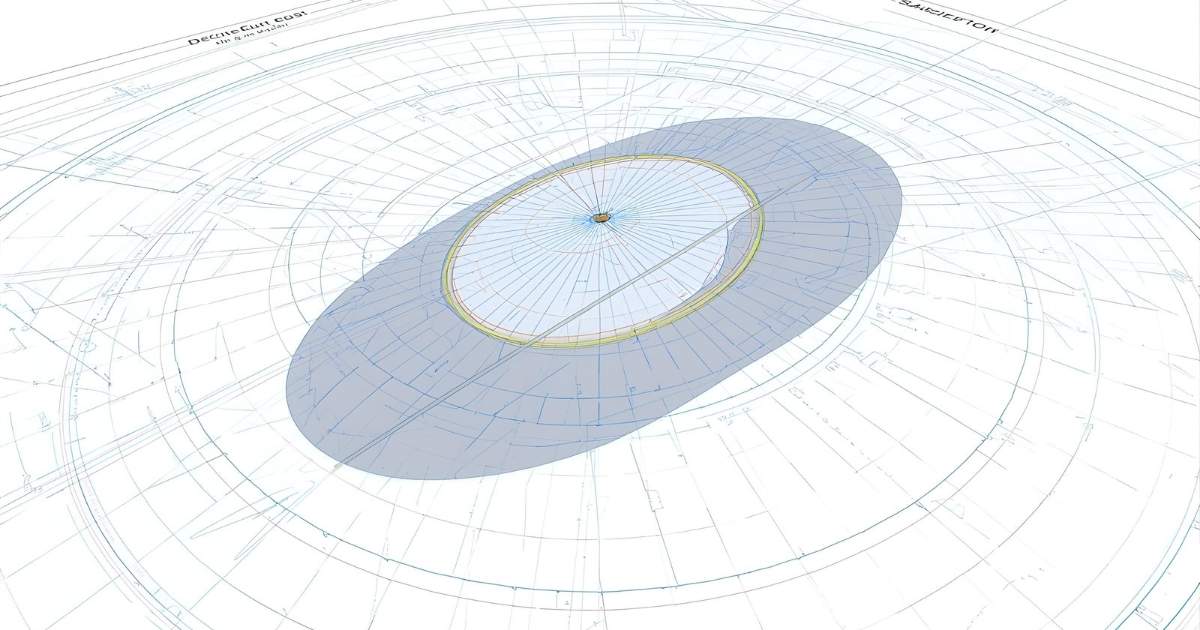
“Elipse” is a common misspelling of ellipse, a term that carries significant weight in various fields, from mathematics and science to technology and design. The ellipse is fundamental to numerous disciplines. This article provides a thorough examination of the ellipse, exploring its definition, mathematical properties, historical significance and practical applications across different domains.
Understanding the Ellipse
An ellipse is a geometric shape that resembles a stretched circle. It is defined as the set of all points in a plane where the sum of the distances from two fixed points (known as foci) is constant. The ellipse is one of the conic sections, which are curves obtained by intersecting a cone with a plane.
Mathematical Definition
Mathematically, an ellipse can be defined by the equation:
(x − h)²/a² + (y − k)²/b² = 1
where (h, k) represents the centre of the ellipse, a is the semi-major axis, and b is the semi-minor axis. The major axis is the longest diameter of the ellipse, while the minor axis is the shortest diameter.
Geometric Properties
Foci: the two fixed points within an ellipse are called the foci. The distance between the foci is denoted as 2c, where c is the focal distance.
Eccentricity: the eccentricity e of an ellipse measures how much it deviates from being circular. It is defined as e = c/a, where 0 ≤ e < 1. A circle is a special case of an ellipse where e = 0.
Axes: the major axis is the longest line segment that passes through the centre and both foci. The minor axis is perpendicular to the major axis at the centre and is the shortest line segment passing through the centre.
Historical Significance of the Ellipse
The study of ellipses dates back to ancient civilisations and has played a crucial role in the development of mathematics and science.
Ancient Greek contributions: the concept of the ellipse was first studied by the ancient Greeks. Mathematicians such as Apollonius of Perga (circa 262–190 BCE) made significant contributions to the understanding of conic sections. His work, “Conics”, explored the properties of these curves and laid the foundation for future mathematical research.
Renaissance and early modern era: during the Renaissance, the study of ellipses was advanced by mathematicians such as Johannes Kepler. Kepler’s laws of planetary motion, formulated in the early 17th century, demonstrated that planets move in elliptical orbits around the sun — a groundbreaking discovery that changed our understanding of the cosmos.
Modern mathematics: in the 19th and 20th centuries, the study of ellipses evolved with calculus and analytical geometry. Mathematicians like Carl Friedrich Gauss and Leonhard Euler deepened the theoretical understanding of ellipses, leading to new applications in science and engineering.
Applications in Science and Engineering
Ellipses have numerous practical applications across different scientific and engineering disciplines, thanks to their unique geometric properties.
Astronomy
Planetary orbits: Kepler’s first law of planetary motion states that planets orbit the sun in elliptical paths. This discovery was instrumental in understanding celestial dynamics and paved the way for modern astrophysics.
Satellite orbits: satellites around Earth follow elliptical paths. Understanding these orbits is crucial for satellite positioning, communication and navigation systems.
Physics
Optics: in optics, ellipses play a significant role in the design of lenses and optical systems. Elliptical mirrors and lenses are used in telescopes and microscopes to focus light and enhance image quality.
Acoustics: elliptical shapes are used in the design of acoustic chambers and soundproofing materials, where the shape of a room affects the distribution and reflection of sound waves.
Engineering
Structural design: in civil engineering, ellipses are used in the design of arches, bridges and other structures. The elliptical shape can provide structural stability and distribute loads more evenly.
Mechanical engineering: elliptical gears and cams are used in mechanical systems to achieve specific motion profiles and improve efficiency.
Computer Graphics and Animation
Modelling and rendering: in computer graphics, ellipses are used to model and render shapes and objects. Representing curves and smooth transitions is essential for realistic visual effects.
Animation: elliptical motion is often used in animation to create natural, smooth movement — for example, the orbit of celestial objects or the path of a swinging pendulum.
Design and Art
The aesthetic appeal of ellipses extends beyond their mathematical and scientific significance. In art and design, ellipses create visually pleasing compositions and specific artistic effects.
Graphic Design
Logo design: elliptical shapes are often used in logos to create a sense of balance and harmony. The smooth curves of an ellipse can convey elegance and professionalism.
Typography: in typography, elliptical forms influence the design of fonts and typefaces, shaping letters and characters to achieve specific visual styles.
Architecture
Building design: elliptical shapes are used to create visually striking structures and spaces, including elliptical domes, arches and floor plans.
Interior design: elliptical patterns appear in furniture, flooring and decorative elements to enhance the overall design of a space.
Mathematical and Computational Challenges
Working with ellipses presents certain challenges. Solving the equation of an ellipse can be complex, especially with transformations or intersecting ellipses, often requiring advanced algebraic techniques and numerical methods. In computational applications, algorithms approximate and analyse elliptical shapes using techniques such as curve fitting and numerical integration. Understanding affine transformations — scaling, rotation and translation — is essential for applications in graphics and visualisation.
Future Trends and Research
The study of ellipses continues to evolve. Machine learning algorithms may improve the analysis and modelling of elliptical shapes in applications such as image recognition, while high-performance computing enables more precise simulations. Elliptical orbits will remain crucial for space exploration and satellite missions, and researchers may draw on biomimicry — how elliptical forms appear in nature — to design innovative materials and structures.
Conclusion
The ellipse is a fundamental geometric shape with wide-ranging applications across science, engineering, art and design. Its mathematical properties, historical contributions and practical uses highlight its importance in understanding and shaping the world around us. Whether in celestial mechanics, structural engineering or artistic expression, the ellipse stands as a testament to the intersection of mathematics and real-world applications, embodying both elegance and utility.
Frequently Asked Questions (FAQs)
What is an ellipse?
An ellipse is a geometric shape resembling a stretched circle, defined as the set of all points in a plane where the sum of the distances from two fixed points (the foci) is constant.
What is the standard equation of an ellipse?
The standard equation is (x − h)²/a² + (y − k)²/b² = 1, where (h, k) is the centre, a is the semi-major axis and b is the semi-minor axis.
What is eccentricity?
Eccentricity (e = c/a) measures how much an ellipse deviates from a circle, ranging from 0 to just under 1. A circle is a special case where e = 0.
How are ellipses used in astronomy?
Kepler’s first law states that planets orbit the sun in elliptical paths, and satellites around Earth follow elliptical orbits essential for positioning, communication and navigation.
What is the difference between an ellipse and a circle?
A circle is a special case of an ellipse with zero eccentricity. An ellipse has two foci and distinct major and minor axes, while a circle has a single centre and constant radius.
Also Read: Bridging Mathematics and Technology