
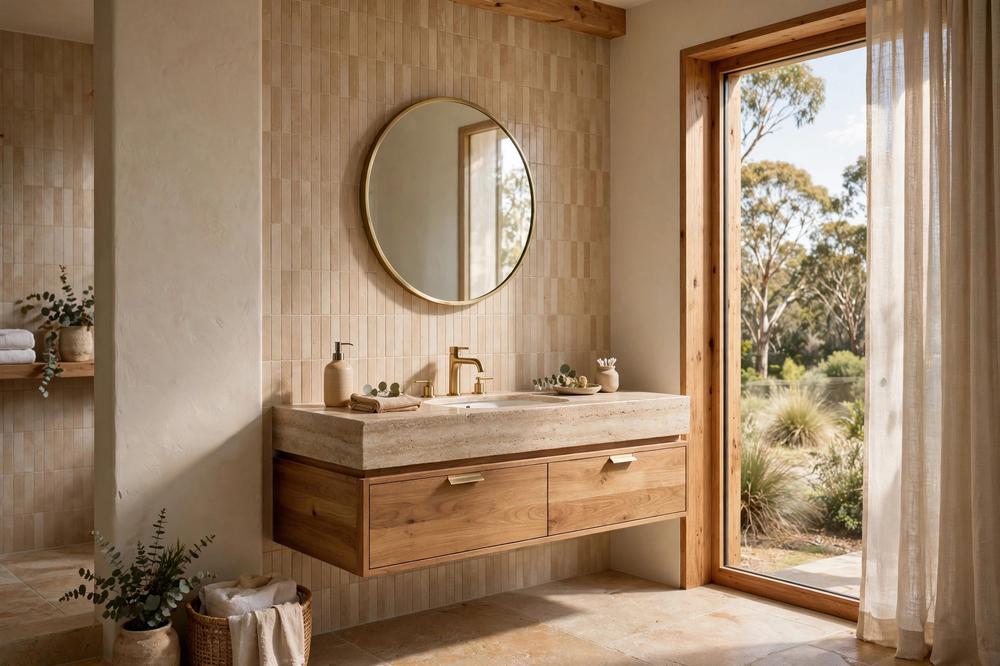
The vanity sets the tone for the whole bathroom. If you’re hunting for bathroom vanity ideas Australia homeowners are actually choosing in 2026, this guide walks you through ten proven looks — from floating timber designs to statement stone tops — with honest Australian pricing and practical tips.
Australian bathrooms have moved well past the plain white cabinet. Warm neutrals, tactile timber, fluted detailing and furniture-like joinery are defining 2026 design, with vanities increasingly reading like bespoke furniture rather than standard joinery. Whether you’re planning a full renovation or a simple swap, these ideas will help you choose a vanity that looks great, stores what you need and stands up to Australian humidity.
How to choose the right vanity before you fall in love with a look
Before picking a style, get the practical basics right:
- Measure twice. Note the width of your wall, the position of existing plumbing and the door swing. A standard single vanity is 600–900mm wide; doubles typically run 1200–1800mm.
- Check your plumbing. Keeping the waste and taps in the same position saves serious money. Moving plumbing can add several hundred dollars to the job.
- Think about storage. Deep drawers suit bottles and towels better than cupboard doors. Open shelves look lovely in photos but gather dust in real life.
- Mind the moisture. Bathrooms are wet zones, and waterproofing rules in Australia are strict. Any renovation work should meet the National Construction Code requirements published by the Australian Building Codes Board — your builder or cabinet maker will know the drill.
If you’re unsure which style direction suits your home, take our interior design style quiz — it takes a couple of minutes and helps you commit to a look before you spend.
10 bathroom vanity ideas Australia is loving in 2026
1. Floating wall-hung vanities with LED underlighting
Still the most requested look in Australia, the floating vanity lifts the cabinet off the floor, making even small bathrooms feel larger and easier to clean. In 2026 the look has matured: thicker profiles, wall-to-wall spans and clean shadow-line details give it a more architectural feel than the thin floating boxes of a decade ago.
Add a strip of warm LED lighting under the cabinet for a soft night-time glow — it doubles as a practical night light and gives the bathroom a relaxed, spa-like feel. Pair with large-format floor tiles to maximise the sense of space.
Best for: small bathrooms, ensuites and anyone who hates mopping around cabinetry legs.
Materials: moisture-resistant MDF or plywood with 2-pack polyurethane, or solid timber.
Colours: warm white, oak, soft grey.
Approximate budget: $800–$2,500 for the unit; installed $1,800–$3,200 mid-range.
2. Fluted and ribbed timber fronts
Fluted (ribbed) drawer fronts are one of the strongest vanity trends of 2026. The vertical texture adds depth and a crafted feel without visual clutter, and it works across styles — coastal, contemporary and everything in between.
Timbers with a smooth, consistent grain take fluting best. Look for Tasmanian oak, blackbutt or spotted gum in lighter stains that show off the ripple of the profile. Keep the benchtop simple so the texture stays the hero.
Best for: adding character to plain bathrooms; main bathrooms that need a focal point.
Materials: solid or veneered Australian hardwood.
Colours: natural oak, honey, warm walnut.
Approximate budget: $1,500–$3,500 for a custom or semi-custom unit.
3. Natural timber vanities with visible grain
Solid timber vanities bring warmth that flat laminates can’t match, and Australian species like Tasmanian oak and Victorian ash are popular for their light, consistent colouring. A simple slab-front timber vanity with a matte finish suits the warm-neutral palettes dominating 2026.
Be realistic about maintenance: timber needs a good sealant and benefits from resealing every few years in a steamy bathroom. If that’s too much upkeep, a quality timber-look laminate or veneer gives you 90% of the look with far less care.
Best for: warm contemporary and coastal bathrooms.
Materials: Tasmanian oak, blackbutt, or quality timber-look laminate.
Colours: natural, light honey, pale grey-wash.
Approximate budget: $1,000–$3,000 depending on timber species and customisation.
4. Statement stone benchtops
The benchtop is moving from background surface to design feature. Veined marble-look porcelain, bold quartz patterns and warm terrazzo are all being chosen as vanity tops in 2026, letting the vanity carry the bathroom’s personality.
If budget is tight, a 20mm engineered stone top in a dramatic pattern gives the statement look for a fraction of natural stone. Thicker 40mm mitred tops read more premium and suit larger double vanities.
Best for: main bathrooms and ensuites where the vanity is the hero.
Materials: engineered quartz, terrazzo, marble-look porcelain, natural marble.
Colours: Calacatta-look white, warm travertine tones, deep charcoal.
Approximate budget: $400–$1,200 extra for a stone top over a standard laminate.
5. Integrated basin and benchtop in one piece
Integrated vanities merge the basin and benchtop into a single seamless piece — usually solid surface, porcelain or terrazzo. With no joins or edges, there’s nowhere for grime to hide, and cleaning takes seconds.
This look suits minimalists and small bathrooms especially well, where the clutter-free surface makes the room feel calm and larger. Choose soft rounded basin shapes for a 2026 feel rather than sharp rectangular troughs.
Best for: small bathrooms, powder rooms, minimalist designs.
Materials: solid surface (Corian-style), cast porcelain, terrazzo.
Colours: white, warm white, soft grey.
Approximate budget: $1,200–$3,000 for the unit.
6. Double vanities for master ensuites
If you share a bathroom, a double vanity is one of the most genuinely life-improving upgrades you can make. Two basins, two mirrors and two sets of storage end the morning queue — and symmetry looks effortlessly calm.
You don’t need a huge bathroom: 1200mm is the practical minimum for two people (600mm each). Floating double vanities keep the floor clear, and a shared LED-lit mirror above ties the pair together.
Best for: master ensuites and family bathrooms.
Materials: timber or 2-pack with stone top; wall-hung or floor-standing.
Colours: oak with white top, matte black with terrazzo, navy with brass tapware.
Approximate budget: $2,000–$5,000+ including extra plumbing for the second basin.
7. Soft curved vanities
Curves are softening Australian bathrooms in 2026 — gently rounded vanity fronts, curved basin edges and arched mirrors. Curves feel welcoming and help tight bathrooms flow better, with no sharp corners to catch hips in narrow ensuites.
Curved fronts cost more to make than flat ones, so this is a look worth investing in for a bathroom you’ll keep for a decade. Pair with round mirrors and soft arch detailing in tiling or niches for a cohesive feel.
Best for: modern Australian and soft-minimalist bathrooms.
Materials: curved plywood or veneered MDF fronts, solid surface tops.
Colours: warm white, mushroom, pale sage, light oak.
Approximate budget: $2,000–$4,500 for a semi-custom curved unit.
8. Hamptons and shaker-style vanities for coastal homes
The Hamptons look remains strong in Australia’s coastal suburbs and new estates. Recessed shaker-style panel fronts, a light timber or painted finish and a marble-look top with chrome or brushed-nickel tapware deliver the classic beach-house feel.
Keep the palette pale — whites, soft blues, pale oak — and let the panel detailing provide the interest. This style pairs beautifully with handmade-look subway tiles and plantation shutters.
Best for: coastal homes, classic renovations, Hamptons-style new builds.
Materials: painted MDF shaker fronts, light timber, engineered stone top.
Colours: chalk white, pale blue-grey, light oak.
Approximate budget: $1,200–$3,000 for the unit.
9. Dark and moody vanities with brass tapware
For contrast-lovers: deep navy, forest green or near-black vanities paired with brushed brass or champagne tapware. The dark cabinet grounds the room while metallic tapware adds warmth — a hotel-inspired combination that photographs beautifully.
Balance is key. Dark vanities work best in bathrooms with good natural light or generous artificial lighting; in a windowless bathroom they can feel heavy. Keep walls and floors light to let the vanity be the drama.
Best for: powder rooms, ensuites and anyone wanting a dramatic focal point.
Materials: 2-pack polyurethane in satin or matte, walnut timber.
Colours: navy, forest green, charcoal, black.
Approximate budget: $1,500–$3,500 for the unit.
10. Compact corner and narrow vanities for tight spaces
Powder rooms and tiny ensuites need vanities that work hard in 500–750mm of width. Wall-hung compact units, corner vanities and slim 460mm-deep cabinets make the most of awkward footprints without blocking movement.
Choose light colours and a mirror that spans the full wall above to bounce light around. Integrated towel rails on the side of the vanity save precious wall space elsewhere.
Best for: powder rooms, small ensuites, apartments.
Materials: 2-pack polyurethane, PVC or laminate.
Colours: white, light grey, pale oak.
Approximate budget: $500–$1,500 for the unit; basic replacement installed from around $800.
How much does a new vanity cost in Australia?
Industry estimates for 2026 put a basic like-for-like vanity replacement at roughly $800–$1,800 installed, a mid-range timber or stone-top unit at $1,800–$3,200, and premium custom or designer vanities at $3,200–$4,500+. These figures cover the unit, installation and standard plumbing reconnection — moving plumbing, electrical work or wall repairs add extra.
| Vanity type | Unit cost (approx.) | Installed total (approx.) |
| Basic PVC/laminate | $380–$680 | $800–$1,800 |
| Timber or stone top | $800–$1,500 | $1,800–$3,200 |
| Custom / designer | $1,500–$3,000+ | $3,200–$4,500+ |
Labour typically runs $80–$150 per hour depending on the trade, and Sydney and Melbourne tend to sit above Adelaide and regional rates. For a full bathroom budget picture, see our renovation costs Australia 2026 guide, and use our renovation tools to plan the numbers.
Practical tips before you buy
- Check the warranty, especially on timber and stone. Australian humidity is unforgiving of poor sealing.
- Keep tapware finishes consistent across basin, shower and bath for a considered look — brushed brass, gunmetal and matte black are all strong in 2026.
- Don’t forget the mirror. A backlit round or pill-shaped mirror completes a 2026 vanity beautifully and adds practical light for grooming.
- Plan storage around your routine, not the showroom display. Count what you actually keep in the bathroom and choose drawer depths to match.
Frequently asked questions
How much does it cost to replace a bathroom vanity in Australia?
A basic like-for-like replacement typically costs $800–$1,800 installed. Mid-range timber or stone-top vanities run $1,800–$3,200 installed, while custom or designer pieces cost $3,200–$4,500 or more. Moving plumbing or adding electrical work (like LED lighting) increases the total.
What size vanity should I choose?
For a single basin, 600–900mm wide suits most bathrooms. Powder rooms can work with 500–600mm compact units, while shared bathrooms need 1200mm minimum for a comfortable double vanity. Always measure your wall, check door swings and confirm the plumbing position before ordering.
Is timber or PVC better for a bathroom vanity?
PVC and laminates handle moisture with the least maintenance and cost the least — ideal for rentals and tight budgets. Solid timber looks warmer and more premium but needs proper sealing and occasional resealing in steamy bathrooms. Timber-look laminates and veneers offer a good middle ground.
Floating or floor-standing vanity — which is better?
Floating vanities make small bathrooms feel larger and are easier to clean around, but they cost more to install because the wall needs proper reinforcement. Floor-standing units are the most budget-friendly and suit existing plumbing without modification. Both look current in 2026 — choose based on your bathroom size and budget.
Where do Australians buy quality vanities?
Specialist bathroom retailers, cabinet makers and online Australian bathroom stores all offer good ranges. For a standard size, off-the-shelf units from established retailers are fine; for unusual dimensions or premium finishes, a local cabinet maker can build to your exact space. Always compare warranties and check that materials suit Australian bathroom humidity.