
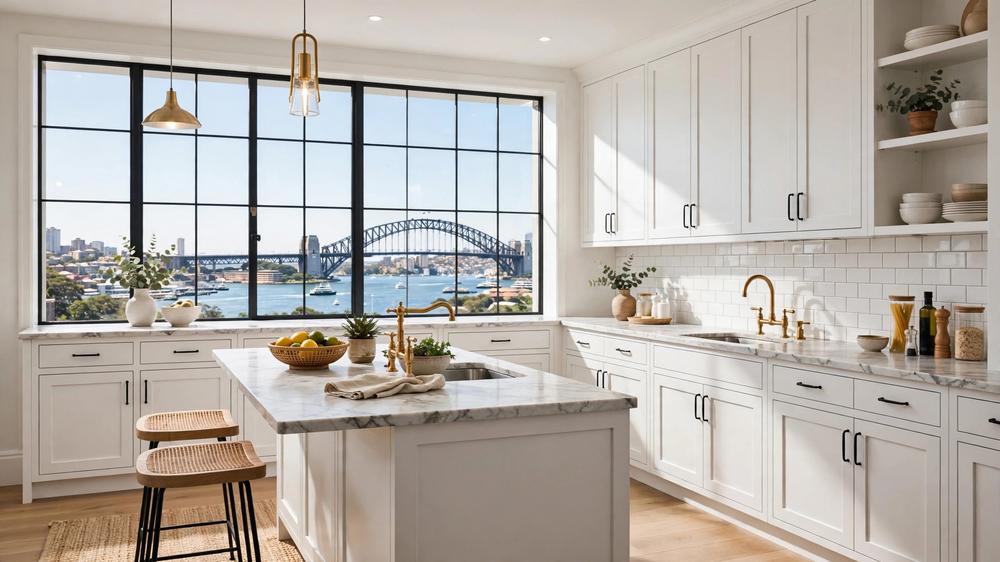
If you’re trying to pin down the kitchen renovation cost in Sydney, you’ve probably discovered that the numbers thrown around online are all over the place. One source says $15,000, another says $100,000, and neither tells you what’s actually included. The truth is that Sydney kitchens span an enormous price range — industry estimates put a basic cosmetic refresh between $10,000 and $22,000, a mid-range renovation at $30,000 to $54,000, and a premium project anywhere from $50,000 to over $100,000. The typical overall range sits around $13,800 to $51,750, up about 4.3% on last year.
Sydney is consistently one of the most expensive cities in Australia to renovate, driven by higher tradie rates, strata complications in apartments, and the sheer cost of labour across the Harbour City. This guide breaks down exactly where the money goes in a Sydney kitchen renovation in 2026, what each tier buys you, the hidden costs that catch people out, and practical ways to keep your budget under control without ending up with a kitchen you resent.
How much does a kitchen renovation cost in Sydney?
The honest answer depends on three things: the size of your kitchen, the scope of work, and the quality of finishes you choose. A small galley kitchen in an Inner West apartment with flat-pack cabinetry is a completely different project to a designer kitchen in a North Shore home with stone benchtops and custom joinery.
Industry estimates for 2026 put Sydney costs at roughly $2,500 to $4,500 per square metre. That means a compact 8 m² kitchen might run $20,000 to $36,000, while a generous 15 m² space could land between $37,500 and $67,500 — before you add designer fees, appliances, or any structural work.
Kitchen renovation cost Sydney: the three price tiers
Tier 1: Cosmetic refresh ($10,000–$22,000)
This is the facelift option. You’re keeping the existing layout, plumbing and electrical points exactly where they are, and refreshing what you see rather than what you don’t.
What you typically get:
- Cabinetry resurfaced or repainted rather than replaced
- New handles, hinges and soft-close hardware
- New laminate or budget benchtop over existing carcass
- Splashback tiles replaced or tiled over
- New sink and tapware in existing cut-outs
- Fresh paint on walls and ceiling
- Basic lighting upgrades using existing wiring points
This tier suits landlords freshening a rental, or homeowners planning a bigger renovation in a few years who just need something clean and functional now. You won’t change how the kitchen works — but it will look dramatically better.
Tier 2: Mid-range renovation ($30,000–$54,000)
This is where most Sydney kitchen renovations land. The old kitchen comes out, a new one goes in, and the layout may shift slightly, but you’re not moving walls or relocating major plumbing.
What you typically get:
- New flat-pack or semi-custom cabinetry with soft-close everything
- Porcelain or sintered-stone benchtops (more on this below)
- New appliances, mid-range brands
- New tiles for splashback and possibly floors
- Upgraded lighting, possibly new circuits
- New sink, tapware and rangehood
- Professional installation by licensed tradies
At this level you get a kitchen that feels genuinely new and should serve you well for 15–20 years. The bulk of your spend goes into cabinetry (often 30–40% of the total) and benchtops, with labour making up a significant chunk on top.
Tier 3: Premium renovation ($50,000–$100,000+)
The sky’s the limit here. Premium Sydney kitchens involve custom joinery, designer input, structural changes and top-tier appliances — and in harbourside suburbs the spend can sail well past $100,000.
What you typically get:
- Fully custom cabinetry built to the millimetre
- Designer or architect involved from concept
- Premium appliances (think Miele, Gaggenau or similar)
- Structural work: wall removal, steel beams, new windows
- Bespoke storage solutions, walk-in pantry
- Designer tapware, lighting design, acoustic considerations
If your budget lives in this tier, the limiting factor is usually the ceiling of your suburb — it rarely makes financial sense to install a $120,000 kitchen in a $900,000 apartment. Check whether a kitchen renovation adds value in your price bracket before you commit.
Kitchen renovation cost breakdown: where the money actually goes
Understanding the typical split helps you spot when a quote is unbalanced. These are industry estimates for a mid-range Sydney project:
| Component | Share of budget | Typical Sydney range |
| Cabinetry and joinery | 30–40% | $10,000–$22,000 |
| Benchtops | 10–15% | $3,500–$8,000 |
| Appliances | 10–15% | $3,000–$8,000 |
| Electrical work | 5–10% | $2,000–$5,000 |
| Plumbing | 5–10% | $2,000–$5,000 |
| Tiles and splashback | 5–10% | $1,500–$5,000 |
| Plastering and painting | 5% | $1,500–$3,000 |
| Design and project management | 5–15% | $1,500–$10,000 |
These ranges assume a licensed, insured crew and proper certification — cash-in-hand quotes will be lower, but come with risks that aren’t worth it on a project this size.
Sydney tradie rates: the labour reality
Labour is the single biggest reason Sydney costs more than regional Australia or even Melbourne. Current industry estimates put typical Sydney rates at:
- Electrician: $110–$160 per hour
- Plumber: $120–$180 per hour
- Tiler: $60–$100 per square metre (labour only)
- Cabinet maker: $80–$120 per hour, or quoted per project
- Painter: $45–$75 per hour
- Plasterer: $50–$85 per hour
A mid-range kitchen typically needs 150–250 hours of combined tradie time. At Sydney rates, that labour component alone can run $15,000 to $30,000. This is also why changing the layout is so expensive: moving a sink 2 metres doesn’t sound like much, but it means new plumbing rough-in, new drainage, new waterproofing-adjacent work and possibly cutting into the slab.
The engineered stone ban: what it means for your benchtop
Since 1 July 2024, engineered stone (including popular brands of quartz composite benchtops) has been banned nationally in Australia due to the silicosis risk to stonemasons. This matters enormously for kitchen renovations, because engineered stone was the default mid-range benchtop for years.
The mainstream alternatives now are:
- Porcelain benchtops — thin, heat-resistant, huge range of stone looks; typically $800–$1,500 per slab installed
- Sintered stone (e.g. Dekton) — extremely hard-wearing, UV stable; typically $1,200–$2,000+ per slab installed
- Natural stone (granite, marble) — timeless but porous and maintenance-heavy; typically $1,000–$2,500 per slab
- Laminate — the budget workhorse, vastly improved in recent years; $200–$600 per linear metre
- Stainless steel and timber — niche options for specific design briefs
Get your benchtop choice locked in early, because the templating and lead times (often 3–6 weeks) sit on the critical path of the whole project. Any quote still offering engineered stone should be treated with suspicion — it’s illegal to supply and install it.
Hidden costs that blow out Sydney kitchen budgets
These are the line items that surprise homeowners. Budget for them from the start:
Asbestos removal: $2,000–$5,000
Homes built before 1990 often hide asbestos in old kitchen flooring, wall sheeting or backing boards. If your builder finds it, work stops until a licensed removalist clears it. A pre-renovation asbestos audit (a few hundred dollars) is cheap insurance.
Switchboard upgrade: $1,500–$3,000
Older Sydney homes frequently have switchboards that can’t safely handle a modern kitchen’s load — induction cooktops, ovens, dishwashers and extra power points add up. If your electrician says the board needs upgrading, it’s not optional.
Council application fees: $800–$2,500
Most straightforward kitchen renovations don’t need council approval in NSW. But if you’re removing a load-bearing wall, changing the building’s external appearance, or doing work in a heritage-listed property, you’ll need a development application or complying development certificate. Heritage overlays are common across the Inner West, Eastern Suburbs and North Shore.
Strata complications: +10–15% on the project
Renovating a kitchen in a Sydney apartment brings strata approval fees, mandatory building insurance checks, lift bookings and restricted work hours (typically 7:30am–4:30pm weekdays only). Waste removal is slower and harder without a driveway. Industry estimates suggest apartment and strata access constraints add 10–15% to the build cost compared to an equivalent freestanding home.
Structural surprises
Once the old kitchen comes out, you may find water damage, termite activity, or framing that doesn’t meet current standards. A contingency fund is non-negotiable (see below).
Design and project management fees
You can DIY-manage a cosmetic refresh, but a full renovation benefits enormously from professional oversight:
- Kitchen designer: $1,500–$5,000 for plans, elevations and material schedules. Worth every cent if it prevents one expensive mistake.
- Project management: typically 10–20% of the build cost. A good project manager coordinates trades, keeps the schedule honest and handles the inevitable surprises.
- Draftsperson/engineer: $1,000–$3,000 if you’re removing walls or altering structure.
An alternative middle path: many kitchen companies offer “design and construct” packages where the design fee is absorbed into the build contract. Just make sure you’re comparing like with like when you get quotes.
Realistic timeline: 8–14 weeks start to finish
Sydney kitchen renovations rarely happen as fast as the TV shows suggest. A realistic schedule:
1. Design and quoting (2–4 weeks): measure, design, get 3 quotes, choose your builder
2. Approvals and ordering (2–4 weeks): strata approval if needed, order cabinetry and benchtops
3. Demolition and rough-in (1–2 weeks): strip-out, electrical and plumbing rough-in, plastering
4. Fit-out (2–3 weeks): cabinetry install, benchtop templating and install, tiling
5. Finishing (1–2 weeks): painting, appliances, tapware, final electrical and plumbing fit-off
The benchtop is usually the bottleneck — templating can’t happen until cabinets are installed, and manufacture takes weeks. Delays also come from Sydney’s favourite renovation season (spring) when every good tradie is booked out.
How to save money without regretting it
Smart savings that don’t compromise the result:
- Keep the layout. Keeping plumbing and electrical points where they are is the single biggest cost saver — moving them can add $5,000–$15,000.
- Choose flat-pack or semi-custom cabinetry. The quality gap with custom joinery has narrowed enormously, at a fraction of the price.
- Time your renovation for winter. Tradies are quieter, lead times shrink, and you may negotiate better rates.
- Supply your own appliances during sales. EOFY and Black Friday sales can save 20–30% on big-ticket items — just confirm dimensions with your designer first.
- Do the demolition yourself. If you’re handy and the kitchen is asbestos-free, DIY strip-out can save $1,000–$2,000 in labour.
- Get at least three detailed quotes. Not estimates — itemised quotes you can compare line by line.
False economies to avoid:
- Unlicensed or uninsured tradies (no certificate of compliance, no warranty, no recourse)
- Skipping the contingency fund — 10% minimum, 15% for older homes
- Choosing materials purely on price with no thought to durability
- Changing your mind mid-build — variations are where budgets go to die
For a broader picture of what renovations cost across the country, check our national renovation cost database. And if you want to run the numbers yourself, our renovation cost calculators can help you build a realistic budget.
What return can you expect?
A well-executed kitchen renovation in Sydney typically returns 60–80% of its cost in added property value — one of the better returns of any renovation project. The key word is “well-executed”: overcapitalising is the real risk. As a rule of thumb, don’t spend more than 5–10% of your home’s value on the kitchen unless you’re renovating your forever home and the financial return is secondary.
You can compare these figures against independent cost data to sanity-check any quotes you receive — if a builder’s number sits far outside these ranges, ask them to explain why.
Frequently Asked Questions
How much does a kitchen renovation cost in Sydney in 2026?
Industry estimates put a cosmetic refresh at $10,000–$22,000, a mid-range renovation at $30,000–$54,000, and a premium project at $50,000–$100,000+. The typical overall range is roughly $13,800–$51,750, up about 4.3% year-on-year. Cost per square metre usually falls between $2,500 and $4,500 depending on finishes and scope.
How long does a Sydney kitchen renovation take?
Expect 8–14 weeks from design to completion. That includes 2–4 weeks for design and quoting, 2–4 weeks for approvals and ordering, and 4–6 weeks of on-site work. Benchtop templating and manufacture is the most common bottleneck, and spring bookings can push timelines out further.
Is engineered stone still available for kitchen benchtops?
No. Engineered stone has been banned nationally since 1 July 2024 due to silicosis risks for stonemasons. The mainstream alternatives are porcelain and sintered stone (such as Dekton), alongside natural stone, laminate, stainless steel and timber. Any quote still offering engineered stone should be treated with suspicion.
Do I need council approval for a kitchen renovation in Sydney?
Most like-for-like kitchen renovations don’t need council approval in NSW. You’ll likely need approval if you’re removing a load-bearing wall, altering the building’s external appearance, or working in a heritage-listed property. Council application fees typically run $800–$2,500. Apartment owners also need strata approval, which is a separate process.
What’s the biggest mistake people make with kitchen renovation budgets?
Skipping the contingency fund. Once the old kitchen comes out, hidden problems — water damage, asbestos, outdated wiring, non-compliant framing — are common in Sydney’s older housing stock. Keep a 10% contingency for newer homes and 15% for pre-1990 properties, and resist the temptation to spend it on upgrades before the build is finished.
Costs are only half the equation — the right designer makes the budget work harder. Find experienced Sydney interior designers who know local suppliers, trades and council requirements.