
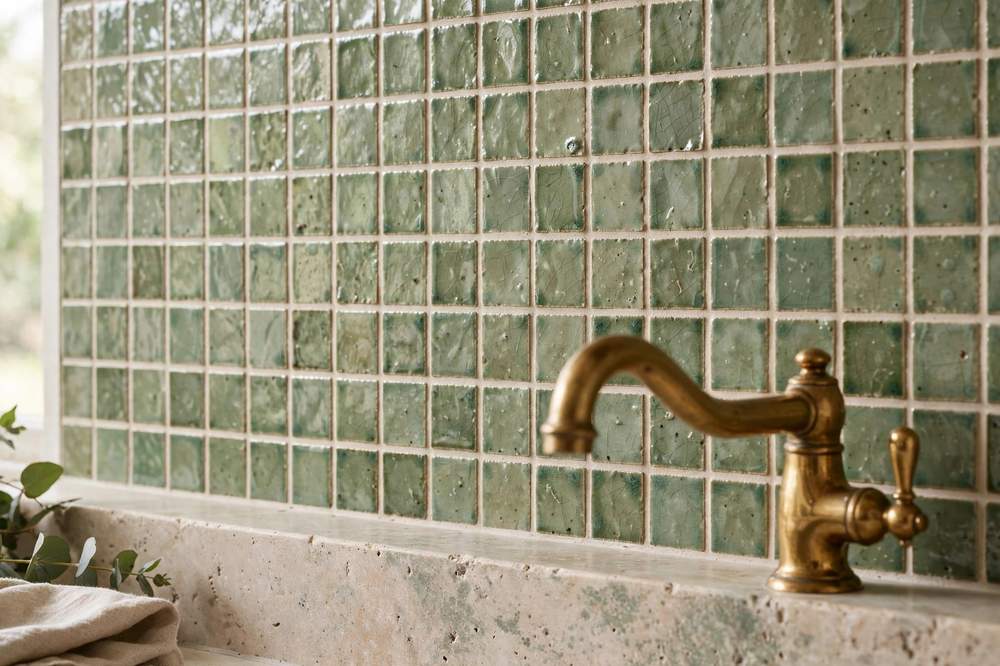
The kitchen splashback trends 2027 Australia is seeing are less about one single “it” look and more about warmth, texture and calm. After years of flat white subway tiles and high-gloss glass, Australian homeowners are choosing splashbacks with handmade character, earthy colour and materials that flow into the rest of the kitchen. The Dulux 2026 Colour Forecast set the tone with warm neutrals, sage, terracotta and dusty blue, and renovators planning for 2027 are carrying those ideas through to their splashback choices.
Whether you are doing a full renovation or just refreshing the look, these nine trends show what is actually being installed in Australian homes right now, what each option tends to cost, and how to get it right.
1. Handmade-look zellige tiles
Zellige — the small square Moroccan-style tiles with slightly uneven, hand-glazed surfaces — has become one of the most requested splashback finishes in Australia. The beauty is in the imperfection: each tile catches light a little differently, so a warm white or cream zellige wall has movement that a flat ceramic tile never will.
Best colours: Warm white, cream, mushroom, soft sage and pale clay — tones that sit beautifully with timber cabinetry and stone benchtops.
Budget: Typically around $60–$120 per square metre for the tiles, plus $60–$90 per square metre for a tiler’s labour — the small format and layout care push labour a little higher than standard subway tile.
Tip: Order 15–20% extra. Handmade-look tiles vary between batches, and you will want spares for future repairs.
2. Benchtop material run up the wall
One of the strongest kitchen splashback trends heading into 2027 is doing away with a separate splashback material altogether. Instead, the benchtop stone — engineered quartz, porcelain slab or natural marble-look stone — continues straight up the wall, sometimes all the way to the rangehood or ceiling. The result is seamless and calm, especially in open-plan kitchens where the kitchen is always on show.
Materials: Marble-look engineered stone, full-vein porcelain slabs, and sintered stone. Porcelain slabs are gaining ground because they are heat-resistant, non-porous and lighter than natural stone.
Budget: Slab splashbacks are premium. Expect roughly $300–$600+ per square metre supplied and installed, with the stone itself often the biggest line item. A full-height slab behind the cooktop alone can add several thousand dollars to a kitchen budget — so get a fixed quote before committing.
Where it suits: Minimalist and architectural kitchens, and homes where the island bench is already stone and you want one continuous visual line.
If the full-slab price makes you wince, read up on what a full kitchen costs first — our breakdown of renovation costs in Australia for 2026 covers where the money goes.
3. Warm neutrals replacing cool white
Cool white and cool grey splashbacks are the fastest-fading trend in Australian kitchens. Under our intense natural light — particularly in north-facing kitchens in Sydney, Brisbane and Perth — stark white reads harsh and clinical. The shift is toward warm whites, mushroom, greige, linen tones and soft clay.
Why it works: Warm neutrals bridge the indoor-outdoor connection that Australian kitchens are famous for. They hold their appeal under bright daylight and sit comfortably with oak, blackbutt and spotted gum timber cabinetry.
Budget: A warm neutral subway or square tile is no more expensive than its cool white equivalent — typically $15–$80 per square metre for ceramic tiles. This is one of the cheapest ways to make a kitchen feel current.
Colour starting points: Dulux favourites like Hog Bristle, Blended Cream and Natural White are the exact kind of warm base tones painters reach for in 2026 kitchens, and a splashback in the same family ties everything together.
4. Muted colour splashbacks
Neutral kitchens still dominate, but the splashback is where Australians are now comfortable adding colour — in a refined, earthy way rather than bright and loud. The colours designers keep specifying are olive green, deep charcoal, dusty blue, smoky grey and terracotta.
How to choose: Pick one colour for the splashback and keep the cabinetry neutral. A dusty blue glass splashback behind the cooktop with white or oak cabinetry gives a feature without a full redesign.
Budget: Coloured toughened glass splashbacks typically run $250–$450 per square metre installed in Australia. Coloured ceramic or porcelain tiles sit in the $40–$120 per square metre range for supply.
Caution: Bold colour dates faster than neutrals. If you are renovating to sell within a few years, lean toward the muted end — olive, sage and dusty blue — rather than anything primary.
Not sure which direction suits your home? The interior design style quiz helps you pin down your style before you commit to colour.
5. Vertical-stacked subway and finger tiles
Lay the familiar subway tile vertically instead of horizontally and the whole kitchen feels different — taller, more modern, and subtly architectural. The slim “kit kat” or finger tile (long, narrow mosaic strips, often stacked vertically) is the standout version of this trend and shows no sign of slowing into 2027.
Formats to look for: Vertical-stack subway (100 x 200 mm tiles set in columns), finger tiles on mesh sheets (usually 15 x 150 mm strips), and slim stacked brick in handmade-look finishes.
Best colours: Linen, warm white, sage, eucalyptus green and soft charcoal. Tonal grout — grout matched close to the tile colour — keeps the look seamless and calm rather than busy.
Budget: Finger and kit kat tiles generally cost $60–$140 per square metre supply, with labour at the higher end of the tiling range ($70–$100 per square metre) because of the fiddly format.
Small kitchens: This is one of the best splashback choices for compact kitchens and apartments, because the vertical lines draw the eye up and make the ceiling feel higher.
6. Large-format stone-look porcelain
At the opposite end of the spectrum from handmade tiles, large-format porcelain panels that mimic marble, travertine or limestone are bringing a quiet luxury to 2027 kitchens. With minimal grout lines, a single 1200 x 2400 mm panel can cover an entire splashback run in one or two pieces.
Why renovators like it: The drama of book-matched marble veining without the sealing, staining and maintenance of real marble. Porcelain is non-porous and heat-tolerant behind gas cooktops.
Finishes: Honed or matte finishes are outpacing polished — they hide fingerprints and suit the warm, calm palettes dominating right now.
Budget: Around $40–$120 per square metre supply for the panels, plus skilled installation. Full-height large-format panels need an experienced tiler and a perfectly flat wall, so labour is the variable to watch.
7. Toughened glass in warm tones
Glass splashbacks are not going anywhere — they are just changing colour. The white gloss or mirror-finish glass of the 2010s has given way to back-painted glass in warm mushroom, soft sage, dusty blue and deep bronze. The seamless, grout-free surface still appeals to cooks who hate scrubbing grout, but the colour temperature has shifted entirely.
Practical benefits: No grout lines to stain, one wipe-down with a damp cloth, and the reflective surface bounces light around — useful in galley kitchens and apartments with limited natural light.
Budget: Toughened glass is a specialist install — expect $250–$450 per square metre installed, with cutouts for power points adding to the cost. It cannot be trimmed on site, so measurements must be exact before manufacture.
Behind gas cooktops: Toughened glass is heat-rated and safe behind gas cooktops under Australian standards, but always confirm the specific product’s rating with your supplier before ordering.
8. Textured and tactile tiles
The broader move away from flat, cold surfaces has made texture itself a trend. Dimensional tiles that play with light and shadow — fluted profiles, soft 3D reliefs, handmade uneven glazes — are being used as a quiet focal point behind the cooktop or sink.
Styles working in Australia: Soft zellige-style squares, slim fluted finger tiles, and subtly ridged subway tiles in a single warm colour. The effect is strongest when the tile colour is restrained and the texture does the talking.
Budget: Textured and handmade-look tiles generally start around $70 per square metre and can exceed $150 per square metre for imported ranges. Labour is typically at the top end of tiling rates because alignment matters more with textured profiles.
Design rule: One textured zone is enough. A fluted splashback behind the cooktop plus flat tiles elsewhere keeps the kitchen calm.
9. Full-height splashbacks
Instead of the standard 600 mm strip between benchtop and overhead cupboards, more Australian renovators are running the splashback all the way to the ceiling — or doing away with overhead cupboards on that wall entirely and letting the splashback be the feature.
When it works: Behind a statement rangehood, in kitchens without overhead cabinetry, or in open-plan spaces where the splashback wall is visible from the living area. It makes the kitchen feel custom and architectural for a relatively modest extra material cost.
Materials that suit: Any of the trends above work full-height, but slab materials and large-format porcelain look particularly good because there are fewer joins.
Budget impact: Doubling the splashback height roughly doubles material and labour cost for that wall — but you often save the cost of overhead cupboards on the same wall, which partly offsets it.
Before you lock in materials, run the numbers — the renovation tools include calculators that help you budget a kitchen project before you start getting quotes.
How to choose: a quick decision guide
- Small kitchen or apartment: Vertical finger tiles, reflective warm-toned glass, or light stone-look porcelain to bounce light around.
- Open-plan living: Slab or full-height splashbacks in a calm material so the kitchen reads as part of the living space.
- Heritage or cottage home: Handmade-look tiles in warm white, cream or sage; pressed metal can suit Federation and Victorian kitchens.
- Rental or tight budget: Quality ceramic subway tiles in a warm neutral, laid vertically for a current feel — the cheapest genuine refresh.
- Cooks who hate cleaning: Toughened glass, porcelain slabs, or large-format porcelain with minimal grout.
Always take samples home and look at them in your kitchen’s actual light, morning and evening. Showroom lighting flatters everything; your north-facing window at 4 pm in summer tells the truth. For any splashback behind a gas cooktop, confirm the material is heat-rated — the Dulux 2026 Colour Forecast is a good starting point for colour direction, but your tile supplier or glazier should confirm the technical specs.
FAQs
What is the most popular kitchen splashback in Australia for 2027?
Handmade-look tiles (zellige and finger tiles) in warm neutrals, benchtop stone continued up the wall, and large-format stone-look porcelain are the three most requested styles for 2027. Warm whites, mushroom, sage and terracotta have largely replaced cool white and grey.
How much does a kitchen splashback cost in Australia?
As a rough guide: ceramic tiles $15–$80 per square metre supply; toughened glass $250–$450 per square metre installed; stone and porcelain slab splashbacks $300–$600+ per square metre installed. Labour typically adds $60–$100 per square metre for tiling, depending on the pattern and format. Always get at least two quotes.
Are white splashbacks out of style?
Stark cool-white splashbacks are fading, but warm whites are very much in. A warm white, cream or linen splashback with a handmade texture looks current and works with almost any cabinetry. What looks dated is flat, bright-white gloss with no variation.
What splashback is best behind a gas cooktop?
Heat-rated materials only: toughened glass, ceramic or porcelain tiles, stainless steel, and stone or porcelain slabs are all safe. Acrylic and laminate splashbacks need a non-combustible backing behind gas. Confirm the specific product’s heat rating with your supplier.
Can I install a splashback myself?
Ceramic subway tiling is achievable for a confident DIYer, and glue-on acrylic or laminate panels are designed for DIY. Glass, large-format porcelain and slab splashbacks need professional installation — glass cannot be cut on site, and heavy slabs need specialist handling.