
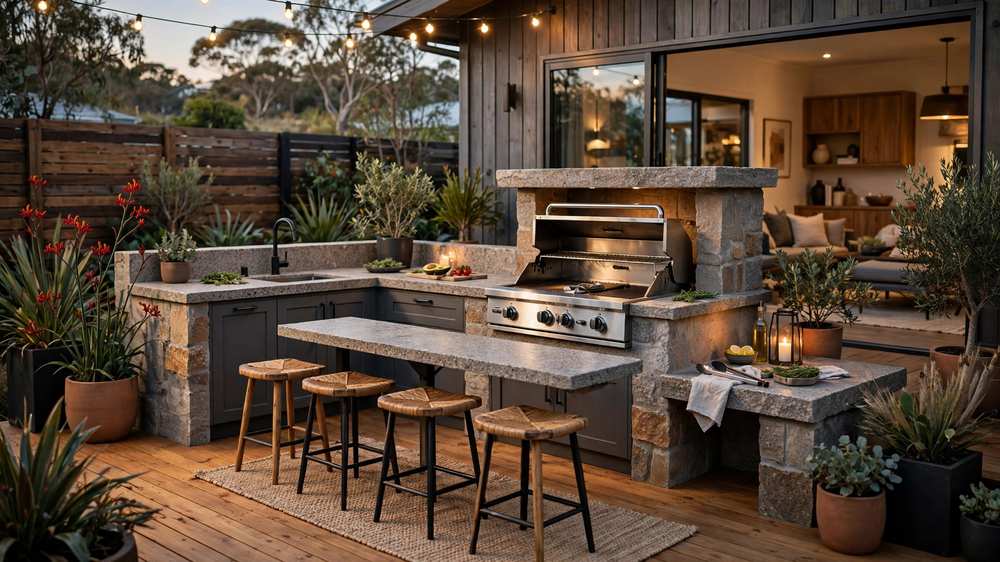
There’s nothing quite like cooking dinner outside while the sun sets and the smell of a proper barbecue drifts across the backyard. That’s why so many Australian homeowners are asking the same question in 2026: what does outdoor kitchen cost Australia really look like? The honest answer is that it varies enormously — a simple built-in barbecue setup might set you back five grand, while a fully fitted alfresco kitchen with plumbing, refrigeration and a roof over it can pass $50,000.
This guide breaks down the real numbers, the materials that survive Australian weather, and the extras that blow budgets out. Every figure below is a range drawn from current Australian suppliers and builders — because there is no single price tag.
Outdoor Kitchen Cost Australia: 2026 Summary
Here’s the quick picture of what Australians are paying right now:
| Setup level | Typical cost range | What you get |
| Basic BBQ setup | $2,500 – $10,000 | Built-in barbecue, simple benchtop, basic weatherproof cabinetry or a prefabricated unit |
| Mid-range alfresco kitchen | $10,000 – $25,000 | Built-in barbecue, sink with plumbing, bar fridge, weather-resistant cabinetry, quality benchtops |
| Full luxury outdoor kitchen | $25,000 – $50,000+ | Stone benchtops, premium appliances, pizza oven, integrated lighting, custom joinery, roofing |
At the very bottom end, a DIY setup with flat-pack modules and a portable barbecue can be done for under $2,000, though that’s a bench and a barbie rather than a kitchen. At the top end, architectural outdoor rooms with enclosed alfresco roofing and heating run well past $50,000.
Detailed Cost Breakdown
Weatherproof cabinetry
Cabinetry is usually the biggest single cost after appliances, and material choice matters more here than anywhere else. Standard indoor materials like MDF and particleboard are hopeless outside — they swell and fall apart within a season or two of Australian rain and humidity.
As a rough guide: flat-pack PVC or composite modular units run about $800 to $1,200 per linear metre; compact laminate joinery (solid waterproof phenolic resin sheets) sits around $1,200 to $1,800 per linear metre; powder-coated aluminium systems land at $1,500 to $2,200 per linear metre; and marine-grade stainless steel starts at $1,800 to $2,800-plus per linear metre. For a typical three-metre run, expect $3,000 to $13,000 depending on material.
Prefab packages are a popular shortcut. Australian brands sell weatherproof flat-pack outdoor kitchen modules — aluminium frames, PVC carcasses and compact laminate doors with a custom concrete benchtop — in the $7,800 to $11,200 range for a barbecue-sized setup. Check the fine print: barbecue and fridge are often sold separately.
For coastal homes, spend more on the carcass now. Salt air chews through anything less than 316-grade stainless steel or powder-coated aluminium within a few years.
Barbecue or grill
The barbecue lives outside year-round, so build quality matters more than it does for a portable unit you wheel into the garage. This is one place where spending a little more pays off.
Entry-level built-in barbecues from reputable brands like BeefEater start around $1,200 to $1,500 for a four-burner unit. Mid-range models with stainless steel construction and roasting hoods run roughly $2,000 to $3,500. Premium built-ins — Weber Summit or high-end BeefEater models with cast stainless burners — start around $5,000 and can pass $7,900. A Weber Family Q built-in module, a favourite for smaller setups, sits around $900 to $1,300.
Gas connection adds to the bill. Bottled gas is cheap and simple, but a plumbed natural gas connection needs a licensed plumber and adds roughly $500 to $1,500 depending on the distance from your meter.
Benchtops
The benchtop is what makes an outdoor kitchen feel like a kitchen. It needs to handle UV, heat, rain and red wine without staining or warping.
Porcelain and granite are the safest bets. Installed granite or porcelain benchtops for a three-metre run typically cost $1,800 to $5,500 depending on thickness, edge profile and the stone itself. Sealed concrete benchtops look terrific and cost less — often $1,000 to $2,500 for a similar run. Some engineered stone brands carry warranty exclusions for direct outdoor UV exposure, so check before you commit.
Sink and plumbing
Adding running water is the upgrade that makes an outdoor kitchen feel finished — and it’s the one that brings trades into the picture. The sink itself is the cheap part: a decent stainless steel outdoor-rated sink and tap set costs $200 to $600. Running hot and cold water typically adds $800 to $2,000, depending on distance from your existing plumbing and whether drainage is straightforward.
Bar fridge and refrigeration
An outdoor-rated bar fridge is one of the most popular additions, and prices are forgiving. A single-door 97-litre model costs around $400 to $700; a two-door 187-litre glass-door model runs roughly $700 to $1,200. The fridge needs its own weatherproof power point and ventilation behind it — built into cabinetry with no airflow, even a good fridge will cook itself in summer.
Roofing and shelter
On a budget, a timber pergola with polycarbonate or Colorbond sheeting offers decent shelter for less, and cafe blinds or zip-track screens (roughly $500 to $1,500 per panel installed) extend the usable season without the cost of a full roof.
Electrical
Lighting, power points, a fridge circuit and maybe a ceiling fan all need a licensed electrician. Budget roughly $1,000 to $2,500 for a typical mid-range build: weatherproof power points, downlights or festoon lighting, and a fridge circuit. Add more for strip heating ($800 to $2,500 per unit installed), a ceiling fan ($300 to $700 installed) or an outdoor TV.
What Pushes the Price Up or Down
- Services connections. Plumbed gas, hot water or extra circuits mean trades, callout fees and compliance. Each trade visit starts around $150 to $250 before any work begins.
- Site access. Retaining walls, sloping blocks and long distances from the house all push labour costs up.
- Existing slab and roof. Building over an existing slab with partial cover can save $5,000 to $10,000 compared to starting from bare ground.
- Appliance choices. The gap between a $1,200 built-in barbecue and a $6,000 one is a holiday. Be honest about how often you’ll cook outdoors before splashing out.
- Custom vs prefab. Prefab modules get you weatherproof cabinetry and benchtops for $8,000 to $11,000 with weekend assembly. Custom joinery fits awkward spaces better but starts higher and climbs fast.
- Approvals. If you need a building permit, factor in council fees and possibly engineering — typically $1,200 to $2,500.
Materials That Survive Australian Weather
Australia is brutal on outdoor kitchens: blazing UV, torrential rain, coastal salt, the occasional hailstorm. Stick with compact laminate, PVC foam board, powder-coated aluminium or stainless steel carcasses — never standard MDF or particleboard, even in covered areas. For benchtops, porcelain, granite or sealed concrete outperform everything else. For appliances, 304-grade stainless steel is the minimum, and 316-grade is worth it near the coast. A quick wipe-down and cover each season, plus a spring check of seals and silicone, keeps small problems from becoming expensive ones.
Do You Need Council Approval?
It depends on your state and what you’re building. A freestanding barbecue and a movable bench generally need no approval. Fixed structures with plumbing, gas or permanent roofing are a different story.
In New South Wales, many minor structures fall under exempt development, but fixed outdoor kitchens with plumbing or electrical work often need a complying development certificate or full approval — and rules vary between councils. In Victoria and Queensland, freestanding structures under certain sizes may not need a permit, but anything attached to the house, over a set size, or involving new plumbing usually does.
How Costs Differ by City
Sydney
Sydney is the most expensive city to build in. Trade labour rates are higher, and many Sydney councils have stricter approval requirements for structures over 10 square metres. Expect 10 to 20 per cent above the national ranges. The upside: a good alfresco kitchen adds genuine sale appeal in suburbs where entertaining space is a drawcard.
Melbourne
Melbourne sits in the middle. Labour is cheaper than Sydney, but the climate means roofing and heating matter more — builds here more often include strip heaters, enclosed blinds and covered roofing, which pushes the average spend up. Allow extra for making the space usable through winter.
Brisbane
Brisbane tends to be the most affordable of the three for labour, and the climate does half the work — outdoor kitchens get used nine months of the year. Many Brisbane builds skip full roofing for pergolas and sails, keeping costs down. Secure and flash everything properly for storm season.
Tips to Keep the Cost Down
- Start with prefab. Modular weatherproof packages give you proper cabinetry and benchtops for under $10,000. Upgrade appliances later.
- Use what you’ve got. Building on an existing slab, under an existing eave, or near existing plumbing and power saves thousands.
- Phase the build. Do cabinetry, barbecue and bench now; add the sink, fridge and lighting next year.
- Buy the barbecue carefully, not expensively. A $1,500 built-in from a reputable brand will outlast a $600 special by years.
- DIY what’s safe. Assembly, tiling a splashback and laying pavers are fair game. Gas, plumbing and electrical go to licensed trades.
- Get three quotes. For custom joinery and roofing, quotes can vary by 30 per cent or more.
- Time it right. Trades are often quieter in winter in the southern states, and end-of-financial-year sales bring material discounts.
FAQs
How much does an outdoor kitchen cost in Australia?
For 2026, expect $2,500 to $10,000 for a basic setup with a built-in barbecue and benchtop, $10,000 to $25,000 for a mid-range outdoor kitchen with a sink, bar fridge and weatherproof cabinetry, and $25,000 to $50,000 or more for a luxury build with premium appliances, stone benchtops and roofing. These are ranges — final cost depends on size, materials, site conditions and trades involved.
Is an outdoor kitchen worth the money?
If you entertain regularly, it can genuinely change how you live — and real estate agents report that a good outdoor kitchen can add $20,000 to $30,000 to a property’s value, with a full alfresco setup adding even more. As with any renovation, the return depends on spending appropriately for your suburb rather than overcapitalising.
Do I need a plumber for an outdoor kitchen sink?
Yes. Any connection to your home’s water supply or drainage must be done by a licensed plumber — it’s the law in every state. Gas connections also need a licensed plumber or gasfitter. The plumbing work typically costs $800 to $2,000 depending on distance and complexity.
What is the best benchtop for an outdoor kitchen?
Porcelain and granite are the most durable choices — they handle UV, heat and rain without staining or warping. Sealed concrete is a good mid-priced alternative. Avoid standard indoor engineered stone unless the manufacturer confirms it’s rated for outdoor UV exposure.
Can I build an outdoor kitchen myself?
You can DIY the cabinetry assembly, benchtop installation and finishing work — prefab packages are designed for exactly that. But gas, plumbing and electrical work must be done by licensed tradespeople; non-compliant work can void your home insurance. A realistic DIY-plus-trades build for a mid-range kitchen runs $7,000 to $10,000.
Before you start, run the numbers properly — the renovation cost calculators can help you sanity-check your budget, and the interior design style quiz is a handy starting point if you’re still deciding what kind of entertaining space suits your home. For a broader look at what outdoor living adds to a home’s appeal, realestate.com.au’s guide to designing an outdoor living space is worth a read.