
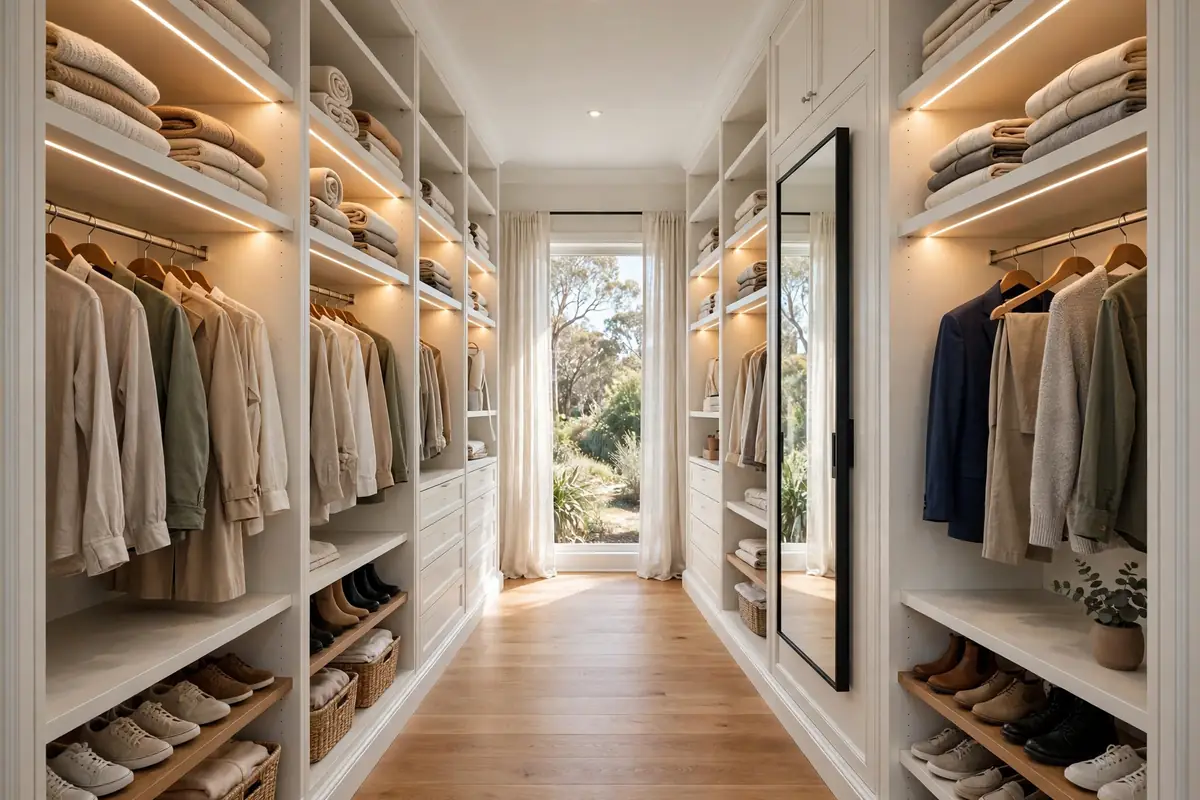
A walk-in wardrobe is one of those upgrades that changes how you start every single day. No more digging through cramped cupboards or balancing shoe boxes on top of each other. Instead, everything has a place, everything is visible, and getting dressed feels effortless. For Australian homeowners renovating or building in 2026, a well-designed walk-in robe is also one of the most requested features in a master suite — and one of the smartest places to invest your renovation budget.
But a great walk-in wardrobe doesn’t happen by accident. The difference between a robe you love and one that frustrates you comes down to layout, storage planning, lighting, and honest budgeting. This guide covers the layouts that actually work in Australian homes, the storage features worth paying for, and what a walk-in wardrobe really costs in 2026.
Walk-In Wardrobe Layouts That Work
The shape of your room determines which layout makes sense. There are three proven configurations, and each suits different room proportions.
Single-Sided (One-Wall) Layout
Storage runs along one wall, leaving the opposite side open. This is the most space-efficient option and works in narrow rooms from about 1.8 metres wide. It’s ideal when you’re converting a small spare bedroom or carving a robe out of a large master bedroom. The downside is limited hanging space, so it suits singles or couples with modest wardrobes.
Double-Sided (Galley) Layout
Storage on both walls with a walkway down the middle — the classic walk-in configuration. You need a minimum room width of about 2.4 metres (600mm of storage each side plus at least 1.2 metres of clear walkway). This layout roughly doubles your storage compared to a single-sided design and is the most popular choice for Australian master suites.
U-Shaped Layout
Storage wraps around three walls, maximising every centimetre. This works best in rooms of at least 3 x 3 metres. The U-shape gives you dedicated zones — hanging on one wall, shelving on another, drawers and accessories on the third. It’s the closest thing to a boutique dressing room and suits larger homes and new builds where space isn’t tight.
Whichever layout you choose, keep the walkway clear. A walk-in robe with a cramped central aisle feels smaller than a well-organised built-in, which defeats the purpose.
How Much Does a Walk-In Wardrobe Cost in Australia?
Walk-in wardrobe costs in Australia vary enormously depending on size, materials, and how much joinery is involved. As a planning guide for 2026:
- Simple walk-in fitout: $3,500–$10,000 — basic shelving, hanging rails, and laminate finishes in a small space
- Mid-range walk-in: $10,000–$20,000 — custom joinery, drawers, quality hardware, and better finishes
- High-end walk-in: $20,000–$30,000+ — full custom cabinetry, stone or timber benchtops, integrated lighting, mirrors, and premium accessories
For comparison, a standard custom built-in wardrobe (not walk-in) typically runs $3,000–$7,000, or roughly $1,100–$3,000 per linear metre. A walk-in costs more because you’re fitting out an entire room rather than a single cupboard opening.
What drives the price up? Drawers are the biggest cost multiplier — each bank of soft-close drawers adds hundreds of dollars. Upgraded board finishes, glass-fronted sections, internal lighting, and stone benchtops all push the total higher. Get an itemised quote so you can see exactly where the money goes, and ask whether the price includes removal of old built-ins, delivery, and installation.
Storage Features Worth Paying For
Not all wardrobe features deliver equal value. These are the ones Australian designers and joiners consistently recommend:
- Double hanging rails — two tiers of hanging for shirts, pants, and folded items. Doubles your hanging capacity in the same wall space.
- Drawer towers — deep, soft-close drawers for underwear, activewear, and accessories. More useful than shelves for small items.
- Open shoe shelving — angled or flat shelves that keep shoes visible and ventilated. Far better than a pile on the floor.
- Full-length mirror — either on a door or a dedicated wall section. Non-negotiable in a dressing space.
- LED strip lighting — under-shelf or recessed lighting that activates when you enter. Makes a dark robe feel luxurious and helps you actually see colours in the morning.
- Overhead storage — high shelves for luggage, seasonal items, and things you rarely need. Use every vertical centimetre.
Features you can skip if the budget is tight: motorised tie racks, built-in safes, and glass-fronted display sections look impressive but add cost without improving daily function for most people.
Lighting and Ventilation
Walk-in robes are often internal rooms with no natural light, so artificial lighting matters more here than in almost any other room. A single ceiling batten isn’t enough. Layer your lighting: a central ceiling light for general illumination, plus LED strips under shelves or along hanging rails for task lighting. Warm white (3000K) renders clothing colours most accurately.
Ventilation is equally important, especially in humid coastal areas. A robe packed with clothes and no airflow develops musty smells fast. If there’s no window, consider a ceiling exhaust fan on a timer, or at minimum leave a gap under the door for air circulation. Your clothes — and your nose — will thank you.
Design Ideas for Australian Homes
The Minimalist All-White Robe
White or light-grey joinery with open shelving keeps a small walk-in feeling bright and spacious. This is the safest choice for resale and works in every Australian home style, from coastal to contemporary.
Timber Warmth
Oak or walnut-look laminate on drawer fronts and shelving adds warmth without the cost of solid timber. Pair with matte black hardware for a modern Australian look that’s very popular in 2026 builds.
The Boutique Dressing Room
If you have the space, add a central island with a stone benchtop for folding and accessories, a feature pendant light, and an ottoman. This is the luxury end of the spectrum but creates a genuine dressing-room experience.
His-and-Hers Zoning
In a shared robe, divide the space clearly — his hanging on one side, hers on the other, with shared drawers in the middle. It sounds obvious, but many robes fail because two people’s storage needs were never planned separately.
For more ideas on planning the bedroom around your new robe, see our guide to master bedroom design ideas for Australian homes.
Common Mistakes to Avoid
- Too little hanging space — most people underestimate how much they hang versus fold. Audit your wardrobe before the design appointment.
- Ignoring the door swing — sliding or cavity doors save space in tight robes. A hinged door that clashes with drawers is a daily annoyance.
- No full-length mirror — you’ll end up walking to the bathroom mirror every morning anyway.
- Forgetting power points — for charging, a hair straightener, or future lighting upgrades. Much cheaper to add during the fitout.
- Choosing form over function — open shelving looks great in photos but collects dust. Mix open and closed storage based on how you actually live.
Frequently Asked Questions
How much does a walk-in wardrobe cost in Australia?
A simple walk-in wardrobe fitout starts from around $3,500–$10,000. Mid-range custom joinery typically runs $10,000–$20,000, while high-end designs with premium finishes, lighting, and accessories can reach $20,000–$30,000 or more. The final cost depends on room size, materials, drawer count, and hardware choices.
What is the minimum size for a walk-in wardrobe?
A functional single-sided walk-in needs a room at least 1.8 metres wide. For the classic double-sided galley layout, allow a minimum of 2.4 metres wide — 600mm of storage on each side plus 1.2 metres of clear walkway. Anything narrower feels cramped and defeats the purpose of walking in.
Is a walk-in wardrobe worth the investment?
In a master suite with enough space, yes — it’s one of the most requested features by Australian homebuyers and adds genuine daily convenience. In a smaller home where space is tight, a high-quality built-in wardrobe often delivers better value per dollar. The key is whether your room proportions support a walk-in that functions well, not just looks good.
Do I need a building permit for a walk-in wardrobe?
In most Australian states, a wardrobe fitout inside an existing room doesn’t require a building permit, as it’s considered non-structural joinery. However, if you’re removing walls, altering the room layout, or doing electrical work, check with your local council. Electrical work must always be done by a licensed electrician.
How long does a walk-in wardrobe installation take?
A straightforward fitout typically takes 2–5 days once the joinery is manufactured. Custom joinery usually has a 4–8 week lead time from measure to installation, so factor this into your renovation timeline. Flat-pack options can be installed in a weekend by a competent DIYer.