
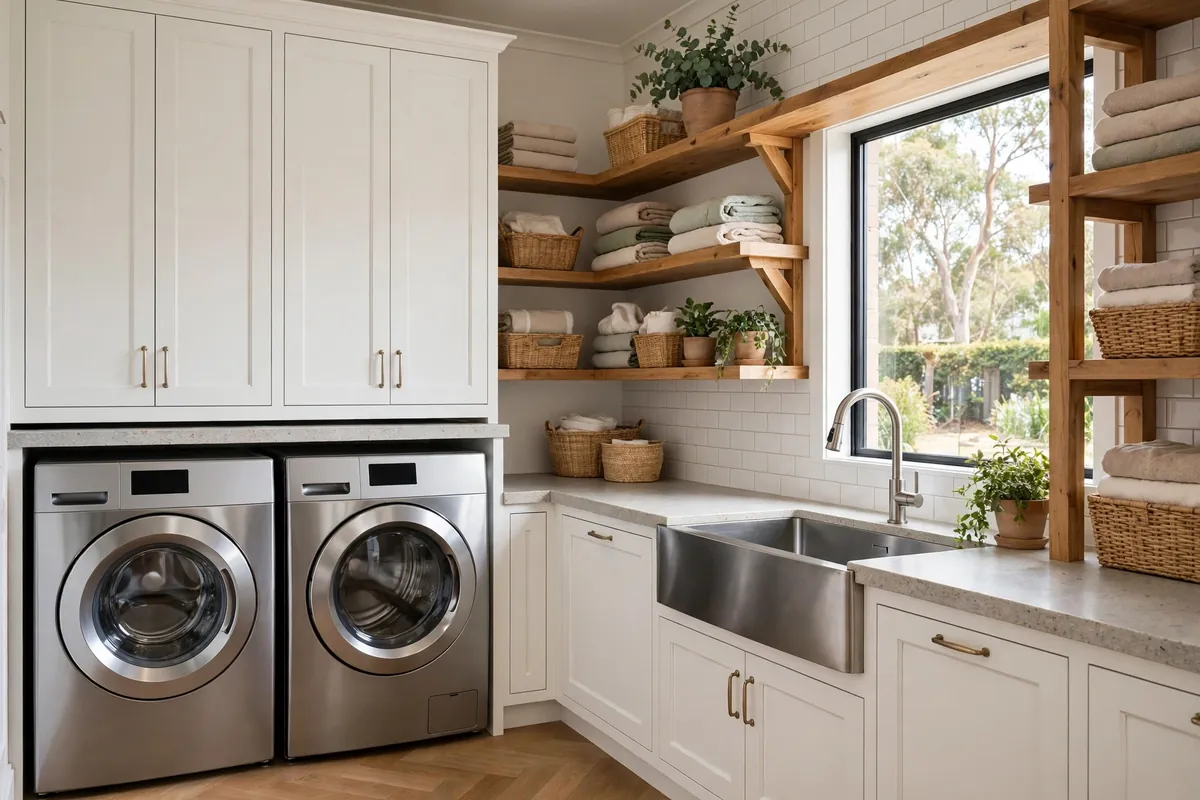
The laundry is the hardest-working room in the house, yet it’s often the last to get any design attention. Most Australian laundries are cramped afterthoughts — a washing machine shoved in a corner, a dryer balanced on top, and cleaning products scattered wherever they fit. But a well-designed laundry doesn’t just look better; it makes one of life’s most repetitive chores genuinely easier.
Whether you’re renovating a dedicated laundry room or carving out a functional laundry zone in a small home, the principles are the same: plan the workflow, maximise vertical storage, choose hard-wearing finishes, and don’t skimp on ventilation. Here’s how to design a laundry that works as hard as you do.
Laundry Layouts That Work
The Galley Laundry
Benchtop and cabinetry along one wall, machines at one end. This is the most common Australian laundry layout and works in narrow rooms from about 1.8 metres wide. Keep the washer and dryer side by side (not stacked) if you have the width — it’s easier on your back and lets you use the benchtop above as a folding station.
The L-Shaped Laundry
Cabinetry wraps around two walls, giving you more bench space and storage. This suits square rooms and lets you zone the space: washing and drying on one wall, folding and ironing on the other. If you have room for a deep sink, put it on the shorter leg of the L, away from the machines.
The Combined Laundry-Bathroom
In smaller homes and apartments, combining the laundry with the bathroom or ensuite is a smart space saver. European-style laundries hide the washer and dryer behind joinery in the bathroom. It works well if you plan for noise (a solid-core door helps) and moisture (proper exhaust ventilation is non-negotiable). For more on planning wet areas, see our small bathroom design ideas and ensuite design ideas guides.
The Laundry Nook
No dedicated room? A laundry nook in a hallway, garage, or under the stairs can work surprisingly well. Use a tall cupboard with bifold doors to hide front-loading machines, add a benchtop above for folding, and make sure there’s a water supply and drainage nearby. Pocket doors or cavity sliders keep the nook accessible without eating floor space.
How Much Does a Laundry Renovation Cost in Australia?
Laundry renovation costs in Australia are among the most affordable of any room — provided you keep the plumbing where it is. As a 2026 planning guide:
- Cosmetic refresh: $3,000–$8,000 — new benchtop, sink and tapware, paint, shelving, and minor fixture updates
- Mid-range renovation: $8,000–$18,000 — new cabinetry, stone or laminate benchtop, tiling, quality tapware, and trade work
- Full rebuild: $18,000–$30,000+ — new layout, re-tiling, custom joinery, and upgraded finishes throughout
Moving the laundry to a new location is a different proposition entirely. Relocating plumbing and drainage typically starts around $15,000 and can exceed $20,000 depending on how far services need to move and the type of floor construction. Moving a single plumbing point can add $1,500–$5,000. If your budget is tight, keeping the existing layout is the single biggest saving you can make.
The Laundry Workflow: Design Around How You Wash
The best laundries follow the natural sequence of doing laundry: sort, wash, dry, fold, iron, put away. Design your layout so each step flows into the next without backtracking.
- Sorting: pull-out hampers or divided baskets near the machines — one for lights, one for darks, one for delicates
- Washing: front-loaders at bench height (on a raised plinth if you want to save your back)
- Drying: a retractable clothesline or wall-mounted airer for delicates, plus space for the dryer
- Folding: a clear benchtop run of at least 900mm — this is the most undervalued feature in any laundry
- Ironing: a pull-out ironing board built into a drawer, or a dedicated spot for a freestanding board
When every step has a designated zone, laundry day stops feeling chaotic — even if you still don’t enjoy it.
Storage Ideas That Actually Help
Laundry storage needs to handle detergents, pegs, cleaning products, mops, and all the other paraphernalia of running a household. Think vertical and think concealed.
- Tall broom cupboard — full-height storage for mops, brooms, and the vacuum. The single most useful addition to any laundry.
- Overhead cupboards — for detergents and products you use weekly. Keep daily items at bench height instead.
- Pull-out narrow cabinets — 150–200mm wide pull-outs beside the machines are perfect for bottles and sprays.
- Open shelving — for folded towels and baskets. Looks great but limit it to things you use often so dust doesn’t build up.
- A designated “lost sock” basket — half joke, half essential. Every household needs one.
Finishes That Survive the Laundry
Laundries cop heat, humidity, water splashes, and chemical spills. Choose finishes accordingly:
- Benchtops: laminate is the budget workhorse and handles laundry duty well. Stone looks better and resists heat from irons, but costs significantly more.
- Cabinetry: moisture-resistant board is worth the small premium over standard particleboard, especially near the sink and machines.
- Flooring: tiles or luxury vinyl planks. Both handle water; vinyl is warmer underfoot and more forgiving if you drop something.
- Walls: semi-gloss or satin paint for wipeability. Full-height tiling behind the sink and machines looks sharp and is easy to clean.
- Sink: a deep, large tub sink — at least 45 litres. Shallow bar sinks are useless for soaking. Stainless steel or matte composite both work well.
Ventilation and Drying
A laundry without proper ventilation becomes a damp, musty box. If you have a window, use it. If not, install a ceiling exhaust fan — ideally on a humidistat that runs automatically when moisture rises. This is especially important if you dry clothes indoors, which many Australian households do in winter.
For indoor drying, a ceiling-mounted pulley airer is brilliant in laundries with high ceilings — it keeps clothes out of the way and uses warm rising air. Wall-mounted retractable lines work well in smaller spaces. Whatever you choose, make sure air can circulate around the clothes, or they’ll take forever to dry and start smelling.
Frequently Asked Questions
How much does a laundry renovation cost in Australia?
A cosmetic laundry refresh typically costs $3,000–$8,000. A mid-range renovation with new cabinetry, benchtop, and tiling runs $8,000–$18,000. A full rebuild with layout changes costs $18,000–$30,000+. Relocating the laundry to a new position starts around $15,000 due to plumbing and drainage work.
What is the best layout for a small laundry?
A single-wall galley layout is the most space-efficient for small laundries. Run benchtop and cabinetry along one wall with the washer and dryer side by side. Use vertical storage — tall cupboards and overhead cabinets — to maximise every centimetre. A cavity sliding door saves valuable floor space compared to a hinged door.
Can I put a laundry in the bathroom?
Yes — combined bathroom-laundry designs are common in Australian apartments and smaller homes. Hide front-loading machines behind joinery, ensure proper exhaust ventilation for moisture, and consider noise (a solid-core door between the toilet area and machines helps). Check that your plumber can connect both sets of fixtures to the existing drainage.
Do I need a permit to renovate my laundry?
A cosmetic laundry renovation generally doesn’t need council approval. However, if you’re moving plumbing or drainage, altering walls, or doing electrical work, check with your local council. All plumbing and electrical work must be done by licensed tradespeople, and plumbing changes may need to be certified.
What’s the ideal benchtop height in a laundry?
Standard kitchen bench height (900mm) works well for most people and allows front-loading machines to fit underneath. If you’re tall or have back issues, consider raising the machines on a 150–200mm plinth — it makes loading and unloading significantly more comfortable and creates useful storage underneath.