
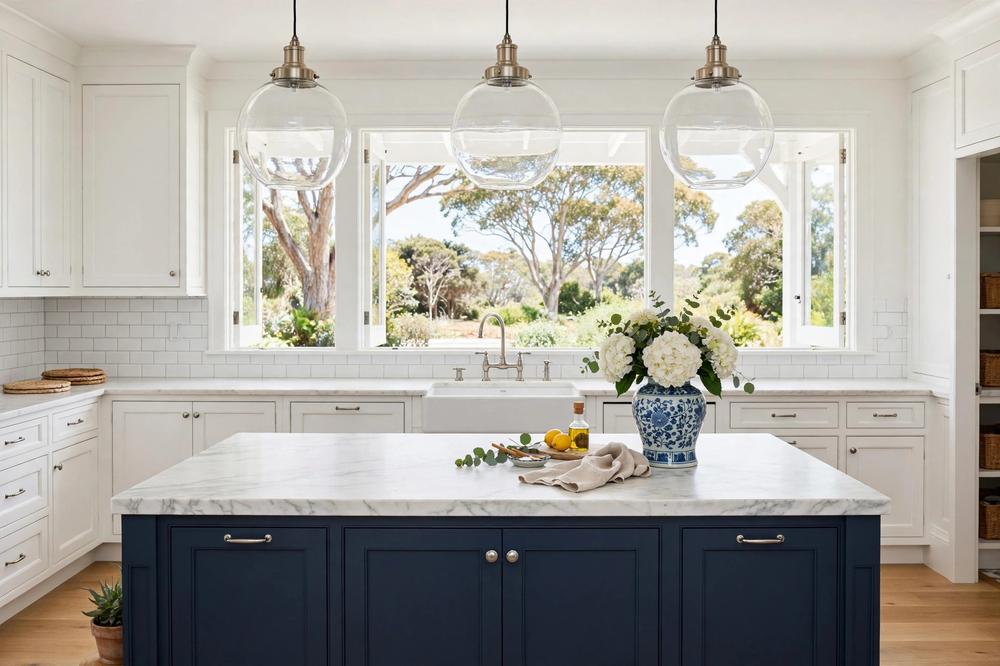
Few looks have the staying power of the Hamptons style kitchen Australia has loved for well over a decade. Named after the coastal enclaves of Long Island, New York, the style has been reinterpreted for Australian homes for well over a decade — and unlike trendier looks, it keeps selling houses. Real estate agents from Sydney’s northern beaches to Brisbane’s bayside suburbs will tell you the same thing: buyers respond to crisp white cabinetry, natural stone and that relaxed-but-polished coastal feeling. Whether you are planning a full renovation or a careful refresh, this guide covers the defining features, honest costs and the Australian adaptations that make the look work in our climate.
What defines a Hamptons style kitchen
Strip the Hamptons look back to its bones and you get five signatures: shaker-profile cabinetry, a predominantly white or soft-neutral palette, natural stone benchtops, classic tapware and hardware, and generous natural light. The mood is tailored rather than rustic — think beach house with good manners. Lines are clean, symmetry matters, and nothing shouts.
What it is not: the style has nothing to do with nautical kitsch. Anchors, rope and seashell motifs belong in a souvenir shop, not a Hamptons kitchen. The coastal reference should come through in colour and material — soft blues, weathered timber, linen — rather than literal decoration. If you are unsure whether your taste leans classic Hamptons or something more relaxed, the interior design style quiz can help you settle it before you commit to cabinetry.
The Hamptons colour palette for Australian homes
White does the heavy lifting, but not all whites are equal. Australian Hamptons kitchens typically layer two or three whites: a crisp white for cabinetry (Dulux Lexicon or Vivid White), a slightly warmer white for walls (Dulux Natural White or Whisper White), and white or pale grey for trims. The subtle shifts stop the room feeling flat.
Accent colours come from the coast: soft duck-egg blue, pale sage, sea-glass green and driftwood grey. Dulux suggests shades like Pale Sage and Milton Moon for the Hamptons look — see their guide to achieving the Hamptons coastal look for how these sit against classic whites. Use blues and greens on an island bench, a butler’s pantry or soft furnishings rather than across every wall; restraint is what keeps it elegant.
Darker accents are creeping in. A navy island bench (Dulux Sapphire Salute or similar) against white perimeter cabinetry is now a familiar sight in Australian renovations, and charcoal tapware reads as a modern update on classic chrome. Keep dark tones to one or two elements so the room stays light.
Cabinetry: getting the shaker profile right
Shaker cabinetry — a flat centre panel framed by a simple rail-and-frame border — is non-negotiable for the look. The profile is widely available through Australian cabinetmakers and flat-pack suppliers alike; even IKEA’s shaker-front ranges can be painted and upgraded with proper hardware to pass convincingly.
Details that matter:
- Keep the profile simple. Overly ornate routed doors tip into French provincial territory.
- Take wall cabinets to the ceiling or finish them with a simple cornice. A gap collecting dust above the cabinets ruins the tailored effect.
- Glass-fronted upper cabinets or open shelving on one run break up the white and give you somewhere to display white ceramics and glassware.
- Integrated appliances keep the lines uninterrupted. If your budget does not stretch to fully integrated, choose white or stainless appliances with minimal branding and consistent handles.
Paint finish matters as much as colour. A satin or low-sheen 2-pack polyurethane finish on cabinetry resists fingerprints and wipes clean — important in a white kitchen. Expect 2-pack to cost roughly 20 to 30 per cent more than standard laminate, and it is worth it for the crispness alone.
Benchtops and splashbacks
Marble is the classic Hamptons benchtop, and Carrara-style stone with soft grey veining remains the benchmark. Real marble costs from around $700 per square metre installed for entry-level stone to well over $2,000 for premium slabs, and it needs sealing and gentle care — lemon juice and red wine are its natural enemies. For busy family kitchens, porcelain slabs or compliant engineered-stone alternatives give you the marble look without the maintenance anxiety; ask your stonemason about low-silica options, since Australia has restricted traditional engineered stone.
For splashbacks, the white subway tile laid in a brick pattern is the default, and it earns its place: affordable, timeless and easy to replace. Herringbone or stacked layouts add interest for a modest extra labour cost. If you want more drama, a marble-look porcelain slab as a full-height splashback behind the cooktop makes a strong focal point.
Tapware, hardware and the details that sell it
Hardware is where budget Hamptons kitchens often fall down, and it is also the cheapest thing to get right. Brushed nickel, polished chrome or unlacquered brass cup pulls and knobs on shaker doors read instantly as Hamptons. Match your tapware finish to your hardware for a considered result. A gooseneck mixer in chrome or brushed nickel over a fireclay butler’s sink is the iconic pairing; the sink itself costs $400 to $1,200 depending on size and brand, with names like Turner Hastings and Franke widely stocked in Australia.
Do not forget the rangehood. A plastered or panelled chimney-style rangehood over the cooktop is a signature Hamptons move and hides the stainless box that would otherwise break the spell. Budget $3,000 to $6,000 for a custom-look canopy, or choose a discreet undermount unit inside a shaker-front cabinet for a similar effect at lower cost.
Flooring and lighting
Flooring should feel warm underfoot and visually quiet. Light oak or pale hybrid timber floors are the standard choice — they handle Australian family life, suit the palette and cost $60 to $120 per square metre installed for quality hybrid boards. Large-format pale tiles work in Queensland and coastal NSW where cool floors are welcome in summer. Avoid dark timber; it fights the airy brief.
Lighting needs three layers. Downlights do the general work, under-cabinet strips light the benches, and pendants over the island provide the jewellery. For pendants, look at oversized glass, woven rattan or classic metal coolie shades in white or soft grey — two or three in a row over the island, hung 75 to 90cm above the benchtop. The Good Guys and Beacon Lighting both carry Hamptons-friendly ranges at sensible prices.
Styling: the relaxed part of relaxed luxury
Styling is what stops a Hamptons kitchen feeling like a showroom. Layer in natural textures: linen seat cushions on counter stools, a jute or flat-weave runner, woven baskets for produce, and timber chopping boards left casually on the bench. Fresh hydrangeas or gardenias in a blue-and-white ginger jar are the cliché because they work — just keep it to one arrangement, not a florist’s window.
Counter stools deserve thought since they are always visible. Timber or rattan stools with linen cushions suit the look; white or pale grey upholstered stools add softness. Allow 60cm of bench width per stool and keep the seat height 25 to 30cm below the benchtop.
What a Hamptons kitchen costs in Australia
Honest 2026 numbers for Australian cities:
- Style refresh (paint cabinetry, new hardware, tapware, splashback, lighting, styling): $8,000 to $20,000
- Mid-range renovation (new shaker-front cabinetry, stone-look benchtops, tiled splashback, mid-range appliances): $30,000 to $55,000
- Full custom Hamptons kitchen (custom joinery, natural stone, butler’s pantry, premium appliances, panelled rangehood): $60,000 to $110,000+
The cabinetry profile and stone benchtop are the two big-ticket items that define the look, so protect those in the budget and save on styling pieces, which can be collected over time from markets and second-hand stores. For a line-by-line sense of where renovation money goes, read our renovation costs Australia 2026 guide and run your own numbers through the free renovation tools.
Australian adaptations worth making
The classic Hamptons look was designed for a New England summer house, so a few local adjustments pay off. In Brisbane, Perth and Darwin, prioritise cross-ventilation and ceiling fans — a beautiful kitchen you cannot stand in during February is a failed kitchen. Choose performance fabrics (or washable linen slipcovers) on stools and banquettes if you have kids or pets. In bushfire-prone areas, check ember-attack requirements before specifying timber decking or cladding near the kitchen’s outdoor flow.
Open-plan living is the Australian norm, so make sure the kitchen’s palette flows into adjoining spaces. Repeating the wall white and one accent colour through the living area keeps the whole floor feeling designed rather than decorated room by room.
Mistakes to avoid
- Too much white with no texture: layer timber, linen, stone and glass or the room feels clinical.
- Fake nautical decor: one beautiful shell or piece of coral is styling; a themed collection is a gift shop.
- Ignoring the ceiling: a simple pendant or painted VJ panelling overhead completes the room. Plain white ceilings are fine, but a considered ceiling lifts the design.
- Undersized island: an island should be at least 2.4 metres long to seat four comfortably and needs 1 metre of clearance on all working sides. A cramped island is worse than none.
- Cheap stone lookalikes that photograph badly: if the budget does not stretch to convincing stone, choose a beautiful laminate or solid colour instead of a poor marble imitation.
Frequently asked questions
How much does a Hamptons style kitchen cost in Australia?
A cosmetic Hamptons refresh starts around $8,000 to $20,000, a mid-range renovation with new shaker cabinetry and stone-look benchtops runs $30,000 to $55,000, and a full custom Hamptons kitchen with natural stone and a butler’s pantry typically costs $60,000 to $110,000 or more, depending on size, materials and city.
What colours define a Hamptons style kitchen?
Crisp and warm whites form the base — Dulux Lexicon, Vivid White and Natural White are Australian staples — layered with coastal accents like duck-egg blue, pale sage, sea-glass green and driftwood grey. Navy or charcoal can anchor an island bench, while brushed nickel, chrome or brass hardware completes the palette.
Can you get the Hamptons look on a budget?
Yes. Paint existing cabinetry white, add shaker-style trim to flat doors, swap in cup pulls and a gooseneck tap, retile the splashback in white subway tile and style with linen, rattan and second-hand blue-and-white ceramics. A disciplined refresh can land under $10,000 and read convincingly Hamptons.
Is marble necessary for a Hamptons kitchen?
No. While Carrara marble is the classic choice, porcelain slabs and compliant low-silica engineered stone alternatives deliver the look with far less maintenance. What matters is the soft grey veining and honed, natural feel — not the quarry the stone came from.
Does a Hamptons kitchen suit a small kitchen?
It suits small kitchens well because the light palette, reflective surfaces and uncluttered lines make compact rooms feel larger. Keep the shaker profile slim, choose one statement element such as the pendant lights or tapware, and avoid heavy styling that eats bench space.