
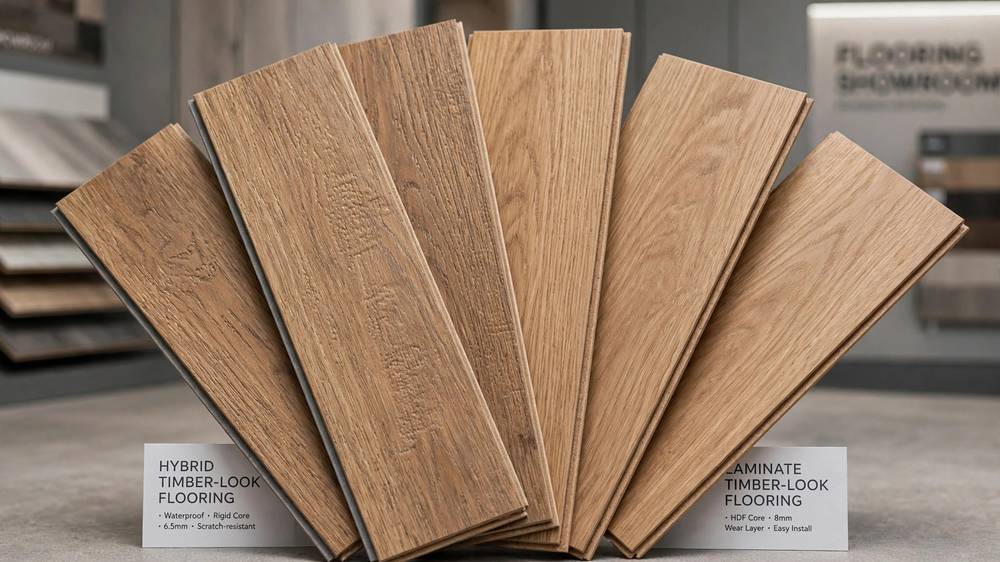
The hybrid flooring vs laminate Australia debate is one of the most common dilemmas in a flooring project — the two look similar at a glance, sit in a similar price bracket, and both promise that timber look without the timber price. But under the surface they’re very different products, and picking the wrong one for your room can mean swollen boards, voided warranties and an early replacement. Here’s how they compare on cost, waterproofing, durability and comfort, with real 2026 Australian prices.
Hybrid Flooring and Laminate: The Quick Version
Both are floating click-lock floors with a photographic timber-look surface, but the cores are completely different:
- Hybrid flooring has a rigid mineral-composite (SPC — stone plastic composite) or WPC core that is 100% waterproof. It was designed for Australian conditions — humidity, spills, pets.
- Laminate has a high-density fibreboard (HDF) core. Modern laminate is far tougher than the chipboard floors of the 2000s, but the core is still wood-based, so standing water is its enemy.
That single difference drives almost everything else in the comparison.
Head-to-Head: Hybrid vs Laminate at a Glance
| Factor | Hybrid flooring | Laminate |
| Installed cost per m² | $55–$105 | $45–$85 |
| Water resistance | 100% waterproof core | Low–moderate; not for wet areas |
| Durability | Excellent dent/impact resistance | AC3–AC5 wear ratings; excellent scratch resistance |
| Feel underfoot | Harder, cooler (tile-like) | Warmer, slightly softer (timber-like) |
| Installation | Heavier boards; pro install common | Lighter; friendlier DIY |
| Underlay | Usually pre-attached | Separate underlay + moisture barrier needed |
| Lifespan | 15–25 years | 15–25 years |
| Best for | Wet areas, pets, rentals, whole-house | Budget jobs, bedrooms, DIY in dry rooms |
Price is where most people start, and it’s close — but not identical.
| Cost element | Hybrid flooring | Laminate |
| Materials (per m²) | $33–$55 | $20–$35 |
| Installed (per m²) | $55–$105 (SPC typically $60–$95) | $45–$85 (typical total $50–$110) |
| Underlay | Usually pre-attached | Separate underlay + moisture barrier required |
Laminate wins on materials — it’s typically $10–$20 per m² cheaper at the shelf. But the gap narrows once installed: laminate needs a separate underlay and moisture barrier, which adds both material cost and labour, while hybrid’s acoustic underlay usually comes pre-attached. For a 60m² living area, the installed difference is often just a few hundred dollars — check the hybrid flooring cost breakdown for a detailed look at what installers actually charge.
Also compare against your overall project budget using the renovation cost database — flooring is one of the few renovation line items where spending slightly more per square metre pays back in lifespan.
Water Resistance: Hybrid’s Decisive Advantage
This is the category that settles most decisions.
- Hybrid: 100% waterproof rigid core. Spills, pet accidents, mopping and even minor flooding won’t swell the boards. This is why hybrid is routinely installed in kitchens, bathrooms and laundries.
- Laminate: low to moderate water resistance. Quality laminate with wax-sealed edges handles the occasional spill if wiped promptly, but it is not suitable for wet areas. It needs a separate moisture barrier over concrete slabs, and a dishwasher leak or overflowing bath can ruin it.
If the room has water — kitchen, bathroom, laundry, entryway — hybrid is the clear choice. In dry rooms only, laminate’s water weakness stops mattering.
Durability and Wear Ratings
Laminate actually has the more standardised durability story. Laminate wear layers are rated AC3 to AC5: AC3 suits normal residential use, while AC4 and AC5 handle high-traffic commercial-grade wear. A good AC4 laminate shrugs off scratches, chair castors and gritty shoes impressively.
Hybrid doesn’t use the AC system, but its rigid SPC core resists dents and impacts better than laminate’s fibreboard — dropped pans and pet claws are less of a threat. Both products realistically last 15–25 years in a home with normal care, though hybrid’s waterproofing means it’s more likely to actually reach the top of that range in busy family homes.
Feel, Comfort and Noise
Here’s where laminate quietly wins a round. Laminate boards are generally thinner and feel warmer and slightly softer underfoot, closer to the feel of timber. Hybrid’s dense stone-composite core is harder and cooler — closer to tile underfoot, though the pre-attached acoustic underlay helps with sound.
In practice: laminate feels nicer barefoot in bedrooms; hybrid’s harder surface is fine in living areas where shoes stay on. Neither is as warm as carpet or as soft as cork — if underfoot comfort is your top priority, both are compromises.
Installation: DIY-Friendliness
Both use click-lock floating installation — no glue, no nails — but laminate has the edge for DIY:
- Laminate: lighter boards, easier to cut with basic tools, and a well-established DIY track record. A competent home handyperson can lay a bedroom over a weekend.
- Hybrid: heavier, denser boards that are harder to cut (a proper saw helps) and less forgiving of subfloor unevenness. DIY is possible but professional installation is more common.
One caveat for both: subfloor preparation matters enormously. An uneven slab will telegraph through either floor and can void warranties. Budget for levelling if your slab isn’t flat — it’s cheaper than relaying.
Lifespan and Maintenance
Both floors are low-maintenance: regular sweeping and damp mopping with a manufacturer-approved cleaner is all they need. The lifespan difference comes down to failure modes:
- Hybrid’s failure mode is usually surface wear after very long service — the waterproof core doesn’t degrade from moisture events along the way.
- Laminate’s failure mode is moisture damage — one serious leak can end a floor years early.
In dry, stable rooms, both comfortably deliver 15–25 years. In real family homes with kids, pets and the occasional plumbing mishap, hybrid’s resilience gives it the longer expected life.
SPC vs WPC: Know Your Hybrid
Not all hybrid flooring is the same. The two core types behave differently:
- SPC (stone plastic composite): limestone-based, extremely rigid and dense. This is the dominant type in Australia — thinner profile (typically 5–7mm), excellent dent resistance, and the $60–$95/m² installed range quoted most often.
- WPC (wood plastic composite): wood-plastic mix, slightly thicker and softer underfoot with better acoustic properties. Less common here and usually pricier.
For most Australian homes, SPC is the default recommendation — it handles our heat and humidity well and the rigid core stays stable over minor subfloor imperfections.
Laminate Grades: What AC Ratings Actually Mean
Laminate’s AC rating is one of the few genuinely standardised durability measures in flooring, so it’s worth understanding:
- AC3: rated for moderate residential traffic — bedrooms, home offices. Fine for most homes.
- AC4: rated for heavy residential and light commercial — living rooms, hallways, rentals.
- AC5: heavy commercial grade — overkill for most homes, but excellent if you want maximum scratch resistance.
Don’t pay for AC5 in a spare bedroom, but do insist on AC4 for hallways and living areas. Also check the board thickness: 12mm laminate feels more solid and handles minor subfloor variation better than 7–8mm budget boards.
What About Resale Value?
Neither hybrid nor laminate adds value the way solid timber does, but both present well to buyers when they’re in good condition — which is precisely why hybrid has the edge for resale. A five-year-old hybrid floor in a kitchen still looks new; a five-year-old laminate floor in the same kitchen may show swelling at the dishwasher or sink. Real estate agents consistently report that waterproof flooring in wet zones photographs better and raises fewer buyer questions. If you’re renovating to sell within a few years, hybrid in the living zones is the safer investment.
Best Rooms for Each
| Room | Better choice | Why |
| Kitchen | Hybrid | Waterproof — spills and appliance leaks are no threat |
| Bathroom / laundry | Hybrid | Only hybrid is rated for wet areas |
| Entryway / hallway | Hybrid | Wet shoes and grit; dent resistance helps |
| Living / dining | Either | Depends on budget and pets |
| Bedrooms | Laminate | Warmer underfoot, quieter, dry room |
| Rental properties | Hybrid | Survives tenants, pets and neglect better |
| Home office (DIY weekend) | Laminate | Lighter, simpler DIY install |
Choose hybrid flooring if: the room sees water, you have pets or young kids, it’s a rental or high-traffic zone, or you want the longest realistic lifespan and better resale appeal. The small price premium buys genuine peace of mind.
Choose laminate if: you’re flooring dry rooms on a tight budget, you want the simplest DIY install, or underfoot warmth matters most (bedrooms especially). A quality AC4 laminate in a bedroom will serve you beautifully for decades.
For whole-house flooring in one product — the most common scenario — hybrid usually wins in Australia because our homes mix wet and dry zones and our climate is humid. But there’s no shame in the smart split: hybrid in the kitchen, living areas and hallways; laminate in the bedrooms. Many flooring retailers will happily quote exactly that combination.
Before you commit, run the numbers for your floor area through the free renovation cost calculators to see how the per-m² difference scales across your project.
Frequently Asked Questions
Is hybrid flooring really 100% waterproof?
Yes — hybrid flooring’s rigid SPC (stone plastic composite) core does not absorb water, so the boards won’t swell, warp or delaminate from spills, mopping or pet accidents. The surface joints are also tightly engineered. Note that “waterproof” refers to the boards themselves; large-scale flooding can still get underneath a floating floor and require it to be lifted and dried.
Can laminate be installed in kitchens or bathrooms?
It’s not recommended. Laminate’s HDF core is wood-based and will swell if water sits on it or seeps into the joints. Some manufacturers offer water-resistant laminate ranges with sealed edges for kitchens, but warranties typically exclude wet areas. Hybrid is the safer choice anywhere near water.
How much does hybrid flooring cost per m² installed in Australia?
In 2026, hybrid flooring materials run $33–$55 per m², with installed costs of $55–$105 per m² (SPC-core products typically $60–$95 installed). The pre-attached acoustic underlay keeps installation simpler than laminate, which needs separate underlay and a moisture barrier.
Which lasts longer, hybrid or laminate?
Both have a realistic lifespan of 15–25 years in a home. Hybrid tends to reach the upper end of that range more reliably because its waterproof core is immune to the moisture damage that is laminate’s most common cause of early failure. In dry rooms with no water risk, a quality AC4/AC5 laminate lasts just as long.
Is hybrid flooring better for pets than laminate?
Generally yes. Hybrid’s rigid waterproof core handles pet accidents, water bowls and claw scratches better than laminate’s fibreboard core. That said, a high-AC-rated laminate (AC4 or AC5) is also quite scratch-resistant — the main pet risk for laminate is urine or water-bowl spills reaching the core.