
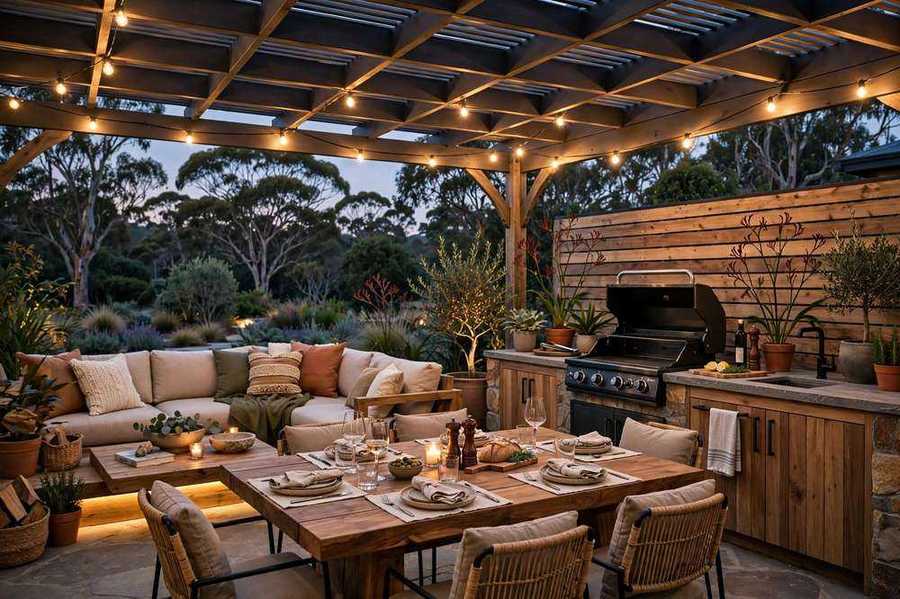
Some of the best alfresco design ideas Australia has to offer are taking shape in backyards right now — and 2026 is shaping up to be the year of the outdoor room. Domain’s end-of-year data showed the top three property search terms in 2025 were ‘pool’, ‘waterfront’ and ‘view’: Australians value their outdoor spaces above almost everything else.
The big shift this year is that alfresco areas are no longer an add-on at the back of the house. They’re being designed with the same detail as interiors — defined zones, proper furniture, layered lighting — so the backyard reads as another room rather than a patio with a barbecue. Here are ten ideas that work in real Australian backyards, with the cost ranges you should actually budget for.
1. Design an outdoor living room, not a patio with chairs
The outdoor room getting the most use in 2026 is the alfresco lounge — a space that feels like an extension of your indoor living zone. The formula: plush but durable lounge seating, an outdoor rug to define the footprint, and layered lighting so it’s usable after dark.
Skip matchy-matchy outdoor furniture sets — mix eclectic, durable pieces that would look natural inside the house too.
Budget guide: decent outdoor lounge settings start around $1,500 to $3,000; a quality setup with a rug, side tables and lighting lands between $4,000 and $8,000.
2. Zone your backyard like a bento box
One of the strongest trends for 2026 is the zoned backyard — breaking the outdoor space into distinct areas rather than one big lawn. A sunken fire-pit lounge for evening conversation. A dining zone near the kitchen. A play or hobby corner further out.
You don’t need walls to create zones. Use changes in material (decking under the dining area, pavers under the lounge), low hedging or screening between areas, and lighting that treats each zone separately.
Zoning costs surprisingly little if the structure is already there — outdoor rugs, planters, screening and lighting for a two-zone setup typically run $2,000 to $6,000. If you’re adding a new deck or paved area to create the zone, allow $250 to $450 per square metre installed for composite decking.
3. Build the outdoor kitchen you’ll actually use
Outdoor kitchens remain one of the most popular home improvements in Australia, and for good reason — they turn entertaining from a logistical exercise into something effortless. The key word is actually: design around the meals you really cook, not the ones you imagine.
A sensible mid-range outdoor kitchen ($10,000 to $25,000) typically includes a quality built-in barbecue ($1,500 to $6,000), weatherproof cabinetry, a solid benchtop, a sink with plumbed water ($1,200 to $3,500) and a bar fridge ($800 to $2,500). Go luxury ($25,000 to $50,000+) and you’re adding natural stone benchtops, a pizza oven ($1,500 to $8,000), wine fridge, integrated lighting and custom joinery.
Placement rules that matter:
- Keep the kitchen under the covered section — cooking in driving rain is nobody’s idea of a good time.
- In coastal areas (within about a kilometre of saltwater), choose 316-grade stainless steel or powder-coated aluminium cabinetry to resist corrosion.
- Gas installations must comply with Australian gas standard AS/NZS 5601 — use a licensed gas fitter for the bayonet line.
4. Get the roof right — it’s the room’s ceiling
The roof defines whether your alfresco is a three-season space or a year-round room. Options range from a simple attached Colorbond roof to insulated sandwich panels that noticeably cut heat transfer.
Typical installed cost ranges per square metre: a basic insulated roof over an existing slab runs $400 to $650/m²; a mid-range flyover or gable roof with electrics runs $600 to $900/m². A fully enclosed alfresco room with slab, blinds and kitchen fit-out can reach $1,200 to $2,500/m².
As a worked example, a 30m² insulated-roof alfresco in 2026 typically totals $15,900 to $31,800 installed including footings, frame, electrical work and permits — though costs vary by state. Industry guides put a 30m² covered alfresco with a Colorbond roof between $22,000 and $42,000 in Queensland, $26,000 and $50,000 in NSW, and $20,000 and $38,000 in South Australia.
Keep the roofline high enough — 2.4m minimum clear — so the space feels like a room, not a carport.
5. Nail the indoor–outdoor floor transition
The difference between a house with a patio and a house with an outdoor room is often one step — literally. A flush or near-flush floor transition between inside and outside makes both spaces feel bigger and makes entertaining effortless.
Practical ways to get there:
- Match materials — continue the internal flooring out, or pick an external paver or deck board in a complementary tone. Large-format outdoor pavers in a colour close to your internal tiles blur the line beautifully.
- Remove the step — where waterproofing and structure allow, level the transition. Even reducing a 150mm step to 40mm transforms the feel.
- Align the axis — line up your kitchen or living room opening with the main alfresco zone so furniture placement and serving lines make sense.
For decking, composite boards at $250 to $450/m² installed are the low-maintenance favourite; hardwood timber costs a similar installed range but needs oiling every year or two. Our renovation cost guide breaks down how decking compares against other outdoor spends if you’re weighing options.
6. Light it in layers — including for winter
Outdoor lighting is what turns a daytime space into an evening one, and Australians increasingly use their alfrescos year-round. Layer it the same way you would indoors:
- Task lighting over the barbecue and benchtops — bright, focused, ideally on its own switch.
- Ambient lighting — warm LED strip lighting under beams, along deck steps and beneath the bar overhang creates atmosphere and safe movement after dark.
- Feature lighting — up-lights in garden beds, a statement pendant over the dining table, or festoon lights strung across the zone.
Plan electrics early: outdoor-rated (IP66) power points, a couple of circuits for lighting and the fridge, and conduit run before the slab or decking goes down. Electrical work for an alfresco typically adds $1,200 to $2,800 to the build. And in Queensland and the Northern Territory, budget for a ceiling fan or two — they’re expected by buyers, not a luxury.
7. Make it a four-season space with heating and cooling
The alfresco areas that get used most are the ones that work in July, not just January. A combination of heating, cooling and weather protection extends your outdoor season dramatically.
Heating: a gas or ethanol fireplace under cover ($2,000 to $8,000 installed), a wall-mounted infrared heater ($500 to $1,500), or a classic chiminea/fire pit for the lawn zone ($300 to $2,000). In Canberra, Melbourne and Tasmania, an enclosed or semi-enclosed design with heating is almost essential.
Cooling: ceiling fans ($200 to $600 installed each) are the best value in Australian outdoor rooms — they make a 35-degree evening bearable. Misting systems help in dry heat; shade sails or louvres handle the glare.
8. Sort privacy before you buy the furniture
Nothing kills an alfresco faster than feeling on display. Before you spend on furniture, deal with sightlines from neighbours and the street.
Effective options:
- Vertical timber slat screening — the current default for modern Australian homes; $150 to $300 per linear metre installed, and it looks good from both sides.
- Hedging — lilly pilly and murraya are the go-tos for a fast, dense screen in most climates; allow $80 to $150 per plant installed in 200mm pots.
- Louvred screens — adjustable for light and airflow; pricier at $400 to $800/m² but excellent on western boundaries.
- Raised planters with bamboo — good for renters and strata situations where permanent screening isn’t an option.
9. Add the showpiece: fire pit lounge or pool cabana
If the budget allows one indulgence, make it a destination within the destination. Two ideas Australians are building in 2026:
The sunken fire-pit lounge — a circular or square seating area set 400 to 600mm below deck or lawn level, with built-in bench seating and a central fire pit. The sunken design creates intimacy and natural wind protection. Allow $5,000 to $15,000 depending on whether you’re cutting into an existing slab or building it into new works.
The pool cabana — if you have a pool, a simple roofed structure at the pool edge with daybeds and shade turns the pool area into a resort zone. Even a modest pergola-style cabana starts around $4,000 to $10,000.
Both work because they give the backyard a sense of occasion — somewhere to go, not just somewhere to stand with a drink.
10. Check what needs approval before you build
This is the boring step that saves expensive mistakes. Australian councils vary, but the rough rules in most states are:
- Exempt development (no approval): ground-level decks under 600mm high and under 25m²; open-lattice pergolas under 20m² attached (36m² freestanding); small sheds under 10m².
- Complying development certificate (CDC): for projects that exceed exempt thresholds but meet standard criteria — most standard roofed alfrescos and decks fall here. Fast-track approval of 5 to 15 business days via a private certifier, costing $800 to $2,500.
- Development application (DA): needed for heritage areas, flood zones, or projects outside CDC criteria. Expect 4 weeks to 6 months and $500 to $3,000 in lodgement fees.
Always verify with your specific council before starting — thresholds and overlays differ, and building without a required approval can mean rectification orders when you sell. For a broader look at what’s trending and why Australians are investing so heavily in outdoor rooms, Home Beautiful’s 2026 interior design trends roundup is worth a read. And if you’re still deciding which style direction suits your home, our interior design style quiz takes a couple of minutes and will point you toward the look that fits your house — you can also run the numbers through our renovation tools before committing to a build.
Frequently asked questions
How much does an alfresco cost in Australia?
A mid-range 30m² covered alfresco with a Colorbond roof and timber or composite decking typically costs $22,000 to $50,000 installed, varying by state — NSW and the NT sit at the upper end, South Australia and Tasmania at the lower. Adding an outdoor kitchen ($10,000 to $40,000+) or full enclosure pushes the total higher.
Do I need council approval for an alfresco?
It depends on size and structure. Ground-level decks under 600mm high and 25m² are usually exempt. Most roofed alfrescos qualify for a fast-track complying development certificate (5 to 15 days, $800 to $2,500 in certifier fees). Heritage areas, flood zones or oversized builds may need a full development application — check with your local council.
What is the best flooring for an alfresco?
Composite decking ($250 to $450/m² installed) is the low-maintenance favourite, while hardwood timber offers a classic look but needs regular oiling. Large-format outdoor pavers work well where you want a seamless transition from indoor tiles. Choose slip-rated, UV-stable materials designed for Australian conditions.
How do I make my alfresco usable in winter?
Combine heating (gas fireplace, infrared heaters or a fire pit), weather protection (outdoor blinds on the windward side), and good lighting. In cooler states like Victoria, Tasmania and the ACT, a semi-enclosed design with heating is what separates a year-round room from a summer-only patio.
What adds the most value to an alfresco for resale?
A covered, well-lit outdoor room that flows from the living areas consistently appeals to buyers — Domain data showed ‘pool’, ‘waterfront’ and ‘view’ were the top property search terms in 2025, reflecting how much Australians value outdoor living. A functional outdoor kitchen and quality decking are the features agents say photograph and present best.