
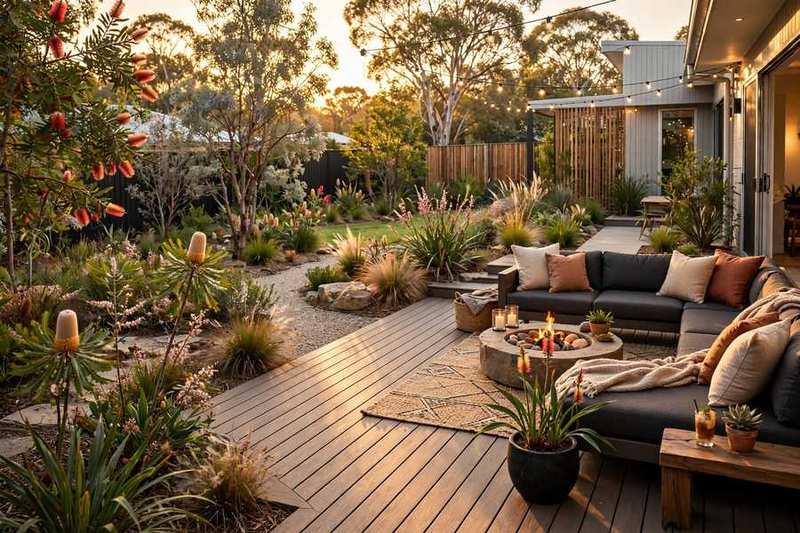
Ask an Australian agent what sells a house in 2026 and the answer is rarely the kitchen — it’s the outdoor room. The alfresco has become, in the words of one national property report, the most popular room in the house. The outdoor living trends for 2027 in Australia take that idea further: proper outdoor kitchens, rooms that work in July as well as January, planting that survives a dry summer, and backyards planned in zones like the interiors they extend.
These ten trends come with practical detail on materials, layouts and approximate costs in AUD — whether you’re refreshing a courtyard or planning a full backyard overhaul, these are the ideas that will still look right in five years.
Why 2027 is the year of the outdoor room
A few forces are converging. Australia’s renovation market keeps growing — industry estimates put national spending at around $48 billion in 2025 — and with property prices high, improving the home you have beats buying the next one. Outdoor projects are a natural pick: industry research suggests well-executed upgrades can return 60–100% of their cost at resale.
Longer, hotter summers make shade and cooling non-negotiable, while mild winters make a year-round outdoor room genuinely achievable. Add the lasting shift to entertaining at home, and the backyard is no longer a lawn with a barbecue — it’s floor space that has to perform.
10 outdoor living trends for 2027 in Australia
1. Multi-zone backyards
The single biggest shift in outdoor planning is zoning. Instead of one undifferentiated backyard, designers carve out distinct areas — cooking, dining, lounging, plus space for kids or a garden retreat — each with its own flooring, lighting and furniture, so the garden reads like a series of outdoor rooms.
Zoning doesn’t need a big block. A change in level, a screening wall of timber battens, or even an outdoor rug over a different paving pattern can define a zone. The payoff is a garden that hosts a dinner party and a quiet morning coffee at once — and feels much larger than its measurements. A zoned redesign of an average suburban backyard typically starts around $15,000 for landscaping and furnishings.
2. Proper alfresco kitchens
The humble barbecue on the patio is giving way to the full outdoor kitchen: built-in grill, benchtop, weatherproof cabinetry, sink, bar fridge, and increasingly a pizza oven. In 2026 it became one of the most requested alfresco additions, and the trend is accelerating into 2027.
A basic setup — built-in barbecue, benchtop and cabinet joinery — starts around $5,000 to $8,000 installed. A premium kitchen with stone benchtops, plumbed sink, under-bench refrigeration, pizza oven and custom cabinetry can reach $25,000 to $50,000 or more. Position it under a roofed structure, keep it within a few steps of the indoor kitchen, and run gas, water and power during the build — retrofitting services later is where budgets blow out.
3. Seamless indoor-outdoor flow
The wall between inside and out keeps dissolving. Wide sliding or stacking doors — and in new builds, full corner-opening systems — connect living areas to the alfresco so the two read as one space. The trick is continuity: complementary flooring running inside to out, aligned ceiling heights, and interior colours repeated on the patio.
A living room that opens fully to a covered alfresco effectively gains 25–30 square metres of usable space for much of the year. Even upgrading a standard slider to a wider stacking system (typically $4,000–$12,000 installed) transforms the connection.
4. Shade you can live under
Australia’s sun is the defining design constraint, and 2027’s answer is engineered shade: insulated roofing that keeps the alfresco measurably cooler, louvred roofs that open to winter sun and close against summer heat, and zip-track blinds that enclose the space against wind and afternoon glare.
Insulated patio roofing with ceiling fans is the workhorse — a quality covered alfresco with slab, structural roof, insulated ceiling and builder-installed lighting and fans typically runs $30,000–$60,000 in Sydney. Zip-track blinds add roughly $500–$1,500 per panel installed and stretch the usable season deep into the cooler months. Plan shade before summer: you’ll use a shaded outdoor room daily and an unshaded one hardly at all.
5. Composite decking goes mainstream
Timber decks are beautiful, but oiling every 6 to 18 months wears people down. Composite decking (brands like Trex and ModWood are widely available in Australia) has crossed into the mainstream: it looks close to real timber, needs little more than an occasional wash, and carries long warranties.
Installed, composite runs roughly $350–$600 per square metre, against $320–$500 for hardwoods like spotted gum or blackbutt and $200–$250 for treated pine — with the sub-frame adding around $225 per square metre regardless. Over 20 years, industry estimates put composite maintenance at just $1,000–$2,000 versus $6,000–$10,000 for hardwood oiling. For bushfire-prone and coastal homes, it’s often the most sensible choice full stop.
6. Fire pits and heaters for four-season use
An uncovered outdoor area in Sydney is usable maybe six months of the year; a covered, heated one stretches toward ten. Fire pits have become the centrepiece of the evening garden — a natural gathering spot needing no power and little maintenance. Built-in gas fire tables ($2,000–$6,000 installed) suit contemporary designs; wood-burning pits and chimineas ($500–$3,000) bring the crackle.
For covered areas, ceiling-mounted infrared heaters ($800–$2,500 per unit installed) warm people rather than air. Check council rules before installing a wood-burning pit — many urban councils restrict them, and gas or ethanol options sidestep the issue.
7. Lighting designed like an interior
Instead of a single floodlight, 2027 gardens get layered light: warm LED strips along deck steps and under bench seating, dimmable downlights in the alfresco ceiling, spike lights washing feature trees, and festoon or pendant lighting over dining zones. Solar path lights handle the basics for almost no running cost; wired 12V systems deliver the drama.
It’s a safety story too — lit steps and paths to the clothesline and side gate. Allow $150–$300 per installed downlight and $2,000–$6,000 for a designed garden lighting scheme. Put zones on separate switches so the garden shifts from dinner-party glow to late-night low.
8. Native, water-wise planting
The days of the thirsty exotic garden are numbered. Native and drought-tolerant planting — kangaroo paw, banksia, grevillea, westringia, lomandra and ornamental grasses — looks intentional and survives water restrictions and dry summers with minimal irrigation. Layer heights for a relaxed, naturalistic feel, and mulch well to hold moisture.
It’s the cheapest trend here to adopt: a bed refresh with native tube stock, fresh mulch and drip irrigation transforms a tired backyard for $2,000–$8,000. Drip on a timer (roughly $800–$2,500 installed) is the unsung hero — it keeps natives alive through establishment, then barely needs to run.
9. Bushfire-wise landscaping
For homes on the urban fringe or in regional areas, landscaping is a safety system as well as a design choice. The NSW Rural Fire Service’s guide to landscaping in fire-prone areas sets out the essentials: lower-flammability plants (succulents, broad fleshy leaves, high moisture content), garden beds separated from the house, spacing between plants, and non-combustible materials like stone and gravel near structures.
Practical moves: replace flammable mulch against the house with gravel or stone, prune lower shrub limbs, keep lawns mowed and hydrated through summer, and site timber features — pergolas, screens, sheds — away from the building. A well-designed defendable space can still be a beautiful garden; it just means choosing and placing plants with intent.
10. The small-space alfresco
The trends have caught up with apartment and townhouse living. Balconies and courtyards are being treated as genuine outdoor rooms: compact modular furniture, vertical gardens for privacy, a bistro set rather than a full dining suite, and layered pots in varying heights instead of one lonely planter.
The principles scale down — zoning works on a 20-square-metre courtyard, and one well-placed shade sail plus outdoor lighting makes a balcony usable most evenings. Check body corporate rules on structures and balcony planting before committing. A thoughtful small-space makeover — furniture, pots, lighting, shade — typically lands between $2,000 and $8,000, the highest joy-per-dollar on this list.
What will it cost? Outdoor living budgets for 2027
Every site is different, but current Australian guides give reliable starting points — use these as planning figures, then get local quotes.
| Project | Typical cost (AUD) |
| Timber decking, installed | $200–$600 per m² depending on material |
| Composite decking, installed | $350–$600 per m² |
| Patio or pergola structure | $15,000–$45,000 |
| Covered alfresco with insulated roof, lighting, fans | $30,000–$60,000 |
| Outdoor kitchen, basic | $5,000–$8,000 |
| Outdoor kitchen, premium | $25,000–$50,000+ |
| Zip-track blinds / cafe screens | $500–$1,500 per panel |
| Garden lighting scheme | $2,000–$6,000 |
| Native garden refresh with irrigation | $2,000–$8,000 |
| Landscaping, full backyard | $10,000–$50,000 |
As a rule of thumb, 10–15% of your home’s value is considered the sweet spot for outdoor spending at resale. For a detailed room-by-room breakdown, see our 2026 renovation costs guide.
Before you build: approvals and planning
The costliest mistake in outdoor projects is building first and asking council later. Broadly: ground-level decks under 600mm high and 25 square metres often qualify as exempt development; larger or roofed structures usually need a complying development certificate (typically 5–15 business days via a private certifier); heritage areas, flood zones and oversized builds need a full development application. Rules vary by state and council, so confirm locally before signing a contract.
Plan the whole project on paper first: sketch the zones, list the services (power, gas, water, drainage) and sequence the trades. Our free renovation planning tools help organise budgets and checklists before the first quote.
Find your outdoor style
An outdoor room should feel like your home, not a display centre. Coastal interiors call for pale timber, white and soft blue outside; contemporary homes suit clean lines, dark frames and architectural planting; period homes can handle a classic pergola and heritage colours. Not sure where you sit? Our two-minute interior design style quiz points you to the palette that fits — style doesn’t stop at the back door.
Frequently asked questions
What are the biggest outdoor living trends in Australia for 2027?
The standouts are multi-zone layouts, full alfresco kitchens, seamless indoor-outdoor flow, engineered shade, composite decking, fire pits and heaters, layered lighting, native water-wise planting, bushfire-wise landscaping, and small-space alfresco design for apartments.
How much does an alfresco renovation cost in Australia?
A quality covered alfresco with slab, structural roof, insulated ceiling, lighting and fans typically costs $30,000–$60,000 in Sydney. An outdoor kitchen ranges from $5,000–$8,000 basic to $25,000–$50,000+ premium. Decking adds roughly $200–$600 per square metre installed.
Do I need council approval for a deck or pergola?
It depends on your state and council. Ground-level decks under 600mm high and 25 square metres often qualify as exempt development; larger or roofed structures usually need a complying development certificate or development application. Always confirm with your local council before building.
What is the best decking material for Australian conditions?
Composite is increasingly popular for low maintenance — an occasional wash versus oiling timber every 6–18 months. Hardwoods like spotted gum look superb but need regular oiling; treated pine is the budget option. In bushfire-prone or coastal areas, composite or aluminium is often most practical.
How do I make my outdoor area usable in winter?
Combine a roofed structure with zip-track blinds to block wind, add infrared heaters or a fire pit, choose outdoor-rated cushions, and install warm lighting. Together these can extend an outdoor room from six months of use toward ten.