
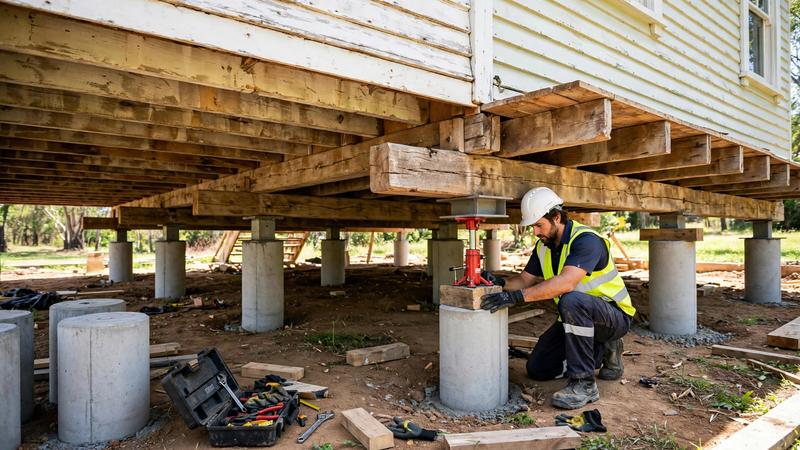
Restumping a house in Australia costs $10,000–$30,000 for most homes in 2026, or roughly $280–$700 per stump supplied and installed. A small cottage can come in at $10,000–$16,000, while a large period home with 60–90 stumps can reach $24,000–$38,000. In Victoria the same job is called “reblocking,” and reactive clay soils there often add $1,500–$3,000 in engineering and permits. This guide breaks down every cost driver — stump count, material, state, access — so you know exactly what to budget and what to ask contractors.
How Much Does House Restumping Cost in Australia? (2026)
There is no single national price because every house sits on a different number of stumps, in different soil, with different access. But across contractor price guides, engineering firms, and homeowner reports, a consistent picture emerges for 2026:
- National typical range: $10,000–$30,000 for an average home
- Per-stump rate: $280–$700 depending on material, state, and access
- Partial restump (a few stumps only): $3,000–$8,000
- Permits and engineering: $1,500–$3,000 (usually bundled into quotes)
Melbourne specialists tend to quote lower per-stump rates ($280–$550 for concrete) than the national engineering-firm average ($500–$700), largely because high-volume reblocking contractors in Victoria have streamlined the process. Brisbane quotes cluster around $500 per stump for steel, with a typical 3-bedroom Queenslander landing near $20,000 all-in.
The honest caveat: no single 2026 national survey of restumping costs exists. The figures below are compiled from contractor price guides, engineering firms, suppliers, and homeowner forums. Treat them as indicative ranges — and always get at least three written quotes for your specific house.
Restumping Cost by House Size
The number of stumps is the single biggest cost driver. This Melbourne 2026 breakdown from a specialist reblocking contractor is the most detailed published table available:
| Job size | Stump count (approx.) | Typical cost (2026) |
|---|---|---|
| Partial restump (a few stumps) | — | $3,000–$8,000 |
| Small home / cottage | 25–35 | $10,000–$16,000 |
| Average weatherboard home | 40–55 | $15,000–$24,000 |
| Larger / period home | 60–90 | $24,000–$38,000 |
Building permits and engineering reports ($1,500–$3,000) are typically included in these ranges rather than charged on top. For Brisbane Queenslanders, guides converge on $10,000–$30,000 for an average house with easy subfloor access, and a 3-bedroom home on ~30 stumps commonly lands around $20,000.
Stump Materials Compared: Concrete vs Steel vs Timber
What your stumps are made of affects both the upfront quote and how long you’ll wait before doing this again:
| Material | Per-stump (indicative) | Lifespan | Best for |
|---|---|---|---|
| Concrete | $280–$550 (Melbourne) / ~$500 (national) | 50+ years | Most homes — the standard recommendation. Termite-proof, moisture-resistant, low maintenance. |
| Galvanised steel (adjustable) | $500–$700+ | 50+ years | Reactive-soil areas (Melbourne’s west, Ipswich). Adjustable for future re-levelling; fast to install. |
| Timber (treated hardwood) | Lowest upfront | 15–25 years | Budget jobs only. Rots, attracts termites, and is being phased out — expect to restump again in your lifetime. |
Our take: concrete is the default choice for most Australian homes — it’s the cheapest long-life option. Galvanised adjustable steel is worth the premium if you’re on reactive clay (common across Melbourne and parts of south-east Queensland), because the house can be re-levelled later without replacing stumps. Timber stumps are a false economy: you’ll pay for the job twice.
Queensland vs Victoria: Why “Restumping” and “Reblocking” Cost Different Amounts
If you’re in Victoria, you’ll hear the word “reblocking” — in Queensland, it’s “restumping.” Same process, different regional terminology. But the costs genuinely differ between the states, and here’s why:
Soil conditions
Melbourne sits on reactive clay that swells when wet and shrinks when dry — exactly the movement that wrecks stumps. That means deeper footings, mandatory soil testing, and engineering reports. Budget an extra $1,500–$3,000 for permits and engineering in Victoria that you may not need in Queensland.
Regulation
Victoria requires a building permit plus a Regulation 126 Certificate of Compliance for reblocking work — your contractor usually arranges this. Queensland requires building approval through a private certifier or council. In both states, unpermitted structural work causes grief at sale or refinance time: banks routinely ask for proof the foundation work was compliant.
House type and stump height
Queensland’s high-set timber Queenslanders have generous subfloor clearance (common stump height 1.5m; up to 2.3m around Ipswich), which makes access easier — but taller stumps use more material. Victorian weatherboards and period homes often sit lower to the ground, so labour is harder even though the stumps are shorter.
What about NSW and WA?
Stump homes are less common in Sydney than in Brisbane or Melbourne, but the same national ranges apply — and permits are still required (Sydney contractors confirm council approval is needed). In WA, councils like the Town of Cottesloe explicitly list “reblocking or restumping” as permit-required work.
7 Signs Your House Needs Restumping
Most homeowners search for symptoms long before they search for costs. If you recognise several of these, get a professional inspection — catching stump failure early is always cheaper than fixing the damage it causes:
- Uneven or sloping floors — the earliest and most obvious sign. Furniture rolls, and you’ll notice gaps appearing under skirting boards.
- Cracks in walls and ceilings — especially diagonal cracks, stair-step cracks in brickwork, or cracks radiating from door and window frames.
- Doors and windows sticking — frames are no longer square because the house has settled unevenly.
- Bouncy, soft, or spongy floors — the stumps have lost bearing capacity and the floor structure is flexing.
- Visible stump damage — rot, termite mudding, or visibly leaning stumps if you can get under the house.
- Gaps between walls, floors, and ceilings — the house is no longer sitting evenly on its foundations.
- Creaking sounds or recent soil changes — new drainage problems, large tree roots nearby, or reactive soil movement after wet/dry extremes.
One or two mild symptoms might just need monitoring. Three or more — or any sudden change after heavy rain or drought — warrants a professional restumping inspection, which most contractors offer free or obligation-free.
Restumping vs Restumping + Raising: Should You Go Higher?
In flood-prone parts of Brisbane, many homeowners combine restumping with raising the house — lifting the whole structure to gain legal-height living space underneath or get above flood levels.
| Option | Typical cost | When it makes sense |
|---|---|---|
| Restump only (3-bed Queenslander) | $15,000–$25,000 | Stumps are failing but height and flood risk are fine. |
| Raise + restump | $30,000–$35,000 | You want extra living space or storage underneath. |
| Raise + restump (sloping block, full works) | $100,000+ | Flood protection plus stairs, slab, and services reconnection on difficult blocks. |
Raising adds serious value in Brisbane’s flood-affected suburbs, but it’s a different project with different approvals — budget for the engineering, the lift, new stairs, and reconnecting every service. Get a specialist raising quote separately; don’t assume your restumping contractor covers it.
What Affects Your Quote: 7 Price Factors
- Number of stumps — the dominant factor; more stumps, more labour and material.
- Subfloor access and clearance — tight, low crawl spaces slow everything down and push labour costs up.
- Stump material — concrete is the baseline; adjustable steel adds roughly $100–$200 per stump.
- Soil conditions — reactive clay means deeper footings, soil tests, and engineering reports.
- Full vs partial restump — replacing a handful of failed stumps ($3,000–$8,000) is far cheaper than the whole house, but partial jobs can mask systemic issues.
- Reusing existing footings — if old stump holes and concrete pads are sound, reusing them saves excavation cost.
- House height — very low houses may need excavation for access; very high houses are easier to work under but need more material per stump.
How Long Does Restumping Take? Will I Need to Move Out?
Most restumping jobs take 3–10 days: around 3–7 days for an average home, up to two weeks for large or complex houses. The good news: you usually don’t need to move out. Contractors work in stages, jacking and replacing sections progressively so the house stays structurally safe throughout.
Expect minor cosmetic fallout — the jacking process can pop doorframes out of alignment, crack a few tiles, or open hairline cracks in plaster. Reputable contractors repair this as part of the job; confirm it’s in your written quote. Properly installed concrete or steel stumps should last 50+ years, so this is genuinely a once-in-a-lifetime job for most homeowners.
And yes — you need a permit. Structural foundation work requires council approval in virtually every Australian LGA. Your contractor should handle the paperwork (in Victoria, that includes the Reg 126 certificate), but confirm it in writing before work starts.
Getting Quotes: What to Ask Restumping Contractors
- Is the quote per-stump or a fixed total — and how many stumps are included?
- Which stump material are you quoting, and why is it right for my soil?
- Are permits, engineering, and the Reg 126 certificate (VIC) included?
- Is cosmetic repair after jacking included in the price?
- What warranty do you offer on materials and workmanship?
- Can you provide two recent local references I can call?
Get three written quotes minimum. Be wary of any quote dramatically cheaper than the others — it usually means fewer stumps, cheaper materials, or skipped permits. For a broader sense of what structural work costs in the context of a full project, see our house renovation cost per square metre guide.
Frequently Asked Questions
How much does it cost to restump a house in Australia in 2026?
Most Australian homes cost $10,000–$30,000 to restump in 2026, or $280–$700 per stump. Small cottages start around $10,000–$16,000; large period homes can reach $24,000–$38,000. Always get three written quotes — every house is different.
What is the difference between restumping and reblocking?
Nothing structural — it’s regional terminology. Victoria calls the process “reblocking” while Queensland (and most other states) calls it “restumping.” If you’re getting quotes in Melbourne, search for reblocking contractors; in Brisbane, search for restumping.
How long do house stumps last?
Concrete and galvanised steel stumps last 50+ years when properly installed — effectively a once-in-a-lifetime job. Treated timber stumps last only 15–25 years and are being phased out across the industry.
Do I need council approval to restump my house?
Yes, in almost all cases. Structural foundation work requires a building permit from your council or a private certifier. In Victoria you’ll also need a Regulation 126 Certificate of Compliance. Unpermitted work can cause problems when selling or refinancing.
Can I stay in my house during restumping?
Usually yes. Contractors restump in stages, keeping the house structurally supported throughout. Most jobs take 3–10 days and homeowners stay put — confirm the schedule with your contractor before work begins.
Is it cheaper to restump or demolish and rebuild?
Restumping ($10,000–$30,000) is dramatically cheaper than demolishing and rebuilding, which typically costs hundreds of thousands. Restumping makes sense when the house structure above the stumps is sound. If the house itself is failing, get a builder’s assessment before committing.
Does restumping add value to my house?
Restumping rarely adds value above market — but failed stumps actively destroy value and can make a house unsellable or uninsurable. Think of it as protecting your existing equity rather than creating new value. For more on which renovations actually add value, see our renovation ROI guide.
How do I know if I need restumping or just re-levelling?
Re-levelling (re-packing or adjusting existing stumps) suits houses where stumps are sound but the house has settled slightly. Full restumping is needed when stumps are rotted, termite-damaged, or structurally failed. A professional inspection — often free — will tell you which applies. If your stumps are timber and over 20 years old, budget for full replacement.
Plan Your Renovation Budget
Restumping is often the first — and most urgent — step in renovating an older home. Once your foundations are solid for the next 50 years, you can plan the visible work with confidence. Use our free renovation cost calculators to budget the kitchen, bathroom, and extension work that comes next — and browse our house extension cost guide if you’re thinking bigger.
Prices in this guide are indicative 2026 ranges compiled from contractor price guides, engineering firms, and homeowner reports. Every house is different — get at least three written quotes from licensed contractors in your area before committing.