
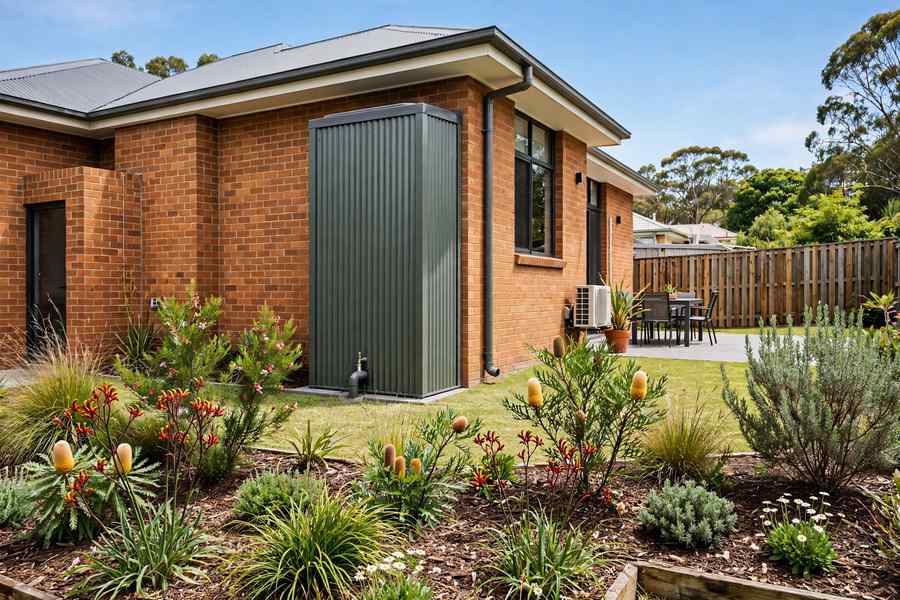
A rainwater tank in Australia costs $900–$12,000 installed in 2026, depending on size, material and how far you plumb it into your home. A basic above-ground poly tank for garden use starts around $900–$2,400 fully set up, while a large steel tank plumbed to your toilets and laundry lands at $2,300–$5,500. Underground systems run $3,500–$12,000. This guide breaks down every cost — tank prices by size and material, installation, pumps, council approvals, the honest truth about 2026 rebates, and how long it actually takes to pay for itself.
How Much Does a Rainwater Tank Cost in Australia? (2026)
There is no single price because a tank is really three purchases in one: the tank itself, the installation (base, plumbing, pump), and any extras like council permits. Across live Australian retailer listings and trade cost guides checked in October 2026, the picture is consistent:
- Garden-only setup (small poly, DIY-friendly): $900–$2,400 installed
- Household steel tank (plumbed to toilet/laundry): $2,300–$5,500 installed
- Underground poly: $3,500–$8,000 installed
- Concrete underground: $5,000–$12,000 installed
- Retrofit plumbing into an existing home: up to ~$10,000 extra for new fittings and labour
The honest caveat: no single 2026 national price survey exists. The figures below are compiled from live retailer listings (Stratco, Kingspan, Bushmans, Clark Tanks, Bunnings and others, all checked October 2026) and trade cost guides. Treat them as indicative ranges — and always get at least three written quotes for your property.
Rainwater Tank Prices by Size and Material (Tank Only)
The tank itself is the biggest single cost. Polyethylene (poly) is the cheapest per litre; steel (Aquaplate/Colorbond) costs roughly twice as much but carries a longer warranty; concrete is mainly used for underground installations.
Polyethylene (poly) tanks
| Size | Shape | Price (AUD incl. GST) |
|---|---|---|
| 5,000L | Round | $1,063–$1,195 |
| 5,000L | Slimline | $1,945–$2,150 |
| 5,000L | Slimline (premium) | ~$2,970 |
| 10,000L | Round | $2,425–$2,450 |
| 10,500L | Corrugated | $2,739 |
| 13,500L | Round | $2,215–$2,375 |
| 22,700L | Round | $3,100 (sale) |
| 25,000L | Round | $3,880 |
Poly tanks typically carry a 10-year warranty (QTank, Clark Tanks), with Stratco’s Boabab offering a 25-year pro-rata warranty. The slimline premium is real: the same litres in a slimline shape costs 60–100% more than a round tank — you pay for the space saving. Delivery is often extra at $99–$325+ depending on your zone.
Steel (Aquaplate/Colorbond) tanks
| Size | Shape | Price (AUD incl. GST) |
|---|---|---|
| 5,000L | Round | $2,435–$2,600 |
| 5,000L | Slimline | $3,265 |
| 5,000L | Modline | $2,970–$3,755 |
| 5,000L | Square | $3,285–$3,380 |
| 10,000L | Slimline | $5,454 |
Steel costs roughly double poly at the same capacity, but Kingspan backs its tanks with a 20-year corrosion warranty plus 10-year construction warranty, versus 10 years for most poly. Kingspan also offers made-to-measure slimline tanks from 600L to 10,000L in custom sizes — useful for awkward side passages.
Concrete tanks
Above-ground concrete rainwater tanks are uncommon in Australian residential retail. Concrete is mainly used for underground installations: expect $3,000–$8,000 for the tank plus $2,000–$4,000 labour, or $5,000–$12,000 total installed.
Installation Cost Breakdown (2026)
Installation is where quotes vary most. A Hipages 2026 cost guide breaks it down as follows:
| Component | Typical cost |
|---|---|
| Plumbing connections | $500–$1,650 |
| Base preparation (concrete pad or sand) | $200–$500 |
| Pump installation | $300–$500 |
| Council permits | Up to ~$200 |
Total installed cost by system type:
| System | Total installed estimate |
|---|---|
| Small above-ground poly (garden use) | $900–$2,400 |
| Large above-ground steel (household) | $2,300–$5,500 |
| Underground poly | $3,500–$8,000 |
| Concrete underground | $5,000–$12,000 |
Retrofit warning: connecting tank water to toilets and laundry in an existing home can cost up to ~$10,000 for new fittings and labour. On a new build, the marginal extra cost is small — which is why tanks make most financial sense when planned from day one.
Pump Costs
If your tank feeds anything beyond a garden hose, you’ll need a pump — and where tank water is plumbed indoors, plumbing code requires an automatic mains-switching device (often called a RainBank or rain-to-mains switch) so the system falls back to mains water when the tank runs dry.
| Pump setup | Price (AUD) |
|---|---|
| Davey pressure pump + RainBank auto-switch (single storey) | $1,040–$1,299 |
| Davey pressure pump + RainBank (double storey) | $1,445–$1,499 |
| Davey submersible pump | $339 |
| Budget garden/irrigation pump | $160–$210 |
Budget for a pump replacement roughly every 10 years (~$1,000), and about $0.36 per kilolitre in electricity to run it.
Rainwater Tank Rebates in 2026: The Honest Truth
Here’s what you need to know upfront: there are no broad state-government rainwater tank rebates operating in 2026. The old programs — Victoria’s Living Victoria, Water Smart Gardens & Homes and similar — ended years ago. Anyone telling you otherwise is working from outdated information.
What does exist in 2026 is council-level and regional water-authority rebates. These are real, current, and worth checking — but they’re local, capped, and come with conditions. Verified active programs as of October 2026:
| Council / Authority | Rebate | Key conditions |
|---|---|---|
| Armidale NSW | $250 (2,000–10,000L); $500 (10,000L+) | Licensed plumber; limited funding |
| Randwick NSW | 25% up to $250 (household); up to $2,000 (apartments) | Min 1,000L; installed within 12 months |
| Rous County Council NSW (Ballina, Byron, Lismore, Richmond Valley) | $200–$1,000 by size | Min 2,000L; town-water connected |
| Water Corporation WA (regional towns) | Varies by town | Scheme-water connected; eligible towns list |
| City of West Torrens SA | $100–$400 by size (+$50–$100 if plumbed in) | 1,000L+; residential |
| Rockhampton QLD | $250 standalone / $500 integrated | Min 5,000L; integrated = plumbed to toilet/laundry |
How to Check Your Council’s Rebate
- Search “[your council name] rainwater tank rebate” — most councils list current programs on their water or sustainability pages.
- Check your water authority too (not just the council) — regional authorities like Rous County Council and Water Corporation WA run their own schemes.
- Ask about conditions before you buy: most rebates require a licensed plumber, minimum tank size, and installation within a set timeframe. Some exclude tanks that were already required under BASIX or development consent.
- Apply early — several programs note “until funds exhausted.”
Do You Need Council Approval?
For most above-ground tanks under 10,000L, the answer is no — but check your local rules. In NSW, tanks up to 10,000L are generally exempt development provided setback and height rules are met (larger tanks need approval). In other states, rules vary by council. Two constants everywhere: tanks plumbed indoors always need a licensed plumber and backflow prevention device, and it’s always worth a five-minute check of your council’s website before you order.
Payback Period: How Long Until a Tank Pays for Itself?
This is where honesty matters more than hype. A Swinburne University and Yarra Valley Water study of 6,390 Melbourne households found tanks saved an average of 137 litres per day (22.7%), with a payback period of 12.5–16.8 years depending on tank size — larger tanks plumbed to toilet, laundry and garden paid back fastest.
The honest caveats:
- Academic modelling for Sydney shows payback can range from 20 to 101 years depending on water prices, rainfall, roof area and usage. Payback is highly variable.
- Garden-only tanks have the longest payback. It’s the indoor plumbing — toilet flushing and laundry — that drives real savings.
- Don’t buy a tank purely as an investment. Buy it for water security, garden health during restrictions, and modest bill savings over a long horizon.
Ongoing Maintenance Costs
Tanks are low-maintenance but not no-maintenance. Budget roughly $150–$250 every five years for gutters, first-flush diverters, inlet screens and the occasional desludge. Plan on a pump replacement about every 10 years (~$1,000). Expected lifespans: poly 20–25 years, steel 20+ years (warranty-backed), concrete 30+ years.
The Bottom Line
For most Australian households in 2026, a sensible rainwater tank setup costs $2,000–$5,500 installed — a mid-size poly or steel tank on a proper base, plumbed to at least the garden and ideally the laundry and toilets. Check your council for a rebate before you buy (it could shave $250–$1,000 off), get three quotes, and go in with honest expectations: this is a 12-to-17-year payback, not a get-rich-quick scheme. Done right, though, it’s one of the most satisfying home improvements you can make — lower bills, a healthier garden, and water security when restrictions bite.
Prices checked against live Australian retailer listings in October 2026. Always confirm current pricing with suppliers before purchasing.
Frequently Asked Questions
How much does a 5,000L rainwater tank cost in Australia?
A 5,000L poly tank costs $1,063–$2,150 for the tank alone depending on shape (round is cheapest, slimline costs 60–100% more). A 5,000L steel tank costs $2,435–$3,755. Installed with base and basic plumbing, budget $1,500–$3,500 for poly or $3,000–$5,500 for steel.
Are there government rebates for rainwater tanks in 2026?
There are no broad state-government rebates in 2026 — the old programs ended years ago. However, several councils and regional water authorities offer rebates: Armidale NSW ($250–$500), Randwick NSW (25% up to $250), Rous County Council NSW ($200–$1,000), Rockhampton QLD ($250–$500), City of West Torrens SA ($100–$400), and Water Corporation WA (regional towns). Check your council’s website before buying.
How long does it take for a rainwater tank to pay for itself?
A Swinburne University study of Melbourne households found payback of 12.5–16.8 years for tanks plumbed to toilet, laundry and garden. Garden-only tanks take longer. Payback depends heavily on your water prices, rainfall, roof size and usage — Sydney modelling ranges from 20 to 101 years in extreme cases.
Do I need council approval for a rainwater tank?
Most above-ground tanks under 10,000L don’t need approval, but setback and height rules apply — and rules vary by council. In NSW, tanks over 10,000L need approval. Tanks plumbed indoors always require a licensed plumber and a backflow prevention device. Always check your local council first.
What size rainwater tank do I need?
For garden-only use, 2,000–5,000L is usually enough. For toilet and laundry connection, 5,000–10,000L is the sweet spot for most households. Larger families or big gardens may benefit from 13,500–25,000L. Your roof catchment area matters too — there’s no point buying a 25,000L tank if your roof can only fill half of it.
Is a poly or steel tank better?
Poly is cheaper (roughly half the price of steel at the same capacity) and fine for most homes, with 10-year warranties typical. Steel costs about double but carries 20-year corrosion warranties and offers custom made-to-measure sizes. For underground installation, concrete ($5,000–$12,000 installed) lasts 30+ years.
How much does it cost to plumb a rainwater tank into the house?
On a new build, the extra cost is marginal. Retrofitting tank water to toilets and laundry in an existing home can cost up to ~$10,000 for new fittings and labour. You’ll also need a pump ($160–$1,500 depending on type) and an automatic mains-switching device where tank water is plumbed indoors.