
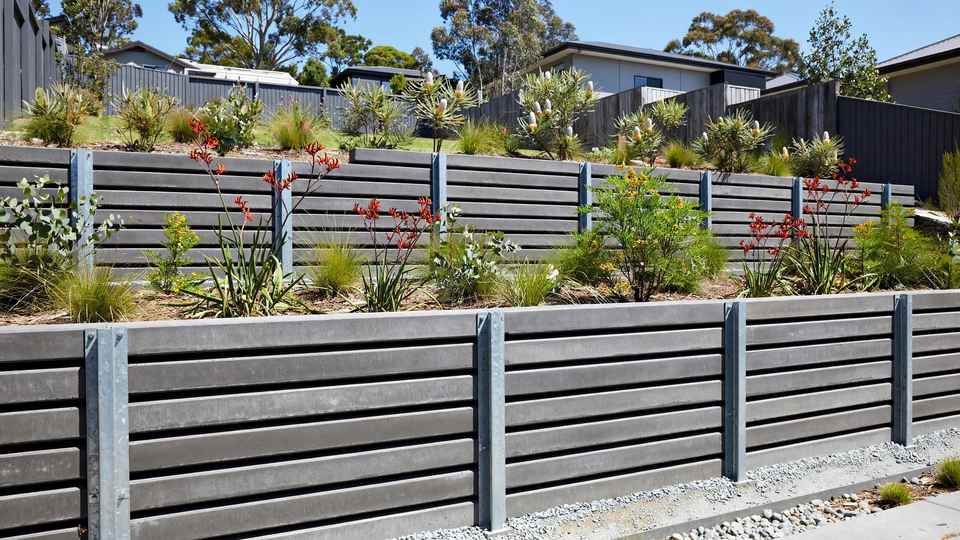
Retaining walls in Australia cost $200–$750 per square metre installed in 2026, depending on the material you choose. A basic timber sleeper wall sits at the budget end ($200–$400/m²), mid-range concrete sleepers or blocks run $280–$550/m², and premium stone or sandstone can reach $400–$750/m². For a typical 10-metre-long, 1-metre-high wall (10m²), expect to pay roughly $2,500–$7,500 for a professional installation including drainage.
But here’s what most cost guides don’t tell you: the material is not the most important decision. What happens behind the wall — the drainage, the backfill, the soil preparation — matters more for longevity than whether you pick timber or concrete. Old timber walls with proper drainage routinely outlast brand-new concrete walls without it. Get the drainage wrong and even a $20,000 wall can start leaning within a few years.
This guide breaks down retaining wall costs by material, the hidden extras that blow out budgets, council approval rules by state, and the drainage secret that determines whether your wall lasts 15 years or 50.
Retaining Wall Costs by Material (2026)
These are installed prices per square metre from Australian retaining wall builders, current as of October 2026. Prices include materials and labour but not always drainage, engineering, or council fees — more on those below.
| Material | Cost per m² (installed) | Lifespan | Best for |
|---|---|---|---|
| Timber Sleeper | $200–$400 | 15–25 years | Budget garden walls, DIY-friendly |
| Concrete Block | $250–$500 | 50+ years | Modern look, good value |
| Concrete Sleeper | $280–$550 | 50+ years | Most popular — durable, low maintenance |
| Rock / Boulder | $300–$700 | 100+ years | Natural aesthetic, large blocks |
| Gabion (wire cage + rock) | $350–$650 | 50–100 years | Industrial-modern look, great drainage |
| Limestone | $350–$650 | 50+ years | Coastal WA/SA classic |
| Sandstone | $400–$750 | 100+ years | Premium, heritage look (Sydney/National) |
| Brick | $250–$650 | 50+ years | Matching existing brickwork |
Sources: retainingwallbuildersadelaide.com.au, servicetasker.com.au cost guides, October 2026.
What Does a Typical Retaining Wall Project Cost?
Per-square-metre rates are useful for comparing materials, but most homeowners think in total project cost. Here’s what real projects look like:
| Project size | Example | Typical total (installed) |
|---|---|---|
| Small garden wall | 5m long × 0.6m high (3m²), timber | $2,000–$4,000 |
| Standard boundary wall | 10m long × 1m high (10m²), concrete sleeper | $4,000–$7,500 |
| Terraced backyard | 20m long × 1.2m high (24m²), concrete block | $8,000–$16,000 |
| Large engineered wall | 30m+ with engineering, stone finish | $20,000–$50,000+ |
| Sloping block, multi-tier | Complex site, poor access | $50,000–$100,000+ |
Installation typically takes 2 days to 2 weeks depending on size and complexity, according to Adelaide builders.
The Hidden Costs Most Quotes Don’t Include
This is where budgets blow out. A quote for “$350/m²” might not include:
Drainage ($100–$300 per lineal metre)
Proper drainage — agricultural pipe (ag pipe), geotextile fabric, and gravel backfill — adds $100–$300 per lineal metre. It’s the single most important part of the wall and the most commonly skipped. A wall without drainage is a wall with an expiry date.
Engineering fees ($800–$2,000)
Required for walls over 1 metre in most states. A structural engineer designs the footing and certifies the wall. Budget $800–$2,000 for a standard residential design.
Council approval fees
Development application or building permit fees vary by council — typically a few hundred dollars, but the process can add weeks to your timeline.
Site preparation and spoil removal
Excavation, removing excess soil, and dump fees. On a $5,000 project, the rough breakdown is typically: materials ~33%, labour ~33%, and sand/rubble/dump fees/earthworks ~33%.
Rendered and painted finishes
A fully rendered block wall (footings, reinforcement, waterproofing, rendering, priming, painting) is a multi-stage build. Brisbane builders quote these from $2,000/m² + GST — dramatically more than the base block rate.
Always ask: “Does this quote include drainage, engineering, council fees, and spoil removal?” Get the answer in writing.
Council Approval Rules by State
Retaining wall regulations differ across Australia. The general rule: anything over 1 metre needs engineering and council approval. But some states are stricter:
| State | Approval threshold | Notes |
|---|---|---|
| NSW | Over 600mm | Council permission needed above 600mm from ground level |
| VIC | Over 1 metre | Building permit required; engineer certification needed |
| QLD | 1 metre+ (Gold Coast) | Building approval for walls 1m or more; rules vary by council |
| SA | Over 1 metre | Usually no approval under 1m unless supporting a driveway or structure |
| WA | Over 500mm (some councils) | Check with your local council — thresholds vary |
Sources: gorillawall.com.au regulations guide, tjrconstruct.com.au (Adelaide).
Other triggers for approval regardless of height:
- Wall is close to a boundary (usually within 900mm–1.5m)
- Wall supports a driveway, building, or other structure
- Wall is near a sewer main or easement (minimum 1m clearance)
- Significant cut or fill (over 600mm) is involved
Always call your local council before starting. It takes five minutes and can save you from a stop-work order.
Timber vs Concrete: Which Should You Choose?
This is the most common decision Australian homeowners face. Here’s an honest comparison:
Timber sleepers ($200–$400/m²)
Pros: Cheapest upfront, DIY-friendly, natural look that suits gardens, quick to install.
Cons: 15–25 year lifespan, susceptible to termites and rot (use H4-treated timber minimum), needs regular inspection, will eventually need replacing.
Verdict: Great for low garden walls under 1m where you want to keep costs down. Not ideal for structural walls holding back significant soil.
Concrete sleepers ($280–$550/m²)
Pros: 50+ year lifespan, zero maintenance, termite-proof, rot-proof, available in wood-look and stone-look finishes, Australia’s most popular choice.
Cons: Higher upfront cost, heavier (needs machinery for install), less “natural” looking than real timber or stone.
Verdict: Best long-term value for most Australian homes. The extra upfront cost pays for itself when you don’t have to rebuild in 20 years.
The total cost of ownership argument
A $4,000 timber wall replaced once in 25 years costs $8,000 over 50 years (plus the hassle). A $6,500 concrete sleeper wall lasts 50+ years with no maintenance. Concrete is cheaper over the wall’s lifetime — even though timber wins on day one.
Drainage: The Secret Behind Every Long-Lasting Wall
Here’s the unique insight most cost guides miss: the wall behind the wall matters more than the wall itself.
When it rains, water builds up in the soil behind your retaining wall. Without an escape route, hydrostatic pressure pushes against the back of the wall with every storm. Over months and years, this pressure causes leaning, bulging, cracking, and eventually failure.
The old timber sleeper walls from the 1990s still standing in Melbourne suburbs? Nearly all of them have gravel backfill and an ag pipe draining water away. The builders didn’t know they were doing engineering — they just remembered someone telling them to “put rocks behind the wall so it drains.”
Proper drainage includes:
- Ag pipe (slotted agricultural pipe) at the base, behind the wall
- Gravel or scoria backfill (300mm+ wide) directly behind the wall face
- Geotextile fabric separating gravel from soil (stops silt clogging the system)
- Weep holes or outlets directing water away from the wall
Budget $100–$300 per lineal metre for drainage. It’s the best money you’ll spend on the entire project.
DIY vs Professional: What’s the Real Saving?
DIY is realistic for low timber walls under 1 metre on flat ground with good access. You’ll save roughly the labour component (~33% of project cost) but you’ll need to:
- Dig and level the footing trench by hand (or hire a mini-excavator)
- Source and transport materials (sleepers are heavy)
- Install drainage correctly (the part most DIYers skip)
- Dispose of excess soil (skip bin: $300–$600)
A realistic DIY budget for a 10m × 0.8m timber sleeper wall: $1,500–$3,000 in materials, drainage, and skip hire — versus $3,500–$5,000 professionally installed.
Hire a professional for: walls over 1m, concrete/block/stone (heavy materials), poor or reactive soil, restricted access, walls supporting driveways or structures, or any wall needing engineering.
7 Warning Signs Your Retaining Wall Needs Attention
- Leaning or tilting — the wall is moving under soil pressure
- Bulging in the middle — hydrostatic pressure building behind the face
- Cracking — especially horizontal cracks in mortar or concrete
- Water pooling behind or at the base after rain
- Soil washing out from under or around the wall
- Rotting timber — soft spots, fungal growth, termite mudding
- Separation from adjacent structures — gaps opening at joins
Any of these warrant a professional inspection. Catching problems early can mean a $2,000 repair instead of a $15,000 rebuild.
Retaining Wall Maintenance: Protecting Your Investment
A retaining wall isn’t a “set and forget” structure. Annual inspection takes 15 minutes and catches problems while they’re cheap to fix:
- Clear drainage outlets — check ag pipe outlets and weep holes aren’t blocked by soil, mulch, or roots. Blocked drainage is the fastest path to wall failure.
- Inspect for movement — stand back and sight along the wall face. Any new lean, bow, or step-cracking deserves a professional look.
- Control vegetation — tree roots can push through joints and displace blocks. Keep large plants at least 1–2 metres from the wall face.
- Timber treatment — reapply a timber preservative or oil every 2–3 years to slow rot and extend the life of sleeper walls.
- Repoint and seal — for brick, block, or stone walls, repair cracked mortar joints promptly to stop water getting behind the face.
Most maintenance costs nothing but your time. The expensive repairs come from ignoring small problems until they become structural ones.
How to Get the Best Price
- Get 3+ quotes — and compare what’s included, not just the headline rate. Ask specifically about drainage, engineering, and spoil removal.
- Time it right — landscapers are busiest September to April. Winter (May–August) can mean better pricing and shorter wait times.
- Consider total cost of ownership — not just day-one price. A concrete wall that lasts 50 years beats a timber wall replaced twice.
- Bundle with other landscaping — if you’re already getting excavation done, adding a wall is cheaper than a standalone job.
- Fixed-price contracts — insist on fixed pricing with a clear scope. The one thing no builder can guarantee is what’s underground (rock), so understand where the fixed scope ends.
Planning a Retaining Wall? Start With Our Free Tools
Before you call a builder, get a rough estimate with our free renovation cost calculators — and read our related guides on house restumping costs and rainwater tank costs if you’re tackling a bigger backyard project.
Frequently Asked Questions
How much does a retaining wall cost per square metre in Australia?
Retaining walls cost $200–$750 per square metre installed in 2026. Timber sleepers are cheapest ($200–$400/m²), concrete sleepers and blocks are mid-range ($250–$550/m²), and stone or sandstone are premium ($400–$750/m²). Drainage, engineering, and council fees are often extra.
Do I need council approval for a retaining wall?
Usually yes if the wall is over 1 metre high. NSW requires permission above 600mm, while VIC, QLD, and SA generally require approval at 1m+. Always check with your local council — rules on boundary distances and easements also apply.
How long do retaining walls last?
Timber sleeper walls last 15–25 years. Concrete sleepers, concrete blocks, and limestone last 50+ years. Rock, boulder, and sandstone walls can last 100+ years. Drainage quality affects lifespan more than material choice.
Can I build a retaining wall myself?
Yes, for low timber walls under 1 metre on straightforward sites. DIY saves roughly a third of the project cost (the labour component). Hire a professional for walls over 1m, heavy materials like concrete or stone, poor soil, or any wall needing engineering certification.
What is the cheapest retaining wall to build?
Timber sleeper walls are cheapest at $200–$400/m² installed, or $1,500–$3,000 in materials for a DIY 10m × 0.8m wall. However, timber needs replacing in 15–25 years, making concrete sleepers cheaper over a 50-year lifetime.
Why do retaining walls fail?
Poor drainage is the #1 cause. Water builds up behind the wall, creating hydrostatic pressure that causes leaning, bulging, and cracking. Other causes include inadequate footings, reactive clay soil, and overloading (e.g., parking on soil above the wall).
How deep should a retaining wall footing be?
As a rule of thumb, the footing should be buried to at least one-third of the wall’s visible height, or a minimum 150–200mm for low garden walls. Walls over 1m need engineer-designed footings — don’t guess on structural walls.
Does a retaining wall add value to my property?
A well-built retaining wall that creates usable flat land, prevents erosion, or improves drainage can add value — particularly on sloping blocks where it unlocks usable yard space. Buyers view quality landscaping as a premium feature, though you rarely recoup 100% of the cost.
Last updated: October 2026. Prices are indicative installed rates from Australian builders and cost guides; always get 3+ written quotes for your specific site.