
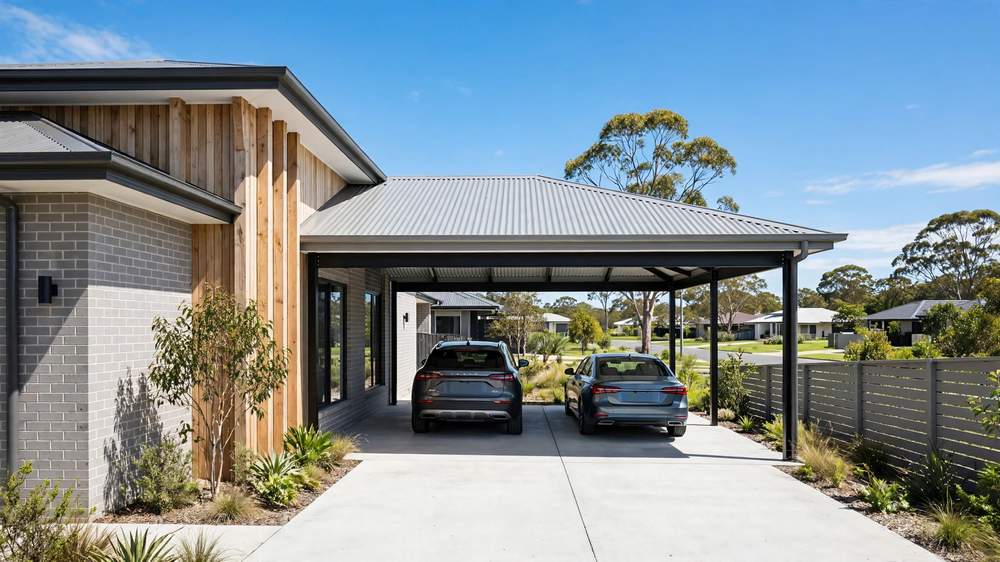
A carport in Australia in 2026 costs anywhere from $1,700 for a basic single steel kit you assemble yourself, to $25,000+ for a premium custom-built double carport with a concrete slab and professional installation. Most homeowners land somewhere in the middle: a quality double carport kit runs $3,500–$6,000 for materials, while a custom-built Colorbond double typically costs $6,000–$12,000 installed.
The final price hinges on four decisions: kit versus custom build, single versus double, your choice of material, and how much site work (slab, excavation, council approval) your block needs. This guide breaks down every cost with real 2026 Australian pricing, so you can budget accurately before you buy.
Carport Costs at a Glance
| Carport type | Kit only (materials) | Custom built (supply + install) |
|---|---|---|
| Single carport | $1,700–$4,000 | $4,500–$7,000 |
| Double carport | $2,700–$6,000 | $6,000–$12,000+ |
| Triple / multi-vehicle | $7,600+ | $15,000+ |
Those figures are for the structure itself. Budget extra for a concrete slab ($2,300–$3,800 for a standard double), council approval fees ($300–$1,200+), and any excavation your site needs — we itemise those below.
Carport Kit Prices in Australia (2026)
DIY kits are the cheapest way to get a carport. You get engineered steel components, roof sheeting, gutters and fixings delivered flat-packed, and either assemble it yourself or pay a handyman to do it. Here is what kits actually sell for right now:
| Kit | Size | Price from |
|---|---|---|
| YardPro single, flat roof (zinc) | 3m × 5.5m | $1,739 |
| YardPro single, flat roof (colour) | 3m × 5.5m | $1,749 |
| YardPro double, flat roof (zinc) | 5.9m × 5.5m | $2,699 |
| YardPro double, flat roof (colour) | 5.9m × 5.5m | $2,839 |
| Fair Dinkum single, skillion | 3m × 6m | $3,405 |
| Fair Dinkum double, skillion | 6m × 6m | $4,679 |
| Fair Dinkum triple, skillion | 9m × 6m | $7,619 |
| Excalibur single, gable | 3m × 6m | $4,927 |
| Excalibur double, gable | 6m × 6m | $6,477 |
| Excalibur extra-large double, gable | 7m × 7m | $8,427 |
A few things those kit prices do not include: delivery (typically $300–$400), the concrete slab or footings, council approval fees, and installation labour if you are not doing it yourself. A basic single kit starts around $800–$3,000 for the steelwork alone, and most suppliers include site-specific engineering drawings — worth $500–$2,000 if you had to commission them separately — which you will need for council approval.
Most single kits go up in one to two days with two people on the tools. A double or gable-roof kit is more realistically a full weekend job, and that excludes the time concrete footings need to cure.
Custom-Built Carport Costs
A custom build means a builder designs and constructs the carport for your exact site — matching your roofline, dealing with slopes, and handling the slab and approvals. You pay more, but you get a structure that looks like it was always part of the house.
| Custom build | Price range |
|---|---|
| Single, Colorbond skillion | from $4,000 |
| Single, general custom | $4,500–$7,000 |
| Double, Colorbond skillion | $6,116–$8,409 |
| Double, Colorbond gable | from $9,174 |
| Double, general custom | $6,000–$12,000+ |
| Double, premium (hip roof, extras) | $10,703–$25,000+ |
Roof style is the biggest cost lever on a custom build. Flat or skillion roofs are the simplest and cheapest; gable roofs add complexity and start around $9,174 for a double; hip roofs are the premium option from about $10,703. A fully custom double with Colorbond roofing, concrete slab and all the extras can easily pass $15,000.
Single vs Double Carport: What Is the Price Difference?
Doubling the cars does not double the price — but it adds more than you might expect. A single steel kit starts around $1,739 while the equivalent double is about $2,699, roughly 55% more. On custom builds the gap widens: a single averages $4,500–$7,000 installed versus $6,000–$12,000+ for a double.
The standard double is 6m × 6m (36m²), and that extra span is where the money goes: longer beams, more posts, more roof sheeting, and a bigger slab. If you are tossing up between sizes, remember that a double carport is one of the cheapest ways to add covered space to a property — and many buyers specifically look for double undercover parking.
Material Showdown: Colorbond vs Timber vs Aluminium vs Galvanised Steel
| Material | Cost range | Lifespan | Maintenance |
|---|---|---|---|
| Colorbond steel | Kits from $2,000; installed $5,000–$10,000 | 50+ years | Hose down twice a year |
| Galvanised steel | $1,400–$3,000 (double kit) | 20–30 years | Low; watch for scratches |
| Timber | $4,000–$10,000 (single structure) | 25–40+ years | Stain/seal regularly; termite checks |
| Aluminium | Higher upfront than timber | 20+ years | Minimal; rinse in coastal areas |
Colorbond steel is the default choice for most Australian carports, and for good reason. It is Australian-made for local conditions, comes in 22 colours, carries a 30-year corrosion warranty, and its Thermatech coating reflects heat — your car genuinely stays cooler underneath it. Expect 40–70 years of service in practice.
Galvanised steel is the budget metal option. Zinc-coated rather than painted, it costs less upfront but will not win any beauty contests, and any scratch in the coating is a future rust spot.
Timber suits period homes where a steel structure would look out of place. It costs $4,000–$10,000 for a single structure and needs ongoing care — re-staining every few years and vigilance against termites — but a well-built hardwood carport can last 40–60+ years and arguably adds more street appeal than metal.
Aluminium is the coastal specialist: naturally rust-proof, lightweight, and 30–40% cheaper to maintain than steel or timber near salt water. The catch is a higher purchase price than timber for comparable sizes.
Installation and Extra Costs Most Quotes Leave Out
The kit or build price is only part of the story. These are the extras that catch people out:
- Concrete slab: $91.74–$137.61 per square metre — about $2,293–$3,822 for a standard 36m² double carport.
- Excavation and site preparation: $765–$2,293, more if your block slopes or needs retaining.
- Concrete footings: $300–$1,500+ if you are not pouring a full slab.
- Professional installation labour: $1,529–$3,822 on top of the kit price.
- Council approval fees: $300–$1,200+ (around $765 is typical).
- Engineering drawings: $500–$2,000 if your kit supplier does not include them — most reputable ones do.
- Gutters and downpipes: often included in kits; allow a few hundred dollars if not.
A realistic all-in budget for a double carport, then: a $2,700–$4,700 kit, plus $2,300–$3,800 for the slab, plus $300–$1,200 for council, plus installation if you are not DIY. That is why a “cheap” $2,700 kit can become a $6,000–$8,000 project once everything is counted.
Do You Need Council Approval for a Carport?
In most cases, yes — but many standard carports qualify as exempt development, meaning no formal approval is needed as long as you meet your state’s criteria. The rules differ by state:
- NSW: Exempt if the carport is ≤20m² on lots of 300m² or less (≤25m² on larger lots), no higher than 3m, at least 1m behind the building line, set back 900mm from side and rear boundaries, and at least two sides plus one-third of the perimeter stay open.
- Victoria: Exempt if under 10m² in area, no taller than 3m, and more than 1m from property boundaries.
- ACT: Unenclosed carports are exempt from development approval if the roof plan is ≤50m², height ≤3m, no more than two walls, and it sits behind the building line.
Always confirm with your local council before you build — zoning, heritage overlays and bushfire ratings can all change the answer. Building without a required approval can attract fines of up to around $152,899 for individuals in some jurisdictions, plus orders to modify or demolish the structure. It can also complicate your home insurance and a future sale.
Kit vs Custom: Which Should You Choose?
Choose a kit if: your block is flat, you want the lowest cost, you are comfortable with DIY (or know a good handyman), and a standard size suits your cars. Kits are engineered, quick, and hard to beat on value.
Choose custom if: your block slopes, you want the carport to match your home’s architecture, you need an unusual size, or you want extras like integrated storage, lighting or a roof engineered for future solar panels. Attached carports — fixed to the house on one side — cost about 20% less than freestanding equivalents because they need fewer posts and less steel.
Either way, get at least three quotes on identical specifications. Material markups can vary enormously between suppliers, and an apples-to-apples comparison is the only way to spot the genuine bargain.
Standard Carport Sizes Explained
Carports are sold by width × length, and the standard sizes reflect the cars they shelter. A single carport is typically 3m × 6m — enough for one car with room to open the doors. A 3.5m or 4m width gives more breathing room and suits larger SUVs and utes. The standard double is 6m × 6m, while 6m × 7m or 7m × 7m versions suit two large vehicles plus a bit of storage. Heights run from 2.1m to 4.2m in 0.1m increments; if you own a caravan, boat or motorhome, look at the dedicated high-clearance kits around 3m+ high rather than squeezing under a standard roof.
Bigger is not always dearer per square metre — the price per square metre actually falls as the structure grows, because the fixed costs (delivery, approval, slab preparation) are spread over more area. That said, check your council’s exempt-development size limits before upsizing: in NSW the cap is 20m² on smaller lots, so a 6m × 6m double needs approval while a 3m × 6m single may not.
Solar and EV-Ready Carports: The 2026 Trend
The fastest-growing corner of the carport market is the solar carport — a structure engineered from the start to carry rooftop photovoltaic panels. The frame is beefed up to handle the panel weight and wind load, the roof pitch is optimised for your latitude, and conduit is pre-run for wiring. Expect to pay a premium of roughly 20–40% over a standard custom build for the reinforced structure, before the cost of the panels themselves.
Even if solar is not on your immediate agenda, it is cheap insurance to have your builder include EV charger rough-in — a simple conduit run from the switchboard to the carport — while the trenching and slab work is happening. Retrofitting it later means cutting concrete. With EV uptake climbing across Australia, a carport that is ready for a home charger is a genuine selling point.
Ways to Keep the Cost Down
- Go attached, not freestanding — using the house wall as one side saves around 20%.
- Pick a skillion roof — the simplest profile is also the cheapest.
- Do the assembly yourself — installation labour is $1,529–$3,822 you can keep.
- Pour the slab in the off-season — concreters are often cheaper when work is quiet.
- Check exempt development first — skipping a DA saves $300–$1,200+ in fees and weeks of waiting.
- Choose zinc over colour — unpainted galvanised kits run a few hundred dollars cheaper.
Frequently Asked Questions
How much does a single carport cost in Australia?
A single carport kit costs $1,700–$4,000 for materials, while a custom-built single runs $4,500–$7,000 installed. Add $300–$1,200 for council approval and $300–$1,500+ for footings if you are not pouring a full slab.
How much does a double carport cost in Australia?
Double carport kits range from $2,700–$6,000 for materials; custom-built doubles cost $6,000–$12,000+ installed, and premium designs can exceed $25,000. A concrete slab adds roughly $2,300–$3,800 for a standard 6m × 6m double.
Is it cheaper to build a carport or a garage?
A carport is significantly cheaper. A double carport can be built for $6,000–$12,000, while a comparable double garage typically costs $25,000–$50,000+ because of walls, a roller door, and higher engineering requirements.
Do I need council approval for a carport in NSW?
Often not — carports up to 20m² (on lots ≤300m²) can be exempt development in NSW if they are ≤3m high, ≥1m behind the building line, set back 900mm from boundaries, and at least two sides stay open. Check with your local council first.
What is the cheapest carport material?
Galvanised steel kits are the cheapest upfront ($1,400–$3,000 for a double kit). Colorbond steel costs more initially but lasts 50+ years with minimal maintenance, making it cheaper over the life of the structure.
How long does it take to install a carport kit?
Most single kits take two people one to two days; a double or gable kit is a full weekend job. Allow extra time for concrete footings to cure and for council approval before you start.
Does a carport add value to your home?
Yes — covered parking is consistently on buyers’ wish lists, and a double carport is one of the cheapest ways to add it. A well-built Colorbond carport that matches the home generally returns its cost at sale, especially in sunny or hail-prone areas.
If you are weighing up bigger outdoor projects, see our house restumping cost guide and rainwater tank cost guide for more 2026 Australian pricing. Browse all our renovation cost guides in Home Improvement.