
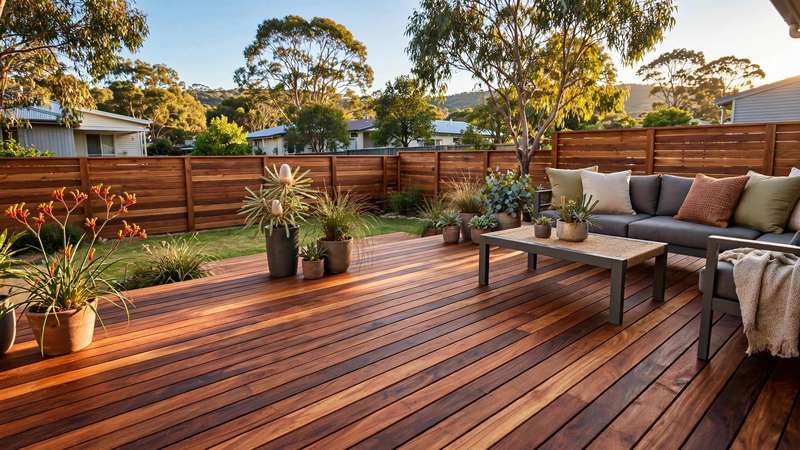
A new deck in Australia in 2026 typically costs between $4,000 and $22,500, depending on its size and the material you choose. The simplest ground-level treated pine deck runs around $200–$400 per square metre installed, while hardwood sits at $250–$450+ per square metre and composite decking lands at $250–$450 per square metre fully installed. Elevated decks, stairs, balustrades and roofing push costs higher, and decks above 600mm off the ground usually need council approval.
This guide breaks down deck prices by material, size and build type using current 2026 Australian pricing, so you can budget realistically and compare quotes with confidence.
Deck Cost Per Square Metre in Australia (2026)
Per-square-metre pricing is the most useful way to estimate a deck budget. These are fully installed ranges — boards, subframe, footings, fasteners and labour — for a standard ground-level build in a capital city:
| Decking material | Installed cost per m² | Typical 25m² deck |
|---|---|---|
| Treated pine | $200–$400 | $5,000–$10,000 |
| Merbau (hardwood) | $250–$450 | $6,250–$11,250 |
| Spotted gum (premium hardwood) | $280–$450 | $7,000–$11,250 |
| Composite decking | $250–$450 | $6,250–$11,250 |
| Premium composite (capped) | $400–$700+ | $10,000–$17,500+ |
These figures reflect mid-market labour rates in capital cities. Sloping blocks, difficult site access, regional locations and premium finishes push prices toward — or beyond — the upper end. Yellow Pages’ 2026 guide puts the average Australian deck project between $3,000 and $11,500, with most falling in the $5,000–$10,000 band.
Treated Pine Deck Cost: $200–$400 per m²
Treated pine is the most affordable decking material in Australia and remains the default choice for budget-conscious builds. At $200–$400 per square metre installed, a modest 20m² ground-level pine deck can come in around $4,000–$8,000.
The trade-off is maintenance. Pine needs oiling or staining at least once a year to protect it against Australia’s harsh UV and moisture. Skip the maintenance and it greys, splits and splinters far sooner than its 15–20 year potential lifespan. Over 20 years, the cumulative cost of oils, stains and your time can close the gap with composite more than many homeowners expect.
Pine is the sensible pick when the budget is tight, the deck is small or low to the ground, or you plan to upgrade down the track. For a deck you want to enjoy for decades with minimal fuss, look at hardwood or composite.
Hardwood Deck Cost: $250–$450+ per m²
Hardwood — most commonly merbau, with spotted gum at the premium end — delivers the rich, natural look many Australian homeowners want, with far better durability than pine. Installed costs run $250–$450+ per square metre depending on species, board width and your city.
Merbau is the workhorse of Australian decks: a durable imported tropical hardwood with natural oils that resist rot, decay and termites, and a Janka hardness rating around 8.5 kN. Material-only board costs sit roughly between $55 and $125 per square metre depending on board profile, with the subframe, footings and Sydney-rate labour bringing the installed total to the $250–$450+ range.
Spotted gum, a native Australian hardwood, sits at the premium end at $280–$400+ per square metre installed, with an exceptional lifespan of 30–50 years when maintained. Like all timber, hardwoods still want an annual oil to hold their colour — without it, they silver to grey. If you love the greyed-off coastal look, that can be a feature rather than a bug.
Composite Deck Cost: $250–$450 per m² Installed
Composite decking — made from recycled wood fibre and plastic — has grown rapidly in Australia because it needs almost no maintenance: an occasional wash instead of annual oiling. Fully installed composite decks run $250–$450 per square metre, with premium capped ranges pushing $500–$700+ per square metre.
Board-only costs tell part of the story:
| Composite brand / product | Board-only cost |
|---|---|
| Ekodeck (Bunnings), 137mm boards | ~$15–$22 per lineal metre |
| ModWood standard, 88mm boards | ~$15 per lineal metre |
| ModWood standard, 137mm boards | ~$28–$32 per lineal metre |
| ModWood Xtreme Guard (low maintenance) | ~$169 per 5.4m board |
| Trex Transcend Lineage (premium) | ~$166–$195 per 5.48m board |
Entry-level uncapped composite ($50–$100 per m²) exists but is generally not recommended for Australian conditions — intense UV causes faster fading and staining, and warranties are short. Capped composite boards, with a protective polymer shell, are the products most installers recommend and carry 25–30 year warranties.
For a like-for-like 25m² ground-level deck, composite installed ($6,250–$11,250) now overlaps heavily with merbau pricing — the decision often comes down to whether you value timber’s natural feel or composite’s near-zero maintenance.
Deck Cost by Size: What Common Decks Cost
Size is the single biggest driver of total cost. Based on a mid-range installed rate of roughly $200–$350 per square metre for composite and $200–$400 for timber:
| Deck size | Area | Indicative installed cost |
|---|---|---|
| 3m × 3m (small courtyard deck) | 9m² | $1,800–$3,600 |
| 3.6m × 4.9m | 17m² | $3,400–$6,800 |
| 4.3m × 6.1m | 26m² | $5,200–$10,400 |
| 6m × 6m | 37m² | $7,400–$14,800 |
Smaller decks often carry a higher cost per square metre because mobilisation, design and setup time are fixed regardless of size. A 30m² deck is the common benchmark used by Australian cost guides: roughly $6,000–$12,000 in treated pine, $10,500–$21,000 in hardwood, or $12,000–$22,500 in composite.
Elevated vs Ground-Level Deck Costs
A ground-level deck sits close to the earth on a simple subframe. An elevated deck — anything raised on posts and bearers — adds structural engineering, deeper footings, stairs and balustrades, all of which add cost.
As a rule of thumb, add $100–$200 per square metre for an elevated build compared with the ground-level equivalent. On a 30m² deck, that’s an extra $3,000–$6,000 before stairs and railings. Add:
- Stairs: $1,000–$3,000+ depending on width, treads and materials
- Balustrades: $150–$600+ per lineal metre (timber at the low end, glass or stainless at the high end)
- Roofing: a Colorbond skillion roof over the deck adds roughly $700–$1,100 per m² of covered area; an insulated panel roof $1,000–$1,500 per m²
Elevated cyclone-rated decking in northern Australia can exceed $1,000 per square metre once engineering, tie-downs and compliance are factored in.
What Affects Deck Cost Most
Beyond material and size, these factors move quotes up or down significantly:
- Site access and slope. Tight backyards, steep blocks and limited access for materials and machinery increase labour time — sometimes dramatically.
- Subframe and footings. Reactive clay soils, poor drainage or the need for deeper piers add cost before a single board is laid.
- Design complexity. Curved edges, picture-frame borders, multi-level layouts and integrated seating all increase cutting and fitting time.
- Existing structures. Demolishing an old deck typically adds $1,000–$3,000 depending on size and disposal.
- Location. Labour rates in Sydney and Melbourne run higher than in regional centres; remote areas add freight costs for materials.
- Finishes. Lighting, privacy screens, built-in benches and planter boxes are quoted as extras.
DIY vs Professional Deck Installation
A competent DIYer can save roughly 30–50% of the installed cost by building a simple ground-level deck themselves — but only where no approval or structural engineering is required. Material-only costs for a DIY pine deck can be as low as $100–$150 per square metre, and composite board packs from Bunnings (Ekodeck, ModWood) make DIY composite realistic for simple layouts.
Hire a professional when the deck is elevated, attached to the house, needs stairs or balustrades, or triggers council approval. Structural mistakes in elevated decks are safety issues, not cosmetic ones — and unapproved structural work can cause serious problems at resale or with insurance.
If you DIY, budget for tools (a drop saw, impact driver and levels at minimum), fixings, and the very real cost of your weekends. And get the subframe right: most deck failures start with inadequate footings, not the boards.
Do You Need Council Approval for a Deck?
Approval rules vary by state and council, but the general thresholds across Australia are consistent. You will generally need a building permit if your deck:
- Is higher than 600mm above natural ground level
- Exceeds roughly 10–25m² in area (threshold varies by council)
- Is attached to the house or another structure
- Has a roof, or balustrades above a certain height
- Sits close to a boundary, easement, or in a bushfire-prone, flood or heritage overlay area
A small, low, freestanding deck — under 600mm high and under 10–25m² — is often exempt development requiring no approval. But “often” isn’t “always”: always check with your local council before starting, because building without required approval can lead to rectification orders or even a demolition notice.
Where approval is needed, most standard decks go through a fast-track complying development (CDC) pathway via a private certifier — typically 5–15 business days and $800–$2,500 in certifier fees in NSW, VIC and QLD. In Queensland, a straightforward deck permit is around $500. Full development applications, needed for heritage or complex sites, take 4 weeks to 6 months and cost $500–$3,000 in lodgement fees.
Ongoing Maintenance Costs: Timber vs Composite
The sticker price isn’t the whole story. Over 20 years:
- Treated pine: annual oiling/staining at roughly $200–$500 per year in materials (plus your time), with board replacements likely in years 15–20.
- Hardwood: annual oiling at a similar cost; well-maintained merbau or spotted gum can last 25–50 years.
- Composite: occasional cleaning only — a pressure wash and mild detergent once or twice a year. No oiling, no staining, no splinters.
This is why composite’s higher upfront cost often breaks even with timber within 7–12 years on maintenance savings alone — before factoring in your time.
Does a Deck Add Value to Your Home?
A well-built deck is consistently rated among the better-value outdoor improvements for Australian homes, particularly in markets where indoor-outdoor living is prized (which is most of Australia). Real estate agents typically estimate a quality deck returns a good portion of its cost at resale — though rarely all of it — and, more importantly, it broadens buyer appeal and can speed up a sale.
The value equation is strongest for modest, well-executed decks in mid-range materials. A $40,000 premium composite entertainer’s deck on a $600,000 home is harder to justify on resale maths alone than a $10,000 pine deck on the same property. Build the deck for your lifestyle first; treat any resale uplift as a bonus.
Frequently Asked Questions
How much does decking cost per m² in Australia?
In 2026, expect $200–$400 per m² installed for treated pine, $250–$450+ per m² for hardwood like merbau, and $250–$450 per m² for composite decking. Premium capped composite runs $400–$700+ per m². Elevated decks add $100–$200 per m².
What is the cheapest decking material?
Treated pine is the cheapest decking material at $200–$400 per m² installed. For DIY builds, material-only costs can drop to $100–$150 per m². The trade-off is annual maintenance and a shorter lifespan (15–20 years) than hardwood or composite.
Is composite decking worth the extra cost?
For most homeowners, yes — if you value low maintenance. Composite costs more upfront than pine but needs only occasional cleaning instead of annual oiling. Maintenance savings typically close the price gap within 7–12 years, and composite lasts 25–30 years with a warranty to match.
Do I need council approval for a deck?
Generally yes if the deck is higher than 600mm above ground, exceeds 10–25m² (varies by council), is attached to the house, or has a roof. Small, low, freestanding decks are often exempt. Always confirm with your local council before building.
How long does a deck last?
Treated pine: 15–20 years with maintenance. Merbau: 25–40 years. Spotted gum: 30–50 years. Composite: 25–30 years with minimal maintenance. Lifespan depends heavily on maintenance, drainage and exposure.
Can I build a deck myself?
Yes for simple ground-level decks that don’t need approval — DIY can save 30–50% of installed cost. Hire a professional for elevated decks, attached decks, stairs, balustrades, or anything requiring council approval or structural engineering.
How much does a 20m² deck cost?
A 20m² ground-level deck costs roughly $4,000–$8,000 in treated pine, $5,000–$9,000 in merbau hardwood, or $5,000–$9,000 in composite. Elevated versions add $2,000–$4,000 for the extra structure, plus stairs and balustrades.
Planning more outdoor upgrades? See our house restumping cost guide and rainwater tank cost guide, or browse all our home improvement guides.
Updated: October 2026. Prices are indicative 2026 Australian ranges based on published supplier and trade pricing; always get at least three local quotes for your specific site.