
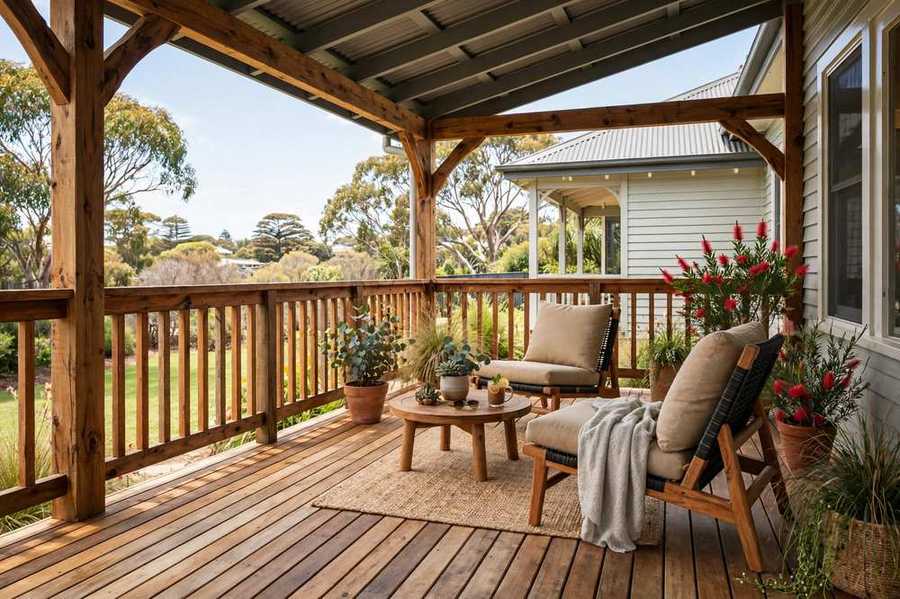
If you’re weighing up an outdoor project this year, the first figure you need is the timber decking cost per square metre in Australia — and in 2026 it sits roughly between $200 and $600 per m² fully installed, depending on the timber and how complicated your site is. Treated pine keeps things affordable; a premium hardwood like spotted gum pushes toward the top of that range. Labour usually makes up close to half the total. This guide covers 2026 pricing by material, a realistic cost breakdown, what drives quotes up or down, Sydney/Melbourne/Brisbane differences, and practical ways to keep the budget under control.
Timber Decking Cost Per Square Metre in Australia: The 2026 Numbers
Here’s the short answer for 2026. A straightforward ground-level timber deck, supply and install, lands in these ranges:
| Timber type | Cost per m² (installed) | Typical 20m² deck | Expected lifespan |
| Treated pine | $200–$350 | $4,000–$7,000 | 15–20 years |
| Merbau (hardwood) | $320–$500 | $6,400–$10,000 | 25–40 years |
| Spotted gum / blackbutt | $380–$600 | $7,600–$12,000 | 30–50 years |
Those figures assume a simple single-level deck on a reasonably flat block, installed by a licensed carpenter or deck builder. Add height, stairs, balustrades, roofing or a difficult site and the per-square-metre rate climbs — an elevated deck with stairs and a roof can push past $800 per m².
Treat every number here as an industry range, not a promise — quotes vary a lot between contractors, so always get at least three itemised ones. Timber prices and tradie rates remain elevated after the recent construction cost surge, with Master Builders Australia reporting new home building costs up 3.7% in the year to February 2026. For the broader picture, our renovation costs Australia 2026 guide puts decking alongside kitchens, bathrooms and extensions.
Cost Breakdown: Where Your Decking Budget Actually Goes
A deck quote isn’t one number — it’s a stack of components, and knowing the split helps you spot an inflated line item. For a mid-range 20m² merbau deck at roughly $8,500 total, the money typically lands like this:
| Component | Share of total | Indicative cost (20m² deck) |
| Decking boards | 20–25% | $1,700–$2,100 |
| Subframe (joists, bearers, posts) | 15–20% | $1,300–$1,700 |
| Labour (carpentry) | 40–50% | $3,400–$4,250 |
| Footings / piers & concrete | 5–10% | $450–$850 |
| Fixings, screws & hardware | 3–5% | $250–$425 |
| Staining / oiling (first coat) | 2–4% | $200–$350 |
| Council approval / certification | Varies | $0–$1,500 |
A few notes on the moving parts. On an elevated deck the subframe is engineered to a tighter spec, which adds cost. Fixings matter more than people think — stainless steel screws for hardwood can run several hundred dollars on a full deck, but they won’t rust-stain your boards. And that first coat of oil isn’t optional if you want the colour to hold; it’s the start of the annual maintenance every timber deck needs.
Timber Types Compared: Treated Pine vs Merbau vs Spotted Gum
Treated pine
The budget workhorse. Treated pine boards are the cheapest to buy and the easiest for a carpenter to work with, which keeps labour down too. The trade-offs are real, though: pine is a softwood, so it dents and scratches more easily, and it’s more prone to warping and splitting if maintenance slips. Expect 15–20 years with oiling or staining every 12 months. A sensible pick for a rental, a first deck, or anywhere budget is the deciding factor.
Merbau
The most common hardwood choice in Australia for good reason. Merbau sits mid-ladder on price and delivers a rich reddish-brown colour that deepens with oiling. It’s naturally resistant to termites and rot, and a well-kept merbau deck can push 25–40 years. Two quirks: new merbau leaches tannins heavily for the first few months (keep it off light-coloured pavers until it settles), and it needs oiling roughly once a year or it silvers to grey — a look plenty of coastal decks wear well.
Spotted gum and blackbutt
The premium Australian natives, at $380–$600 per m² installed. Spotted gum brings varied, characterful grain in browns and olives; blackbutt is lighter and more uniform, suiting modern coastal homes. Both are Class 1 durability timbers with 30–50 year lifespans that handle harsh UV better than most imports. On a per-year-of-life basis, hardwood often works out cheaper than replacing a pine deck — even though the upfront number stings.
Factors That Affect Your Timber Decking Cost Per Square Metre
Deck height and structure
This is the single biggest cost lever. A low deck under 500mm off the ground needs minimal substructure — short posts, simple bearers, straightforward footings. Raise it a metre or more and everything changes: taller posts, cross-bracing, deeper footings, engineered connections, safety rails. Labour hours climb with every extra step — going from ground-level to a metre off the ground can add 20–40% to the per-square-metre rate.
Site conditions and access
Sloping blocks need retaining, stepping or deeper piers. Reactive clay soils — common across parts of Sydney and Melbourne — need beefier footings. Tight access (narrow side passages, no room for a trailer) slows everything down and adds labour hours, and any clearing, levelling or drainage needed first is a separate bill on top of the deck.
Stairs, balustrades and roofing
A couple of steps off the side of a deck are cheap. A full staircase with compliant balustrades is not — budget $2,000–$6,000+ depending on materials, and remember any deck more than a metre off the ground needs a balustrade by law. Add a pergola or insulated roof and you’re looking at $800+ per m² for the covered section. These extras are where modest projects quietly become major ones.
Council approval and engineering
Not every deck needs council approval. In NSW, a small ground-level deck (under 25m², floor height under 1m) can often be built as exempt development with no approval at all. Elevated decks, decks in heritage or bushfire-prone areas, and anything beyond the exempt thresholds need a complying development certificate or full DA, plus engineering drawings — typically $1,000–$3,000 all up. The NSW Planning Portal’s deck and patio guide spells out the exempt standards clearly, and other states have equivalent rules worth checking before you commit to a design.
Finish level and extras
Hidden fixings cost more than face-screwed boards but give a cleaner surface. Picture-frame borders, curved edges and diagonal layouts chew through extra material and labour. Integrated lighting, bench seating and planter boxes are lovely — just price them separately so they don’t ambush the budget.
Timber Decking Costs by City: Sydney, Melbourne and Brisbane
Sydney
The dearest of the three for decking labour. Expect the top end of every range — treated pine from around $250–$350 per m² installed, hardwoods $400–$600. Dense blocks, difficult access and reactive soils in parts of the inner west and north shore push quotes up. The flip side: Sydney has the most deck specialists, so getting four or five quotes is easy and genuinely moves the price.
Melbourne
Slightly softer than Sydney. Typical installed rates run $220–$320 per m² for treated pine and $350–$550 for hardwood. Melbourne’s weather hammers decks — UV in summer, moisture in winter — so take builders’ advice on drainage gaps and oiling schedules seriously. Regional Victoria is usually 10–15% cheaper than metro Melbourne for labour.
Brisbane
Often the most affordable of the three capitals, with treated pine from around $200–$300 per m² and hardwoods $320–$500 installed. Queensland’s outdoor lifestyle means deck builders are plentiful and experienced, and the long building season keeps schedules moving. One local factor: termite pressure is higher, so don’t skimp on termite-resistant species or proper ground clearance — and the subtropical sun is brutal on unsealed timber, so budget for the annual oil.
7 Money-Saving Tips for Your Deck Build
- Keep it low and simple. A rectangular ground-level deck is the cheapest deck to build, full stop. Every curve, level change and angle adds labour hours and offcuts.
- Size it sensibly. A 20m² deck in merbau runs around $6,400–$10,000; stretching to 30m² adds roughly 50%. Design for how you’ll actually use it.
- Get four or five itemised quotes. Deck quotes vary wildly in Australia. Itemised quotes let you compare like with like — if one builder’s “fixings” line is triple the others, ask why.
- Do the finishing yourself. Builders charge a premium for oiling and staining. Doing the first coat yourself over a weekend can save $300–$600.
- Match the timber to the job. Treated pine under a roofed entertaining area that never sees direct sun can last very well. Save the spotted gum for the exposed hero deck.
- Build in winter. Deck builders are quieter in the cooler months and more likely to sharpen their pencils — and you’ll dodge the spring rush.
- Handle site prep yourself. Clearing the area, removing old pavers and organising skip bins yourself can shave real money off — just agree it upfront. Our renovation tools can help you sketch the layout and work out board quantities first.
Timber Decking Cost FAQs
How much does timber decking cost per square metre in Australia in 2026?
Treated pine costs roughly $200–$350 per m² installed, merbau $320–$500 per m², and premium Australian hardwoods like spotted gum or blackbutt $380–$600 per m². Elevated decks with stairs, balustrades or roofing can exceed $800 per m².
Is treated pine or hardwood decking better value?
It depends on your time horizon. Pine is cheapest upfront but lasts 15–20 years with annual maintenance. Merbau and spotted gum cost more but last 25–50 years, so the per-year cost can work out lower — plus hardwood adds more to resale appeal.
How much of the decking cost is labour?
Labour typically accounts for 40–50% of the total — roughly $90–$200 per m² depending on your city and build complexity. This is why multiple itemised quotes matter so much.
Do I need council approval for a deck in Australia?
Sometimes. Small ground-level decks often qualify as exempt development — in NSW the threshold includes decks under 25m² with floor height under 1m. Elevated decks, decks in heritage or bushfire-prone areas, and larger structures generally need a complying development certificate or DA. Check your state’s planning rules first.
How much does it cost to maintain a timber deck each year?
Budget around $200–$400 per year for oil or stain plus your time — most timber decks need re-oiling every 12 months here. Skipping maintenance leads to greying, splitting and a shorter lifespan, so factor this into your timber-vs-composite decision.