
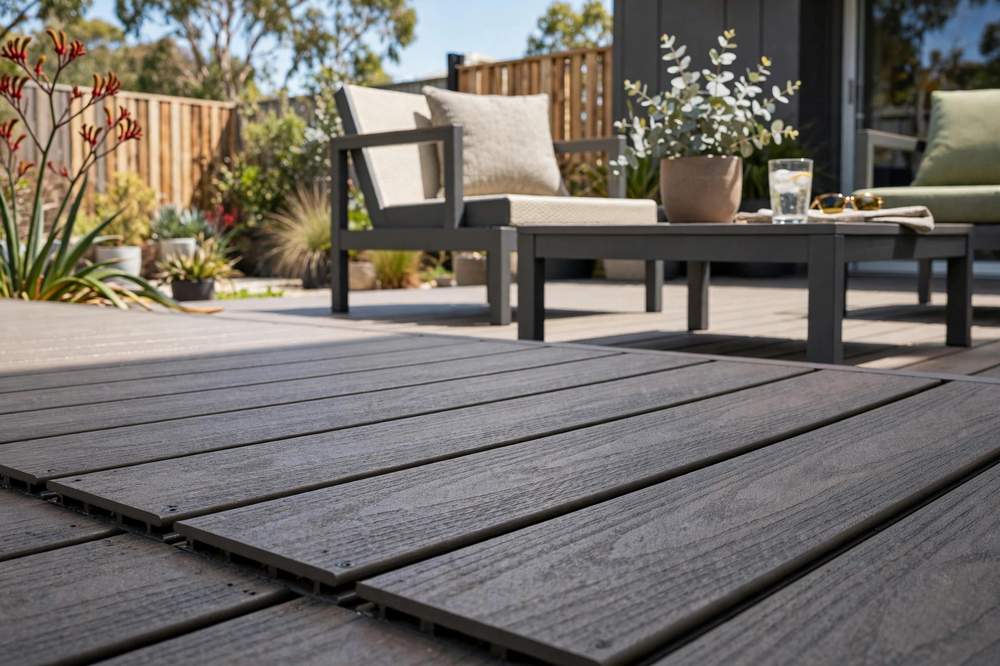
If you’re weighing up a new deck, the composite decking cost per square metre in Australia is the number everything else hangs off. In 2026, expect to pay roughly $250 to $450 per square metre fully installed for a standard composite deck — boards, subframe, fixings and labour all in. The boards alone run $100 to $190 per m², and the rest is labour, framing and the finishing touches that turn a pile of boards into a deck you’d actually want to sit on.
Composite decking isn’t cheap, and nobody should pretend otherwise. But the sticker price is only half the story — the real comparison is against timber over 20-plus years of oiling, restaining and replacing weathered boards. This guide lays out the 2026 numbers honestly: per-square-metre rates by quality tier, what installers actually charge, how prices differ across Sydney, Melbourne and Brisbane, and whether composite genuinely saves you money in the long run.
Composite Decking Cost Per m²: The Quick Answer
- Composite boards only (materials): $100 – $190 per m²
- Fully installed composite deck (typical): $250 – $390 per m²
- Fully installed (premium or complex sites): up to $450 per m²
- 25m² deck, installed: $6,250 – $10,250
- 40m² deck, installed: $10,000 – $15,200
- Installation labour alone: roughly $90 – $200 per m²
These are 2026 industry ranges from Australian suppliers and installers — use them to budget and to sense-check quotes, not as a substitute for one. Context helps too: the Housing Industry Association reports renovation spending hit a record $4.15 billion in the June 2026 quarter alone, up 23 per cent since 2020, as more Australians choose to improve rather than move (realestate.com.au). Decks are right in the middle of that boom, which means good installers are busy — and worth booking early. For how decking fits into a full project budget, see our renovation costs Australia 2026 guide.
Composite Decking Cost Breakdown Table
| Cost Component | Price Range (2026) | Notes |
| Entry-level uncapped boards | $50 – $100 per m² | Not recommended for harsh Aussie UV; short warranties |
| Mid-range capped composite boards | $100 – $150 per m² | The sweet spot for most homes |
| Premium capped boards (embossed grain) | $150 – $190 per m² | Best fade and stain resistance |
| Subframe (treated pine or steel) | $30 – $60 per m² | Steel costs more, lasts longer |
| Fixings, clips, screws, fascia | $10 – $25 per m² | Hidden clip systems cost more than screws |
| Labour (installation) | $90 – $200 per m² | 40–50% of total project cost |
| Stairs, balustrade, extras | $500 – $3,000+ | Per project, not per m² |
| **Total, fully installed (typical)** | **$250 – $390 per m²** | Standard ground-level residential deck |
| **Total, fully installed (premium/complex)** | **$350 – $450 per m²** | Elevated, curved, or difficult access |
What does a real deck cost? Three examples
- Small 15m² ground-level deck, mid-range boards: $3,750 – $5,850 installed
- Standard 25m² deck, good-quality capped boards: $6,250 – $10,250 installed
- Large 45m² entertaining deck with stairs and lighting: $11,250 – $20,250 installed
Composite Decking vs Timber: Honest Cost Comparison
The upfront gap between composite and timber is real, but it narrows — and often reverses — once maintenance enters the maths.
| Material | Installed Cost per m² | Lifespan | Annual Maintenance |
| Treated pine | $150 – $250 | 15 – 20 years | Oiling/staining yearly |
| Merbau hardwood | $220 – $320 | 25 – 40 years | Oiling yearly ($300–$800/yr) |
| Spotted gum | $280 – $400 | 30 – 50 years | Oiling every 1–2 years |
| **Composite decking** | **$250 – $450** | **25 – 30+ years** | Occasional wash only |
| PVC/synthetic | $280 – $480 | 30+ years | Occasional wash only |
Run the numbers on a 30m² deck over 20 years and the picture sharpens. A composite deck at roughly $9,000 to $14,000 total (installed, with near-zero upkeep) compares against a merbau deck at $14,000 to $28,000 once you factor in two decades of oiling, occasional board replacements and your weekends. Timber wins on natural beauty and lower entry cost; composite wins on total cost of ownership and your time. Neither choice is wrong — but go in with both numbers, not just the quote.
Factors Affecting Composite Decking Cost
Board quality and capping
This is the biggest material variable. Uncapped (first-generation) composite at $50 to $100 per m² is cheap for a reason: no protective outer shell means faster fading, staining and moisture uptake, and most brands only back it with 5 to 10 year warranties. In Australian conditions — brutal UV, sudden downpours — capped composite (a polymer shell around a wood-plastic core) is the sensible minimum, and premium embossed-grain boards at $150 to $190 per m² look and feel closest to real timber.
Subframe choice
Your deck is only as good as what’s underneath it. A treated-pine subframe is standard and keeps costs down, but it can twist and rot over time. A steel or aluminium subframe costs noticeably more ($30 to $60 per m² all in) yet stays dead straight and can outlast the boards themselves. For elevated decks or poor-drainage sites, the upgrade is money well spent.
Deck height and complexity
A low, ground-level rectangle is the cheapest deck to build — minimal posts, no balustrade required, easy access. Raise it a metre and you add posts, bearers, stairs and (legally) a balustrade. Add curves, picture-frame borders, inlays or multiple levels and labour hours climb fast. Complex designs can push installed costs toward $450 per m².
Site access
If the installer can back a ute to the site and carry boards 10 metres, you’re golden. If everything has to come through the house, down a steep slope or up a narrow side passage, expect a labour premium. Demolition and removal of an old deck is another line item — typically $500 to $2,000 depending on size and material.
Fixings and finishing
Hidden clip systems give that clean, screw-free look but cost more in both materials and labour than face-screwing. Fascia boards to close off the deck edge, end caps, stair nosings and trim add $10 to $25 per m² in materials. Small line items, but they add up across a 30m² deck.
Composite Decking Costs by City
Sydney
Sydney pays a premium — roughly 10 to 15 per cent above the national average for installed composite decking. A 25m² deck that costs $8,000 in a regional centre will typically quote $9,000 to $10,500 in Sydney. Labour is the driver: decking carpenters in Sydney command top-end rates, and the better crews book out weeks ahead in spring. On the plus side, Sydney has the country’s deepest bench of composite specialists, so competition keeps quotes honest — get three, and you’ll see the real market rate quickly.
Melbourne
Melbourne tracks close to the national average, with typical installed rates of $250 to $400 per m². The city’s weather patterns make composite particularly popular here — boards that don’t need annual oiling before winter are an easy sell when the rain sets in. One local factor to watch: Melbourne’s reactive clay soils in many suburbs mean footing work needs extra care (and sometimes deeper, dearer footings), so make sure your quote specifies the footing design rather than a vague allowance.
Brisbane
Brisbane is generally the most affordable of the three, with installed composite decking often landing 5 to 10 per cent below Sydney prices. Queensland’s year-round outdoor living culture means installers do huge volumes of deck work, and that competition benefits you. The watch-outs are heat and storms: darker composite boards can get hot underfoot in a Queensland summer (lighter colours are worth the small premium), and cyclone-region wind ratings can add engineering costs north of the city. Always confirm the board’s slip rating and heat performance, not just the price.
How to Save Money on Composite Decking
Choose mid-range capped boards
The jump from mid-range to premium boards is mostly about aesthetics — deeper grain embossing, slightly better fade warranties. Mid-range capped composite at $100 to $150 per m² gives you 90 per cent of the durability at a meaningfully lower price. Skip uncapped boards entirely; the “saving” disappears the first time you deal with staining or fading.
Keep the design simple
A rectangle at ground level is the cheapest deck shape that exists. Every curve, angle, step and level change adds cutting, waste and labour. A picture-frame border looks sharp and adds only modest cost — a curved edge can add thousands. If budget matters, spend your design dollars on the boards and keep the geometry boring.
DIY the demolition and prep
Ripping up an old deck, clearing the site and disposing of the waste yourself can save $500 to $2,000. It’s unskilled, sweaty work — exactly the kind installers charge good money for. Just confirm with your installer what state they want the site in before they arrive.
Get quotes in winter
Decking installers are slammed from September to December. Booking your build for the quieter winter months can mean faster start dates and occasionally sharper pricing. You’ll also avoid the spring rush where some operators inflate quotes because they’re turning work away anyway.
Buy boards during supplier sales
Composite board suppliers and big retailers run promotions a few times a year — end of financial year and winter clearances are the reliable ones. If your project timeline is flexible, buying materials on sale and storing them (flat, dry, out of sun) until the installer is ready can shave 10 to 15 per cent off material costs.
Don’t skimp on the subframe
This sounds like the opposite of saving money, but a cheap or undersized subframe is the most expensive mistake in decking. Boards can be replaced; a rotting or twisting frame means rebuilding the whole deck. Spend the money where you can’t see it.
Use our calculators before you commit
Before signing anything, run your deck dimensions through our renovation tools to sanity-check the quote against current per-square-metre rates. An installer quoting $500 per m² for a simple ground-level rectangle should be able to explain exactly why.
Frequently Asked Questions
What is the average composite decking cost per square metre in Australia?
In 2026, composite decking costs $250 to $450 per square metre fully installed in Australia. The boards themselves cost $100 to $190 per m², with labour, subframe, fixings and finishing making up the rest. A typical 25m² deck costs $6,250 to $10,250 installed. Prices vary with board quality, deck complexity, site access and your city.
Is composite decking cheaper than timber decking?
Upfront, no — composite costs more than treated pine and about the same as mid-range hardwoods like merbau to install. Over 20 years, though, composite is usually cheaper in total: a 30m² composite deck runs roughly $9,000 to $14,000 all-in with almost no maintenance, versus $14,000 to $28,000 for merbau once two decades of oiling and repairs are counted. Composite trades a higher entry price for near-zero upkeep.
How long does composite decking last in Australia?
Quality capped composite decking lasts 25 to 30+ years in Australian conditions, and most reputable brands back their boards with 15 to 30 year warranties. Longevity depends on buying capped (not uncapped) boards, installing to the manufacturer’s specifications — especially board spacing and ventilation underneath — and giving the deck an occasional wash. Uncapped budget boards have much shorter warranties and fade faster under harsh UV.
Does composite decking get hot in summer?
Yes, it can — darker composite boards absorb heat and can be uncomfortable underfoot on a 35-degree day, noticeably more so than light timber. The fix is simple: choose lighter colours, which reflect more heat, and consider shade from a pergola or sail if the deck cops full afternoon sun. Premium boards with heat-reflective technology run cooler but cost more.
Can I install composite decking myself?
A confident DIYer can install composite decking — the hidden clip systems are genuinely straightforward, and manufacturers publish detailed guides. You’ll save $90 to $200 per m² in labour. But be honest about the subframe: getting footings, levels and bearer spacing right is structural work, and mistakes void warranties. Many homeowners split the difference — a carpenter builds the frame, they lay the boards themselves.