
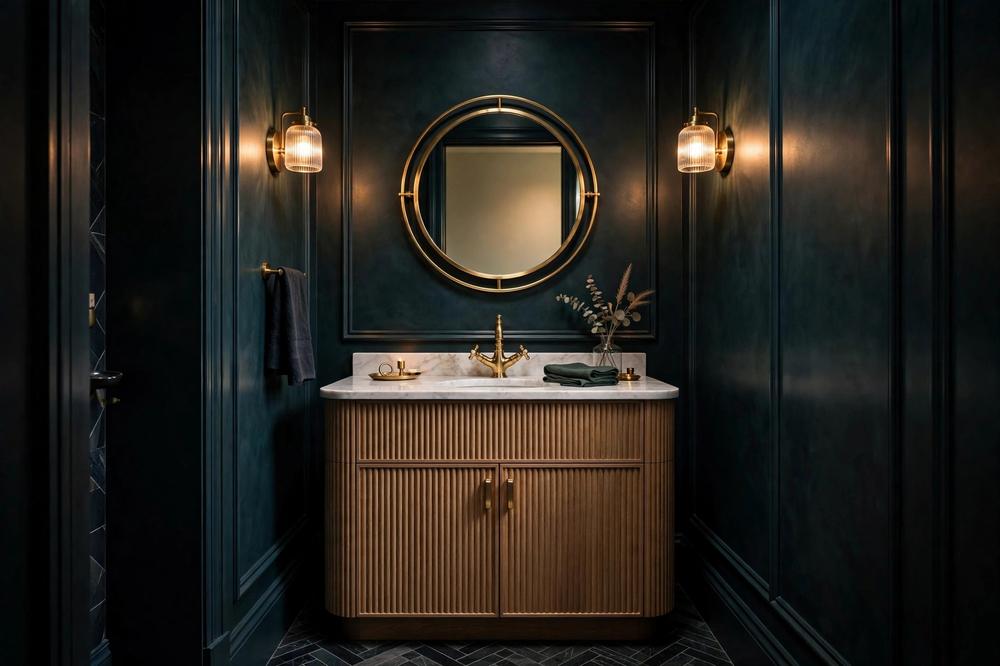
A powder room is a strange little room to be taken seriously — no shower, no bath, usually about two square metres, and guests use it for roughly ninety seconds. And yet it might be the most judged room in the house. It’s the one space almost every visitor actually sees, and Australian homeowners are finally giving it the attention it deserves. If you’re looking for powder room ideas in Australia, you’re in good company: 2026’s biggest bathroom trend is the “jewel box” powder room — small in size, big on personality, and finished like a tiny designer showpiece.
Below are ten ideas that work in Australian homes, with real materials, dimensions, and honest budget ranges in Australian dollars.
What Counts as a Powder Room?
A powder room (also called a half-bath or guest WC) is a compact bathroom with a toilet and hand basin but no shower or bath — usually tucked under a staircase, off the laundry, or near the entry where guests can reach it.
Most powder rooms measure 1.5–3 square metres: one wall for the vanity, one for the toilet, and about enough floor to turn around in. The 2026 mindset is to treat that as a licence to be bold — a patterned wallpaper or deep green wall that would overwhelm a family bathroom feels exactly right in a two-square-metre jewel box.
1. The Jewel-Box Feature Wall
This is the headline 2026 move and it suits powder rooms better than any other room. Because there’s no shower splashing water around, you can use materials that would never survive a family bathroom: proper wallpaper, limewash paint, even timber lining boards.
Pick one wall — usually the one behind the vanity — and make it the star. Botanical wallpapers in deep greens and inky blues are having a moment in Australian interiors, and moisture-tolerant Australian-made papers are appearing in real powder room projects from City Beach to the Gold Coast.
Typical budget: $300–$900 for the paper plus $400–$800 for professional hanging. A limewash or textured painted feature wall runs around $150–$400 if the wall is already sound.
2. The Fluted Timber Vanity
A wall-hung vanity around 600–750mm wide with a fluted timber-look front in oak or blackbutt-look laminate gives you storage, warmth, and a designer detail in one hit. Floating it shows more floor, which makes the room read bigger. Pair it with a simple rectangular basin and brushed brass or matte black tapware.
Typical budget: $1,200–$2,500 for a wall-hung vanity with basin and tapware, installed. Flat-pack sits at the lower end; custom joinery runs higher.
3. The Wall-Hung Toilet
If your powder room feels cramped, the single most effective change is a wall-hung (wall-faced) toilet with a concealed cistern. The pan floats off the floor, the cistern hides inside the wall, and cleaning becomes a two-minute job instead of a gymnastics routine.
There’s a catch: the concealed cistern frame needs to sit inside the wall cavity, so it’s cheapest to specify when walls are already open. Most in-wall cistern frames need around 180–200mm of wall depth.
Typical budget: $1,500–$3,000 supplied and installed, including frame, pan, and flush plate. Australian brands like Caroma are the go-to here.
4. Arched Mirrors and Warm Metallics
Round and arched mirrors are everywhere in Australian powder rooms in 2026: an arch breaks up the boxiness of a tiny room and its reflection doubles the sense of space. Go as large as the wall allows — a 600–800mm arch above the vanity is the sweet spot.
Finish the look with warm metallic tapware. Brushed brass, brushed gold, and brushed nickel have overtaken chrome as the default in mid-to-high-end Australian bathrooms. Stick to one metallic finish across taps, towel ring, and toilet roll holder — mixing finishes in a tiny room reads as clutter.
Typical budget: $150–$500 for an arched mirror; $400–$1,200 for a brushed brass or nickel tapware set.
5. Dark and Moody Colour
The all-white powder room is officially tired. Deep, saturated colour — forest green, inky navy, charcoal, even black — is one of the most requested powder room palettes among Australian designers right now. Dark walls recede, which paradoxically makes the room feel larger, and they make white sanitaryware and metallic details pop.
Two practical notes: you need good task lighting at the mirror plus ambient light, or a dark room feels like a cave. And use a quality washable low-sheen paint — powder rooms get humid, and cheap flat paint marks easily.
Typical budget: $200–$600 professionally painted. DIY with a quality low-VOC interior paint runs about $80–$120 for enough to cover a powder room.
6. Handmade-Look Feature Tiles
Handmade-look tiles — zellige-style squares, kit-kat mosaics, and small-format subway tiles with visible variation — keep showing up in Australian powder room projects. They add craft and texture without needing much square meterage, which matters because artisan-look tiles cost more per square metre than plain ones.
The smart play is to tile one feature area — the wall behind the vanity or a splashback-height band — and paint the rest. You get the texture where the eye lands and save hundreds on tiling labour. Gloss-finish tiles also bounce light around, which helps in windowless rooms.
Typical budget: $80–$200 per square metre for handmade-look tiles, plus $70–$110 per square metre for tiling labour in metro areas. A 2–3 square metre feature band typically lands around $600–$1,500 all in.
7. The Vessel Basin on Stone
A vessel (above-counter) basin on a stone-look benchtop is a classic powder room move that still works in 2026 — provided the proportions are right. The danger is a basin that eats the whole vanity top and leaves nowhere for soap. Choose a compact round or oval vessel, roughly 350–400mm across, on a vanity at least 460mm deep.
For the benchtop, note that Australia banned the manufacture and installation of traditional engineered stone benchtops from July 2024 — today’s options are zero-silica alternatives, porcelain, or natural stone. Your stonemason will quote the compliant options.
Typical budget: $250–$700 for a quality vessel basin; $600–$1,500 for a small stone-look benchtop cut for a powder room vanity.
8. Statement Lighting
Lighting is the cheapest way to make a powder room feel designed rather than merely functional. In 2026, Australian designers are using small pendants, backlit mirrors, and wall sconces in powder rooms — fixtures that would be lost in a big bathroom but shine in a small one.
A single pendant hung at about 1.8–2 metres above the floor, offset to one side of the mirror, adds drama without blocking the reflection. Or flank the mirror with two slim sconces at face height (around 1.5–1.6m) for flattering, shadow-free light. If there’s no natural light, add a sensor strip light under the floating vanity — a soft night-time glow that costs very little to run.
Typical budget: $150–$600 for fixtures; $300–$800 for an electrician if new wiring points are needed.
9. The Coastal-Hamptons Powder Room
Not every powder room needs to be dark and moody. The coastal-Hamptons look — white shaker vanity, marble-look benchtop, brushed nickel tapware, framed mirror, maybe a VJ-panel feature wall — remains strong, especially in Sydney’s east, the Gold Coast, and Perth’s western suburbs.
The 2026 update to the classic is warmer: swap stark white for warm white or soft greige, add an oak-framed mirror, and choose brushed nickel rather than chrome. It keeps the breezy feel without the clinical look that’s fallen out of favour.
Typical budget: $3,000–$8,000 for a full cosmetic refresh in this style (vanity, tapware, mirror, paint, accessories), keeping the existing toilet and tiles.
10. Water-Wise and Low-Tox Finishes
Powder rooms are quietly getting more sustainable. Choose tapware and toilets with high WELS water-efficiency ratings — a 4-star toilet and 5 or 6-star taps cut water use with zero lifestyle cost. Low-VOC paint matters more in a small, sometimes windowless room than anywhere else, and LED lighting is now the default.
If the existing vanity carcass is sound, keep it and replace only the top, basin, and handles — the most sustainable renovation reuses what’s already there.
Typical budget: WELS-rated fixtures cost about the same as standard equivalents; low-VOC paint adds roughly 10–20%. Reusing a vanity carcass can save $800–$1,500.
What Does a Powder Room Renovation Cost in Australia?
Sydney and Melbourne run 10–20% above the national average, but 2026 Australian cost guides give a consistent picture for a typical 2–3 square metre powder room:
| Scope | Typical range (AUD) | What it covers |
| Cosmetic refresh | $5,000–$12,000 | Paint, vanity, tapware, mirror, lighting; tiles and layout stay |
| Mid-range renovation | $8,000–$15,000 | New tiles, fixtures, vanity, lighting; minor plumbing changes |
| High-end renovation | $15,000–$25,000+ | Designer tiles, wall-hung toilet, custom joinery, statement lighting |
Small rooms cost more per square metre than big ones — the same plumber, electrician, waterproofer, and tiler have to show up regardless of room size. Get at least three itemised quotes. If you’re planning a bigger project at the same time, our renovation costs guide for 2026 breaks down room-by-room budgets across Australia.
Practical Tips Before You Start
Mind the clearances. Allow roughly 600mm of clear space in front of the toilet and basin where you can. In a genuine 1.5 square metre powder room that means compact fixtures — short-projection toilets and 450mm-deep vanities — rather than standard ones.
Waterproofing still matters. Even without a shower, wet-area work must comply with the National Construction Code’s waterproofing provisions, which reference AS 3740. If your renovation involves retiling or moving plumbing, the waterproofing has to be done — and certified — properly. The ABCB’s housing provisions on wet-area waterproofing set out what’s required; read them before you sign a contract.
Ventilation is non-negotiable. Many powder rooms have no window. An exhaust fan ducted to outside — not into the roof cavity — prevents mould and protects paint and wallpaper. Budget $300–$700 installed.
Use licensed trades. Plumbing, electrical, and waterproofing all require licensed practitioners in every state. The cheapest quote that skips the licensed waterproofer is the most expensive renovation you’ll ever do.
Plan the style first. One wrong choice dominates a room this small. Before you buy anything, work out which direction suits your home — our interior design style quiz takes a few minutes and helps you commit to a palette with confidence. You can also play with layouts and budgets using our free renovation tools.
Frequently Asked Questions
How much does it cost to renovate a powder room in Australia?
A cosmetic refresh typically costs $5,000–$12,000, a mid-range renovation with new tiles and fixtures runs $8,000–$15,000, and a high-end designer finish can reach $15,000–$25,000+. Sydney and Melbourne sit about 10–20% above the national average. Get three itemised quotes.
What is the smallest size for a powder room in Australia?
Most Australian powder rooms are 1.5–3 square metres. A functional layout needs roughly 900mm × 1,800mm minimum for a toilet and compact basin with enough clearance to use them. Under-stair and hallway nooks are common locations.
Can you put wallpaper in a powder room?
Yes — powder rooms are ideal for wallpaper because there’s no shower steam. Choose a wipeable, moisture-tolerant paper (vinyl or vinyl-coated grades work well) and make sure the room has decent ventilation.
Do I need waterproofing in a powder room with no shower?
If you’re retiling or moving plumbing, yes — wet-area waterproofing must comply with the National Construction Code provisions referencing AS 3740, installed by a licensed waterproofer. A paint-and-fixtures refresh that doesn’t disturb tiles or plumbing generally doesn’t trigger new waterproofing.
What adds the most value to a powder room renovation?
Wall-hung toilets, quality tapware in a current finish like brushed brass or nickel, a large mirror, and good lighting give the strongest upgrade per dollar. A feature wall or handmade-look tiles make the room memorable to guests and future buyers alike.