
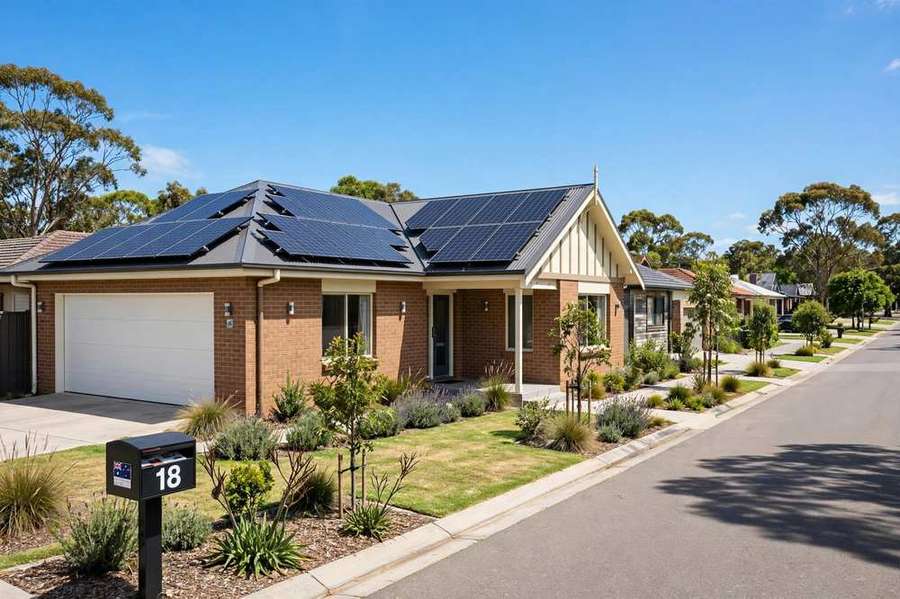
If you’re weighing up solar for your place, the big question is whether do solar panels add value to home australia enough to justify the outlay — not just in lower power bills, but in what your house is actually worth when you sell it. It’s a fair question, because a solar system is one of the bigger cheques you’ll write on your home. The good news: in 2026, we finally have proper Australian data on this, and the answer is more encouraging than most people expect.
The short answer
Yes, solar panels add value to Australian homes — and now there’s hard evidence to prove it. A 2026 report by property data giant Cotality (formerly CoreLogic) found that homes with rooftop solar sold for about 2.7% more than comparable homes without it, which works out to roughly $23,100 on the national median. That’s based on an analysis of more than six million house sales across the country — not a marketing claim.
That premium alone is worth more than most 6.6kW systems cost to install. But not every setup adds the same value. An owned, well-maintained system on a good roof is a genuine asset; a leased system, or ageing panels that look tired, can do the opposite. Here’s the full picture: costs, rebates, payback maths, and what buyers actually think solar is worth.
What a solar system costs in Australia in 2026
Prices have held fairly steady, and the federal STC discount is already baked into most quotes. The 6.6kW system is still the sweet spot for the average family home — it pairs with a standard 5kW single-phase inverter and suits typical daytime usage. Here’s what Australian households are paying after the federal incentive, based on 2026 pricing data from Solar Choice’s price index and industry guides:
| System size | Typical installed cost (after STC discount) | Suits |
| 6.6kW | $5,000 – $6,500 | Standard family home, moderate daytime use |
| 10kW | $8,000 – $10,500 | Larger households, EVs, heavy air-con use |
| 13kW | $11,000 – $14,000 (estimate) | Big roofs, high usage, future battery plans |
Premium brands (SunPower, REC, Tindo) and microinverters push costs 20–30% above these ranges, while budget quotes come in lower. Tile roofs cost more to install on than tin or Colorbond, and double-storey or steep-pitched roofs add labour. As with any renovation project, getting three quotes from accredited installers is the best way to check you’re paying a fair price, and our renovation tools can help you compare quotes and budget the job.
One more cost worth knowing: a 10kWh battery typically costs $8,000–$12,000 before rebates, or $5,500–$9,500 after — and the federal Cheaper Home Batteries program has driven a boom in installs, with more than 221,000 batteries fitted in 2025, about triple the 2024 figure.
The rebate that takes thousands off the price
Here’s how it works in plain English:
- Your system earns Small-scale Technology Certificates (STCs) based on its size, your postcode’s solar zone, and the years left before the scheme winds down.
- Most people assign those STCs to their installer, who applies the value as an upfront discount — worth roughly $1,600 on a typical 6.6kW system in 2026.
Two things to know. First, the scheme ends on 31 December 2030 and steps down every year, so the discount shrinks annually — install in 2026 and you get about five times the certificate value you’d get in 2030. Second, only installers accredited by Solar Accreditation Australia (SAA) can create valid STCs, so check accreditation before signing. The Clean Energy Regulator has a plain-English guide for householders explaining how the scheme works and what to watch for.
How the payback maths actually works
Solar pays you back two ways: the power you use yourself (avoiding grid prices of 27–36 cents per kWh) and the feed-in tariff for surplus sent back to the grid. In 2026, feed-in tariffs are modest, and self-consumption is where the real savings live.
Typical daytime feed-in rates: NSW around 3.4–6.5 cents per kWh (a non-binding benchmark), Victoria averaging barely a cent since the minimum was scrapped, regional Queensland about 6 cents, South Australia 2–5 cents, Tasmania a regulated 9.276 cents, WA’s buyback scheme paying 2 cents off-peak and 10 cents between 3pm and 9pm, and the NT paying 9–18 cents. Don’t chase the highest headline rate — plans with generous feed-ins often carry higher daily supply charges that wipe out the gain.
So what’s a realistic payback? Solar Choice’s 2026 modelling for Sydney puts a 6.6kW system (about $5,440, 40% self-consumption) at roughly 4.8 years, saving about $1,200 a year; a 10kW system pays back in about 4.5 years. Most households land between four and six years depending on state, usage, and how much power they use while the sun’s up. The ACCC has also found solar-plus-battery households pay $329–$909 a year less than grid-only homes.
Put simply: you could pay the system off well before its 25-year panel warranty is up, enjoy close to two decades of cheaper bills, and still have an asset to sell with the house.
What solar does to your home’s resale value
This is where it gets interesting for sellers. The Cotality–REIA report *The Efficiency Edge* (September 2026) is the most serious Australian research on this to date:
- Nationally, homes with solar sold for ~2.7% more than comparable homes without — about $23,100 on average.
- The premium ranged from +1.6% to +6.9% (roughly $14,000 to $31,000) depending on location, with regional Northern Territory the biggest at 6.9% ($31,350).
- Among the capitals, Hobart led at 5.4% ($30,459), followed by Brisbane ($30,218), Melbourne ($24,369) and Sydney ($19,179).
- Each extra NatHERS energy star was linked to about 1.3% more value.
Cotality’s point was blunt: solar is “one of the few home energy-efficient upgrades that is both easily recognised by buyers and reliably measurable in valuation models.” Unlike a fancy tap or a fresh coat of paint, a solar system is something buyers can see, understand, and put a dollar figure on — and with cost-of-living pressure front of mind in 2026, cheaper bills are a powerful selling point.
For property investors, there’s an extra angle: you don’t get the bill savings (your tenant does), but the resale uplift is yours at sale time. And roughly one in three Australian homes now has rooftop solar, so in many suburbs *not* having panels is starting to look like the exception.
Cost vs value: the comparison in one table
Here’s how the numbers stack up for a typical 6.6kW system:
| Amount | |
| Typical installed cost (2026, after STC discount) | $5,000 – $6,500 |
| Estimated STC discount included in quotes | ~$1,600 |
| Annual bill savings (typical household) | ~$1,200 – $2,000 |
| Payback period | 4 – 6 years |
| Average resale premium (Cotality 2026) | ~$23,100 (+2.7%) |
| System warranty | 25 years (panels) |
Even at the conservative end, the resale premium alone can exceed the installation cost — before counting a single year of bill savings. Few home improvements can make that claim.
What adds value — and what doesn’t
Not all solar is equal in a buyer’s eyes. Here’s where the details matter:
Owned vs leased panels
This is the big one. Owned systems add value; leased systems or power purchase agreements can subtract it. Under a lease or PPA, a third party owns the panels and the buyer must take over the contract. Many won’t. If you’re selling, owned outright and debt-free is the ideal. Buying a home with leased panels? Get the contract terms in writing first.
A battery helps, but do the maths
Buyers like batteries — one survey found 57% of households would pay up to $10,000 more for a home with solar, and that figure rises with storage included. A battery keeps the lights on through blackouts and shifts cheap daytime power into the evening. But batteries are still the expensive part of the package, so don’t expect a dollar-for-dollar return on a $12,000 battery at sale time.
System age and condition count
Buyers judge panels the way they judge anything visible: newer looks better. A tidy, well-maintained array on a sound roof reads as an asset; a ten-year-old system with a dusty inverter and no monitoring reads as someone else’s problem. Keep panels clean, keep your paperwork (warranties, installer details, generation history), and make sure the system is actually working before listing.
Size and placement
A 6.6kW-plus system on a north-facing roof is what most buyers hope to see. Odd placements — panels scattered across shaded sections, or a tiny 1.5kW system from the early days — still help, but carry less weight. And aesthetics matter: neat, symmetrical layouts with hidden cabling photograph better and lift kerb appeal. Take our interior design style quiz to pin down your home’s design direction, and ask your installer to keep the array as clean and unobtrusive as possible.
Tips before you install or sell
- Use an SAA-accredited installer and CEC-approved gear. It’s a rebate requirement, a warranty safeguard, and a selling point.
- Size for your usage, not the maximum. A system covering your daytime needs pays back fastest. Oversizing for export alone rarely stacks up at 3–6 cent feed-in rates.
- Keep every document. Installation certificate, warranties, inverter model, generation data from the monitoring app. A buyer who can see the system’s track record values it more.
- Mention it properly in your listing. “6.6kW solar, owned outright, $1,800/year in bill savings” tells a buyer more than “solar panels” in the features list. Give your agent the numbers.
- Time it right. The STC discount drops every year until 2030. Every year you wait costs you some of the federal incentive — and a year of savings.
- Don’t hide the panels in photos. Clean arrays on the roof are a feature now; they reassure buyers the home is cheap to run.
Frequently asked questions
Do solar panels really increase property value in Australia?
Yes. The 2026 Cotality–REIA research found homes with rooftop solar sold for about 2.7% more than comparable homes without, equating to roughly $23,100 nationally — and up to 6.9% ($31,350) in parts of the country. The premium held across cities and regions, with buyers valuing the lower running costs.
How much does a 6.6kW solar system cost in Australia in 2026?
A standard 6.6kW system typically costs $5,000–$6,500 fully installed after the federal STC discount, based on 2026 industry pricing data. Budget quotes run lower, premium panels and microinverters run 20–30% higher, and roof type and location also move the price.
How long does it take for solar panels to pay for themselves?
Most Australian households reach payback in four to six years. Solar Choice’s 2026 modelling puts a 6.6kW system in Sydney at about 4.8 years (around $1,200 in annual savings with 40% self-consumption). Households that use more power during the day pay off faster.
Do leased solar panels add value to a home?
Generally no — and they can make a sale harder. Leased panels or power purchase agreements mean a third party owns the system and the buyer must take over the contract, which puts many buyers off. Owned, paid-off systems are the ones that attract the resale premium.
Is it worth installing solar if I’m selling soon?
Often, yes. If payback through bills alone would take longer than you plan to stay, the resale premium changes the equation: the ~$23,100 average uplift found in 2026 research exceeds the cost of most 6.6kW systems. A new, owned system with paperwork in order is one of the few renovations that can return more than it costs.