
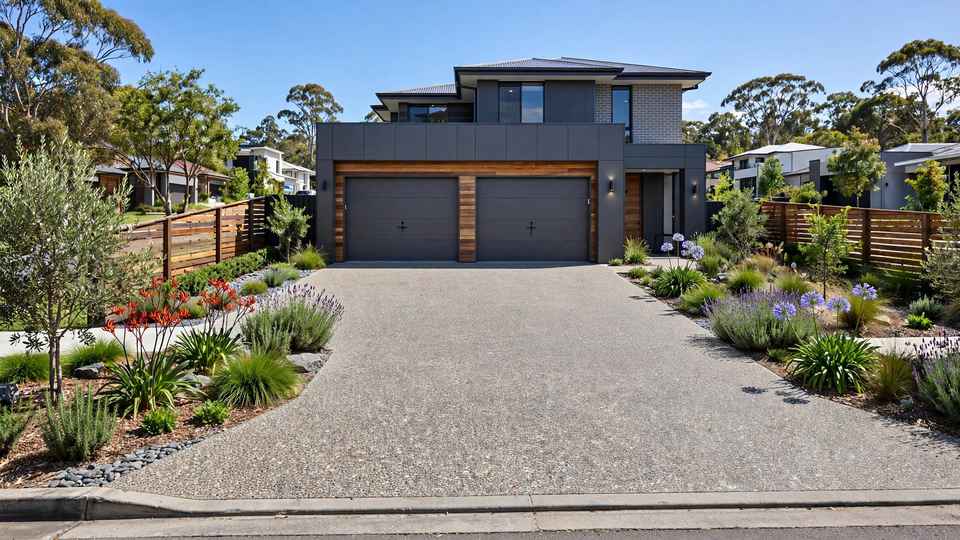
A new driveway in Australia costs between $1,500 and $12,000 in 2026, depending on the material, size, and site conditions. A small gravel driveway can come in under $2,000, while a large exposed-aggregate concrete or premium paver driveway easily exceeds $10,000. The biggest price lever is material choice: gravel runs $20–$100/m² installed, asphalt $65–$160/m², plain concrete $60–$100/m², pavers $120–$260/m², and exposed aggregate $95–$160/m². This guide breaks down every cost with 2026 Australian pricing.
Driveway Cost by Material (Per Square Metre)
| Material | Cost per m² (installed) | Typical Lifespan | Best For |
|---|---|---|---|
| Gravel / crushed rock | $20–$100 | 10–20 years | Rural blocks, tight budgets |
| Asphalt (bitumen) | $65–$160 | 15–25 years | Large driveways, quick install |
| Plain concrete | $60–$100 | 25–40 years | Durable all-rounder |
| Coloured concrete | $75–$140 | 25–40 years | Subtle kerb appeal |
| Exposed aggregate | $95–$160 | 25–40 years | Premium look, slip-resistant |
| Concrete or clay pavers | $120–$260 | 30–50 years | High-end finish, easy repairs |
These are installed rates for 2026 including materials, labour, and basic site preparation on a flat, accessible block. Sloping sites, poor access, or old-surface removal push costs above these ranges.
Total Driveway Cost by Size
Most Australian councils specify a minimum driveway width of 3 metres. A standard single-car driveway is around 18–20m² (3m × 6m); a double is roughly 36–40m².
| Driveway Size | Gravel | Asphalt | Plain Concrete | Pavers |
|---|---|---|---|---|
| Single (18–20m²) | $800–$2,000 | $1,500–$3,200 | $1,300–$2,000 | $2,400–$5,200 |
| Double (36–40m²) | $1,500–$4,000 | $2,600–$6,400 | $2,600–$4,000 | $4,800–$10,400 |
| Large / circular (60m²+) | $2,500–$6,000 | $4,500–$9,600 | $4,000–$6,000 | $7,200–$15,600 |
These totals assume flat, clear sites. Demolition of an existing driveway adds $45–$65/m², and sloping land typically adds around $10/m².
Concrete Driveway Costs Explained
Concrete remains Australia’s most popular driveway material, and 2026 pricing varies mainly by finish. Plain broom-finish concrete runs $60–$85/m² installed in most states, with Sydney and Melbourne at the upper end and regional Queensland and South Australia cheaper. Coloured (oxide) concrete costs $75–$110/m². Exposed aggregate — where the surface is washed back to reveal stone — costs $100–$150/m², and stencilled or stamped patterns run $120–$180/m².
The gap between plain and decorative finishes is mostly labour: exposed aggregate requires a retarder, precise curing timing, then washing and brushing to reveal the stone. That skilled, time-critical step is why decorative finishes carry a premium. For a standard 100mm residential slab, expect SL72 steel mesh reinforcement. Thinner slabs or skimped sub-bases are where cheap quotes cut corners — and where cracks appear later. If you are budgeting a broader project, our renovation cost per square metre guide puts driveway work in context with other trades.
Ready-mix supply-only concrete costs roughly $250–$400 per cubic metre delivered in 2026 (more in metro areas and for higher-strength mixes), with regional delivery typically 10–35% higher. A 40m² driveway at 100mm thick needs 4 cubic metres.
Asphalt Driveway Costs
Asphalt is generally the cheapest hard-surface option at $65–$160/m² installed in 2026, though pricing is the most volatile of all materials because bitumen tracks crude oil prices. It is fast to lay and drivable within 24–48 hours, compared with 5–7 days for concrete. The trade-offs: asphalt can soften on 40°C+ days, needs resealing every 3–5 years, and petrol or oil stains can damage it. For large driveways where budget matters most, it is hard to beat.
Paver Driveway Costs
Pavers sit at the premium end at $120–$260/m² depending on whether you choose concrete pavers, clay brick, or natural stone. Installation is labour-intensive — every unit is laid individually over a compacted base with jointing sand. The payoff is repairability: a damaged section can be lifted and replaced without touching the rest of the driveway, and pavers last 30–50 years. Edge restraints are essential to stop the units spreading. For the walls flanking your driveway, see our retaining wall cost guide.
Gravel Driveway Costs
Gravel is the cheapest option at $20–$100/m² depending on the stone — basic crushed rock at the bottom, decorative granite or limestone higher. It suits rural and acreage blocks far better than suburban streets. The honest caveat: gravel ruts, needs edging, requires periodic top-ups, and kicks up dust. Ongoing maintenance costs add up over a decade.
Council Crossover and Permit Costs
The crossover — the section of driveway between your property boundary and the kerb — sits on council land, and you need a permit before touching it. Fees vary by council:
- Gold Coast: around $401 application fee (2026 standards)
- Blacktown (Sydney): approximately $340 for a standard application
- Darebin (Melbourne): around $547 in combined application and permit fees (2025–26 schedule)
- Holdfast Bay (Adelaide): $70 application fee
- Regional councils: $98–$152
Approval typically takes 2–6 weeks. In NSW, you cannot legally build the crossover yourself — councils require a licensed, insured contractor (most Sydney councils demand at least $20 million in public liability cover) for any work on the road reserve. Some WA councils offer a crossover contribution — the City of Kalgoorlie-Boulder, for example, contributes $191 per linear metre up to 6 metres for a compliant first crossover.
Excavation, Base Prep and Hidden Costs
What goes under the surface moves the total as much as the finish. Budget for:
- Excavation and levelling: included in basic quotes for flat sites; sloping land adds ~$10/m²
- Old driveway removal: $45–$65/m² for breaking out and carting away existing concrete
- Sub-base: compacted road base is non-negotiable — skimping here causes settlement and cracking
- Drainage: grated drains or spoon drains where water pools; essential on clay soils
- Pump hire: if concrete trucks cannot reach the site, a concrete pump adds several hundred dollars
Labour for concreters runs $30–$45/m² depending on the state — around $35/m² in Melbourne and Queensland, $40/m² in Sydney, up to $45/m² in Perth.
DIY vs Professional: What’s Realistic?
A gravel driveway is genuinely DIY-able: spread, compact, edge, and top up. For asphalt and concrete, DIY is a false economy for most homeowners. Concrete requires correct sub-base compaction, formwork, reinforcement placement, and finishing within a tight time window — mistakes are permanent and expensive to fix. Asphalt needs heavy compaction equipment and hot-mix supply. Pavers are the one hard surface a skilled DIYer can tackle, but expect the job to take several weekends and the result to depend entirely on base preparation. For the crossover section, DIY is not an option at all — councils require licensed contractors.
Maintenance Costs Over Time
| Material | Maintenance | Typical Cost |
|---|---|---|
| Concrete (plain/coloured) | Reseal every 2–3 years | $3–$8/m² per seal |
| Exposed aggregate | Reseal every 1–2 years | $5–$10/m² per seal |
| Asphalt | Reseal every 3–5 years | $4–$8/m² per seal |
| Pavers | Re-sand joints, weed control | $2–$5/m² as needed |
| Gravel | Top-ups, regrading | $200–$600 per top-up |
Driveway Costs by State
Labour rates and ready-mix supply costs vary across Australia. NSW and the ACT sit at the top of the market; Queensland and South Australia at the bottom.
| State / Territory | Plain Concrete (per m²) | Exposed Aggregate (per m²) |
|---|---|---|
| New South Wales | $70–$90 | $110–$155 |
| Victoria | $65–$85 | $100–$150 |
| Queensland | $60–$80 | $95–$140 |
| Western Australia | $65–$85 | $100–$145 |
| South Australia | $60–$80 | $95–$140 |
| Tasmania | $65–$85 | $100–$145 |
| ACT | $70–$90 | $110–$150 |
| Northern Territory | $75–$95 | $115–$160 |
Regional areas typically run 10–35% above metro ready-mix delivery prices due to transport. Within metro areas, tight-access sites in inner Sydney or Melbourne can push installed rates well above these bands.
Choosing the Right Material for Your Block
The cheapest material is not always the cheapest driveway. Match the material to your situation:
- Suburban family home: Plain or exposed-aggregate concrete. Durable, low maintenance, suits every streetscape, and buyers expect it.
- Large rural or acreage block: Gravel or asphalt. Paving hundreds of square metres in concrete is rarely worth it; gravel handles long driveways affordably.
- Heritage or character home: Clay pavers or exposed aggregate. Both complement period architecture far better than plain grey concrete.
- Steep driveway: Exposed aggregate or pavers. Both offer better traction than smooth concrete or asphalt, which can be slippery when wet on a gradient.
- Reactive clay soil (much of Sydney, Melbourne, Adelaide): Concrete with proper sub-base and SL72 mesh, or flexible pavers that move without cracking. Get the sub-base right — this is where cheap jobs fail.
- Hot climates (Perth, Brisbane, Darwin): Light-coloured concrete or pavers. Dark asphalt absorbs heat and can soften on extreme days.
Red Flags in Driveway Quotes
Watch for these warning signs that a quote will cost you more later:
- No slab thickness specified. A proper quote states 100mm minimum (125–150mm for heavier vehicles). No thickness = expect a thin slab.
- No mention of reinforcement. SL72 mesh or equivalent should be standard. Fibre-only reinforcement is not a substitute for mesh in driveways.
- Sub-base not itemised. If excavation depth and compacted road base are not listed, they are probably being skimped.
- Crossover excluded without mention. Some quotes quietly exclude the council crossover, leaving you with a surprise $2,000–$4,000 extra.
- Verbal only. Itemised written quotes beat lump sums every time. If a contractor will not put it in writing, walk away.
- Far below other quotes. A quote 30% under the rest is not a bargain — it is a thinner slab, no mesh, or a skimped base that will crack within two years.
Best Time of Year to Build a Driveway
Concrete and asphalt both prefer mild, dry conditions. The shoulder seasons — autumn and spring — are ideal in most of Australia: moderate temperatures help concrete cure evenly, and contractors are less booked out than in the summer rush. Winter slows concrete curing (additives can help) and wet ground complicates excavation and compaction. Summer heat accelerates curing, which sounds good but can cause surface cracking if the slab dries too fast — experienced concreters manage this with curing compounds and timing pours for early morning. Booking 4–8 weeks ahead in spring and autumn is wise; good concreters fill up fast.
Resurfacing vs Replacing: When Each Makes Sense
If your existing driveway is structurally sound but looks tired, resurfacing costs far less than replacement because no earthworks or base preparation are needed. Concrete resurfacing (spray-on or stencil) runs roughly $50–$85/m², and asphalt overlay is similarly cheaper than a full rebuild. Resurfacing makes sense when the slab is level, drainage works, and damage is cosmetic — stains, fading, or minor surface wear.
Replacement is the honest answer when the slab has settled unevenly, tree roots have lifted sections, drainage has failed, or cracking runs through the full depth. Pouring a new surface over a failed base just hides the problem for a year or two. A good contractor will tell you which camp you are in — be wary of anyone who quotes resurfacing without inspecting the base.
How to Get an Accurate Quote
Get at least three itemised quotes. A proper quote specifies slab thickness (100mm minimum, 125–150mm for heavier vehicles), reinforcement type, sub-base depth, finish, and whether excavation, removal, drainage, and the crossover are included. Verbal lump-sum quotes are where budget blowouts hide. Ask each contractor what happens if they hit rock or poor soil — and get the answer in writing.
Frequently Asked Questions
How much does a concrete driveway cost per m² in Australia?
Plain concrete costs $60–$100/m² installed in 2026, coloured concrete $75–$140/m², exposed aggregate $95–$160/m², and stencilled or stamped finishes $120–$180/m². Prices include materials and labour for a flat, accessible site.
What is the cheapest driveway material?
Gravel at $20–$100/m² is the cheapest, followed by asphalt at $65–$160/m². Gravel suits rural blocks; for suburban homes, asphalt or plain concrete offer better long-term value despite higher upfront cost.
Do I need council approval for a new driveway?
You need a permit for the crossover section (between your boundary and the kerb) in every Australian council. Permit fees range from $70 to over $500 depending on the council. The driveway on your own land generally does not need approval, but check for heritage overlays or estate covenants.
How long does a concrete driveway last?
A properly built concrete driveway lasts 25–40 years. The keys are correct sub-base compaction, adequate slab thickness (100mm minimum), steel mesh reinforcement, and control joints to manage cracking.
Can I build my own driveway crossover?
No. In NSW and most other states, only licensed and insured contractors may work on the road reserve. Most Sydney councils require contractors to hold at least $20 million in public liability insurance before granting crossover approval.
How long before I can drive on a new concrete driveway?
You can walk on it after 24–48 hours, but wait at least 7–10 days before driving a standard car on it. Concrete takes 28 days to fully cure and reach maximum strength.
Is asphalt cheaper than concrete for driveways?
Yes, upfront. Asphalt averages $65–$160/m² versus $60–$100/m² for plain concrete — similar at the low end, but asphalt needs resealing every 3–5 years while concrete needs it every 2–3 years (or 1–2 for exposed aggregate). Over 25 years, concrete usually wins on total cost.
Does a new driveway add value to a house?
A well-built driveway improves kerb appeal and can support a higher sale price, particularly exposed aggregate or paver finishes. A cracked, stained, or crumbling driveway does the opposite. Real estate agents consistently rank the driveway among the first things buyers judge. Pairing a new driveway with a carport can further lift street appeal.