
For example, ask three builders what your renovation will cost and you’ll get three different answers. At least one will quote a dollars-per-square-metre rate — Australian renovation’s most quoted and most misunderstood number. As a result, a $/m² figure can sense-check a quote in seconds. However, many homeowners learn too late that it excluded design fees, approvals, or the rooms that cost the most.
Short answer: In 2026, the renovation cost per square metre in Australia typically runs $1,200–$2,500/m² for a cosmetic refresh, $3,000–$5,000/m² for a standard mid-range renovation, and $5,000–$8,000+/m² for structural work and extensions. Yet one number hides big variation.
Note: all figures below are indicative 2026 Australian ranges from published builder and industry guides — costs vary by location and supplier, so always get itemised quotes.

What the $/m² rate actually measures
A dollars-per-square-metre rate is total construction cost divided by the floor area being renovated. It’s a builder’s shorthand for “roughly how expensive this type of work is.” Consequently, it’s handy early on but dangerous as a final budget.
However, it’s an average stretched across very different rooms. Cheap space, such as a repainted bedroom, blends with expensive space — for example, a kitchen packs plumbing, electrical, joinery and appliances into a few metres. Therefore two projects with identical floor areas can cost wildly different amounts, depending on how much of that area is “wet” versus just paint and carpet.
2026 renovation cost per square metre benchmarks
Australian builder guides publish remarkably consistent bands:
| Renovation scope | Indicative $/m² (2026) | What it typically means |
|---|---|---|
| Cosmetic refresh | $1,200–$2,500/m² | Paint, floor coverings, fixtures and fittings; no walls move, no structural work |
| Mid-range renovation | $3,000–$5,000/m² | New kitchen and bathrooms, flooring, some layout changes, rewiring and re-plumbing |
| Structural / extensions | $5,000–$8,000+/m² | Load-bearing changes, second storey, new slab, engineer and DA/CDC approvals |
Melbourne guides split the middle band further: budget $1,200–$1,800/m², mid-range $1,800–$2,800/m², and premium or structural $2,800–$4,500+/m².
Extensions step up. General home extensions run around $2,000–$4,500+/m². Single-storey rear extensions in Melbourne run $4,500–$7,000/m², and second-storey additions $5,500–$9,000/m². Whole-house budgets for 2026 sit around $150,000–$500,000+.
What a $/m² rate usually includes — and what it leaves out
A builder’s $/m² rate usually covers demolition of the work area, labour, materials and finishes, the core trades, the builder’s margin, and GST.
However, what it commonly excludes matters just as much:
- Design and documentation. Architect or draftsperson fees typically run 6–12% of construction value, plus engineer and energy reports ($2,000–$5,000).
- Approvals. Building permits and surveyor fees run $3,000–$8,000; town planning permits add $5,000–$20,000 where required.
- Furniture, loose appliances and window furnishings. Many rates stop at fixed joinery and plumbed appliances.
- Landscaping and external works. Decks, driveways and retaining walls are almost always separate.
- Temporary accommodation and storage. Months without a kitchen or bathroom mean extra rent and storage costs.
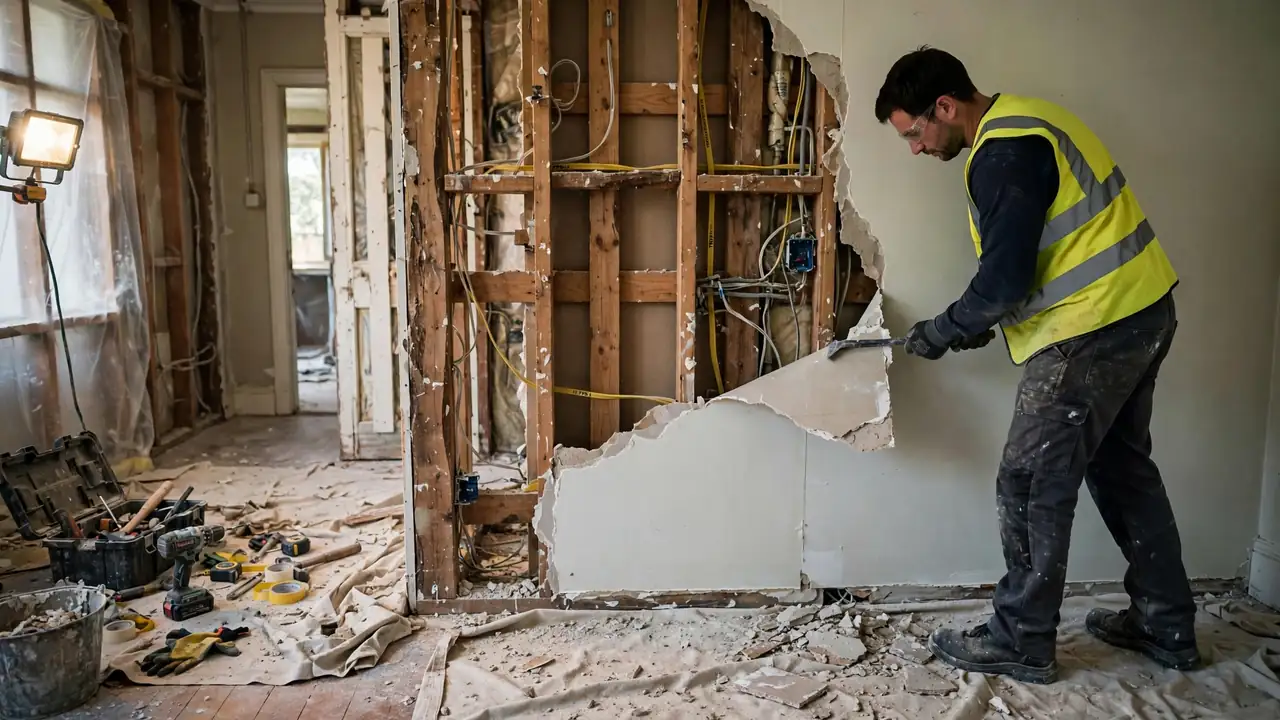
- The unknowns. Asbestos removal, rotten stumps, termite damage, illegal wiring — the things nobody sees until walls come off.
Two “honest” $/m² quotes can still differ by 40%: one includes the kitchen joinery while the other uses a prime-cost allowance. The rate also assumes all structural, electrical and plumbing work meets the National Construction Code and relevant Australian Standards (see Standards Australia). Consequently, shortcuts aren’t savings; they’re liabilities.
Per-room benchmarks: why kitchens skew the average
Wet areas pack five or six specialist trades into a small footprint, while a bedroom might need only paint and carpet. As a result, the kitchen alone can carry a third of a whole-house budget while occupying a tenth of the floor area:
| Room | Indicative cost (2026) |
|---|---|
| Kitchen (mid-range) | $25,000–$45,000 nationally; $35,000–$60,000 in Sydney |
| Bathroom | $15,000–$35,000+ depending on size and fittings |
| Laundry | $8,000–$25,000 |
| Bedroom (cosmetic) | $10,000–$30,000 for a full refresh |
Moving plumbing is the single biggest cost lever in a kitchen. Relocating a sink or cooktop on a concrete slab means concrete cutting, new drainage and replanning. Our kitchen renovation cost guide breaks down where every dollar goes, from cabinetry (often 30–40% of the budget) to appliances.
Bathrooms run a close second — see our bathroom renovation cost guide. The laundry runs $8,000–$25,000 once plumbing, waterproofing and joinery are counted; our laundry renovation cost guide has the detail. Therefore, when a builder quotes $3,500/m², ask what mix of rooms that assumes.
Worked example: cost to renovate a 3 bedroom house
Take a typical 3-bedroom brick-veneer of about 130m²: new kitchen, two updated bathrooms, new flooring and paint.
Step 1 — Measure the work area, not the whole house. 70m² gets the full treatment and the rest gets paint and minor repairs. Multiplying the whole floor area by a mid-range rate is the classic mistake.
Step 2 — Apply a realistic rate. 70m² of substantial work at $3,000–$5,000/m² comes to $210,000–$350,000. The remaining 60m² at a cosmetic $1,200–$1,800/m² adds $72,000–$108,000.
Step 3 — Cross-check against per-room benchmarks (kitchen $25,000–$45,000, two bathrooms $30,000–$70,000, laundry $8,000–$25,000).
Step 4 — Add 15% contingency. Then budget design fees, approvals and accommodation separately.
Published guides put 3-bedroom internal renovation budgets from around $120,000, exceeding $300,000 with major structural changes or extensions. For the flooring and tiling portion, our free renovation tools take the guesswork out of quantities.
Renovation cost per sqm: Sydney and Melbourne vs the regions
Location moves the $/m² needle more than any other single factor. Sydney and Melbourne sit atop Australian renovation pricing. For example, Sydney guides budget $2,000–$4,000/m² for comprehensive work. A mid-range Sydney kitchen alone runs $35,000–$60,000, against $30,000–$50,000 in Melbourne and $25,000–$40,000 in Adelaide.
However, regional jobs carry their own premiums instead: travel time for specialist trades, freight, and fewer competing builders. Therefore adjust for your city before comparing any quote to a national benchmark.
Personal experience: three quotes, one lesson
We renovated a tired 1970s brick-veneer — new kitchen, one bathroom, floors and paint. Three quotes came back nearly 40% apart. The difference was entirely in the inclusions: the cheapest excluded bathroom waterproofing rectification and ignored the borderline switchboard.
We took the middle quote, added our own 15% buffer, and spent nearly all of it. The lesson: the cheapest $/m² is usually the one that’s missing something. Consequently, compare inclusions line by line, and never spend the contingency in week one on tapware.
Expert insights: what the industry says about $/m²
The industry warns against leaning too hard on square-metre pricing. For example, Sydney renovation specialists Addbuild note two identical 60m² additions can cost vastly different amounts. It depends on structure, access, services changes and the mix of kitchens and bathrooms. You’re not just building new space, you’re modifying an existing building — and the relationship between old and new drives cost more than floor area.
Master Builders WA chief executive Matt Moran makes the same point publicly. Renovations can carry a higher construction cost per square metre than a new home, because you’re working around an existing structure: demolition, temporary works, restricted access, and matching old to new. “Somebody might spend less overall because they are only altering part of their home,” he noted, “but that doesn’t necessarily mean the building work itself is cheaper.” Therefore, use $/m² to set your range and smell-test quotes — then demand itemised pricing.
The contingency rule: the 10–20% buffer
Every credible Australian renovation guide agrees: hold back 10–20% of your construction budget as contingency. Allow 10–15% for straightforward cosmetic work. In addition, push to 15–20% or more for structural changes, extensions, or pre-1990s homes where asbestos, lead paint, termite damage or outdated wiring are likely.
The contingency is for unforeseen problems — rotten joists, illegal wiring, a cracked slab — not showroom tapware. Track every dollar drawn from it: when the buffer hits zero, stop and re-scope.
How to use $/m² for early budgeting
- Define your scope in plain words. “New kitchen, two bathrooms, paint and hybrid floors throughout, no walls moving” beats any number.
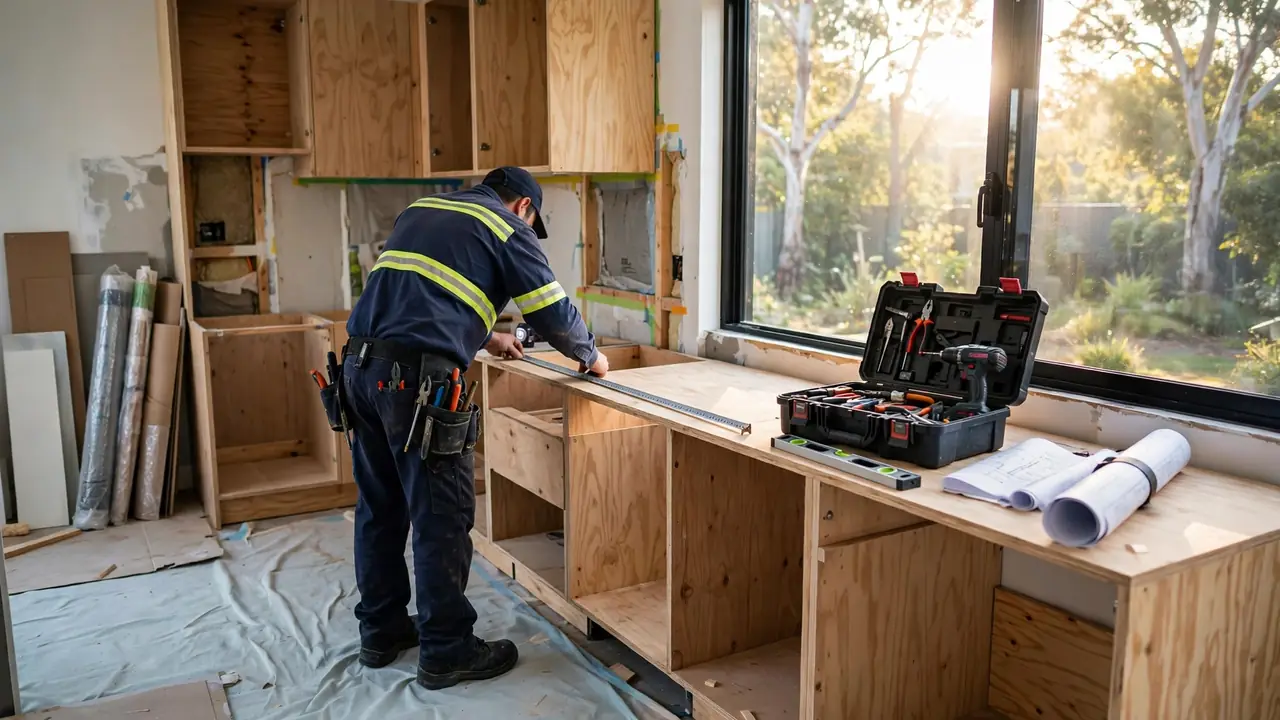
- Measure the work area, room by room. Count only floor area actually being renovated, splitting wet areas from dry.
- Apply the right band, then cross-check with per-room benchmarks. If the $/m² maths says $180,000 but the room-by-room sum says $260,000, trust the rooms.
- Add contingency (10–20%) and the excluded costs — design, approvals, accommodation — as separate lines.
- Get three itemised quotes and compare scopes, not rates. The builder quoting $3,200/m² with full inclusions beats the one quoting $2,600/m² with half the job in allowances. In Australia, tradie services also come with automatic consumer guarantees — so the ACCC’s guidance on consumer guarantees is worth reading before you pay any deposit.
Know when the metric stops applying: if your renovation quote approaches 50–60% of a knockdown rebuild’s cost, compare both options. Our guide to knockdown rebuild costs in Australia walks through that decision — sometimes the bravest call is not to renovate at all.
Frequently asked questions
What is the average renovation cost per square metre in Australia?
2026 builder benchmarks cluster around $1,200–$2,500/m² for a cosmetic refresh, $3,000–$5,000/m² for a standard mid-range renovation, and $5,000–$8,000+/m² for structural work and extensions. In Melbourne, expect budget $1,200–$1,800/m², mid-range $1,800–$2,800/m², and premium or structural $2,800–$4,500+/m².
What does a $/m² renovation rate include — and what does it exclude?
It usually covers demolition of the work area, labour, materials and finishes, core trades, builder’s margin and GST. However, it commonly excludes design fees (6–12% of construction value), approvals and permits, furniture, landscaping, temporary accommodation, and unforeseen issues like asbestos.
Why do renovation quotes per square metre vary so much?
Because $/m² averages across very different rooms. For example, kitchens and bathrooms concentrate multiple specialist trades into small footprints, so they cost several times more per square metre than bedrooms. Scope inclusions, finish levels, structural complexity, site access, home age and location all shift the number.
How much does it cost to renovate a 3 bedroom house in Australia?
2026 guides put 3-bedroom internal renovation budgets from around $120,000, exceeding $300,000 with major structural changes or extensions. As a rough method, apply $3,000–$5,000/m² to the area receiving substantial work (not the whole floor plan). Then cross-check against per-room benchmarks, and add 10–20% contingency plus design and approval fees.
Should I add a contingency to my renovation budget?
Yes. 10–20% of construction cost is the industry standard: 10–15% for straightforward cosmetic work, and 15–20%+ for structural changes, extensions, or pre-1990s homes where asbestos, lead paint, termite damage or outdated wiring are likely. Reserve it strictly for unforeseen problems, not finish upgrades.
Is it cheaper per square metre to renovate or knock down and rebuild?
Renovations can cost more per square metre than a new build. For example, demolition, restricted access, temporary works and tying new into old all add up. You may still spend less overall renovating only part of the home. However, if the quote approaches 50–60% of a knockdown rebuild cost, compare both options first.
Conclusion
The renovation cost per square metre in Australia is a useful compass for early budgeting: $1,200–$2,500/m² cosmetic, $3,000–$5,000/m² standard, and $5,000–$8,000+/m² structural in 2026. However, it’s an average stretched across rooms that cost wildly different amounts. Use it to set your range and sanity-check quotes. Then define the scope, cross-check with per-room benchmarks, hold a 10–20% contingency and compare itemised inclusions.
Work through the room guides linked above to build your total from the parts, not the average.