
Nearly every Australian homeowner knows a renovation that went sideways. The four-week bathroom took four months, the quote blew out by $30,000, and council ordered the deck torn down. Unfortunately, these are renovation mistakes Australian homeowners repeat every year — and most were avoidable.
Short answer: Homeowners make the renovation mistakes to avoid in Australia before a single tradie arrives. The usual culprits: no written budget or contingency, skipped approvals, demolishing before asbestos testing. Others include ignoring the NCC’s 7-star energy rules, hiring on price alone and forgetting to tell your insurer.
Below are the 12 mistakes, each with what to do instead, plus a printable renovation planning checklist at the end.
Figures are indicative 2026 Australian ranges from published guides (sources at the end). Costs vary by location and supplier — always get itemised quotes.
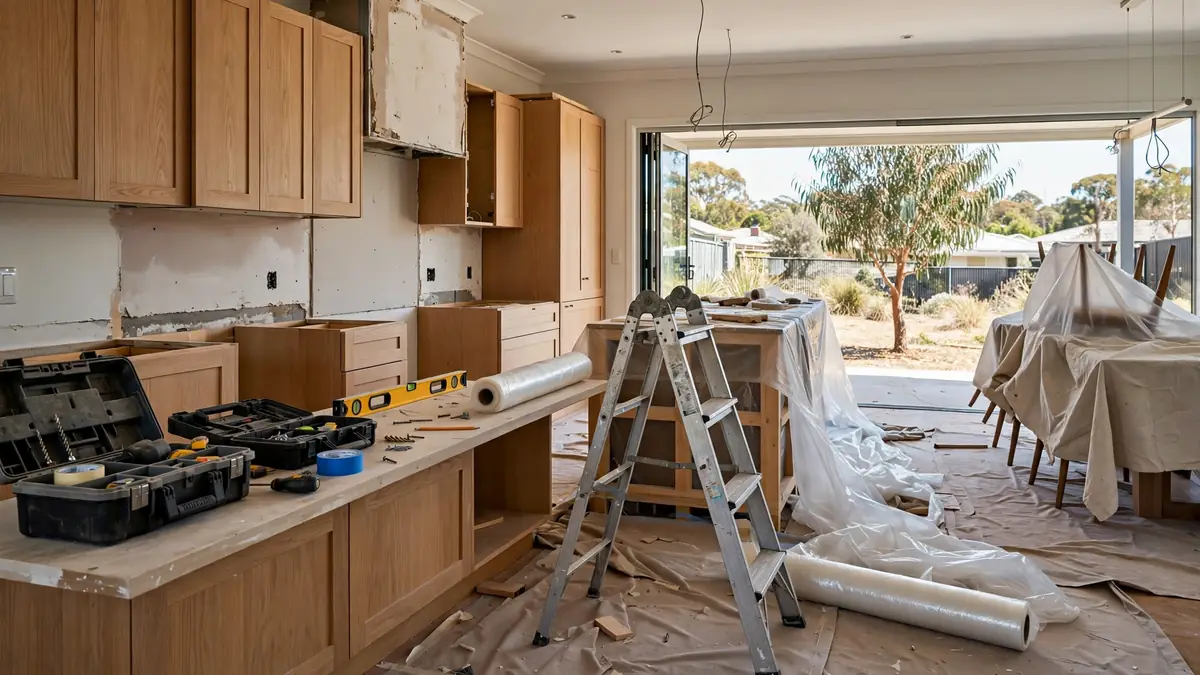
Budget mistakes: renovation mistakes to avoid before you spend a dollar
Mistake 1: Starting without a written budget (and no contingency)
Most renovators start with a number in their head — no line items, no allowance for surprises. Then the tiler finds a rotted floor and the budget is dead by week three. One in four Australian renovations goes over budget. Equifax data from September 2026 showed about 43 per cent of households couldn’t absorb even a 1–5 per cent cost rise.
Do this instead: Write the budget down before getting a single quote — materials, labour, approvals, insurance and contingency. Trade guides recommend 15–20 per cent above your quoted price for older homes. Finally, lock quotes in writing with a validity date.
Mistake 2: Renovating for yourself when you should renovate for the street
For example, that $25,000 imported tap set will make you happy. On a $650,000 house in a $700,000 street, you’ll never see the money again. Overcapitalising is the classic first-renovation error.
Do this instead: Check recent sales of comparable renovated homes in your suburb. Then keep your spend well below the suburb’s ceiling. Our guide to renovation cost per square metre in Australia helps sanity-check the budget. If the property needs everything, run the maths on a knockdown rebuild first.
Approvals and compliance: renovation mistakes to avoid in Australia
Mistake 3: Assuming you don’t need council approval
Knocking down a wall, converting a garage, adding a deck or changing the footprint can all trigger approvals. Unapproved work can stall a sale, void insurance or lead to a council demolition order. NSW offers three pathways. Exempt development covers minor works and needs no approval. Complying development is a fast-track CDC through council or a private certifier. A full development application is the third option. Complying development certificates are possible in as little as 20 days.
Do this instead: Confirm which pathway applies before you sign. NSW Planning’s exempt and complying development policy is the starting point in NSW. Elsewhere, check your state planning portal or council. In strata, get owners’ corporation approval in writing too.
Mistake 4: Taking an owner-builder permit when a builder is really running the job
A “builder” suggests you take out an owner-builder permit while he organises everything. Legally, you become the builder. You carry the warranty liability and insurance obligations, and the home warranty insurance that would have protected you doesn’t exist. Building Commission NSW’s consumer building guide explicitly warns against this pitch.
Do this instead: If a builder manages the work, he holds the licence. Only take an owner-builder permit if you genuinely intend to supervise the project yourself. In NSW you need a permit for work over $20,000. It requires an approved course and a white card. The rules generally limit you to one permit per five-year period.
Mistake 5: Demolishing before you test for asbestos
In pre-1990 homes, asbestos can hide in eaves, wall sheeting, vinyl flooring, pipe lagging and switchboards. Ripping into it untested spreads fibres and turns a weekend demolition into a licensed-removal emergency. A 2026 guide puts removal at $50–$100 per square metre (bonded) and $150–$300 (friable). Testing costs $300–$800. Minimum call-outs run $1,500–$2,500.
Do this instead: Treat pre-1990 homes as suspect until proven otherwise. Get an accredited inspection before demolition. Budget removal inside the renovation budget. Only licensed removalists may do the work.
Mistake 6: Designing without the NCC’s 7-star energy rules in mind
Under the National Construction Code 2022, new homes must reach a 7-star NatHERS rating. They must also meet a new whole-of-home annual energy use budget. Assessors can apply these rules to substantial additions too, which can force costly redesigns.
Do this instead: Read the ABCB’s overview of the energy efficiency and condensation changes. Ask your designer or certifier early whether your addition needs an energy assessment. At concept stage it’s cheap; at approval stage it’s expensive.
Hiring and timing: renovation mistakes to avoid once work starts
Mistake 7: Hiring the cheapest quote without checking the paperwork
One quote lands 30 per cent below the others. Tempting — but it can mean the builder hasn’t understood the scope, is cutting corners, or isn’t licensed and insured.
Do this instead: Check licences on your state fair trading portal and confirm insurance before anyone starts. Compare quotes line by line — materials, labour, prep, waste removal — not as lump sums.
Mistake 8: Paying big deposits and never putting changes in writing
NSW caps the upfront deposit at 10 per cent of the contract price. Paying more leaves you exposed if the builder disappears. Then come the variations. “While we’re here, can you just…?” Every unrecorded change becomes a dispute over what was agreed and what it cost.
Do this instead: Never pay more than the legal maximum. Tie progress payments to completed stages. Put every change in writing as a priced variation first. Our guide to kitchen renovation costs in Australia shows what itemised quotes look like.
Mistake 9: Renovating without telling your insurer
Home policies expect you to disclose building work. An undisclosed reno can complicate or void a claim. The insurer set your sum insured for the house as it was. Australia Institute polling in 2025 found around 1.4 million Australian homes were uninsured or under-insured. The Insurance Council of Australia notes building material costs rose 40 per cent since 2022. Old rebuild estimates are badly out of date.
Do this instead: Call your insurer before work starts. Disclose the scope and value. Update your sum insured to the finished home’s rebuild cost.
Mistake 10: Ordering fittings too late — or demolishing too early
The tiles arrive six weeks after the tiler has moved on. The vanity doesn’t fit the rough-in. Or you gut the kitchen on day one. Then you learn the stonemason only templates the benchtop after the cabinets go in. You’re washing dishes in the bathtub for weeks.
Do this instead: Order everything with a lead time before demolition and confirm every critical dimension first. Our free tile calculator takes the guesswork out of tile, adhesive and grout quantities.
Mistake 11: Designing in your head instead of on paper
Saying “we’ll work it out as we go” is how renovators make $5,000 mistakes. Without plans and a finishes schedule, every tradie interprets your vision differently. No one can quote the job accurately.
Do this instead: Document the scope room by room before quoting — what’s staying, what’s going, materials and finishes. Even a rough plan with dimensions transforms quoting accuracy.
Mistake 12: Forgetting you’ll be living through it
Dust gets everywhere. The water goes off for a day that becomes three. The 6:30am concrete cut starts early. Living in a construction zone is genuinely hard, and most renovators underestimate the toll.
Do this instead: Decide before demolition whether you’re staying or going. Add the living costs to the budget from Mistake 1.
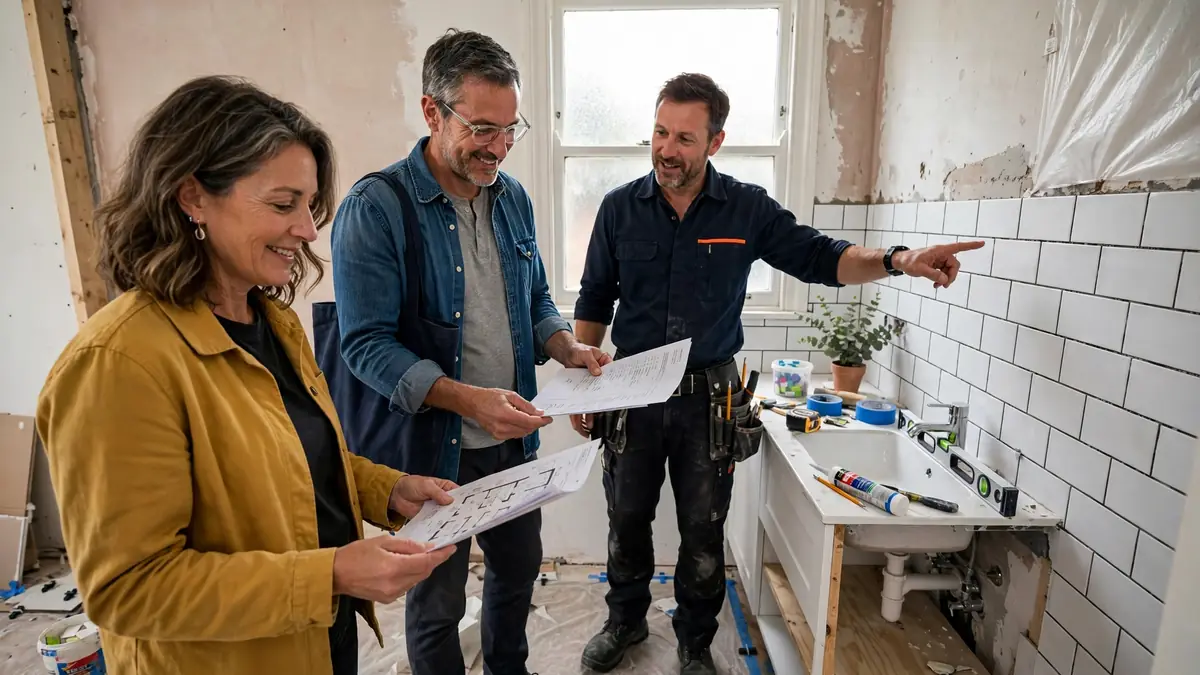
Personal experience: what our bathroom reno taught me
I’ll be honest — I learned most of these the expensive way. Renovating our main bathroom, I fell in love with a wall-hung vanity at a showroom sale. The price was too good to pass up. I bought it on the spot and “told” the plumber it was coming. Mistake 10, textbook.
One look told him the story. Our waste outlet suited a floor-standing vanity, in completely the wrong position for the wall-hung bracket. Moving it meant cutting into the slab edge, new pipework and an extra day of labour. The “bargain” vanity ended up costing several hundred dollars more than the dearer floor-standing option I’d ignored.
Now the finishes schedule comes first. I confirm every rough-in against the actual products before ordering. I never buy fixtures on impulse.
Expert insights: what the published guidance says
The Australian Building Codes Board’s overview of the NCC 2022 changes sets out two residential energy requirements plainly. They are 7-star-equivalent NatHERS thermal performance and a whole-of-home annual energy use budget. Message for renovators: assess energy compliance at concept stage, not approval stage.
NSW Planning’s published policy distinguishes three approval pathways: exempt, complying and full development applications. Complying certificates are possible in as little as 20 days. Indeed, that one page would have saved many renovators from stop-work orders.
Equifax’s 2026 figures are sobering. About 43 per cent of households couldn’t absorb even a 1–5 per cent rise in build costs. Fewer than 5 per cent had the buffer for an overrun above 15 per cent. That is the entire argument for a 15–20 per cent contingency in one statistic.
Building Commission NSW’s contracts put the protective rules in black and white. They cap deposits at 10 per cent in NSW and require progress payment schedules on contracts over $20,000. Put every variation in writing and have it signed. Statutory warranties run six years for major defects and two years for other defects.
Your printable renovation planning checklist
Before accepting a single quote, run through this list — one fix per mistake.
- Budget: Line items plus a 15–20% contingency.
- Value check: Keep total spend below comparable renovated homes in your suburb.
- Approvals: Confirm exempt, complying or DA pathway.
- Permits: If a builder runs the job, he holds the licence — not you.
- Asbestos: Licensed inspection for any pre-1990 home before demolition.
- Energy rules: Ask your certifier whether NCC 2022 7-star rules affect your addition.
- Trades: Check licences on your state fair trading portal; confirm insurance.
- Contracts: Deposits at or below the legal maximum; every variation in writing.
- Insurance: Tell your insurer; update your sum insured.
- Procurement: Order long-lead items early; confirm all measurements.
- Scope: Full scope, plans and finishes schedule documented before quoting.
- Living plan: Decide staying or moving out; add living costs to the budget.
Frequently asked questions
What is the biggest renovation mistake in Australia?
Starting without a written budget that includes a 15–20% contingency. Equifax data reported in 2026 found around 43% of households couldn’t absorb even a 1–5% cost rise. Fewer than 5% could absorb an overrun above 15%.
Do I need council approval to renovate my home in Australia?
It depends on the work and your state. In NSW: exempt development (minor works, no approval), complying development (fast-track CDC) and a full development application. Complying certificates are possible in as little as 20 days. Structural changes, extensions, decks and garage conversions often need approval — check your state portal first.
How much contingency should I add to a renovation budget?
Allow 15–20% above your quoted price. That is the standard recommendation for established homes, where hidden problems like rot, asbestos and outdated wiring are common.
Should I get an owner-builder permit to save money?
Only if you genuinely intend to supervise the project yourself. In NSW you need a permit for work over $20,000. It requires an approved course and white card. The rules generally limit you to one per five-year period. Never accept a permit just because a “builder” suggests it. That makes you legally responsible while he avoids licensing and insurance obligations.
What should I check before demolishing a pre-1990 Australian home?
Get an accredited asbestos inspection first — it can hide in eaves, wall sheeting, vinyl flooring, pipe lagging and switchboards. Removal typically costs $50–$100 per square metre (bonded) and $150–$300 (friable), with testing at $300–$800. Budget it inside your renovation budget.
Costs vary by location and supplier. Figures are indicative 2026 ranges from the sources below — get itemised quotes for your project.
The bottom line: the cheapest renovation is the one you plan properly
Every one of these 12 mistakes shares a root cause: rushing the planning phase. You need a written budget with a real contingency, confirmed approvals and licensed trades on written contracts. Add a finishes schedule signed off before demolition. That paperwork separates a renovation you enjoy from one you survive.
Next, work through the checklist above. Then use our free renovation calculators to price tiles, paint and flooring before you call anyone. When you’re ready to budget the big-ticket room, start with our guide to bathroom renovation costs in Australia. In fact, planning mistakes cost the most there.