
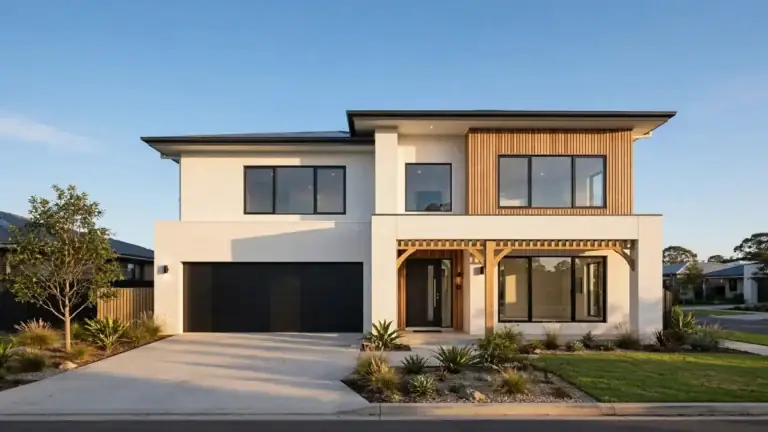
Knockdown Rebuild Cost in Australia (2026): Demolition, Build & Hidden Costs Explained
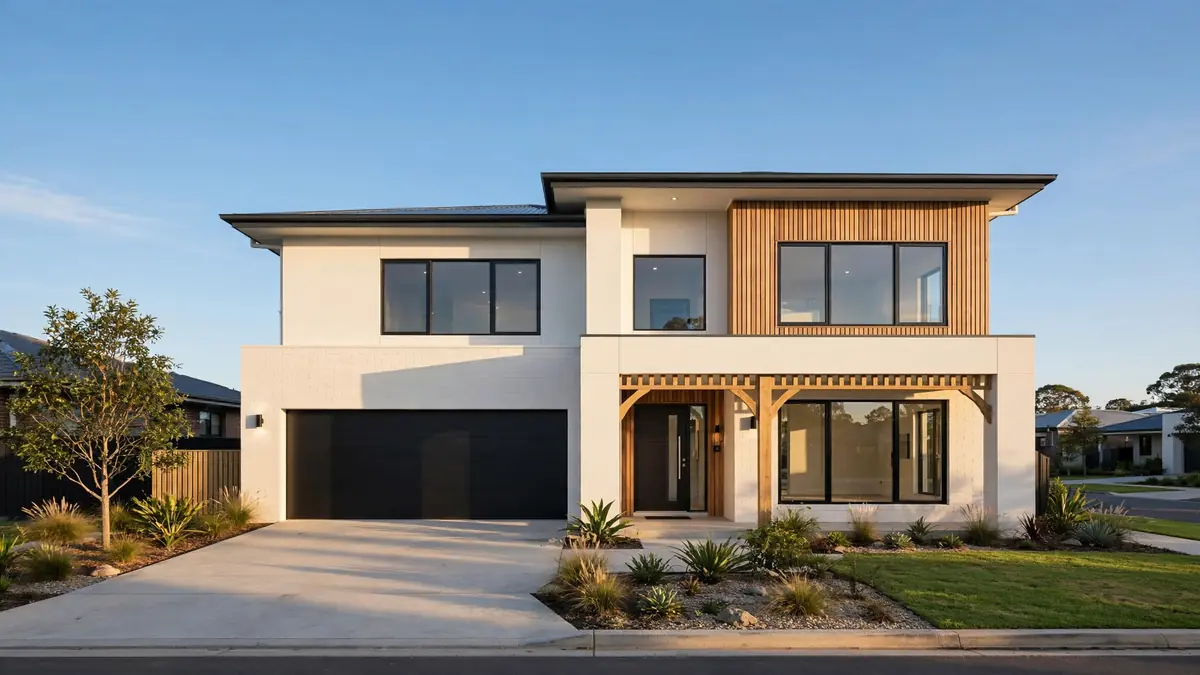
You love your street — the neighbours, the school around the corner, the shortcuts to the station. It’s the house that’s the problem: the poky 1970s floor plan, the ceilings you can practically touch, the kitchen that belongs in a museum. So you face the big fork: pour money into renovating, or knock the whole thing down and start again?
For example, people usually compare a $400,000 renovation quote with a $600,000 build quote and conclude renovating is cheaper — without realising those numbers contain completely different risks, timelines and finished products. A knockdown rebuild is not “a renovation, but bigger”. It deserves its own maths.
Short answer: In 2026, a knockdown rebuild in Australia typically costs $450,000 to $900,000+ all-in. Construction runs roughly $1,900–$4,000 per square metre nationally ($2,195–$2,370/m² for a medium-spec brick veneer home in Sydney; $2,100–$3,900/m² in Melbourne). Add $15,000–$40,000+ for demolition, plus approvals, site works and temporary accommodation. Allow 12–18 months from feasibility to moving in.
Note: all prices below are indicative 2026 Australian figures drawn from published builder, industry and trade guides (sources listed at the end). Costs vary by location, supplier and site complexity — always get itemised quotes for your block.
Knockdown rebuild cost Australia: the 2026 averages
A knockdown rebuild has two cost stages — demolition and construction. However, most advertised “from” prices only show the second, which is why budgets blow out before the first brick is laid.
For instance, published 2026 guides put a standard knockdown rebuild at $480,000 to $900,000 all-in in Sydney and $450,000 to $900,000+ in Melbourne — demolition, approvals and construction. Nationally, guides quote $480,000 to $950,000. A flat block with no asbestos and a standard single-storey design sits at the bottom. In contrast, a sloping block, asbestos remediation and a two-storey custom design sit at the top.
The per-square-metre rates builders quote:
| Build specification | Indicative $/m² (2026) |
|---|---|
| Basic / project-home build | $1,900–$2,400 |
| Medium-spec brick veneer, Sydney | $2,195–$2,370 |
| Melbourne standard to mid-range | $2,100–$3,900 |
| High-spec, Sydney | $3,075–$3,375 |
| Premium custom / architectural | $4,500+ |
Here’s the counter-intuitive bit: Archicentre’s 2026 CostGuide puts work inside an existing building at $1,600–$3,900/m² versus new work at $2,700–$5,100/m² — a heavy renovation can cost more per square metre than building new.
Demolition costs in detail: the first cheque you’ll write
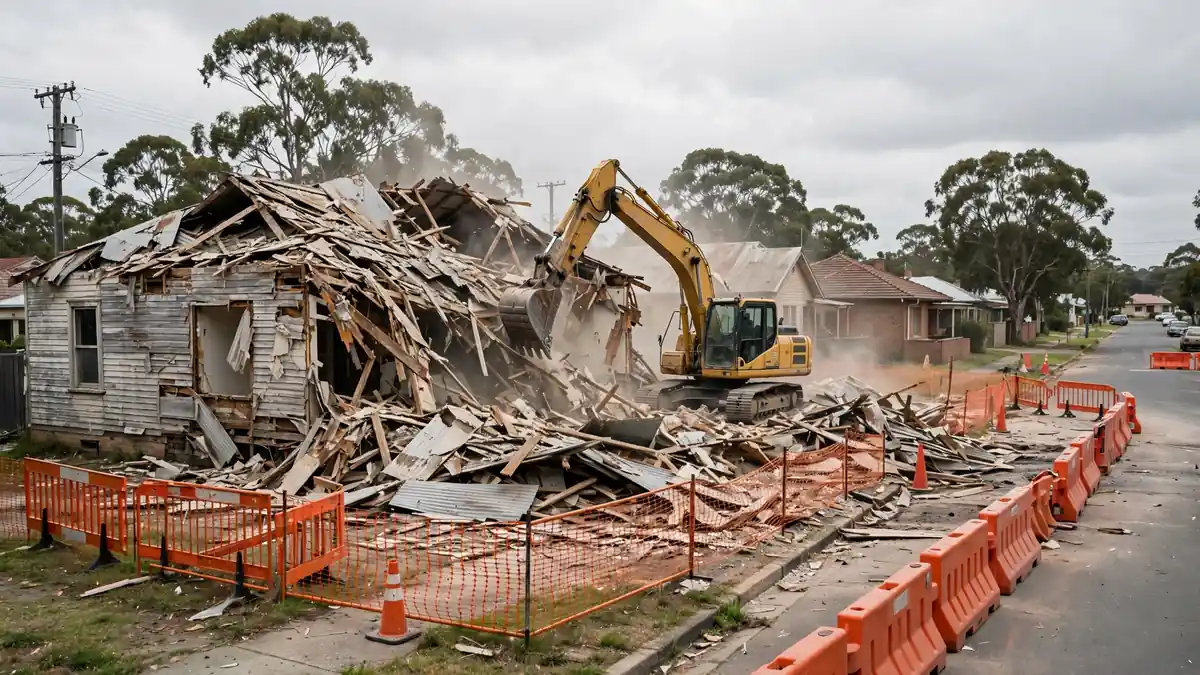
Most homeowners price demolition as “a day or two with an excavator”. However, the reality is a licensed, notified operation that typically lands between $10,000 and $40,000 for a standard single-storey home.
A useful rule of thumb is $100–$150 per square metre of the existing house: a modest 150m² single-storey home typically costs $10,000–$15,000; a larger or double-storey home runs $22,000–$38,000. A compliant full site clearance — survey, licensed asbestos removal, EPA-tracked disposal, clearance certificate, mechanical demolition, documentation — is quoted at $25,000–$55,000 in 2026.
Asbestos. Any pre-1990 home very likely contains asbestos — fibro sheeting, eaves, roofing, vinyl flooring, lagging. Consequently, licensed removal is mandatory and priced separately: $8,000–$20,000 is commonly quoted in Sydney; Melbourne guides put it at $5,000–$15,000, with a full 3-bedroom fibro house reaching $5,000–$30,000. Bonded removal runs $50–$100/m², friable $150–$300/m², with a $1,500–$2,500 minimum call-out. Therefore, organise an asbestos survey ($300–$800) before you finalise your budget.
Disconnections. In addition, gas, electricity, water, sewer and NBN must all be permanently disconnected first — typically $1,200–$3,500. SafeWork NSW requires notification five calendar days before licensed demolition work begins — check the notification requirements with your state’s regulator.
Finally, before you sign, confirm your contractor holds a demolition licence, an asbestos removal licence, public liability insurance and workers compensation cover. A dramatically cheaper quote almost always means corners cut on licensing, disposal or the clearance certificate.
Knockdown rebuild cost Australia: 2026 build rates by city
| City | Indicative build rate | Typical 200m² build cost |
|---|---|---|
| Sydney | $2,195–$2,370/m² (medium); $3,075–$3,375/m² (high-spec) | $439,000–$675,000 |
| Melbourne | $2,100–$3,900/m² | $420,000–$780,000 |
Furthermore, each city layers its own approval costs on top: Sydney Section 7.11/7.12 contributions of $15,000–$30,000 plus professional fees of $12,000–$25,000; Melbourne council fees of $2,500–$6,000. New service connections — power, water, sewer, stormwater, NBN — run $6,000–$14,000 everywhere.
The hidden costs nobody puts on the flyer
The “from $2,195/m²” price on the builder’s flyer covers the house itself. However, everything below is extra.
Site works. For example, your geotechnical report dictates the engineering: reactive soils $10,000–$40,000; retaining walls and benching $30,000–$80,000; rock excavation $15,000–$45,000. A sloping block with rock or reactive clay can add well over $100,000. However, none of this can be priced until the geotech report and survey are done.
Approvals. A CDC pathway in NSW is faster and cheaper than a full DA. However, neither is free — budget for certifier fees, surveys, BASIX assessment and council contributions. In addition, every new dwelling must meet a 7-star NatHERS rating.
Temporary accommodation. Therefore, budget rent for the full build period plus a buffer — a three-month delay on $600/week rent is $7,200 gone. Furthermore, add storage and removalists (twice — out and back in).
External works. Similarly, driveway, fencing, landscaping and letterboxes are rarely in the base price. Sydney breakdowns allow $25,000–$50,000.
Fit-out gaps. For instance, base inclusions often exclude window furnishings, air con upgrades, security screens and smart wiring. Therefore, price the gaps line by line.
Contingency. Finally, keep 10–15% in reserve. A rebuild is lower-risk than a major renovation once the ground is known. However, nobody can see the ground until they dig.
Knockdown rebuild vs renovation: the crossover maths
Run both options through the same five tests before you decide.
1. Useful space. Compare finished project cost per room that serves your brief — not a blended $/m². A $450,000 renovation that leaves the same poky layout is not cheaper than a $650,000 rebuild delivering the bedrooms and open plan you need.
2. Uncertainty. A rebuild’s risk sits in demolition, ground and connections — discoverable with surveys before you commit. A renovation’s risk hides inside retained walls: termites, asbestos, dodgy wiring, structural defects. Renovation costs can approach or exceed rebuild costs once these appear — with less price certainty.
3. Approvals. Rules are state-specific. A NSW complying-development path is not a Victorian rule, and heritage overlays can prohibit demolition outright.
4. Occupancy. Renovation often lets you stay on site. A rebuild forces you to vacate — add rent, storage and a three-month delay to the rebuild column.
5. Value. A new build on premium land, built to 7-star energy standards with a full new-home warranty, is a different asset from a patched-up older home. If land value greatly exceeds house value, rebuilding usually wins long-term.
The crossover point most builders describe: when your renovation quote reaches roughly 60–70% of the rebuild quote, or the house has structural damage or needs major layout surgery — the rebuild is usually the better financial choice. On the other hand, if the structure is sound and only needs selective surgery, renovation wins.
How long does a knockdown rebuild take?
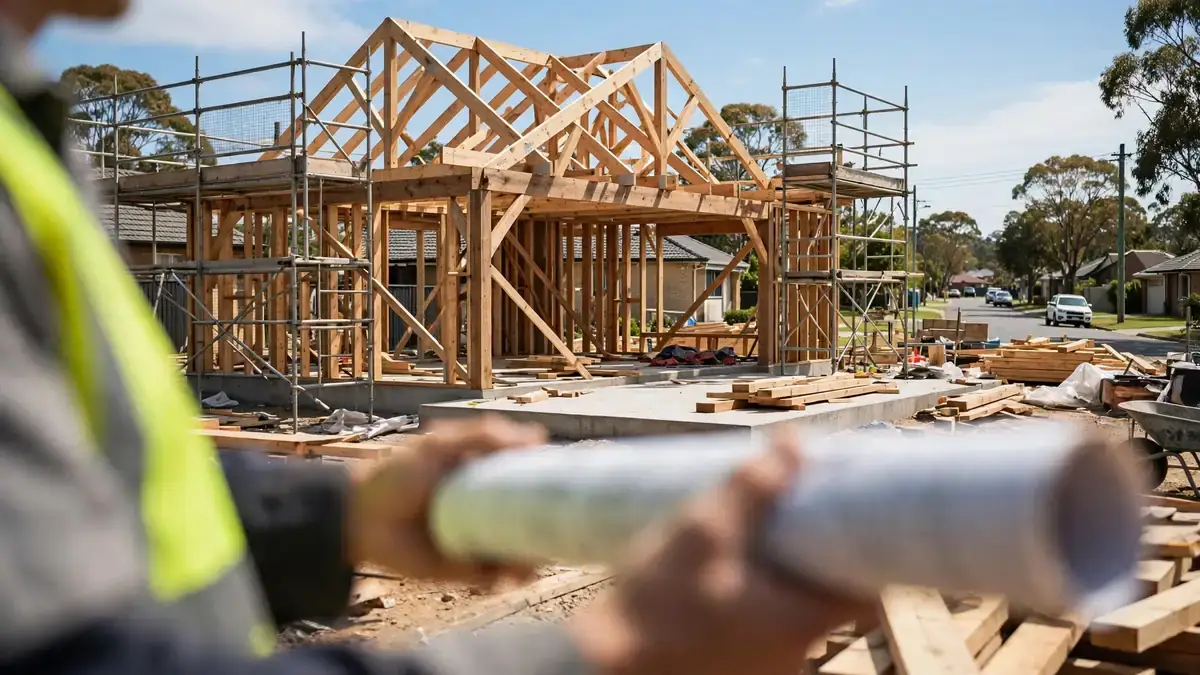
Ask ten builders and you’ll get ten timelines. However, published 2026 guidance converges on 12–18 months from feasibility to handover. Here is where the time goes:
| Stage | Typical duration |
|---|---|
| Feasibility, design and builder selection | 1–3 months |
| Approvals (CDC or DA) | 1–6 months |
| Demolition and site clearance | 1–2 weeks |
| Construction, single-storey | 6–9 months |
| Construction, double-storey | 9–12 months |
| Practical completion, defect rectification, certification | 4–6 weeks |
A CDC pathway in NSW runs faster than a full DA. In contrast, heritage or character overlays add months. One Melbourne guide quotes a full 14–22 months for a knockdown rebuild versus 6–18 months for a major renovation. Therefore, use the conservative end of every range when you plan your rental lease.
Instead, sign your rental with a month-to-month tail, not a hard end date that expires a week before practical completion. Indeed, delays are normal; being homeless because of them is avoidable.
Financing a knockdown rebuild: what to know
Most knockdown rebuilds are funded with a construction loan, which releases funds in stages — slab, frame, lock-up, fixing, final — and charges interest only on what’s drawn down. Get pre-approval before you engage a builder. In addition, keep your 10–15% contingency in savings rather than relying on the loan for variations — re-applying for credit mid-build is slow and expensive. However, one caution: a lender values the finished home on comparable sales, not on what it cost to build, so overcapitalising in a flat market is a genuine risk.
Personal experience: what I’d do differently
A few streets from me, a neighbour did exactly this last year — knocked down a weatherboard cottage and rebuilt a double-storey home on the same block. First, the part that went well: they got the asbestos survey done first. For example, the cottage was pre-1990: the survey found fibro in the eaves and laundry, and licensed removal was sequenced before demolition day. No surprises.
In contrast, the part that didn’t go well: they signed a 12-month rental lease to the day. For instance, the DA took four months instead of two, the build slipped three months, and they spent the last quarter paying unbudgeted rent plus storage. Their summary: the build cost what the builder said; the project cost about $40,000 more.
In conclusion, my takeaway: soil test and asbestos survey before any deposit, a genuine 15% contingency for surprises (not upgrades), and a rental with a flexible end. In other words, the house is the project you budget for; the 14 months of living is the project that actually costs you.
Expert insights
For example, Master Builders Australia advises homeowners to check their builder’s licence, insist on a written contract spelling out the full scope and price, and understand deposit limits and progress payment stages before signing. That advice matters doubly here, because a knockdown rebuild spans demolition contractors, certifiers and builders, each with their own contract. Therefore, verify every licence number with your state regulator.
In addition, get your demolition quotes itemised — demolition, asbestos removal, disconnections, waste disposal and the clearance certificate listed separately. Indeed, a lump-sum quote hides exactly the line items that blow out. Similarly, our guide to renovation mistakes that blow out budgets covers the same discipline for the renovation side.
Frequently asked questions
How much does a knockdown rebuild cost in Australia?
In 2026, a typical knockdown rebuild costs $450,000 to $900,000+ all-in. Construction runs roughly $1,900–$4,000 per square metre nationally ($2,100–$3,900/m² in Melbourne; $2,195–$2,370/m² for medium-spec brick veneer in Sydney). Demolition adds $15,000–$40,000+, more if asbestos removal is required.
How much does it cost to demolish a house in Australia?
A standard single-storey demolition typically costs $10,000–$40,000 ($100–$150 per square metre of the existing house). A compliant full site clearance — survey, licensed asbestos removal, disposal, clearance certificate — is quoted at $25,000–$55,000 in 2026. Disconnections add roughly $1,200–$3,500.
Is it cheaper to knock down and rebuild or renovate?
When a renovation quote reaches 60–70% of the rebuild cost, the home has structural damage or needs major layout surgery, or the land is worth far more than the dwelling, rebuilding usually wins long-term. If the structure is sound and the layout needs only selective changes, renovation is usually cheaper. Heavy renovations can exceed $3,900/m² — more than building new.
How long does a knockdown rebuild take?
Allow 12–18 months from feasibility to handover: 1–3 months for design, 1–6 months for approvals, 1–2 weeks for demolition, 6–9 months for single-storey construction (9–12 for double-storey), plus 4–6 weeks for practical completion and certification.
Costs vary by location, supplier and site complexity. Figures above are indicative 2026 ranges — get itemised quotes for your block.
The bottom line
A knockdown rebuild in Australia in 2026 is a $450,000–$900,000+ project, not just a build price plus a vague allowance for demolition. For example, the homeowners who get it right commission the asbestos survey and soil test before committing, budget honestly for rent and delays, and run the rebuild-vs-renovate maths on useful space rather than blended square-metre rates.
Alternatively, if you’re leaning towards keeping the existing house after all, start with our kitchen renovation costs in Australia guide and our renovation cost per square metre guide — then run your early material estimates through our free renovation calculators before you call a single tradie.