
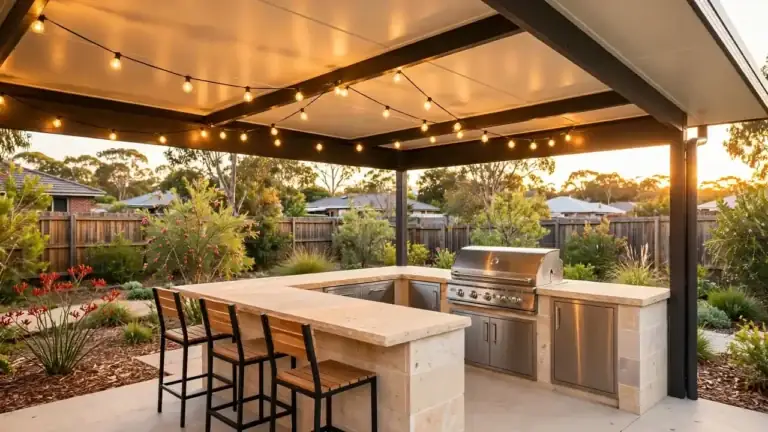
There’s nothing more Australian than a summer evening around the barbecue — except the sinking feeling when the “weatherproof” cabinets you installed two years ago start swelling, the benchtop fades to chalk, and someone tells you the indoor fridge you dragged outside has voided its warranty. The outdoor kitchen ideas Australia homeowners rate highest avoid all of that, because they’re designed for our climate from day one.
Short answer: In 2026, a basic built-in outdoor kitchen starts at around $5,000–$8,000, a mid-range build with a sink, plumbing and quality appliances typically costs $15,000–$30,000, and fully custom designs run $30,000–$60,000 or more. The best outdoor kitchen ideas Australia homeowners choose are simple: a covered cooking zone, 316-grade stainless steel or porcelain in coastal areas, and licensed trades for gas and plumbing.
Note: all prices are indicative 2026 Australian figures from published guides. Costs vary by location and supplier — get itemised quotes.
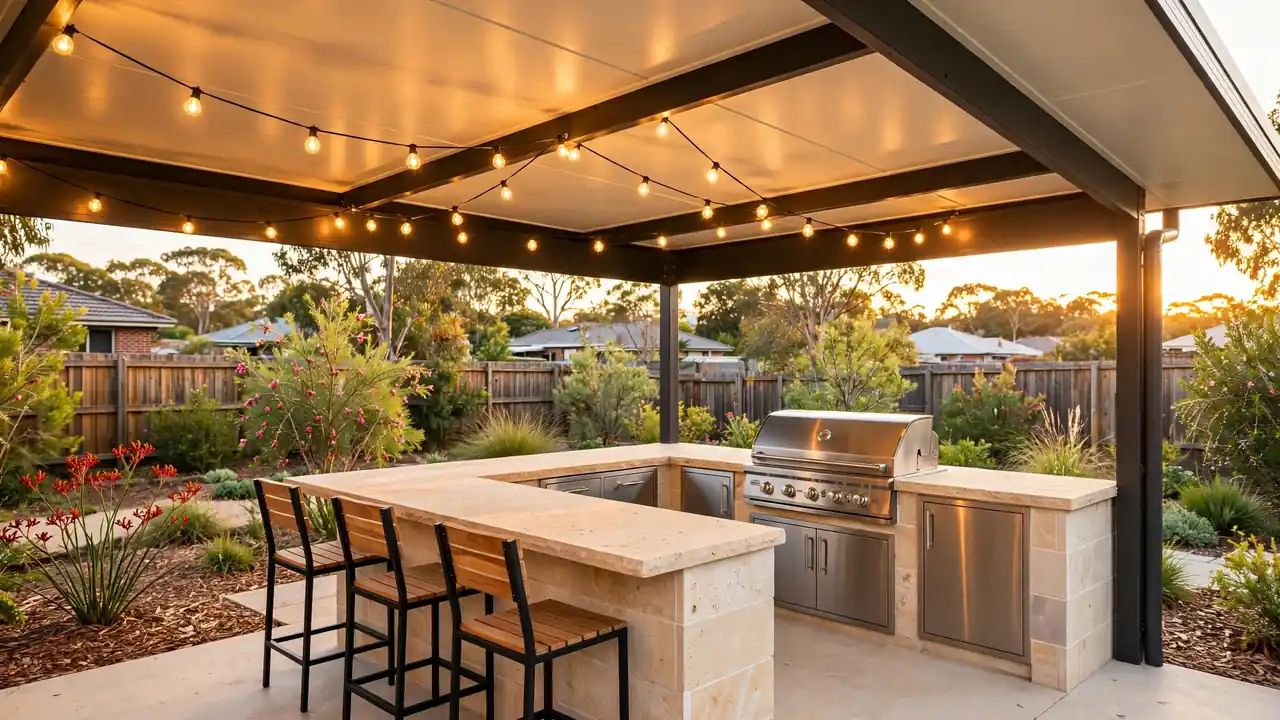
Outdoor kitchen ideas Australia: layouts that suit real blocks
So start with the layout, not the barbecue. Keep the barbecue, the prep bench and the sink within a few steps of each other — otherwise you’re doing laps across the patio with raw chicken.
Straight run (single wall). For example, one long bench along the house wall or fence — barbecue, prep space, sink in a row. It’s the cheapest layout because services run in a straight line: one gas point, one water line, one drainage run.
L-shape. A straight run with a return leg, usually for bar seating (allow roughly 300mm of knee room per stool). As a result, the cooking zone stays separate from the entertaining zone — ideal for corners under a patio roof.
Island. For big backyards and serious entertainers — but plumbing and gas must cross the slab to reach it, so budget for that before you fall in love with the look.
A few rules for every layout: keep at least 900mm of clear bench beside the barbecue, position the cooking zone so smoke drifts away from the house and neighbours, and never enclose a gas barbecue in cabinetry without its manufacturer’s ventilation clearances.
Outdoor kitchen ideas Australia: materials built for our climate
This is where most outdoor kitchens succeed or fail. Blazing UV, downpours and coastal salt air destroy indoor-rated materials fast. So here’s what actually lasts.
Benchtops. Porcelain and sintered stone (Dekton, Laminam, Neolith) are the standouts: UV-stable, heat- and fire-resistant, non-porous, no sealing needed. Granite is also durable and UV-stable but needs periodic resealing, while compact laminate is a genuine budget option. Warning: manufacturers don’t warrant many benchtop products for outdoor use at all — so check the fine print before you specify. Our benchtop materials guide compares the main options in more detail.
Cabinetry. For coastal homes, 316 marine-grade stainless steel is the gold standard against salt-air corrosion. Inland, 304 stainless steel does the job for less. Alternatives include weatherproof composite boards, marine-grade polymer (HDPE) that can’t rust or rot, and anodised aluminium frames with porcelain or glass doors. Ordinary kitchen cabinetry board will swell and delaminate outdoors, no matter how covered your patio feels — so skip it. For tapware, hinges and runners, specify marine-grade stainless: moving parts seize first in salt air.
In short: 316 stainless and porcelain for the coast; 304 stainless, granite or compact laminate inland; and confirm the benchtop warranty covers outdoor use.
Outdoor kitchen cost Australia: the 2026 price bands
Pricing falls into fairly consistent bands — use them to sanity-check quotes.
| Build level | What it typically includes | Indicative installed cost |
|---|---|---|
| Basic built-in | Built-in BBQ, benchtop, simple cabinetry | $5,000–$8,000 |
| Entry to mid-range | Built-in BBQ, benchtop, fridge cavity, weatherproof cabinetry | $8,000–$15,000 |
| Mid-range | Stone or porcelain benchtop, sink with plumbing, quality appliances, outdoor fridge, lighting | $15,000–$30,000 |
| Premium / fully custom | Natural stone benchtop, rangehood or pizza oven, custom cabinetry, bar seating | $30,000–$60,000+ |
The big variables are appliances, services and the roof: a built-in barbecue alone ranges from roughly $800 for a basic five-burner to around $2,400–$3,350 for a four- or six-burner built-in with a hood, while a three-piece package (barbecue, sink and bar fridge) lists around $9,000. On top of that, allow for the plumber, the gasfitter, the electrician and possibly a patio roof. To compare against an indoor project, our renovation cost per square metre guide puts whole-project budgets side by side.
Appliances: the barbecue, the fridge and the sink
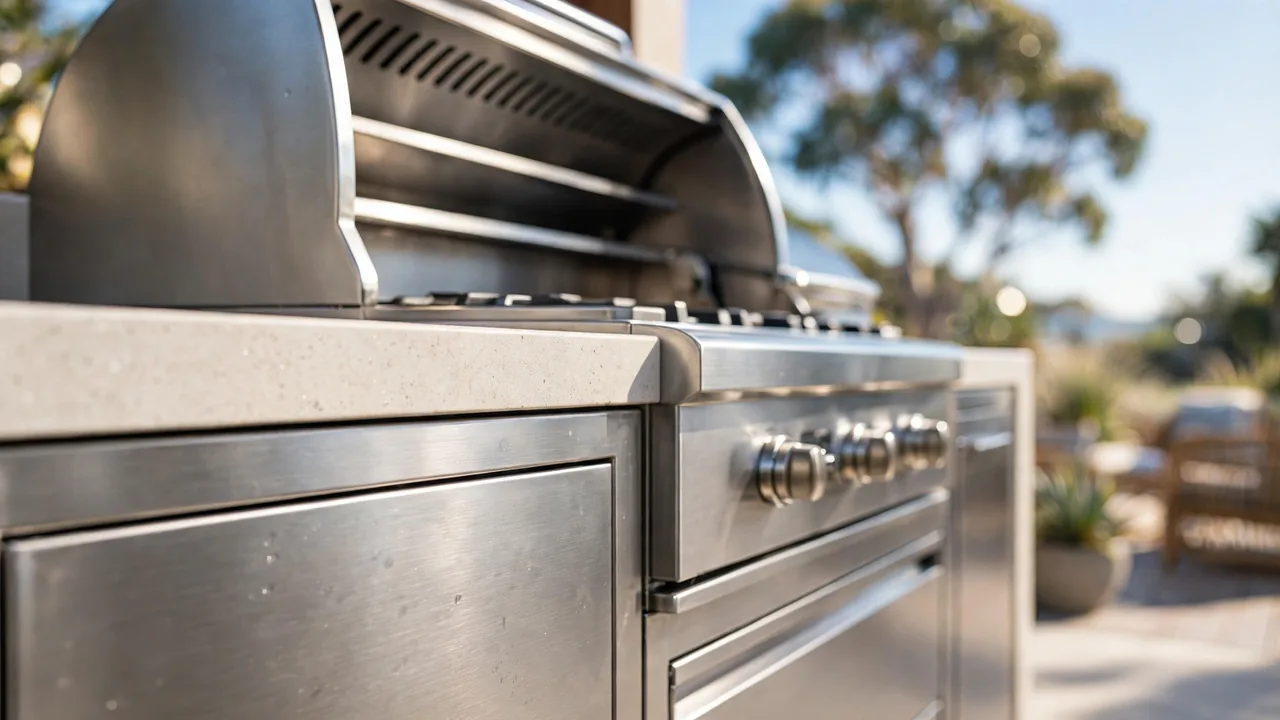
The barbecue. Built-in gas barbecues are the heart of most Australian outdoor kitchens. Choose natural gas with a mains connection, or LPG bottles for flexibility. Whatever you pick, buy a model actually rated for built-in installation — because dropping a freestanding barbecue into a cabinet cut-out is a fire risk and voids the warranty.
The fridge. The mistake almost everyone makes. Manufacturers don’t rate standard indoor bar fridges for outdoor temperature swings, humidity or dust, so installing one outside can void the warranty. Instead, buy an outdoor-rated refrigerator and keep it out of direct sun, away from the barbecue’s heat.
The sink. A sink turns a barbecue station into a real workspace. But it needs a licensed plumber for water supply and drainage — in most councils, a proper connection rather than a hose into the garden. Therefore, budget the plumbing as a separate line item; it’s never as cheap as people hope.
Worth-it extras. A pizza oven or wok burner for serious cooks, an outdoor-rated rangehood under a low roof, and task lighting — after all, you’ll use the kitchen after dark more than you think.
Council approval, setbacks and tradie rules
Rules differ by state and council, but the pattern is consistent.
Do you need approval? A freestanding barbecue and benchtop with no roof often falls under exempt development — several NSW councils list “BBQs and other outdoor cooking structures” as examples that don’t need approval. Add a roof, enclose the space, build near a boundary or exceed size limits, and you may need a complying development certificate or a full DA. In NSW, councils typically cap exempt patios and pergolas at 25m², with 900mm boundary setbacks and a 3-metre height limit. So confirm the current rules with your council or a registered certifier first — start with your council’s guidance on whether you need approval to understand the categories.
Gas and plumbing are licensed trades. In NSW, the law requires a licence before anyone carries out plumbing, draining or gasfitting work — including LP gasfitting for your barbecue. DIY gas work risks serious injury, legal penalties and insurance problems. Therefore, keep the gasfitter’s certificate of compliance with your house records.
One gas wrinkle for Sydney. From January 2027, new residential developments in the City of Sydney council area won’t be able to connect mains gas for outdoor appliances — but bottled-gas barbecues are unaffected. If you’re building new in inner Sydney, plan for LPG from the start.
Covered alfresco designs for year-round use
You’ll use an uncovered outdoor kitchen about four months a year — but a covered one all year. That’s why the roof is arguably the most important part of the design.
Attached patio roof. It extends from the house, keeps services short, and creates classic indoor-outdoor flow. In addition, insulated sandwich-panel roofing stays cooler in summer and quieter in rain than single-skin metal.
Pergola or louvred roof. Roofing just the cooking zone costs less than roofing the whole area, and smoke ventilates freely. Louvred roofs open for sun and close for rain, but they’re pricey — and closing the roof over a barbecue needs proper ventilation or a rangehood.
Whatever roof you choose, design for smoke: a slightly higher pitch, open gable ends, or an outdoor-rated rangehood. Then layer in comfort — dimmable downlights ($150–$300 each installed), an infrared heater or two ($800–$2,500 installed), and zip-track blinds — because that’s what turns a barbecue area into a genuine outdoor room.
Small outdoor kitchen ideas for courtyards and narrow blocks
Small doesn’t mean compromised — it means disciplined. In fact, the best small outdoor kitchens do three things well: cook, prep and store.
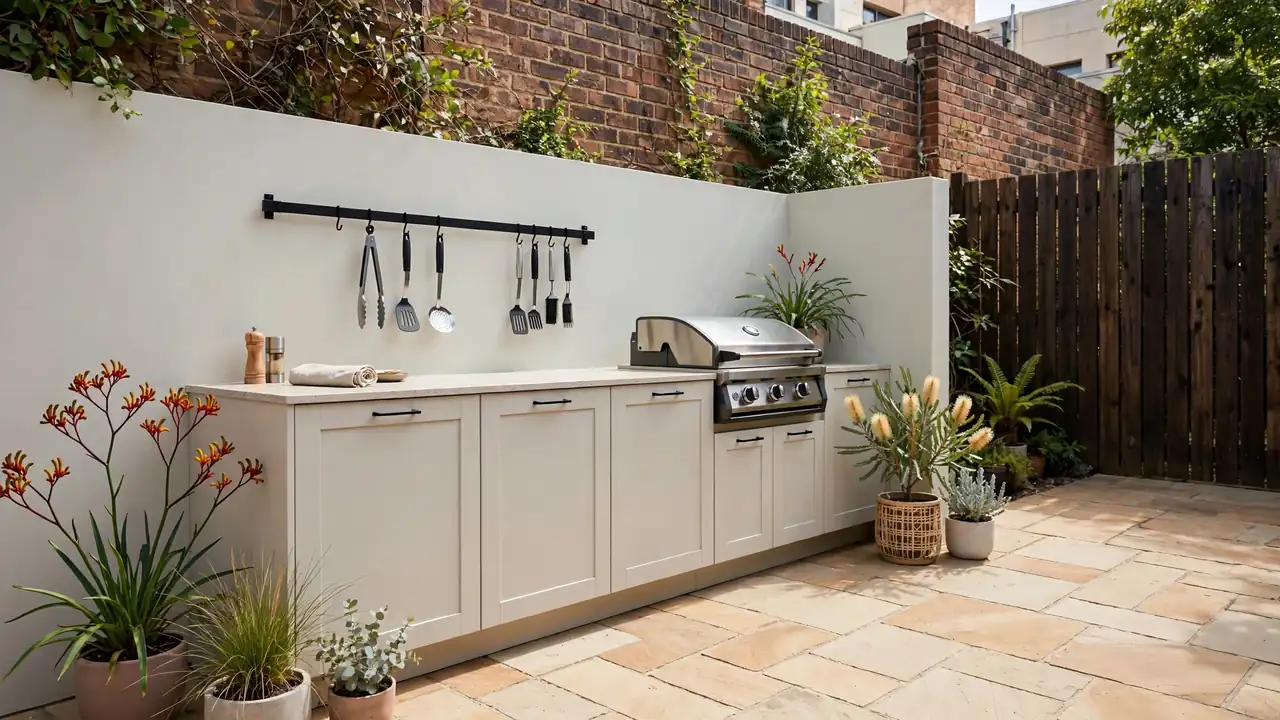
Start with a single straight run of 2–2.4 metres: a compact built-in barbecue, about 900mm of prep bench, a slim cabinet bank, and a small outdoor-rated bar fridge under the bench. A fold-down shelf doubles prep space when you’re cooking for a crowd.
Storage is the make-or-break: tall, slim weatherproof cabinets use vertical space without eating floor area, while magnetic strips or wall rails keep utensils off the bench. Keep the palette light so the space reads as furniture, not a shed. For hard-wearing surfaces underfoot, see our guide to the best flooring for Australian homes.
My personal experience: what I’d do differently
I’ll be honest: the first outdoor kitchen I helped plan — for my own place — taught me about false economies. We chose good-looking cabinetry without an outdoor rating because it cost half the price of the 316 stainless option. Within two summers the doors were swelling and the hinges had seized.
The second lesson was lighting. We wired a single batten light and called it done — then spent every evening cooking in our own shadow. Task lighting over the barbecue and prep bench makes the difference between a kitchen you use and one you photograph.
If I did it again tomorrow: 316 stainless cabinetry from day one, porcelain benchtop, twice the power points, task lighting over every work zone, and the plumber booked before the bench went in — not after.
Expert insights: what published Australian guidance says
You don’t need to take my word for it — the published guidance is consistent.
Check the warranty before you specify. Designers quoted in Mortgage Choice’s outdoor kitchen guide warn that manufacturers don’t warrant many benchtop products for outdoor use — they fade or fail — and recommend weatherproof board cabinetry with marine-grade steel hardware.
Only licensed trades touch gas and water. Master Plumbers Association national secretary Paul Naylor states that NSW law requires a licence before anyone carries out plumbing, draining or gasfitting work. EnergyAustralia’s NSW gas safety guidance says the same for gas: only a qualified contractor may install or repair gas appliances.
Gas clearances are a standards matter. Gas barbecue clearances fall under AS 5601 from Standards Australia — your gasfitter designs to it, so make sure the cabinet maker leaves the clearances needed.
The common thread: warranties, licences and clearances are what separate a ten-year outdoor kitchen from a two-year one.
Frequently asked questions
How much does an outdoor kitchen cost in Australia?
In 2026, a basic built-in outdoor kitchen costs around $5,000–$8,000, mid-range builds with a sink, plumbing and quality appliances typically run $15,000–$30,000, and fully custom designs reach $30,000–$60,000 or more.
What is the best material for an outdoor kitchen in Australia?
Porcelain or sintered stone benchtops — UV-stable, heat-resistant and non-porous with no sealing needed. For cabinetry, 316 marine-grade stainless steel is best near the coast; 304 stainless suits inland homes. Avoid indoor cabinetry and any benchtop not warranted for outdoor use.
Do I need council approval for an outdoor kitchen?
Often not for a freestanding barbecue and benchtop, which many councils treat as exempt development. You’ll likely need approval once you add a roof, enclose the space, build close to a boundary or exceed size limits (in NSW, exempt patios and pergolas are typically capped at 25m² with 900mm boundary setbacks and a 3m height limit). Check with your council or a registered certifier first.
What size outdoor kitchen fits a small courtyard?
A single straight run of 2–2.4 metres: a compact built-in barbecue, about 900mm of prep bench, a slim cabinet bank, and a small outdoor-rated bar fridge under the bench. Tall slim storage and fold-down prep shelves maximise a tight footprint.
Can I use a regular indoor fridge in an outdoor kitchen?
No — buy an outdoor-rated model. Standard indoor fridges aren’t designed for outdoor temperature swings, humidity and dust, and using one outside can void the warranty. Keep it out of direct sunlight and away from the barbecue’s heat.
The bottom line: plan the boring bits first
The best outdoor kitchen ideas in Australia are the ones still standing in five years. So start with a layout that fits your block, spend the money on weatherproof materials, check your council’s rules before you build anything with a roof, and book licensed gasfitters, plumbers and electricians for everything they touch.
Then finish the job properly: an outdoor kitchen looks twice as good with finished garden beds around it. Work out how much soil or mulch you’ll need with our free mulch and soil calculator before you order a delivery.
Costs vary by location, supplier and site complexity. Figures above are indicative 2026 ranges from the sources below — get itemised quotes for your project.