
Initially, choosing kitchen benchtop materials in Australia used to be easy: most renovators picked a colour from an engineered stone swatch book and got on with the build. Then, on 1 July 2024, Australia became the first country to ban engineered stone benchtops outright, after a wave of silicosis diagnoses among stonemasons. Consequently, almost overnight, the default choice vanished — replaced by porcelain, natural stone and low-silica alternatives many homeowners had never considered.
Short answer: In 2026, porcelain is the closest like-for-like replacement at roughly $700–$1,050 per square metre installed — heat-proof, stain-proof and ban-compliant. Natural stone (granite, quartzite, dolomite, marble) brings one-of-a-kind veining at around $3,000–$6,000 installed for a typical 4–5 metre kitchen run in mid-range marble. Timber costs $550–$1,200/m²; laminate remains the honest budget option at $120–$350/m². Ultimately, your best pick depends on how you cook, how much maintenance you’ll tolerate and what you can spend.
All prices below are indicative 2026 Australian figures drawn from published supplier and trade guides (sources listed at the end). Therefore, costs vary by location and supplier — always get itemised quotes for your kitchen.
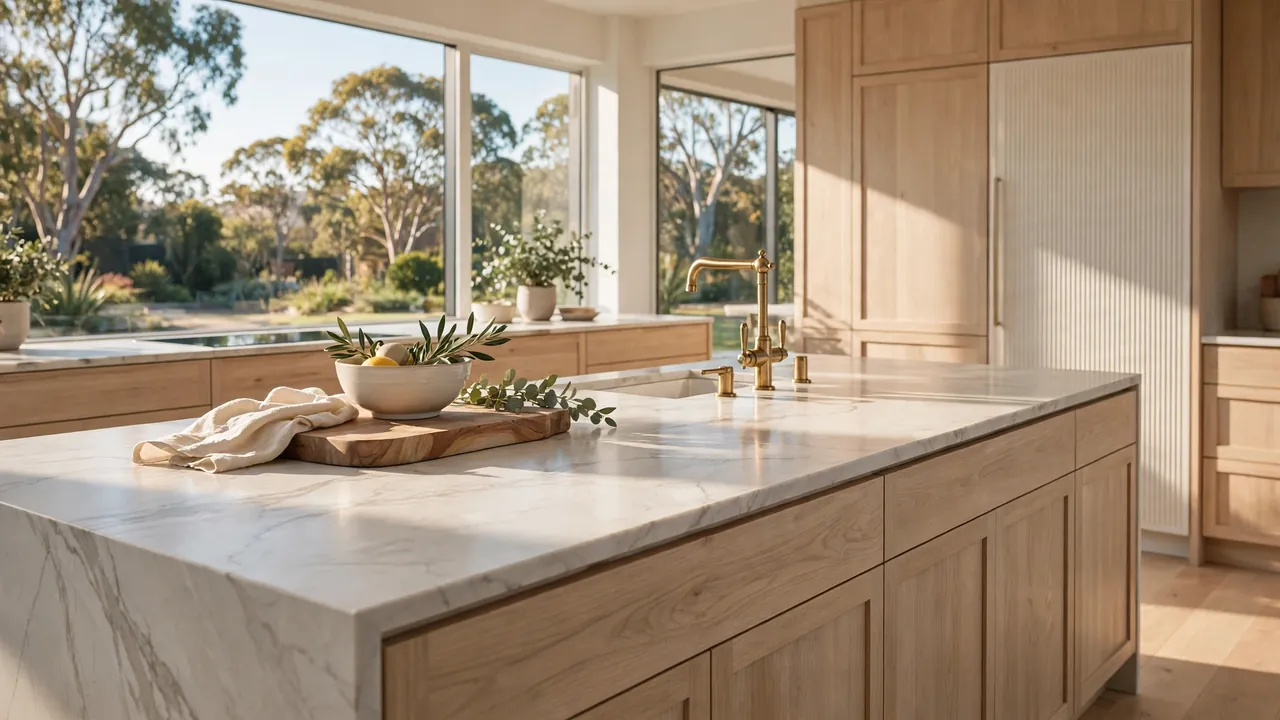
What the engineered stone ban changed for your kitchen
Engineered stone — crushed quartz bound with polymer resin — was the workhorse of Australian kitchens for two decades. However, the problem was the fabrication: cutting it released clouds of respirable crystalline silica, and engineered stone is over 90% crystalline silica by weight (SafeWork NSW puts it at 93% or higher). As a result, workers developed silicosis — an incurable lung disease — after short exposure periods, sometimes under five years.
Subsequently, on 1 July 2024, Commonwealth, state and territory ministers prohibited the manufacture, supply, processing and installation of engineered stone benchtops, panels and slabs nationwide; an import ban followed on 1 January 2025. In fact, Safe Work Australia defines engineered stone as an artificial product containing at least 1% crystalline silica, made by combining natural stone materials with chemical constituents such as resins or pigments, then hardened.
Three practical points for homeowners:
- You can no longer buy or install traditional engineered stone. Therefore, any quote offering it is quoting banned material.
- Porcelain and sintered stone are explicitly excluded, provided they contain no resin binder. Natural stone (granite, marble, quartzite, dolomite) is not banned, and low-silica products under the 1% threshold remain permitted.
- Your existing engineered stone benchtop is safe to keep. Indeed, once installed it releases no silica dust. If it ever needs cutting or drilling, use a competent tradesperson with proper dust controls.
Moreover, note that even compliant materials like granite contain some crystalline silica (typically 20–45%), so fabrication must use controlled dust extraction — leave it to a professional stoneyard. For the full legal detail, see Safe Work Australia’s engineered stone ban guidance.
Kitchen benchtop materials in Australia: the 2026 cost snapshot
| Material | Indicative 2026 cost | Heat resistance | Scratch resistance | Maintenance |
|---|---|---|---|---|
| Porcelain | $700–$1,050/m² installed | Excellent | Excellent | Very low — no sealing |
| Natural stone (granite / quartzite) | Not verified — typically mid to premium | Good | Very good | Medium — needs sealing |
| Natural stone (marble) | $3,000–$6,000 for a 4–5 m run, mid-range, installed | Good | Fair — etches easily | High — seal regularly |
| Timber | $550–$1,200/m² | Fair | Fair — dents and marks | Medium — oil and seal regularly |
| Laminate | $120–$350/m² | Low | Fair | Low — but seams dislike water |
| Stainless steel | $1,200–$3,600 per lineal metre | Excellent | Fair — shows marks | Low |
Porcelain’s installed figure comes from Yellow Pages’ 2026 cost guide; marble pricing from a 2026 Australian stone guide ($3,000–$6,000 installed for 4–5 linear metres in mid-range Carrara, up to $15,000+ for premium Calacatta). However, I could not verify current Australian per-square-metre figures for granite, quartzite or dolomite — get fresh quotes.
Porcelain benchtops: the leading engineered-stone alternative
For instance, if you pointed at an engineered stone sample in 2023, its 2026 equivalent is almost certainly porcelain: powdered clay and pigments fired under extreme pressure and heat — the floor-tile process taken to slab scale. Consequently, major brands now sell porcelain benchtop ranges, and it sits clearly outside the ban because it contains no resin binder.
Why it works: exceptionally hard, heat-resistant (hot pans straight off the flame), stain-resistant and UV-stable — also the top pick for outdoor kitchens. In addition, it never needs sealing, and digital printing makes the marble, concrete and travertine looks convincing.
The trade-offs: However, it demands a skilled fabricator — edges and cut-outs must be planned early, as thin edges can chip. At $700–$1,050/m² installed it sits in mid-range territory, similar to engineered stone before the ban.
Best for: busy family kitchens, low-maintenance households and outdoor serveries.
Natural stone benchtops: granite, quartzite, dolomite and marble
Indeed, nothing looks like real stone — every slab is a one-off. As a result, natural stone has moved from luxury outlier to mainstream alternative.
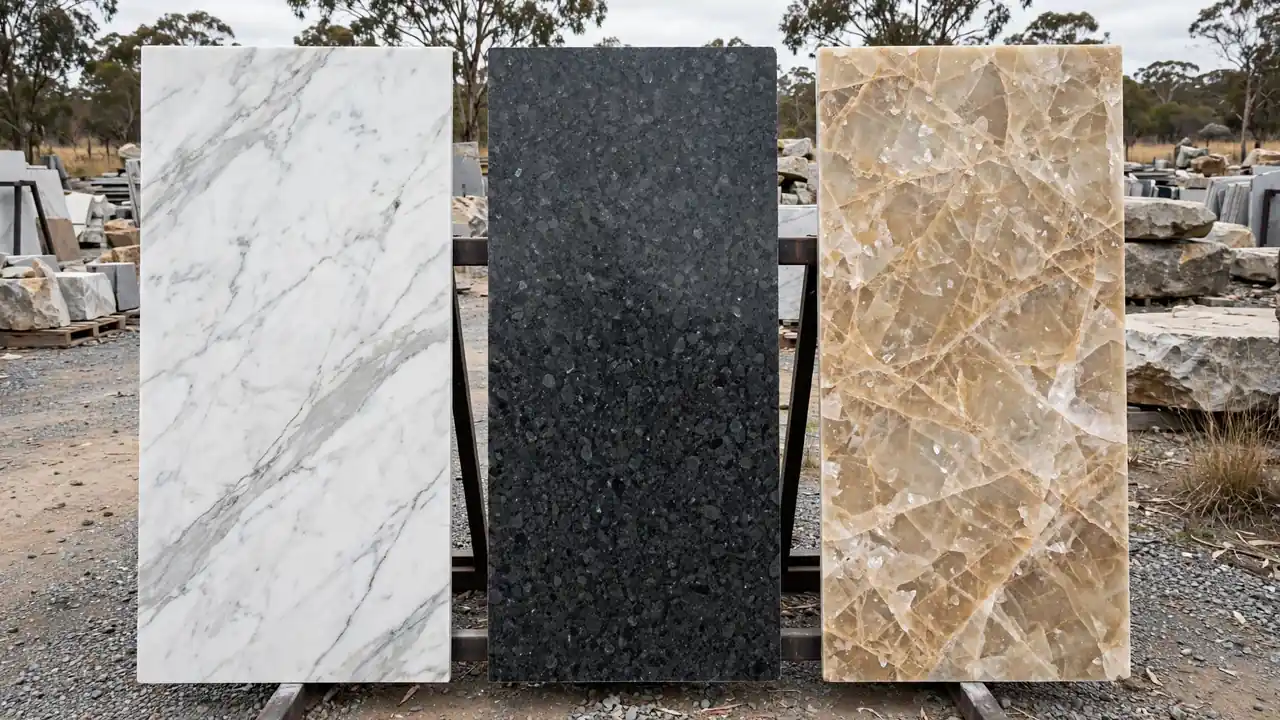
First, Granite is the workhorse: very hard, heat-tolerant and relatively forgiving, needing only periodic sealing. Quartzite looks like marble but behaves like granite — harder and less prone to etching — making it the darling of high-end Australian kitchens post-ban. Dolomite sits between the two: marble-like veining, a bit more hardness, still needs sealing. Marble (Carrara, Calacatta) remains the luxury statement but etches on contact with lemon juice and wine — choose it if you accept patina as part of the charm.
In addition, marble is the only natural stone with solid 2026 Australian figures: $3,000–$6,000 installed for a typical 4–5 metre run in mid-range marble, or $8,000–$15,000+ in premium Calacatta. Therefore, always approve your actual slabs before cutting — the showroom sample is only a hint.
Best for: statement islands and luxury schemes for cooks who don’t mind maintenance.
Timber benchtops: warmth you can refinish
Timber benchtops — blackbutt, spotted gum, American oak or recycled messmate — bring warmth no stone can match. In fact, their party trick: when the surface tires, sand it back and refinish it, resetting the clock.
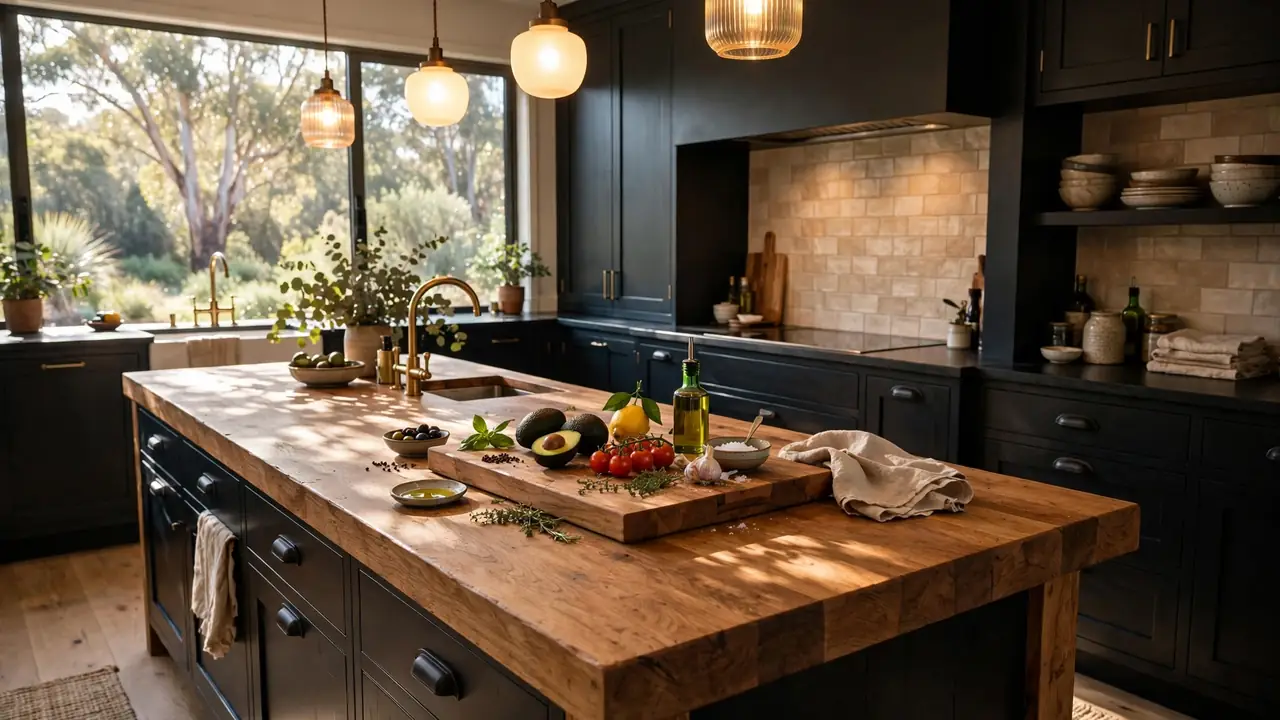
Expect $550–$1,200/m² (a Perth trade guide puts typical hardwood around $400–$800/m²). However, the catch: regular oiling and sealing, seasonal movement, and standing water is the enemy — wipe up around the sink. Timber scratches and dents more easily than stone, though a well-worn bench arguably looks better with age.
Best for: Hamptons, coastal and country kitchens; islands where warmth beats bulletproof performance.
Laminate benchtops: the honest budget option
In fact, modern high-pressure laminates convincingly mimic stone, concrete and timber, cost $120–$350/m² (stone-look laminates run $120–$440 per lineal metre), and install quickly — sometimes DIY if you are handy.
The honest pros: unbeatable price, huge design range, easy to replace in ten years, and simple daily care. The honest cons: poor heat resistance (always use a trivet), scratches show on darker colours, and sink seams are vulnerable to water ingress if the installation isn’t immaculate.
Best for: rentals, first-home budgets, laundries and butler’s pantries.
Stone benchtop vs porcelain: which suits a busy kitchen?
Indeed, this is the comparison most Australian renovators are making in 2026.
| Porcelain | Natural stone | |
|---|---|---|
| Cost | $700–$1,050/m² installed (verified) | Mid to premium; marble $3k–$6k per 4–5 m run (verified) |
| Heat | Excellent — hot pans straight on | Very good (granite/quartzite); marble good |
| Stains | Excellent — non-porous | Good with sealer; marble stains and etches |
| Scratches | Excellent — hard to mark | Good; marble scratches and etches |
| Maintenance | Wipe and go | Seal periodically; gentle cleaners |
| Lifespan | Decades; edges can chip if abused | Decades; can be re-polished |
| Outdoor use | Excellent — UV stable | Good — granite best; marble weathers |
In summary, heavy daily duty — school lunches, big roasts, homework at the island — porcelain wins on practicality. In contrast, designing a showpiece kitchen and love a surface no one else has — natural stone wins on soul.
Choosing kitchen benchtop materials in Australia: picks by budget and lifestyle
Still stuck? Then, start from your situation, not the swatch wall:
| Your situation | Best pick | Why |
|---|---|---|
| Tight budget / rental | Laminate | Looks decent, costs a fraction, easy to replace later |
| Busy family, low maintenance | Porcelain | Stain- and heat-proof, no sealing, ban-compliant |
| Love to entertain / statement island | Quartzite or granite | Drama plus durability; ages gracefully |
| Luxury new build | Marble | Unmatched veining; accept the patina |
| Warm, character kitchen | Timber | Refinishable, forgiving, beautiful with age |
| Outdoor kitchen or servery | Porcelain | UV-stable where resin-based products fail |
Next, pair your choice with the rest of the room: our kitchen design guide covers layout, our splashback cost guide covers the vertical surfaces, and the average renovation cost per square metre in Australia gives the bigger picture.
Personal experience: what I’d do differently on my own kitchen
(Illustrative example — a typical renovation journey, not professional advice.)
For example, when I renovated my kitchen a few years back, I did what everyone did: picked an engineered stone colour off a swatch book in ten minutes. The bench performed fine — but I chose it because it was the default, not because it suited how I cook.
Today I’d think harder. We’re a roast-on-Sunday, hot-pans-on-the-bench household, so I’d put porcelain on the main run — heat-proof, no sealing, no policing trivets. Meanwhile, for the island, where the kids do homework and we perch with coffee, I’d go timber: warmer to lean on, and I could sand out the dents in a decade.
Expert insights: what the authorities actually say
Rather than showroom spin, here’s what the official guidance says:
Specifically, Safe Work Australia states the ban covers engineered stone benchtops, panels and slabs containing at least 1% crystalline silica — and explicitly lists porcelain and sintered stone (no resin) as not engineered stone, so they remain legal. It also notes the import prohibition from 1 January 2025.
SafeWork NSW’s consumer fact sheet advises you can no longer purchase banned products, but products under 1% crystalline silica are still permitted; existing benchtops need not be removed; and any cutting or drilling should be done by a competent tradesperson with proper dust controls. See SafeWork NSW’s silica guidance for detail.
The practical takeaway: Therefore, ask your supplier for written confirmation of crystalline silica content, and only use a fabricator with proper dust extraction and wet-cutting. A reputable stoneyard provides this unasked.
What affects your benchtop quote
For instance, two same-sized kitchens can get quotes thousands apart:
- Slab grade and rarity — Indeed, natural stone is priced by the slab, not just the metre.
- Thickness and edge profile — 20mm with a pencil edge is the budget choice; Consequently, mitred edges and waterfall ends add serious fabrication time.
- Cut-outs — Indeed, every sink, cooktop and powerpoint cut-out is skilled labour.
- Layout complexity — In addition, islands, waterfall panels and upstands add metreage and handling risk.
- Access and location — Finally, apartments, tight stairs, regional freight and city trade rates all move the labour component.
Finally, for the full end-to-end picture, read our kitchen renovation cost guide.
Frequently asked questions
What is the best kitchen benchtop material after the engineered stone ban?
For most households, porcelain: ban-compliant, heat- and stain-resistant, no sealing, $700–$1,050/m² installed. Natural stone suits statement kitchens, timber suits character kitchens, laminate is the budget pick at $120–$350/m².
How much does a porcelain benchtop cost in Australia?
In 2026, roughly $700–$1,050 per square metre supply and install, per published Australian trade guides — and always get itemised quotes.
Is a stone benchtop better than porcelain?
It depends on your priorities. Porcelain wins on stain and heat resistance, maintenance (none needed) and UV stability. Natural stone wins on uniqueness — every slab is one of a kind — and it can be re-polished over its life. For a hardworking family kitchen, porcelain is the more practical choice; for a luxury statement, stone has the edge.
Is my existing engineered stone benchtop safe to keep?
Yes. SafeWork NSW confirms that once installed, engineered stone releases no silica dust and poses no health risk — the ban covers future manufacture, supply and installation only. If yours needs cutting or drilling, use a competent tradesperson with proper dust controls.
What is the cheapest kitchen benchtop option?
Laminate, roughly $120–$350/m². It mimics stone and timber convincingly, but heat resistance is poor — always use a trivet — and sink seams need careful installation to keep water out.
The bottom line on kitchen benchtop materials
The ban didn’t take options away — it reshuffled them. In summary, porcelain is the practical default for busy kitchens, natural stone has gone mainstream, timber remains the warm classic, and laminate keeps honest budgets honest.
First, start with your budget and cooking habits, shortlist two materials, then visit a stoneyard to see — and touch — real slabs. If the benchtop is part of a bigger project, our free renovation tools will help you budget the whole job.