
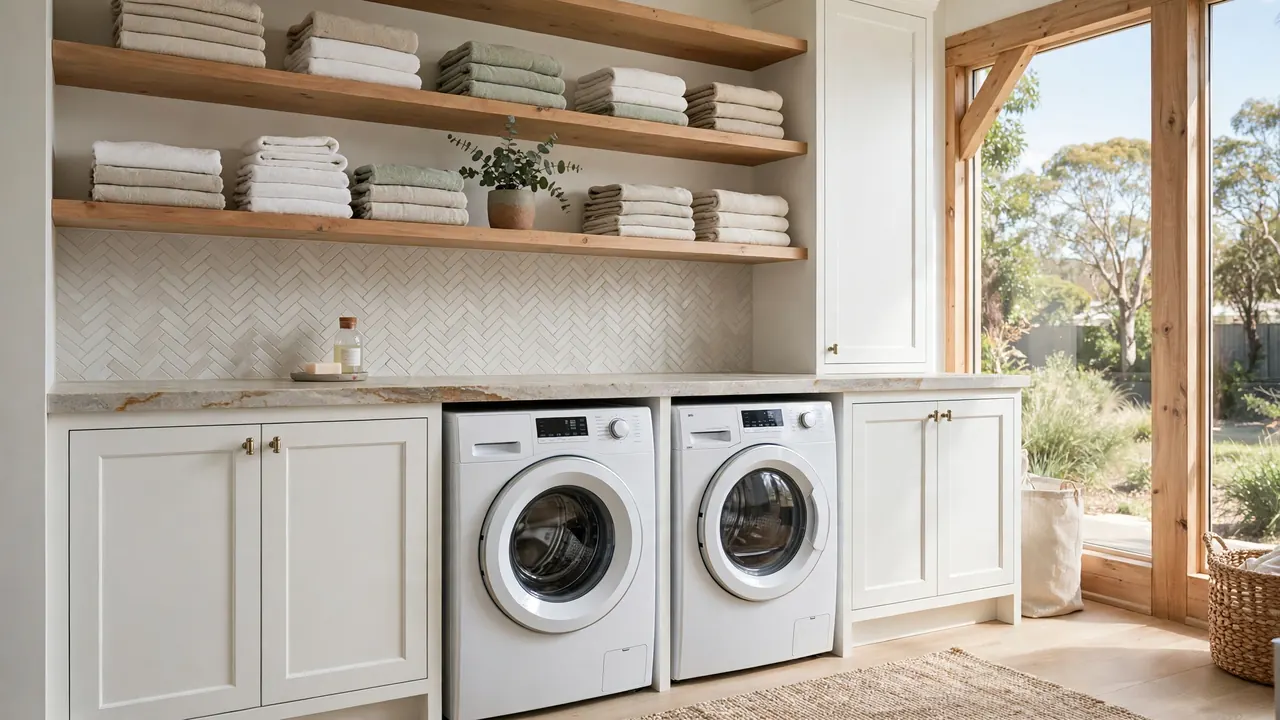
A laundry renovation in Australia costs $3,000–$30,000+ in 2026, depending on scope. A cosmetic refresh with the plumbing untouched typically runs $3,000–$7,000, a proper mid-range laundry renovation with new cabinetry, benchtop, sink, and tiling lands around $8,000–$15,000, and a premium rebuild — especially one that moves plumbing or relocates the laundry — can exceed $20,000. This guide breaks down every cost component of a laundry renovation, so you can budget with confidence and spot an overpriced quote when you see one.
✓ Prices verified: October 2026. All ranges in this guide were researched from Australian architecture firms, builder price guides, trade-quote platforms, and renovation cost calculators.
Laundry Renovation Cost in Australia (2026): At a Glance
The single biggest factor in what your laundry renovation will cost is whether the plumbing stays where it is. Keeping the washer taps, waste, and sink in place lets you renovate at cosmetic or mid-range prices; moving any of them adds $1,500–$5,000 per point (2026, per a published architecture-firm cost guide). Beyond that, it comes down to scope:
| Renovation scope | Typical cost (2026) | What you get |
|---|---|---|
| Cosmetic refresh | $3,000–$7,000 | Repaint, new benchtop or resurfacing, new sink and tapware, paint, shelving, updated lighting; plumbing untouched |
| Mid-range renovation | $8,000–$15,000 | New cabinetry, engineered stone or laminate benchtop, new sink and tapware, floor tiling, paint, lighting; layout unchanged |
| Premium renovation | $15,000–$30,000+ | Custom joinery, stone benchtops, full wall tiling, new appliances, relocated or added power points, drying cabinet or ironing centre |
| Relocation (moving the laundry) | $15,000–$25,000+ | New plumbing, drainage, waterproofing, and joinery in a new location; costs rise quickly with distance services must travel |
Across four independent 2026 Australian sources, the mid-range figure converges tightly at $8,000–$15,000 (a Canberra builder’s actual delivered-work table lists mid-range laundry work at $10,000–$18,000, with premium at $20,000–$30,000). The figure most homeowners actually spend on a considered renovation is $10,000–$15,000.
The honest caveat: no single national survey of laundry renovation costs exists for 2026. The ranges here are compiled from architecture-firm cost guides, builder pricing tables, and renovation cost calculators. Treat them as indicative — and always get at least three written quotes from licensed trades in your area before committing.
Laundry Renovation Cost Breakdown by Component
A laundry is a small room, but the trades don’t scale down proportionally — you’ll still need a plumber, electrician, tiler, painter, and cabinetmaker, and each has a minimum call-out. Here’s where the money actually goes in a typical mid-range project.
Cabinetry and joinery: $2,500–$7,000
Joinery is usually the single biggest line item, often 30–40% of the total. Flat-pack or off-the-shelf laundry cabinets from the big hardware retailers start around $2,500 installed for a compact room, while a custom laundry fit-out with tall broom cupboards, a laundry hamper cabinet, overheads, and fold-down ironing board pushes $5,000–$7,000. If you’re handy, IKEA or flat-pack cabinets with a stone-look benchtop on top are the classic budget play — one widely shared Australian DIY build came in under $1,000 in materials for the cabinetry and benchtop alone.
Benchtops: $400–$2,500
Laminate benchtops over cabinetry run $400–$900 for a standard laundry; timber-look laminates are the sweet spot for budget renovations. A 20mm engineered stone benchtop — the mid-range standard — typically costs $1,200–$2,500 depending on length and edge profile. Solid stone adds resilience against bleach and chemical spills, which is a real consideration in a room that sees harsh cleaning products.
Sink and tapware: $300–$1,200
A drop-in stainless laundry trough starts around $150–$400 for the basin plus $150–$500 for decent mixer tapware. Undermount stone-style or farmhouse sinks sit at the top of the range. If you’re keeping the existing plumbing point, installation is usually folded into the plumber’s day rate.
Appliances: $1,200–$3,500
Washer and dryer aren’t strictly part of every renovation budget — many people keep existing machines — but most renovation guides include them because the room is designed around them. A new front-loader washing machine and heat-pump dryer in 2026 runs roughly $1,200–$3,500 for the pair from major AU retailers. Allow for delivery and removal, and check door-swing and ventilation clearances before the joinery is locked in.
Plumbing: $800–$5,000+
Reconnecting existing services at the same points costs $800–$1,500. Moving a plumbing point — washer taps, waste, or sink — adds roughly $1,500–$5,000 per point (2026 architecture-firm data), and several relocated services compound fast. This is why designers are blunt about it: keep the layout, keep the budget. New drainage for a relocated laundry also means waterproofing to code, which needs a licensed waterproofer’s certificate.
Tiling: $800–$3,000
Floor tiling for a compact laundry (3–6 m²) typically costs $800–$2,000 including materials, with wall splashback tiling adding $300–$1,000. Porcelain tiles from AU retailers start around $20–$40/m²; labour is $50–$100/m² depending on your state. Wall-hung or feature tiles push you to the top of the range quickly in such a small space.
Electrical: $400–$1,500
New LED downlights or a batten light, additional double power points, and an exhaust fan run $400–$1,000. Adding a dedicated circuit for the dryer or heat-pump unit adds a few hundred more. An exhaust fan is worth calling out specifically: laundries are wet areas, and ventilation is the difference between a laundry that lasts and one that grows mould behind the cabinets.
Labour and trades coordination: $1,500–$4,000
If you project-manage the trades yourself, allow $1,500–$3,000 in trade call-outs on top of material costs. Handing the whole job to a renovation builder or bathroom/laundry specialist adds a margin but saves weeks of coordination — full project management typically adds 15–25% to the trade total. For a complex or premium laundry, most homeowners find the margin worth it.
Laundry Renovation Cost by Budget Tier
It helps to think in tiers rather than a single number, because the same 4 m² room can be transformed at three very different price points.
Budget tier: $3,000–$7,000 — the smart refresh
Keep the layout and all plumbing exactly where it is. Resurface or replace the benchtop, drop in a new sink and mixer, repaint in a light washable paint, add open shelving or a flat-pack cabinet, upgrade the light fitting, and regrout or overlay the flooring. This tier suits investment properties and anyone who wants a fresh, clean laundry without touching services. A $10,000 budget, by the way, sits comfortably above this tier — it’s solidly mid-range and buys new cabinetry plus flooring and trade work.
Mid-range tier: $8,000–$15,000 — the full redo
This is where most Australian family homes land. New cabinetry and engineered stone benchtop, new sink and tapware, floor tiles, splashback, paint, lighting, and exhaust fan — everything new, same footprint. The 2026 guides converge here: it’s the tier that delivers the biggest functional improvement per dollar, provided you resist moving plumbing.
Premium tier: $15,000–$30,000+ — the custom laundry
Custom joinery to the ceiling, stone benchtops with undermount sinks, full-height tiling, new washer/dryer with stacking or side-by-side fit-out, drying cabinet, fold-down ironing centre, relocated power points, and layered lighting. At this tier the laundry stops being a utility room and becomes a designed space — but you’re paying custom-joinery prices, and small changes in scope swing the total by thousands.
Cost Per Square Metre: What a Laundry Costs to Renovate by Size
Per-square-metre rates for laundries run higher than kitchens or bathrooms — expect roughly $2,000–$4,000/m² for a mid-range job — because the fixed trade costs (plumber, electrician, tiler, waterproofing) barely change whether the room is 3 m² or 8 m². A compact 3 m² laundry can easily cost $9,000 while a generous 8 m² one costs $15,000; the room with half the floor area doesn’t cost half the money. The practical takeaway: if your laundry is tiny, don’t assume it will be cheap — and if you can reclaim a metre from an adjoining hallway, do it at the design stage, not after the tiles are down. For whole-house budgeting context, see our house renovation cost per square metre guide and the Renovation Cost Index for how laundry costs compare with kitchens, bathrooms, and extensions.
What Moves the Price Most: 7 Cost Drivers
- Plumbing relocation — the single biggest budget lever. Every moved point adds $1,500–$5,000; a full laundry relocation starts around $15,000 and can exceed $20,000.
- Joinery choice — flat-pack versus custom is a $3,000–$4,500 swing on a standard room.
- Benchtop material — laminate at $400–$900 versus engineered stone at $1,200–$2,500.
- Waterproofing requirements — any new wet-area work needs licensed waterproofing with a certificate; budget $500–$1,200 on top.
- State and city labour rates — Sydney and Melbourne trade rates run 15–25% above regional averages; a Canberra builder’s 2026 pricing table sits noticeably higher than national averages across every tier.
- Appliance inclusion — a new washer/dryer pair adds $1,200–$3,500 if you count them in the project.
- Structural surprises — water damage behind old cabinets, rotted subfloor, or asbestos in older laundries can add $1,000–$5,000. Older homes: get a moisture check before quoting joinery.
How to Save Money on a Laundry Renovation
Laundries are one of the most DIY-friendly rooms to renovate, because the biggest savings all come from keeping services where they are:
- Don’t move the plumbing. It bears repeating: this one decision saves more than everything else combined. Design the new layout around the existing washer taps and waste.
- Resurface instead of replacing. A benchtop resurfacing kit or a new laminate top over sound cabinets costs a few hundred dollars versus thousands for new joinery.
- Use flat-pack cabinetry. Off-the-shelf laundry cabinets with a stone-look laminate top can deliver a near-custom look for a third of the custom price.
- Paint it yourself. A weekend of painting in a light, mould-resistant paint saves $800–$1,500 in painter call-outs.
- Keep the flooring simple. Quality vinyl planks over sound existing flooring cost a fraction of re-tiling and handle laundry splashes fine.
- Shop end-of-line tapware. Tapware is the easiest line item to overspend on; last season’s designs at clearance prices perform identically.
- Time trades together. If you’re also doing the bathroom, book the plumber and tiler for both rooms in one visit — shared call-outs cut the per-room cost.
And for design inspiration before you spend a dollar, browse our laundry design ideas for Australia — it covers layouts, storage, and finishes that make small laundries work harder.
Do You Need Council Approval to Renovate a Laundry?
For a straightforward renovation with no structural changes and no plumbing relocation, no — most Australian councils treat it as minor building work that doesn’t need approval. You will need licensed trades for the plumbing, electrical, and waterproofing work regardless, and you should hold their compliance certificates. Approval (or a private certifier) enters the picture when you move the laundry to a new location, alter load-bearing walls, or change the building’s drainage. The YourHome guide from the Australian Government covers renovation planning broadly, and your state’s fair trading or building authority — e.g. NSW Fair Trading — publishes licensing checks so you can verify your trades before they start.
Laundry Renovation Cost: Frequently Asked Questions
How much does a basic laundry renovation cost in Australia?
A basic laundry refresh costs around $3,000–$7,000 in 2026, provided the layout and plumbing stay unchanged. That covers a new benchtop, sink and tapware, cabinet updates, paint, shelving, and lighting or flooring changes.
Is $10,000 enough to renovate a laundry?
Yes, for most standard laundries. A $10,000 budget sits in the mid-range and covers new cabinetry, a benchtop, sink, tapware, flooring, and trade work when the plumbing stays put. Custom joinery or plumbing changes can push the total higher.
How much does it cost to move a laundry to a new location?
A full laundry relocation generally starts around $15,000 and can exceed $20,000, depending on how far plumbing and drainage need to move, the floor construction, and the amount of new joinery. Moving a single plumbing point alone adds roughly $1,500–$5,000.
What is the most expensive part of a laundry renovation?
Cabinetry and joinery — typically 30–40% of a mid-range project ($2,500–$7,000). Plumbing relocation is the biggest variable cost and can overtake joinery on complex jobs.
How long does a laundry renovation take?
A typical laundry renovation takes 2–4 weeks, depending on size, material lead times, and the extent of plumbing and electrical work. Cosmetic refreshes can be done in under a week; relocations and custom joinery extend the timeline.
Does renovating a laundry add value to my home?
A well-executed mid-range laundry renovation ($8,000–$15,000) improves buyer appeal and daily functionality, and agents consistently report that clean, modern wet areas help homes sell faster. It’s rarely a dollar-for-dollar value add like a kitchen, but a dated, tired laundry can actively put buyers off — a fresh one removes an objection.
The Bottom Line on Laundry Renovation Costs
The 2026 data is unusually consistent on this one: $3,000–$7,000 for a cosmetic refresh, $8,000–$15,000 for a full mid-range redo, $15,000–$30,000+ for premium, and $15,000+ if you relocate the room. The single decision that controls your budget is whether the plumbing moves. Lock the layout, choose flat-pack or mid-range joinery, resurface where you can, and get three written quotes — and you’ll land a laundry that works hard for a decade without the budget blowing out.
Prices in this guide are indicative 2026 ranges compiled from Australian architecture-firm cost guides, builder pricing tables, and renovation cost calculators. Every laundry is different — get at least three written quotes from licensed trades in your area before committing.
Last updated: October 2026