
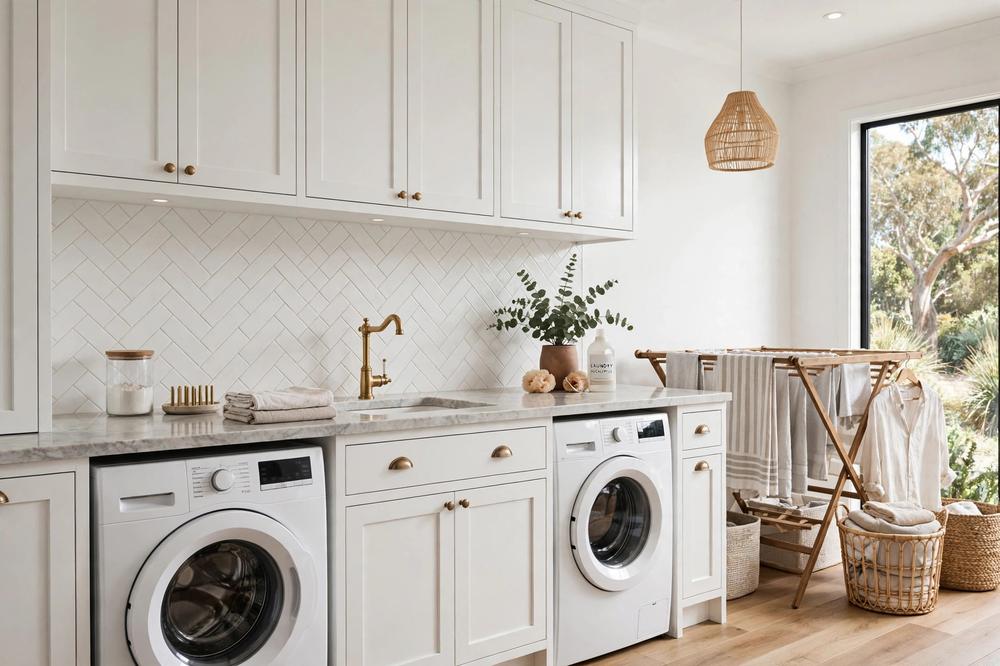
If your laundry is the room you rush through with a basket and a sigh, you’re in good company. It’s quietly become one of Australia’s most renovated rooms — and the best laundry design ideas in Australia right now don’t just make it prettier; they make it work harder. Smarter storage, tougher surfaces, drying space that doesn’t depend on a sunny backyard, and a layout that suits how your household actually lives.
These ten ideas reflect what Australian designers and renovators are doing in real homes in 2026. Each one includes practical detail on materials, colours and approximate budgets in AUD — whether you’re planning a full renovation or a weekend refresh.
Why Australian laundries are getting a second look
For decades the laundry was an afterthought — a poky room tacked onto the back of the house. Three things changed that. Rising house prices pushed families to renovate rather than move, so every square metre has to earn its keep. Open-plan living means the laundry is often visible from the kitchen, so it has to look intentional. And working from home means we spend more time moving through every room of the house.
A well-planned laundry also pays its way at resale. Buyers in 2026 expect bench space for folding, somewhere to sort, and storage that hides the clutter. A tired laundry won’t kill a sale, but a great one is a detail people remember.
10 laundry design ideas that work in Australian homes
1. The hardworking galley layout
Most Australian laundries are long and narrow — the skinny room off the back of a terrace or the nook beside the garage. The galley layout is the answer: machines, sink and bench along one wall, tall storage or open shelving opposite.
Keep the walkway clear: at least 1,050mm between bench fronts so two people can pass with a basket, and a washing machine door that swings into dead space. A galley of about 2 x 3.5 metres is plenty if every centimetre is planned. Stack the dryer above the washer (kits run around $80–$150) to free the bench for folding. Budget around $7,000–$14,000 for a galley re-fit, assuming plumbing stays put.
2. Bleached timber-look cabinetry
The big look in Australian laundries in 2026 is warm, pale timber-look joinery — bleached oak or light ash tones, with the coastal feel seen on this year’s season of The Block, where bleached timber-look cabinetry took out laundry week. Timber-look laminate (Laminex, Polytec and similar) gives you the warmth of real wood without the price tag or the maintenance, and it handles laundry humidity far better than raw timber.
Pair pale timber lowers with white overheads and a light stone-look benchtop for a calm, breezy feel. Expect timber-look to add roughly $1,500–$4,000 to a mid-range joinery package versus plain white laminate, depending on room size.
3. Colour-drenched cabinetry for character homes
Not every laundry needs to be white. In Federation and California bungalow homes, a deep colour on the cabinetry — sage green, deep aqua or inky navy — connects the laundry to the character of the house, and hides the scuffs of a working room far better than white.
Keep colour to the lower cabinetry, with white or warm-white walls and a light benchtop so the room stays bright. Two-pack polyurethane gives the smoothest, most durable coloured finish; standard-range coloured laminate is the cheaper alternative. A 2-pack colour upgrade usually adds $1,000–$3,000 to the joinery cost.
4. Shaker profiles and brass hardware for a Hamptons feel
The Hamptons look shows no sign of leaving Australian homes, and the laundry is one of its best expressions. Shaker-profile doors — that classic recessed-panel look — with antique brass handles, a butler’s sink and a traditional-look tap give instant character. Add timber floating shelves, a subway-tile splashback and black-and-white encaustic-look floor tiles, and the room feels far grander than its size.
This is a mid-range to premium look: 2-pack shaker cabinetry, an engineered-stone benchtop and quality tapware typically land a full laundry between $15,000 and $25,000 — a room that suits the rest of a Hamptons-style home.
5. A benchtop that shrugs off bleach and stains
The laundry benchtop copes with bleach, hot irons and wet baskets, so choose accordingly. Engineered stone (Caesarstone, Quantum Quartz and similar) is the most common choice — non-porous, stain-resistant, and available in concrete, marble-look and plain white. Porcelain is gaining ground for heat resistance and slim profiles.
Timber looks wonderful but needs oiling and will mark; laminate is the budget option and fine if joins are sealed. Allow roughly $800–$2,000 for laminate, $1,500–$4,000 for engineered stone, more for porcelain. Keep at least 900mm of clear bench — folding space is the single most useful thing a laundry can offer.
6. A splashback with personality
The splashback is where a small laundry shows character without much cost. White subway tiles in a brick pattern remain the safe classic — they bounce light around and suit almost any style. For more personality, handmade-look zellige tiles in soft green or blue are trending; a glass sheet behind the sink is the easiest to clean.
Don’t forget the floor: patterned encaustic-look porcelain tiles turn a plain laundry into a designed room for little money and they’re tough enough for the job. Budget roughly $1,200–$3,000 for a tiled splashback installed, and $1,500–$4,000 for floor tiling in a small laundry.
7. Concealed sorting stations
The difference between a tidy laundry and a messy one is usually the dirty clothes. Pull-out hampers built into the cabinetry — one for lights, one for darks — keep sorting off the floor and out of sight. Tub inserts lift out for carrying to the machine, and soft-close runners stop the slamming.
Also plan a tall broom cupboard for the mop and vacuum, a narrow pull-out for detergents beside the machine, and overhead cupboards for weekly-use items. These inserts add a few hundred dollars each — money well spent, because a laundry with a place for everything stays tidy with almost no effort.
8. A drying station for wet-weather weeks
Anyone in Melbourne, Sydney or Hobart knows there are weeks when outdoor drying is a fantasy. Building drying capacity into the laundry is one of the smartest upgrades you can make: a wall-mounted fold-down rack ($150–$600 installed), a ceiling-mounted pulley airer for high ceilings, or a hanging rail under a shelf for delicates.
If you’re replacing machines, a heat-pump dryer (usually $900–$1,800) is far more energy-efficient than a vented dryer. And don’t skimp on the exhaust fan: duct it outside, not into the roof cavity, to protect the room from mould.
9. Layered lighting that makes chores easier
Laundries are often the worst-lit room in the house — a single batten casting your shadow over the sink. Fix it with layers: bright downlights for general light (cool white, around 4000K, so you can actually see stains), plus LED strips under the overhead cupboards to light the bench. A small pendant over the sink adds warmth if the laundry opens to living areas.
Allow $500–$1,500 for LED strips, new downlights and switching — it changes how the room feels more than almost any other single change. Put bench lights on a separate switch so the room can glow softly in the evening.
10. The mudroom-laundry combo
In family homes, the laundry increasingly doubles as a mudroom: the drop zone by the back door for school bags, sports gear, muddy boots and the dog’s lead. Design for it — a bench seat with storage underneath, hooks at kid and adult height, a tiled floor that hoses clean, and a deep sink or low dog-wash station.
Pet bathing stations are a genuine 2026 trend, from raised tubs with a hand shower to fully tiled wash bays. If your laundry sits on the backyard-to-house path, planning it as a mudroom from the start saves years of frustration. Allow an extra $2,000–$5,000 over a standard fit-out.
Getting the layout right: single-wall, galley or L-shape
Lock in the layout before you fall in love with finishes. Single-wall suits open nooks and cupboards — everything in one run. Galley suits narrow dedicated rooms. L-shaped wraps a corner and works in squarer rooms, giving a longer bench run and room for a tall storage tower.
Keep the work triangle tight whatever the shape: washer, sink and bench within a step or two. Store the ironing board near the bench, detergents near the machine, and clean linen on the path back to the bedrooms. And measure your machines before the joiner starts — front loaders vary in depth, and one that juts past the bench ruins the walkway.
How much does a laundry renovation cost in Australia?
2026 industry guides point to consistent ranges: a cosmetic refresh — paint, new tapware, a laminate benchtop over existing cabinets, new flooring — typically runs $3,000 to $8,000. A mid-range renovation with new cabinetry, benchtop, sink, tapware, tiling and lighting usually lands between $8,000 and $18,000. A full rebuild with custom joinery or layout changes can reach $18,000 to $30,000 or more.
The budget-killer is moving plumbing: shifting a waste pipe or water point can add $1,500 to $5,000 per point, and relocating the whole room often starts around $15,000. Keep plumbing where it is and spend on joinery and finishes — that’s where you’ll see and feel the difference. For a detailed room-by-room breakdown, see our 2026 renovation costs guide.
Choosing a style that suits your home
The best laundry feels like it belongs to the house around it. A coastal home calls for pale timber and white; a Hamptons home wants shaker doors and brass; a contemporary apartment suits flat-panel cabinetry in warm grey with black tapware. Not sure which suits you? Our interior design style quiz takes two minutes and points you toward the palette that fits — handy before choosing samples.
One more tip: order physical samples and view them together in the actual room, in daylight and at night. Laundries are small, so a colour that looked soft in the showroom can feel very different on four walls. Samples are the cheapest insurance against an expensive regret.
Pick water-wise appliances while you’re at it
A laundry renovation is the ideal moment to rethink the machines. Australia’s WELS scheme rates washing machines up to 5 stars for water efficiency — the government’s water rating site lets you compare models before you buy. A high-star front loader uses far less water per wash than an old top loader. Just size the machine honestly: an oversized machine run half-empty wastes the water you were trying to save.
Frequently asked questions
How much does a small laundry renovation cost in Australia?
Where plumbing stays put, 2026 industry guides put a cosmetic refresh at $3,000–$8,000 and a mid-range renovation at $8,000–$15,000. Moving plumbing pushes costs up fast — allow an extra $1,500–$5,000 per relocated point.
Do I really need a sink in the laundry?
Not strictly, but most designers recommend one: a deep sink handles hand-washing, soaking stains, filling mop buckets and muddy boots. If space is tight, a compact 400mm sink keeps the functionality without eating the bench.
What is the best flooring for a laundry?
Porcelain or ceramic tiles: waterproof, tough and easy to clean. Waterproof-core vinyl planks are a warmer alternative. Avoid real timber and standard laminate, which swell with water, and make sure drainage falls comply with your state’s plumbing rules.
How can I make a small laundry look bigger?
Keep the palette light, run overheads to the ceiling, and use large-format floor tiles with minimal grout lines. A mirror or glass splashback bounces light around, concealing appliances behind cabinetry fronts calms the look, and under-cabinet LED strips make a surprising difference.
Can I move my laundry to another part of the house?
Yes, but it’s pricey: a full relocation typically starts around $15,000 and can exceed $20,000 once new water, waste, drainage and electrical runs are factored in. An enlarged bathroom, a spot off the garage, or a reconfigured hallway near existing plumbing keeps costs down.