
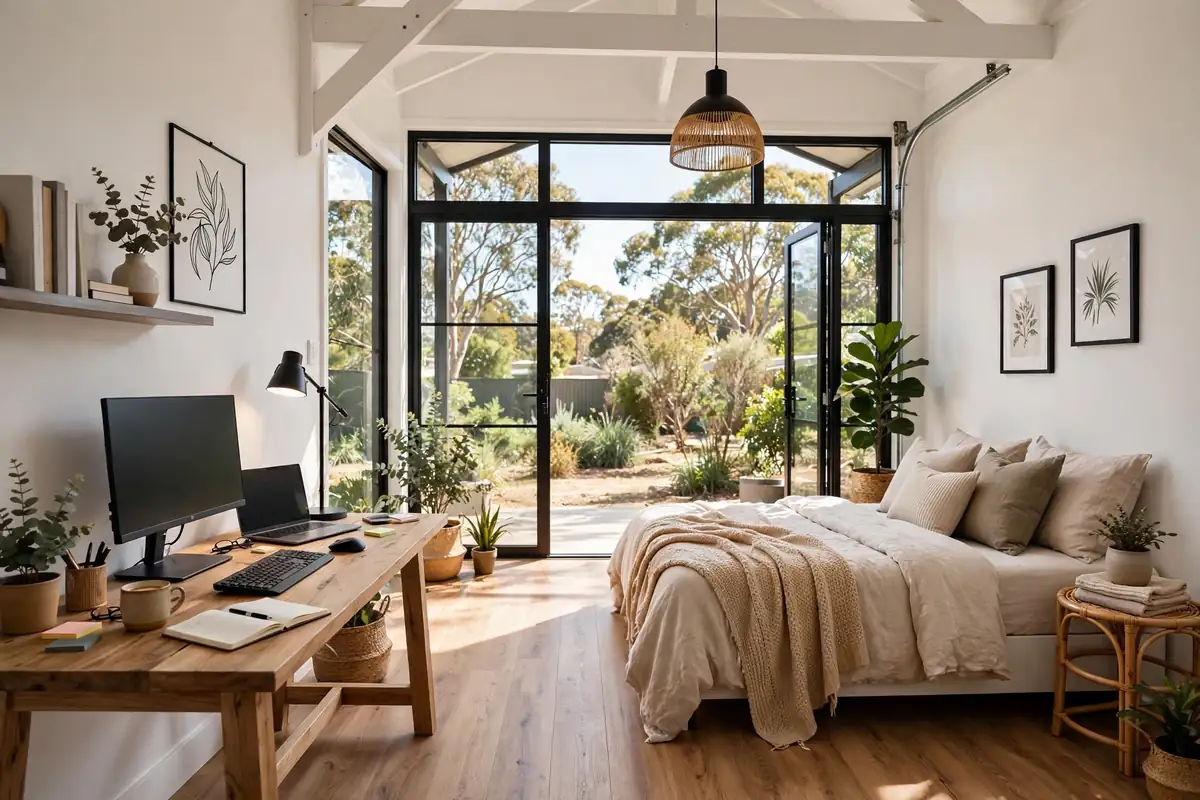
A garage conversion in Australia costs $5,000 to $80,000 in 2026, depending on what you’re turning the garage into. A simple bedroom or home office conversion runs $5,000–$40,000, while a self-contained granny flat or studio conversion can reach $50,000–$80,000+. These are real Australian figures drawn from 2026 trade and builder data — not guesses.
That old garage sitting half-empty could be the cheapest square metres you’ll ever add to your home. No new foundations, no new roof, no new external walls — the shell is already there. But a garage is a Class 10a non-habitable structure under the National Construction Code, which means converting it into a room someone actually lives in involves more than paint and carpet. This guide breaks down exactly what a garage conversion costs in Australia in 2026, what’s included in each price tier, the council approvals you’ll need, and where the hidden costs lurk.
Garage Conversion Cost by Type (2026)
| Conversion Type | Typical Cost Range | What It Includes |
|---|---|---|
| Home office / study | $5,000–$25,000 | Insulation, plasterboard, flooring, lighting, power points |
| Bedroom | $5,000–$40,000 | Insulation, plasterboard, flooring, window, wardrobe, lighting |
| Living / rumpus room | $5,000–$40,000 | Insulation, plasterboard, flooring, lighting, opening to house |
| Home gym | $6,000–$25,000 | Reinforced flooring, insulation, ventilation, mirrors, power |
| Kitchen extension | $6,000–$25,000 | Plumbing rough-in, cabinetry, benchtops, appliances, electrical |
| Self-contained studio / granny flat | $40,000–$80,000+ | Kitchenette, bathroom, plumbing, electrical, fire separation, full approval |
Sources: Airtasker AU 2025 cost data; Duotax garage conversion guide; co-architecture 2026 planning allowances. Figures reflect builder and trade-sourced Australian pricing.
What Does the Money Actually Go To?
A garage conversion isn’t one job — it’s a bundle of trades working in sequence. Here’s where a typical $25,000–$40,000 mid-range conversion budget goes:
Insulation ($1,500–$4,000)
This is the single most important line item, and the one most often skipped by cheap operators. Garages were never designed for human comfort — single-skin brick or metal walls, no ceiling insulation, concrete slab straight on the ground. To meet habitable standards you’ll need wall insulation, ceiling insulation, and often slab-edge treatment. Skip this and the room will be an oven in summer and a fridge in winter — and it won’t pass a building certifier’s inspection.
Plasterboard and internal linings ($1,300–$4,000)
Stud walls, plasterboard lining, cornice and setting. For a single garage expect around $1,300+ in materials alone for drywall before labour; a double garage runs considerably more.
Flooring ($2,000–$6,000)
Garage slabs are often sloped for drainage and may sit below the house floor level. Raising and levelling the floor with a screed or timber battens, adding a moisture barrier, then laying your chosen finish (hybrid, laminate, engineered timber or carpet) is a standard part of the job.
Electrical ($1,000–$5,000)
Basic power and lighting for a simple room runs $1,000–$2,500. Add circuits for air conditioning, a kitchenette or a bathroom and you’re looking at $2,000–$5,000+. All electrical work must be done by a licensed electrician — no exceptions.
Plumbing ($2,000–$5,000+)
Only applies if you’re adding a bathroom, kitchenette or laundry. The cost depends heavily on how far the garage is from existing water and sewer lines. A bathroom addition can add $5,000–$15,000+ to the project once fixtures and waterproofing are included.
Windows and doors ($1,500–$5,000)
Habitable rooms need natural light and ventilation to meet code. Replacing the garage door with a wall and window (or a sliding door) is standard. Budget $1,500–$5,000 depending on size and whether structural work is needed.
Heating and cooling ($820–$2,500)
A split-system air conditioner is the most common choice for converted garages. Allow $820–$1,300 for a basic unit installed, more for larger spaces or multi-head systems.
Painting and finishing ($350–$2,000)
The cheapest part of the job if you’re willing to DIY the final coat. Professional painting of a single garage conversion runs around $1,000–$2,000.
Council Approval: What Do You Actually Need?
This is where garage conversions catch people out. Changing a garage (Class 10a) into a habitable room (Class 1a) is a change of building classification under the National Construction Code — and it always requires some form of approval. There is no state in Australia where you can legally convert a garage into a bedroom without telling anyone.
New South Wales
In NSW, a straightforward conversion may be able to go through a Complying Development Certificate (CDC) via an accredited certifier — faster than a full Development Application (DA). But if the conversion creates a separate dwelling (granny flat), involves structural changes, or doesn’t meet the SEPP criteria, you’ll need a full DA through council. Sydney councils are particularly strict: some require neighbour notification even for internal conversions.
Victoria
You’ll need a building permit from a registered building surveyor. Planning permission may also be required depending on your council and whether the conversion affects the streetscape (for example, removing the garage door changes the facade). Heritage overlays add 15–25% to costs and significant extra paperwork.
Queensland
Brisbane City Council and other SEQ councils require building approval for the change of classification. If the conversion becomes a secondary dwelling, it must comply with the granny flat provisions — including setbacks, site cover and parking requirements.
Western Australia and South Australia
Building permits required in all cases. In WA, the R-Codes govern setbacks and site cover; converting the garage may trigger a requirement to provide replacement parking elsewhere on the block.
The parking problem
Here’s the catch most guides gloss over: many councils require you to replace the parking you’re removing. If your garage was your only covered parking, the council may require a new carport or hardstand parking area before approving the conversion. Budget $3,000–$10,000 for replacement parking if your council requires it.
DIY vs Professional: What’s Realistic?
Let’s be honest about what you can and can’t do yourself:
You can DIY (if competent)
- Demolition of non-structural internal elements
- Painting and final finishes
- Basic flooring installation (floating floors)
- Landscaping and external tidy-up
You must hire licensed trades for
- Electrical — illegal to DIY in every Australian state; fines are severe
- Plumbing — must be done by a licensed plumber, with compliance certificates
- Structural work — removing or altering load-bearing elements needs an engineer
- Waterproofing — licensed waterproofer required for wet areas, with warranty certificate
2026 trade rates give you a sense of the labour cost: licensed plumbers charge $100–$180 per hour, electricians $110–$155 per hour in Sydney (slightly less in other capitals). A “cheap” conversion that skips licensed trades isn’t cheap — it’s a liability that can void your home insurance and become a major problem at sale time.
Will a Garage Conversion Add Value to Your Home?
The honest answer: it depends on what you convert it into and what you give up.
Conversions that typically add value: an extra bedroom in a 2-bedroom house, a home office (post-2020, this is genuinely valued), or a self-contained studio that generates rental income. At $400–$650 per week rental income in Sydney and Melbourne, a compliant studio conversion can pay for itself in 6–10 years.
Conversions that can reduce value: removing the only garage in a suburb where secure parking is expected. In many Australian suburbs, buyers expect at least one lock-up garage. Converting your only garage into a rumpus room in a family suburb may narrow your buyer pool.
The golden rule: if you can provide replacement parking (carport, hardstand), a well-executed conversion almost always adds more value than it costs. If you can’t, think carefully before removing the only garage.
How to Keep Garage Conversion Costs Down
- Keep plumbing where it is. Every metre of new sewer line is money. A bedroom or office conversion without plumbing is dramatically cheaper than one with a bathroom.
- Retain the slab. If the existing slab is sound and at a workable height, work with it rather than replacing it.
- DIY the finishes. Painting, basic flooring and landscaping are genuine DIY savings — potentially $3,000–$5,000 off the total.
- Get three quotes minimum. Conversion quotes vary wildly because every garage is different. Make sure each quote itemises the same scope so you’re comparing apples with apples.
- Sort approval first. Starting work without approval and getting caught means stop-work orders, fines, and potentially ripping out completed work. The approval fee is always cheaper than the penalty.
- Check ceiling height early. Habitable rooms need a minimum 2.4m ceiling. If your garage is lower, raising the roof is a major cost — discover this before you commit, not after.
Garage Conversion vs Alternatives
Before committing, it’s worth comparing a garage conversion against the alternatives:
| Option | Typical Cost | Best When |
|---|---|---|
| Garage conversion | $5,000–$80,000 | You have an underused garage and need 1–2 extra rooms |
| Ground-floor extension | $85,000–$360,000 | You need significant space and have backyard to spare |
| Second-storey addition | $160,000–$440,000 | Block is small and you need major space |
| Standalone granny flat | $130,000–$250,000 | You want a fully separate dwelling with maximum rental return |
For adding one or two rooms, a garage conversion is almost always the most cost-effective option — you’re leveraging an existing roof, slab and three walls.
Frequently Asked Questions
How much does it cost to convert a garage into a bedroom in Australia?
A basic garage-to-bedroom conversion costs $5,000–$10,000 at the budget end (Airtasker 2025 data) or $20,000–$40,000 for a professional job with proper insulation, plasterboard, flooring, window installation and electrical work (Duotax). The wide range reflects differences in the garage’s existing condition and the finish level.
Do I need council approval to convert my garage in Australia?
Yes. Converting a garage (Class 10a) to a habitable room (Class 1a) is a change of building classification under the National Construction Code and always requires approval — either a Complying Development Certificate (NSW), building permit (VIC/QLD/WA/SA) or Development Application. Requirements vary by council, so check with your local authority before starting.
Can I convert my garage into a granny flat?
Yes, but it’s the most complex and expensive conversion type ($40,000–$80,000+). You’ll need full council approval, fire separation between the dwelling and main house, a kitchenette, bathroom, separate metering, and compliance with your state’s secondary dwelling provisions. Many councils also require replacement parking.
How long does a garage conversion take?
A simple bedroom or office conversion typically takes 2–4 weeks of construction time. A self-contained granny flat conversion takes 6–12 weeks. Add 4–12 weeks for council approval before work starts — this is often the longest part of the project.
Does converting a garage add value to a house in Australia?
It can, if done well and with proper approval. An extra bedroom or a compliant rental studio generally adds value. However, removing the only garage in a suburb where buyers expect secure parking can reduce appeal. Providing replacement parking (carport or hardstand) largely solves this problem.
What is the cheapest way to convert a garage?
The cheapest compliant conversion is a simple room without plumbing — insulation, plasterboard, flooring, lighting and a window. DIY-ing the painting and finishes can save $3,000–$5,000. But never skip insulation or licensed electrical work; cutting those corners creates an uninhabitable room and an insurance liability.
Can I live in my garage conversion?
Only if it has proper council approval as a habitable room or dwelling. Living in an unapproved garage conversion can result in council fines and orders to vacate. Your home insurance may also be void for the converted area.
Do I need to replace the parking if I convert my garage?
Often, yes. Many Australian councils require replacement parking (a carport, carport slab or hardstand area) when you remove a garage, especially if it was the property’s only covered parking. Check with your council early — this can add $3,000–$10,000 to the project.