
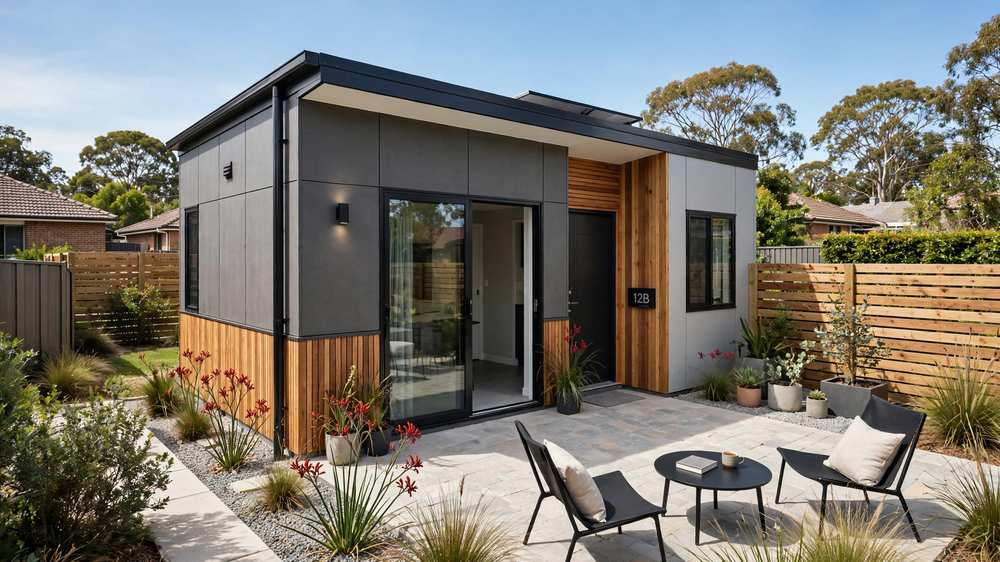
If you’ve typed “does a granny flat add value to property australia” into Google, you’re asking one of the most sensible renovation questions in the current market. A granny flat — a self-contained second dwelling on your block — can generate serious rental income, house family members, and in many cases lift your property’s resale price. But it isn’t an automatic win. The numbers only work when the build cost, your local rental market, and the planning rules in your state all line up. Here’s an honest look at the figures, the rules, and the catches.
The Short Answer
Yes — but the value comes from two different places, and you should weigh them separately.
First, resale value. CoreLogic research suggests a well-built granny flat can add roughly 20 to 30 per cent to a property’s value, depending on build quality, local demand, and how well it suits the block. On a $750,000 Sydney home, that’s a potential uplift of $150,000 to $225,000 — close to or above the build cost in many cases.
Second, rental income. A two-bedroom granny flat in Sydney or Melbourne typically rents for $350 to $600 per week in 2026. On a $200,000 build, that’s a gross yield above 10 per cent — far better than the 3 to 4 per cent of a typical investment property.
The catch? A poorly designed flat on a cramped block, or one built without the right approvals, can add little or nothing at valuation. The value story only works if the build is legal, well finished, and genuinely usable as a standalone home.
How Much Does a Granny Flat Cost in 2026?
Construction costs kept climbing through 2025 and into 2026 — the HIA Housing Scorecard for Q1 2026 recorded secondary dwelling costs up 4.2 per cent year-on-year. So what are people actually paying?
| Build type | Size | Indicative turnkey cost (2026) |
| Studio / 1-bedroom | 30–45 sqm | $80,000 – $140,000 |
| 2-bedroom (most popular) | 55–60 sqm | $140,000 – $210,000 |
| 3-bedroom | 70–90 sqm | $175,000 – $300,000+ |
Industry cost guides put the realistic all-in figure for a detached two-bedroom granny flat at $150,000 to $260,000 turnkey, with most owners landing between $180,000 and $220,000 once site costs, council fees, and service connections are included.
Watch the gap between base price and turnkey price. An advertised “$95,000 kit” can blow out to $180,000 to $225,000 once installation, connections, and approvals are added — including site preparation ($15,000–$25,000), utility connections ($8,000–$17,000), and approval fees ($6,500–$20,000+). Always compare turnkey quotes, and if you’re budgeting the project alongside other works, our guide to renovation costs in Australia for 2026 explains how to allow for the extras.
Sloping blocks, poor soil, difficult site access, long sewer and power runs, and bushfire or flood overlays all push costs up. Three fixed-price written quotes from licensed local builders is the only way to know your real number.
The Rental Yield Maths
This is where granny flats earn their keep. Take a typical scenario: a two-bedroom flat in a capital city suburb, built for $200,000 all-in.
| Item | Figure |
| Turnkey build cost | $200,000 |
| Weekly rent (mid-range, capital city) | $450 |
| Annual rental income | $23,400 |
| Gross yield on build cost | ~11.7% |
| Typical Sydney house gross rental yield | ~3–4% |
CoreLogic’s research found the rental yield on a property with a granny flat was about 27 per cent higher than the same property without one — you’re adding a second income stream on land you already own, without stamp duty or buying a second property.
In strong markets the figures can be better still: Sydney’s western suburbs achieve $380 to $550 per week for two-bedroom flats, Melbourne’s inner and middle rings $350 to $500, and some industry sources report gross yields above 15 per cent on modest builds.
Be honest about the deductions, though: landlord insurance, property management fees (typically 6–8 per cent), maintenance, and vacancies all reduce the net figure. Rental income is taxable too — ask your accountant about depreciation claims on the construction, which can genuinely help in the early years.
How Much Value Does a Granny Flat Add at Sale?
At sale, buyers and valuers judge the flat on what it adds as accommodation. CoreLogic’s research estimated that an extra two bedrooms and an additional bathroom adds roughly 32 per cent to the value of an existing dwelling — about $160,000 on a $500,000 house. Other industry estimates put the uplift from a good granny flat in the 20 to 30 per cent range.
These are estimates, not guarantees. A valuer will consider:
- Build quality — properly finished and council-approved, with its own kitchen, bathroom, and laundry. A converted garage is a different conversation.
- Block size and layout — the flat should sit comfortably without crowding the main house. If the backyard disappears, the main home’s value can suffer.
- Local demand — dual-income appeal is strongest where rental markets are tight and house prices high.
- Tenancy flexibility — where the flat can be rented to anyone, it appeals to a wider buyer pool than a family-only arrangement.
One reality check: you generally cannot sell the granny flat separately — it stays on the one title. The uplift is captured in the total property price when you sell.
Planning Rules by State: NSW, VIC and QLD
Planning rules are the gate you walk through before any of the maths matters. Each state handles secondary dwellings differently, and the rules have loosened significantly in recent years.
New South Wales
NSW has the most builder-friendly regime in the country. Under State Environmental Planning Policy (Housing) 2021, a granny flat (a “secondary dwelling”) can be approved as complying development — fast-tracked by a private certifier, not council — with no full Development Application required, provided your block meets the standards.
Key requirements: minimum lot size of 450 sqm (with at least 12m frontage), maximum internal floor area of 60 sqm, residential zoning (R1–R4, RU5), no dual occupancy on the lot, and no heritage, high-bushfire, or flood overlays. Standard setbacks run roughly 3m rear and 0.9m side.
CDC approval typically takes 10 to 20 working days, compared with 8 to 16 weeks for a council DA. There’s no requirement to provide extra parking — the SEPP overrides council rules that demand it. And you can rent your granny flat to anyone in NSW; there’s no family-occupancy requirement.
If your block fails a CDC standard (under 450 sqm, for example), you can still lodge a DA with council — slower and less certain, but it exists. Check the official requirements on the NSW Planning Portal’s granny flats page.
Victoria
Planning reforms introduced in late 2023 and now fully in effect allow “small second dwellings” of up to 60 sqm to be built without a planning permit in most residential zones where the lot is 300 sqm or more. A building permit from a surveyor is still required, but the planning barrier is gone.
Anyone can live in or rent out a Victorian small second dwelling — family member or unrelated tenant — under standard tenancy law, with rental minimum standards applying. The dwelling must have a kitchen, bathroom, and toilet, and can’t be connected to reticulated natural gas.
Queensland
Queensland removed occupancy restrictions statewide from 26 September 2022: secondary dwellings can now legally be rented to anyone. You still need proper building approvals and a correct RTA tenancy agreement (a general tenancy agreement for a self-contained flat). Before renting, have a building certifier confirm the dwelling meets current National Construction Code standards, as a rented secondary dwelling can trigger extra fire and sound requirements.
What about the other states?
WA, SA, Tasmania, and the ACT all permit secondary dwellings under their own frameworks, typically capped at 60 to 90 sqm. Rules change often — confirm your council’s current requirements before budgeting, and get a certifier’s view in writing.
What Actually Adds Value vs What Doesn’t
Not all granny flats are created equal. Here’s the divide between builds that lift your property value and builds that don’t.
Adds value:
- Fully self-contained: own kitchen, bathroom, laundry, and separate entrance
- Legal approvals with an occupancy certificate — buyers and banks check
- Design that matches or complements the main dwelling
- Privacy between the two dwellings — separate outdoor space, sensible window placement
- Finishes matched to the suburb’s price point (no need for luxury; just avoid budget-looking fittings on a premium street)
Adds little or risks value:
- Unapproved builds — banks can refuse to lend, shrinking your buyer pool
- Flats that eat the entire backyard
- Mismatched, cheap-looking exteriors that drag down the main home’s street appeal
- Shared facilities (no own kitchen or laundry)
- Overcapitalising — spending $300,000 on a flat in a suburb where values can’t support it
Tips to Maximise Your Granny Flat’s Value
- Nail the approval pathway first. In NSW, confirm your lot qualifies for CDC before you commit to a design; in Victoria, check your zone. A month spent on planning saves months later.
- Get three fixed-price turnkey quotes. Compare like with like — same inclusions, same site works, same approval costs.
- Design for the suburb. In family suburbs, target couples or small families (two bedrooms); near universities or hospitals, a well-planned one-bedroom or studio can work perfectly.
- Match the main dwelling. Complementary cladding, roofline, and colours read as one property rather than a backyard afterthought — our interior design style quiz can help you pin down a coherent look.
- Think about sound and privacy. Separate paths, fencing between the dwellings, and decent insulation are the details tenants pay for and valuers notice.
- Budget the extras honestly. Use our renovation tools and keep a 10–15 per cent contingency for the site works and connections that always surprise first-time builders.
- Plan for tax. Get depreciation advice before the build finishes — a quantity surveyor’s report on a $200,000 construction can produce meaningful deductions if the flat is income-producing.
Frequently Asked Questions
How much does it cost to build a granny flat in Australia in 2026?
A turnkey granny flat in 2026 typically costs $80,000 to $250,000 depending on size, location, and finish. Most owners building a standard two-bedroom, 60 sqm unit land between $180,000 and $220,000 once site works, connections, and approvals are included.
Can I build a granny flat without council approval in NSW?
Most NSW granny flats can use complying development (CDC), a fast-track pathway assessed by a private certifier rather than council. Your block must be at least 450 sqm, zoned residential, and the flat capped at 60 sqm internally. CDC approval takes around 10 to 20 working days.
Can I rent out my granny flat to anyone in Australia?
In NSW and Queensland, yes — there are no occupancy restrictions, so you can rent to anyone under a standard tenancy agreement. In Victoria, the small-second-dwelling reforms allow rental to family members or unrelated tenants. Rules vary elsewhere, so confirm your state and council requirements before advertising.
Does a granny flat add value if I don’t rent it out?
It can. Even an owner-occupied or family-used granny flat adds sale appeal: it offers buyers flexible accommodation for extended family, home offices, or future income. Valuers recognise a legal, well-built second dwelling as genuine added accommodation, which is why industry estimates put the uplift at roughly 20 to 30 per cent of property value.
Can I sell a granny flat separately from my house?
No. In every state, a secondary dwelling must remain on the same title as the principal dwelling — it can’t be sold separately. The value it adds is realised in the total sale price of the property.