
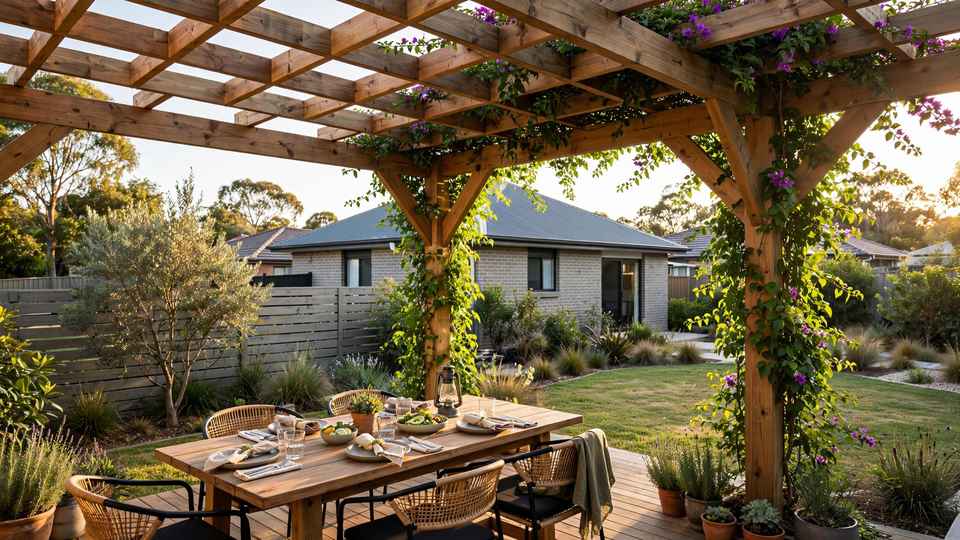
A pergola in Australia typically costs $2,000 to $15,000 professionally installed in 2026, depending on size, material and roof type. A basic 3×3m treated-pine pergola starts around $2,000–$3,000, a mid-range 20m² aluminium or hardwood pergola with roofing runs $8,000–$12,000, and premium motorised louvred-roof systems reach $15,000–$35,000+. DIY kits from Bunnings start under $400 for small wall-mounted units, while full backyard kits run $2,300–$7,900 before installation.
Whether you’re after shade over the deck, a frame for climbing roses, or a full outdoor room, this guide breaks down pergola costs by type and material, per-square-metre pricing, roofing and flooring extras, council rules you need to know, and whether a DIY kit is worth it.
Pergola Cost by Type (2026)
Pergola pricing in Australia falls into clear bands. All figures below are in Australian dollars, including GST, based on 2026 metro pricing from hipages and Australian suppliers.
| Pergola type | Typical size | Cost (installed) |
|---|---|---|
| Treated-pine pergola, no roof | 3×3m | $2,000–$2,500 |
| Hardwood pergola, no roof | 3×3m | $2,600–$3,500 |
| Timber pergola with roof | 10–15m² | $3,000–$8,000 |
| Aluminium / metal pergola kit | 12–20m² | $4,300–$8,000 |
| Aluminium pergola, custom | 20m²+ | $8,000–$15,000 |
| Manual louvred-roof pergola | 12–16m² | $11,000–$22,000 |
| Motorised louvred-roof pergola | 16m² | $19,000–$35,000 |
| Premium louvred + deck combo | 20m²+ | $35,000–$54,000 |
The cheapest way in is a small timber kit, while opening-roof aluminium systems sit at the top end. Most suburban homeowners land in the $4,000–$10,000 band for a roofed 12–20m² pergola installed by a tradie.
Pergola Cost Per Square Metre
Builders and kit suppliers price pergolas per square metre of covered area. These are the 2026 bands:
| Material / system | Cost per m² (installed) |
|---|---|
| Timber (treated pine / hardwood) | $5–$25 |
| Metal / aluminium (standard kits) | $20–$30 |
| Metal pergola, gabled or curved roof | $550–$700+ |
| Manual hand-crank louvre system | $900–$1,380 |
| Motorised louvre system | $1,380–$2,070 |
| Premium insulated / smart louvre | $2,070–$2,875+ |
Per-metre figures are most useful for comparing quotes on the same footprint. Note that small pergolas cost more per square metre than large ones because posts, footings and labour don’t scale down linearly — a 9m² pergola will always look expensive per m² next to a 25m² one. Hipages’ gabled and curved metal-roof figures are indicative estimates; confirm with your builder whether they’re priced per square metre or per project.
Timber vs Aluminium vs Colorbond Pergola
The material you choose drives both the upfront cost and what you’ll spend over the pergola’s life.
Timber pergolas
Timber is the classic choice — treated pine for budget builds, hardwood (spotted gum, merbau, ironbark) for a richer look. A treated-pine pergola with no roof costs around $2,250 installed; hardwood nudges that to about $2,600. Timber pergola kits start from roughly $2,300 with everything in the box.
The trade-off is maintenance. Timber needs sealing or oiling every 2–4 years, and individual members may need replacing over a 15–25 year life. If you love the natural look, budget for upkeep.
Aluminium pergolas
Aluminium kits usually come with a flat roof and a choice of powder-coated colours (Monument, Surfmist and Woodland Grey are the Australian staples). Installed costs run higher than timber — roughly $20–$30 per m² for standard kits, and $8,000–$15,000 for larger custom or gabled designs.
What you get for the premium: no sealing, no termites, no warping. An occasional wash keeps powder-coated aluminium looking new for 20+ years. In coastal or bushfire-prone areas, aluminium is often the smarter long-term buy.
Colorbond / steel roof pergolas
Many “metal pergolas” use a Colorbond steel roof over a timber or steel frame. Colorbond roofing starts from about $18 per m² (single-sided) or $24 per m² for two-sided sheeting. A Colorbond roof turns a pergola into a genuine all-weather space — rain protection that open rafters can’t offer.
Pairing a timber frame with a Colorbond roof is a popular middle path: the warmth of timber posts with a maintenance-free, watertight roof.
Roofing Options and Their Cost
A roof is what separates a garden feature from an outdoor room. Common pergola roofing materials and their 2026 costs:
| Roofing material | Cost | Best for |
|---|---|---|
| Open rafters (no roof) | Included | Climbing plants, filtered shade |
| Shade cloth / shade sail | $200–$800 | Budget UV protection |
| Polycarbonate (Laserlite) | $38–$68 per sheet | Light + rain protection |
| Colorbond steel | $18–$24 per m² | Full weather protection |
| Thatch | $14–$22.50 per sheet | Tropical resort look |
| Retractable awning | $1,500–$5,000+ | Sun-or-shade flexibility |
| Louvred opening roof | $900–$2,875/m² | All-weather outdoor room |
Polycarbonate needs a minimum roof slope of about 5 degrees, so it’s worth checking your design can achieve that before committing — especially on flat, house-attached pergolas where the roofline can get too low to meet building rules.
Flooring and Site Extras
The pergola frame is only part of the project. Most Australians put something under it, and that adds up:
| Extra | Typical cost |
|---|---|
| Concrete slab | $75–$100 per m² |
| Treated-pine decking | $200 per m² |
| Hardwood decking | $320+ per m² |
| Composite decking | $350 per m² |
| Concrete pavers | $45–$60 per m² |
| Travertine / flagstone / granite | Up to $100 per m² |
| Electrical (lights, fan, power points) | $600–$1,800 |
| Footings / site preparation | $1,200–$3,000 |
Combining a deck and pergola in one project usually costs less than doing them separately — the builder shares site setup, access and sometimes structural elements. If a covered outdoor area is the end goal, get quotes for both together. If you’re comparing outdoor structures, see our carport cost guide and fence installation costs for the rest of the backyard budget.
Pergola Maintenance Costs Over Time
The sticker price isn’t the whole story. A treated-pine pergola needs re-oiling or staining every 2–4 years — budget $200–$500 each time if you DIY, or $800–$1,500 for a painter. Hardwood lasts longer between coats but costs more per tin. Over 20 years, timber maintenance can add $2,000–$5,000 to the real cost of the pergola.
Powder-coated aluminium and Colorbond steel need almost nothing: a hose-down twice a year and a check of screws and brackets. Louvred-roof motors and sensors carry 5–10 year warranties; a replacement actuator typically costs $400–$900 fitted. Factor maintenance into your material choice and the “expensive” aluminium option often wins on lifetime cost.
Do I Need Council Approval for a Pergola?
Usually, yes — or at least you need to check. Pergolas are classed as building work in most states, and you’ll generally need a building permit or complying development approval before you start.
Exemptions exist but they’re narrow. In Western Australia, for example, a pergola under 20m² with posts no higher than 2.4m, outside heritage areas, can be exempt — but it still has to comply with building standards. Other states have their own thresholds around height, floor area and boundary setbacks.
Pergolas with solid or louvred roofs almost always need approval because they count as roofed structures. Freestanding open pergolas well inside your boundaries have the best chance of being exempt, but “best chance” isn’t a guarantee — a quick call to your council or a private certifier before you buy materials is the cheapest insurance on the project. Approval and engineering fees typically add $500–$1,500 to the budget.
DIY Pergola Kits vs Professional Installation
DIY kits are a genuine option for handy homeowners. Bunnings stocks pergola kits from about $389 for small wall-mounted units up to $7,890 for large hip-ended patio kits. Standard DIY kits typically run $2,300–$4,000 depending on size and roofing.
DIY suits you if the pergola is freestanding or wall-mounted on an existing slab, you’re comfortable with a post-hole digger and a level, and your design falls under exempt development. You’ll save $1,500–$4,000 in labour on a typical build.
Hire a professional when the pergola attaches to the house roof (flashing and waterproofing matter), the site slopes, you want a louvred or gabled roof, or council approval requires engineered plans. A bad attachment point can cause roof leaks inside the house — the repair bill dwarfs any DIY saving.
Attached vs Freestanding Pergolas
Where your pergola sits changes the price. An attached pergola fixes to the house wall or fascia, while a freestanding one stands on four (or more) posts in the garden.
Attached pergolas are usually cheaper to build — around 10–20% less than the equivalent freestanding design — because you need fewer posts, fewer footings and less framing. A 3×4m attached treated-pine pergola typically runs $1,800–$4,000 installed, versus $2,200–$5,000 freestanding. The catch: attaching to the house means cutting into the fascia or brickwork, adding flashing, and making sure the roof connection is watertight. Get the flashing wrong and you’ll be chasing leaks inside the house every time it rains.
Freestanding pergolas cost more in materials and footings but give you placement freedom — over a pool, in the middle of the lawn, or as a garden walkway feature. They also dodge some of the trickier approval issues, since they don’t touch the dwelling. If your house is brick veneer or you’re not confident about the attachment point, freestanding is the safer spend.
Pergola vs Patio vs Verandah: Which Costs More?
These terms get mixed up constantly, and the cost differences are real:
| Structure | What it is | Typical cost (2026) |
|---|---|---|
| Pergola | Open frame, optional roof | $2,000–$15,000 |
| Patio (roofed) | Attached roofed area, solid roof | $5,000–$20,000 |
| Verandah | Roofed, often wraps the house | $10,000–$30,000+ |
| Alfresco enclosure | Roofed + walls/screens | $15,000–$40,000+ |
A pergola is the cheapest entry point because it starts as an open structure — you add the roof, flooring and extras to taste. A patio or verandah assumes a solid roof from day one, which means heavier engineering, gutters, downpipes and higher approval hurdles. If budget is tight but you want the outdoor-room feel, a pergola with a Colorbond or polycarbonate roof gets you 80% of a patio at roughly half the price.
How to Keep Pergola Costs Down
- Stay under exempt-development limits where possible — skipping $500–$1,500 in approval fees is real money.
- Choose treated pine over hardwood for the frame and spend the saving on a better roof.
- Build on an existing slab or pavers instead of pouring new footings and flooring.
- Attach to the house rather than freestanding — two fewer posts and footings.
- Get three quotes and make sure each one itemises frame, roof, footings and extras separately.
- Time it for winter — outdoor builders are quieter and keener to sharpen the pencil.
Frequently Asked Questions
How much does a timber pergola cost in Australia in 2026?
A treated-pine pergola costs around $2,250 installed with no roof, or $3,000–$8,000 with roofing depending on size. Hardwood (spotted gum, merbau) adds roughly $350–$1,000 to the same design. Timber kits start from about $2,300.
How much does an aluminium pergola cost?
Standard aluminium pergola kits cost roughly $20–$30 per m² installed. A typical 12–20m² aluminium pergola runs $4,300–$8,000, while larger custom or gabled aluminium designs reach $8,000–$15,000.
What does a pergola cost per square metre?
Timber pergolas run $5–$25 per m² installed; standard metal/aluminium kits $20–$30 per m². Louvred-roof systems are far higher: $900–$1,380 per m² for manual and $1,380–$2,070 per m² for motorised.
Do I need council approval for a pergola?
Usually yes. Most pergolas need a building permit or complying development approval. Small exemptions exist (e.g. under 20m² and 2.4m post height in WA, outside heritage areas), but roofed and louvred pergolas almost always require approval. Check with your council first.
Are DIY pergola kits worth it?
Yes, for simple designs. Kits from $389 (small wall-mount) to $7,890 (large patio) can save $1,500–$4,000 in labour. DIY suits freestanding or slab-mounted pergolas under exempt-development limits. Hire a pro for house-attached, sloped-site or louvred-roof builds.
How much does a louvred-roof pergola cost?
Manual hand-crank louvred pergolas cost $900–$1,380 per m² installed ($11,000–$22,000 for 12–16m²). Motorised systems run $1,380–$2,070 per m² ($19,000–$35,000 for 16m²). Premium insulated or smart-automated systems reach $2,070–$2,875+ per m².
How long does it take to build a pergola?
A professional crew builds a standard 12–20m² pergola in 2–4 days. DIY kits take a competent home handyperson 2–3 weekends. Add 2–6 weeks if council approval is required.
Does a pergola add value to my home?
A well-built roofed pergola that creates usable outdoor living space can add tens of thousands to resale value and helps homes sell faster, according to Australian real estate data. Open, unroofed pergolas add less measurable value but improve street appeal and lifestyle.
Last updated: October 2026. Prices are 2026 Australian metro averages including GST. Always get at least three itemised quotes for your specific site.
Planning more outdoor upgrades? Compare retaining wall costs and rainwater tank costs to budget the whole backyard.