
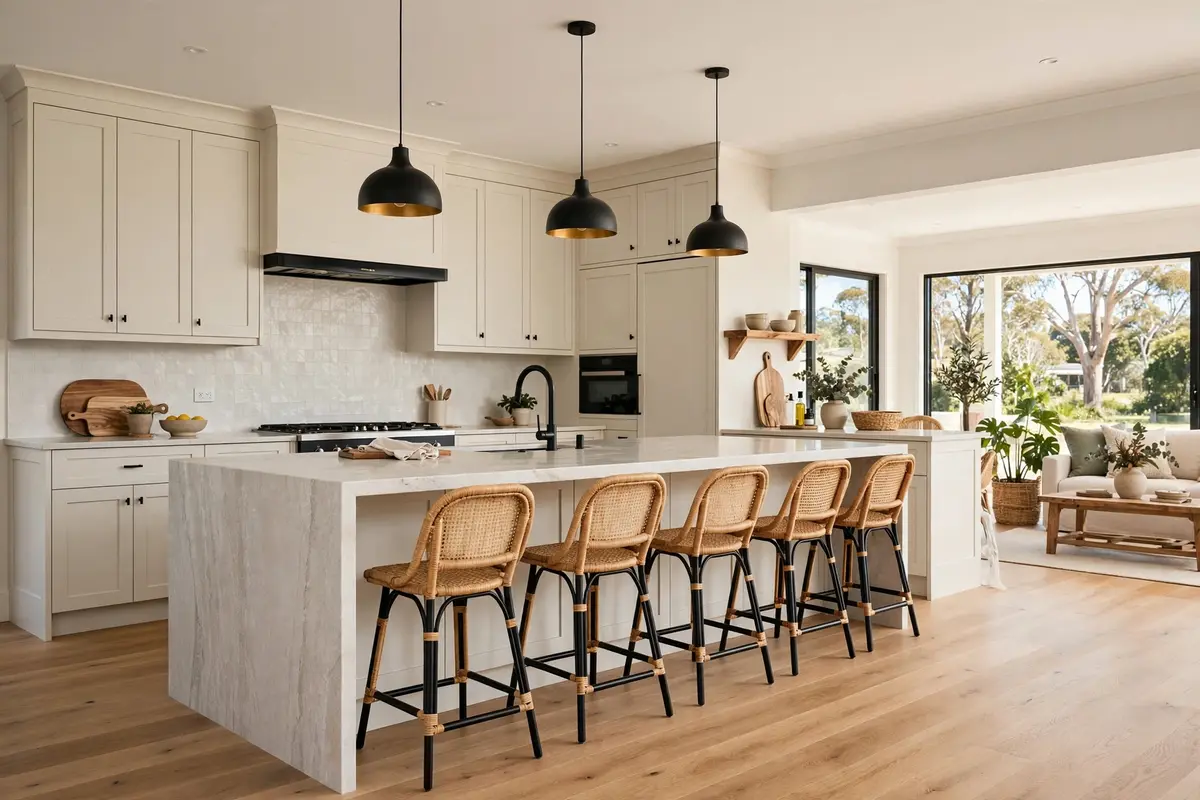
The kitchen island has become the heart of the modern Australian kitchen. It’s where kids do homework while dinner cooks, where guests gather with a glass of wine, and where the serious food prep happens. Get the island right, and the whole kitchen works better.
But kitchen islands aren’t one-size-fits-all. Size, shape, benchtop material and functionality all need to suit your space and how you actually live. If you’re planning a full kitchen overhaul, our butler’s pantry design guide pairs perfectly with island planning, and our flat-pack kitchen cost guide covers budget-friendly cabinetry options. This guide covers everything from dimensions to costs to the design details that make an island truly great.
Kitchen Island Dimensions: What Actually Works
Minimum space requirements
Before falling in love with a design, check your floor plan. You need:
- 1,000–1,200mm clearance around all sides of the island for comfortable movement
- Minimum island size: 1,200mm long x 600mm deep for a functional prep space
- Comfortable island size: 2,400mm long x 1,000–1,200mm deep — seats 3–4 people
- Generous island: 3,000mm+ long x 1,200mm deep — the entertainer’s choice
If you can’t fit 1,000mm clearance on all sides, consider a peninsula (attached on one side) instead. A cramped island is worse than no island.
Benchtop height
Standard Australian benchtop height is 900mm. For islands with seating, you have two options:
- Single height (900mm): clean, modern, works with standard bar stools (650mm seat height)
- Split level: 900mm prep area + 1,050–1,100mm raised bar. Hides kitchen mess from the living area but can feel dated
Single-height islands are the current preference — they’re more versatile and look less cluttered.
Overhang for seating
Allow 300mm of benchtop overhang for comfortable knee space at bar stools. For a 1,000mm deep island, that means 700mm of cabinetry and 300mm overhang. Any less and diners feel cramped; much more and the stone needs additional support.
Kitchen Island Benchtop Costs in Australia
For a standard 2.4m x 1m island, expect these installed prices:
| Material | Cost (Installed) | Pros |
|---|---|---|
| Laminate | $1,500 – $3,000 | Budget-friendly, huge colour range |
| Engineered stone | $3,000 – $5,000 | Durable, consistent, mid-range favourite |
| Sintered stone / porcelain | $3,500 – $5,500 | Heat/scratch resistant, ultra-durable |
| Granite | $4,000 – $6,500 | Natural, unique, very hard-wearing |
| Solid timber | $2,500 – $4,500 | Warm, repairable, ages beautifully |
| Marble | $6,000 – $12,000+ | Stunning, but stains and etches |
Note: engineered stone is subject to Australia’s engineered stone ban (in force since 1 July 2024) for certain silica-containing products. Sintered stone and porcelain are the compliant alternatives most suppliers now recommend. Always confirm with your stonemason.
Waterfall ends
Waterfall ends (where the benchtop material continues down the sides) add $1,500–$2,500 per end. They look spectacular but roughly double the stone required. Best reserved for the visible end of the island.
Island Styles for Australian Homes
Shaker / Hamptons
Panelled cabinetry, marble-look benchtop, classic pendant lights. The Hamptons island is timeless and suits traditional and coastal Australian homes. Choose a soft white or pale grey for the island to contrast with surrounding cabinetry.
Contemporary minimal
Handleless cabinetry, waterfall stone ends, integrated appliances. Clean, architectural, and very now. Works best in open-plan homes where the kitchen is visible from living areas.
Timber warmth
Solid timber benchtop or timber-look cabinetry on the island, contrasting with white perimeter cupboards. Adds warmth and texture. Spotted gum and blackbutt are popular Australian choices.
Industrial edge
Concrete-look benchtop, black steel frame, open shelving. Bold and urban. Suits warehouse conversions and modern apartments.
Making Your Island Work Harder
Storage
An island without storage is a missed opportunity. Consider:
- Deep drawers on the working side for pots, pans and prep tools
- Open shelving on the living side for cookbooks and display
- Integrated bins: a pull-out bin system ($200–$600) keeps waste sorted and hidden
- Power points: pop-up or flush-mounted GPOs in the benchtop for appliances ($150–$300 each installed)
Appliances in the island
- Cooktop: creates a social cooking experience but needs a ceiling-mounted or downdraft rangehood ($2,000–$5,000)
- Sink: convenient for prep, but splashing can be an issue in open plan. A second small prep sink works well.
- Dishwasher: a second dishwasher drawer in the island is a game-changer for entertainers
- Wine fridge: an under-bench wine fridge ($800–$2,000) turns the island into an entertaining hub
Seating
Choose stools that tuck fully under the overhang when not in use. Backless stools save visual space; low-back stools are more comfortable for longer sits. Allow 600mm width per person.
Lighting Your Island
Pendant lights above the island are both functional and decorative:
- Rule of thumb: odd numbers (3 pendants for a 2.4m island, 2 for a smaller one)
- Height: hang 750–800mm above the benchtop — low enough for intimacy, high enough for sightlines
- Scale: pendants should be proportional. Oversized pendants overwhelm a small island; tiny ones disappear over a large one.
Common Kitchen Island Mistakes
- Too big for the space: an island that leaves less than 1,000mm clearance creates a frustrating obstacle course.
- No power: forgetting GPOs means trailing cords across your beautiful stone. Plan electrical early.
- Wrong stone thickness: 20mm looks sleek and modern; 40mm feels more substantial. Match it to your kitchen’s style.
- Ignoring the back: the side facing the living area is the most visible. Make it beautiful — panelled, shelved or simply clean.
- Poor lighting: a single downlight above a 3m island leaves dark spots. Pendants or a linear pendant provide even coverage.
Island Alternatives for Smaller Kitchens
Not every kitchen can fit an island. If yours can’t, consider these alternatives:
Peninsula
Attached to a wall or existing cabinetry on one side, a peninsula gives you extra bench space and seating without needing clearance on all four sides. Ideal for galley kitchens and apartments.
Freestanding island bench
A mobile timber island ($750–$1,780) on castors can be moved where you need it. Perfect for renters or anyone who wants flexibility. Look for solid hardwood construction — it will last decades.
Breakfast bar
A simple 300–400mm deep benchtop along a wall provides casual seating without the footprint of a full island. Pair with backless stools that tuck underneath.
Planning Your Island: A Checklist
Before you commit, run through this checklist:
- Measure your clearances — 1,000mm minimum on all sides
- Decide on functionality: prep, seating, storage, appliances — or all four?
- Choose your benchtop material and confirm availability with your stonemason
- Plan electrical: GPOs, pendant lighting, appliance connections
- Consider plumbing if adding a sink or dishwasher
- Select stools that fit your overhang and tuck away neatly
- Get three itemised quotes — island costs vary enormously between suppliers
- Check lead times: custom cabinetry can take 6–10 weeks
Frequently Asked Questions
How much does a kitchen island cost in Australia?
A basic island with laminate benchtop starts around $2,000–$4,000. A mid-range island with stone benchtop and custom cabinetry costs $5,000–$12,000. A premium island with waterfall ends, integrated appliances and designer lighting can reach $15,000–$25,000+.
What is the standard kitchen island size in Australia?
A comfortable island is 2,400mm long x 1,000–1,200mm deep. Minimum functional size is 1,200mm x 600mm. Always allow 1,000–1,200mm clearance around all sides for comfortable movement.
Can I add an island to an existing kitchen?
Yes, if you have the floor space. Freestanding islands ($750–$1,780 for timber units) are the simplest option. For a built-in island with plumbing or electrical, you’ll need a carpenter and electrician. Check that your floor can support the weight, especially for stone benchtops.
What benchtop material is best for a kitchen island?
Sintered stone/porcelain offers the best combination of durability, heat resistance and low maintenance. Engineered stone is popular but check compliance with Australia’s engineered stone regulations. Solid timber is beautiful but needs regular oiling. Marble looks stunning but stains easily.
How high should pendant lights hang above a kitchen island?
Hang pendants 750–800mm above the benchtop surface. This provides good task lighting without blocking sightlines across the kitchen. Use a dimmer so you can adjust from bright prep light to soft entertaining ambience.