
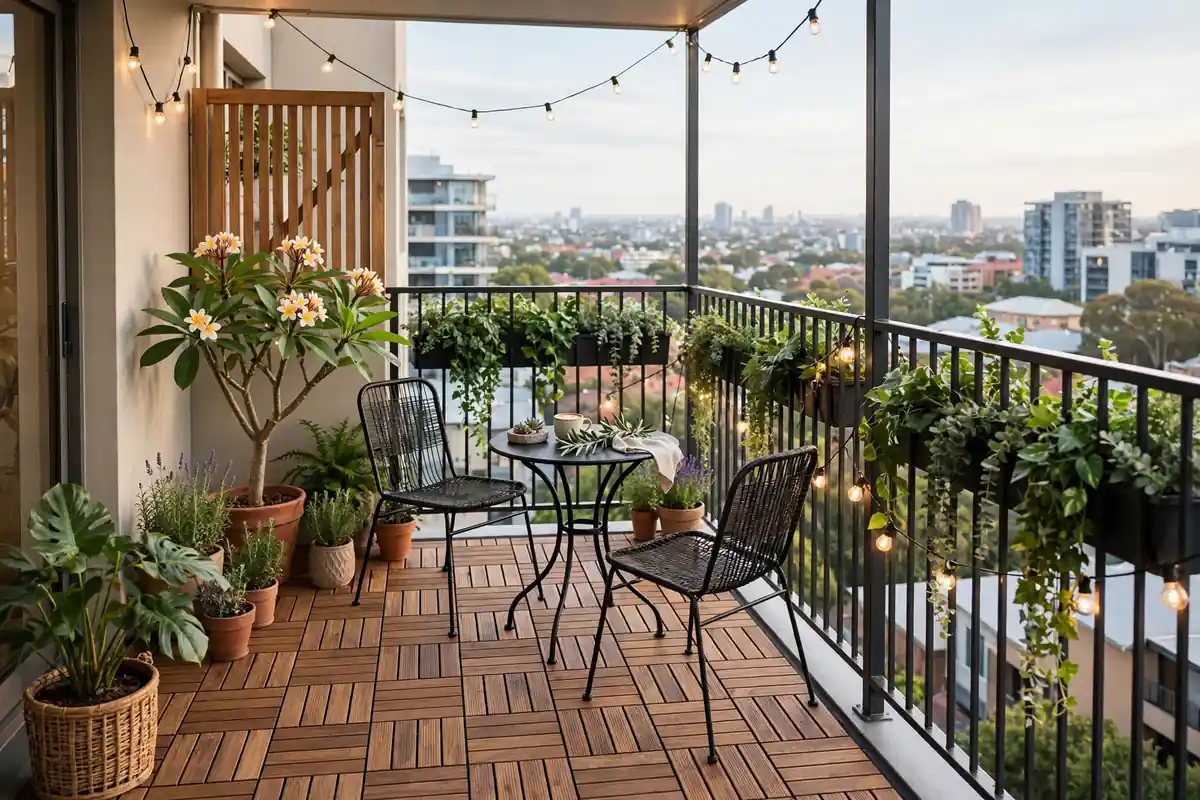
Why Balcony Design Matters in Australian Apartments
More Australians are living in apartments than ever before, and for most of them, the balcony is the only private outdoor space they have. In cities like Sydney, Melbourne and Brisbane, a well-designed balcony can feel like an extra room — a place for morning coffee, evening drinks, or simply a breath of fresh air without leaving home.
Yet most apartment balconies are underused. They become storage zones for bikes, boxes and drying racks instead of the little sanctuaries they could be. The good news is that even the smallest balcony — and many Australian apartment balconies are just 6 to 10 square metres — can be transformed with smart planning and a modest budget.
This guide covers practical balcony design ideas for Australian apartments in 2026: layouts for different sizes, flooring and furniture choices that survive our climate, and realistic costs so you can plan with confidence.
Start With Your Balcony’s Constraints
Before buying a single pot plant, take stock of what you’re working with. Australian apartment balconies come with rules and realities that shape every design decision.
Check Your Strata By-Laws First
Most apartment buildings in Australia are governed by strata by-laws or body corporate rules. These commonly restrict:
- What you can attach — many buildings prohibit drilling into walls, railings or ceilings
- Screening and awnings — external blinds or privacy screens often need written approval
- Flooring changes — some by-laws restrict tile overlays that affect drainage or add weight
- BBQs — gas and charcoal barbecues are banned on many balconies for fire safety; check before you buy
- Visible clutter — some buildings require balconies to be kept “tidy” from street view
A quick email to your strata manager before you start saves expensive mistakes. If you’re renting, you’ll also need your landlord’s written permission for anything beyond freestanding furniture and pots.
Measure Everything
Measure the length, depth and railing height of your balcony. Note the position of:
- Sliding doors and how far they open
- Drainage points (never block these)
- Power outlets and taps
- Downpipes or service ducts you can’t move
Understand Your Sun and Wind
A north-facing balcony in Sydney gets very different conditions from a south-facing one in Melbourne. Spend a few days noting when your balcony gets direct sun, and how windy it gets. This determines your plant choices, furniture materials and whether you need shade.
Balcony Layout Ideas by Size
Tiny Balconies (Under 5m²)
Common in newer inner-city apartments, these narrow strips still have potential. The trick is vertical thinking:
- Fold-down furniture — a wall-mounted drop-leaf table and two folding chairs create a café corner that disappears when not in use
- Railing planters — hook-on planters use the railing instead of floor space
- One statement piece — a single sculptural pot with an architectural plant (like a frangipani or olive) looks intentional rather than cluttered
- Outdoor rug — defines the zone and softens concrete underfoot
Medium Balconies (5–10m²)
The most common size in Australian apartments. You have room for zones:
- Lounge zone — a compact two-seater outdoor sofa or a pair of armchairs with a side table
- Green zone — a cluster of pots at varying heights, or a vertical garden panel on one wall
- Dining option — a small bistro set for two, or a bar table along the railing for breakfast with a view
Large Balconies and Terraces (10m²+)
Found in premium apartments and penthouses. Treat it like an outdoor room:
- Full dining setting for four to six
- Lounge area with outdoor rug, sofa and coffee table
- Dedicated planting beds or large feature pots
- Consider an outdoor-rated pendant light or string lights for evening ambience
Flooring: Your Biggest Visual Win
Most apartment balconies come with plain concrete or basic tiles. Changing the floor transforms the whole space, and renters have options too.
Best Balcony Flooring Options
- Interlocking deck tiles ($30–$60/m²) — timber-look or composite tiles that click together over existing flooring. No glue, no damage, renter-friendly. A 6m² balcony costs roughly $180–$360 in materials.
- Outdoor rugs ($50–$200) — the cheapest transformation. Choose polypropylene rugs rated for outdoor use; they handle rain and hose off clean.
- Artificial grass tiles ($25–$45/m²) — surprisingly effective for a soft, green feel. Modern versions look far better than the astroturf of old.
- Porcelain pavers ($60–$120/m²) — for owners wanting a permanent upgrade. Check weight limits and drainage before committing.
Whatever you choose, never block drainage points, and avoid anything that traps moisture against the slab — your downstairs neighbour will thank you.
Furniture That Survives Australian Conditions
Our sun is brutal on outdoor furniture. Cheap plastic chairs fade and crack within a season. Invest in materials built for the climate:
- Powder-coated aluminium — lightweight, rust-proof, and widely available. A good bistro set runs $200–$500.
- Teak or acacia — beautiful and durable, but needs annual oiling. Expect $400–$1,200 for a quality setting.
- Resin wicker (not natural rattan) — looks like rattan but handles rain and UV. A two-seater starts around $300.
- Concrete and stone — heavy but indestructible. Best for larger balconies where weight isn’t an issue.
Cushions should be solution-dyed acrylic (like Sunbrella fabric) — they resist fading far better than standard outdoor fabrics. Budget $30–$80 per cushion for decent quality.
Plants: Bringing Life to Small Spaces
Plants are the fastest way to make a balcony feel like a retreat rather than a concrete ledge. Choose based on your aspect:
Full Sun Balconies (North/West Facing)
- Succulents and cacti — nearly indestructible
- Lavender and rosemary — fragrant, hardy, useful in the kitchen
- Frangipani in a large pot — the classic Australian balcony tree
- Bougainvillea — spectacular colour, loves heat
Shaded Balconies (South/East Facing)
- Ferns — maidenhair and bird’s nest ferns thrive in shade
- Peace lilies — elegant and low-maintenance
- Philodendrons and monstera — lush tropical feel
- Herbs like mint, parsley and chives — productive in partial shade
Windy Balconies
High-rise balconies cop serious wind. Choose tough, flexible plants: coastal rosemary (Westringia), lomandra, dwarf olive trees and sturdy grasses. Avoid tall, top-heavy pots that can topple — use wide, heavy planters and consider securing them.
Vertical Gardens
When floor space is precious, go up. Wall-mounted pocket planters ($40–$120 per panel) or a simple trellis with climbing jasmine can green an entire wall. Just confirm with strata before attaching anything to common-property walls.
Privacy and Shade Solutions
Overlooked by neighbours? These renter-friendly options help:
- Freestanding planter screens — tall pots with bamboo or screening plants create a living wall ($150–$400)
- Outdoor curtains — tension-rod curtains on a covered balcony add softness and privacy ($50–$150)
- Shade sails (freestanding) — need sturdy posts and strata approval, but transform a harsh west-facing balcony ($200–$600)
- Retractable awnings — the premium option for owners; expect $1,500–$4,000 installed
Lighting for Evening Ambience
Good lighting extends your balcony’s usable hours and makes it magical after dark:
- Solar string lights ($20–$60) — the easiest win; no wiring needed
- LED lanterns ($25–$80 each) — battery or solar, moveable, atmospheric
- Motion-sensor step lights — practical near the door, solar-powered
- Outdoor-rated pendant — for covered balconies with a power point; creates a true “room” feel
What Does a Balcony Makeover Cost in Australia?
Realistic 2026 budgets for a typical 6–8m² apartment balcony:
- Budget refresh ($300–$800): outdoor rug, string lights, 4–6 pots with plants, folding bistro set
- Mid-range makeover ($800–$2,500): deck tiles, quality lounge chairs, vertical garden, privacy screening, decent lighting
- Premium transformation ($2,500–$6,000+): full furniture setting, large feature pots, retractable shade, professional planting, outdoor lighting plan
If you’re considering structural changes — new tiling, built-in seating, or an awning — factor in strata approval time (often 4–8 weeks) and professional installation. For bigger outdoor projects, our timber deck cost guide covers what larger outdoor builds typically run in Australia.
Balcony Design Mistakes to Avoid
- Overcrowding — less is more on a small balcony; leave breathing room
- Ignoring drainage — blocked drains cause leaks into the unit below and angry strata managers
- Wrong plants for the aspect — a sun-lover on a south-facing balcony will just sulk and die
- Skipping strata approval — unauthorised changes can mean forced removal at your cost
- Cheap furniture — it fades, rusts or cracks within a year in Australian conditions; buy once, buy well
Frequently Asked Questions
Do I need strata approval to decorate my balcony?
For freestanding furniture, pots and rugs — generally no. For anything attached to walls, railings or ceilings (screens, awnings, vertical gardens, lighting fixtures), most Australian strata schemes require written approval. Always check your by-laws first.
What is the best flooring for a rental apartment balcony?
Interlocking deck tiles are the best renter-friendly option. They click together over existing flooring with no glue or damage, cost $30–$60/m², and you can take them with you when you move.
How do I make a small balcony feel bigger?
Use a consistent colour palette, keep furniture to scale (small pieces, not oversized), go vertical with plants, use an outdoor rug to define the zone, and avoid clutter. A mirror on one wall can also create an illusion of depth.
What plants survive on a windy high-rise balcony?
Choose tough coastal plants: Westringia (coastal rosemary), lomandra, dwarf olives and native grasses. Use wide, heavy pots to prevent toppling, and avoid tall top-heavy specimens in exposed positions.
Can I have a BBQ on my apartment balcony?
It depends on your building. Many Australian apartment complexes ban gas and charcoal BBQs on balconies for fire safety. Electric BBQs are sometimes permitted. Check your strata by-laws and your lease before buying one.
How much does a balcony makeover cost in Australia?
A budget refresh runs $300–$800, a mid-range makeover $800–$2,500, and a premium transformation $2,500–$6,000+ for a typical 6–8m² balcony. Structural changes like retiling or awnings cost extra and need strata approval.