
Ask three builders for a decking quote and you will get three different numbers — and probably three different materials recommended. That is because the cost depends on more than the boards: subframe, labour, access, council approvals and, crucially, what the deck costs over its life all move the number.
Short answer: In 2026, treated pine costs roughly $150–$220/m² installed (a 25m² deck ≈ $3,750–$5,500) and lasts 15–20 years with annual oiling. Merbau runs $220–$320/m² installed and lasts 25–40 years; spotted gum runs $280–$400/m² for 30–50 years. Composite costs $250–$450/m² installed (25m² ≈ $6,250–$11,250), lasts 25–30 years and needs only washing. But the sticker price is only half the story — over twenty years, a 30m² composite deck can work out cheaper in total than merbau once maintenance is counted.
All figures below are indicative 2026 Australian numbers drawn from published supplier and builder guides (sources listed at the end). Prices vary by region, access and supplier — always get itemised quotes for your deck.
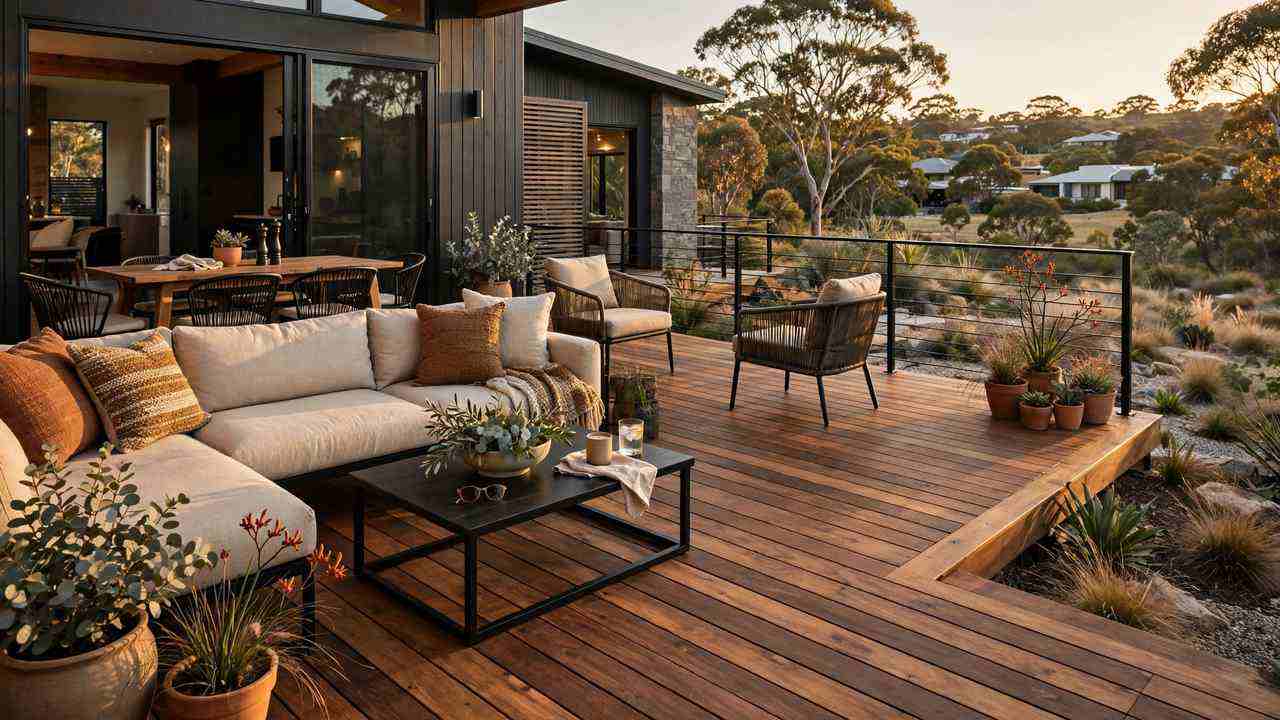
The 2026 deck cost snapshot: all four materials side by side
| Material | Indicative installed cost | Expected lifespan | Maintenance |
|---|---|---|---|
| Treated pine | $150–$220/m² | 15–20 years | High — oil or stain every year |
| Merbau | $220–$320/m² | 25–40 years | High — oil 1–2 times per year |
| Spotted gum | $280–$400/m² | 30–50 years | Medium — oil to hold colour |
| Composite | $250–$450/m² | 25–30 years | Low — wash only |
The figures above are supply-and-install rates from 2026 Australian decking supplier and builder guides. Labour alone accounts for roughly 30–40% of the total (about $80–$180/m²), which is why access, site slope and height move quotes so much. On top of the boards, budget for the subframe: treated pine $30–$45/m², hardwood $45–$70/m², or steel $60–$90/m².
Treated pine decks: the honest budget option
Treated pine remains the default for budget-conscious Australian decks, and at $150–$220/m² installed there is no cheaper way onto timber. The “treated” part matters: pine is a softwood that must be pressure-treated (CCA or ACQ, rated H3 or H4 for outdoor above-ground use) to resist termites and rot. Always confirm the treatment rating on your quote — untreated or under-rated pine can fail within a few years.
What it costs you over time: annual oiling runs roughly $300–$800 a year — over a 15–20 year lifespan, maintenance alone can roughly double the installed cost.
The honest pros: lowest entry cost, widely available, easy to cut and fasten (good for DIY), and takes stain well. The honest cons: soft underfoot — it dents, splinters and checks as it weathers; and it greys fast if you skip the annual oil.
Best for: rental properties, first-home budgets, and decks you plan to replace or upgrade within a decade or so.
Hardwood decks: merbau, spotted gum and blackbutt
In 2026 the three main contenders are merbau ($220–$320/m² installed, 25–40 year lifespan), spotted gum ($280–$400/m², 30–50 years) and blackbutt (typically priced in the same band as spotted gum).
Merbau is the classic: deep reddish-brown, naturally termite-resistant and — worth knowing in fire-prone areas — naturally rated to BAL-29 without treatment. The catch is tannin bleed: fresh merbau leaches a reddish stain for the first few months, which can mark adjacent pavers and walls.
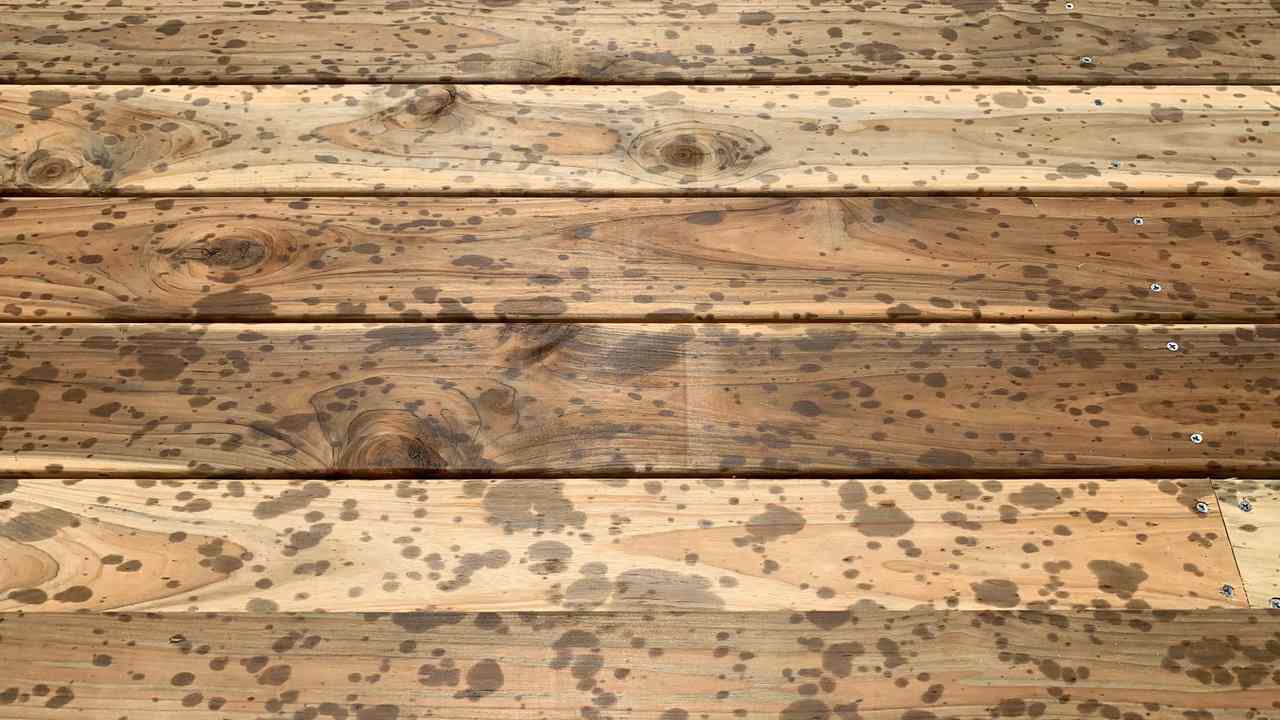
Spotted gum is the premium Australian native: striking variable colouring, extremely dense, with a 30–50 year lifespan. It costs more but holds its surface better than merbau and is also bushfire-suitable. Blackbutt is the lighter-toned native, blonde to pale brown, popular for coastal and Hamptons-style homes; check supply, as native species pricing moves with availability.
The maintenance reality: hardwoods still want oiling once or twice a year to hold colour (roughly $300–$800 a year); without it they silver to grey — a legitimate look, but choose it deliberately.
Best for: forever homes where you want the real-timber look and feel, and bushfire-prone blocks where merbau’s natural BAL-29 rating matters.
Composite decking: capped, ASA-capped, and what to avoid
Composite decking — wood fibres bound in polymer — has moved from budget curiosity to mainstream alternative in 2026, at $250–$450/m² installed. The material divide you need to understand is capped vs uncapped. Modern capped boards carry a protective polymer shell that resists staining, scratching and UV fade; uncapped first-generation composite fades and swells — avoid it entirely.
On the boards themselves (supply only, before installation): mid-range capped boards run roughly $100–$150/m², while premium ASA-capped boards — a harder, more UV-stable cap — run roughly $150–$190/m². For a 25m² deck that is $6,250–$11,250 installed, putting quality composite in the same installed-price band as mid-to-high hardwood.
What to check before buying: confirm the board has a full cap (not a surface film), check the UV and fade warranty in writing, and confirm BAL rating if you are in a bushfire zone. Ask how the boards behave in full Australian sun — darker colours get hot — and sample colours in the actual sun, not the showroom.
The honest pros: wash-only maintenance (no oiling, ever), no splinters, no tannin bleed, consistent colour, and 25–30 year lifespans with minimal upkeep. The honest cons: higher upfront cost, can feel less natural underfoot, and the cheapest boards on the market fade and stain — buy on warranty and reviews, not price.
Best for: time-poor owners, pool surrounds (no splinters, no stain on pavers), and anyone who knows they will not oil a timber deck every year.
The subframe and the other costs quotes hide
The boards are the glamour; the subframe is the structure that determines whether the deck lasts its stated lifespan. Subframe costs add $30–$45/m² for treated pine framing, $45–$70/m² for hardwood, or $60–$90/m² for steel. Steel costs more but suits composite boards — a 30-year composite top on a 15-year pine frame is a false economy.
Other line items that surprise first-time deck builders:
- Labour: around $80–$180/m², roughly 30–40% of the total — the biggest single component after materials.
- Stairs and balustrades: priced separately; stairs can add hundreds per step, and glass or stainless balustrades add thousands.
- Lighting and power: deck lighting, outdoor powerpoints and fans are far cheaper to run during the build than after.
- Access: cranes, carry-in distances and sloping blocks all push labour up.
- Height and footings: decks raised off the ground need deeper footings and more structure — costs climb with every 300mm of height.
When comparing quotes, make sure each one itemises boards, subframe, labour, stairs, balustrade and site costs separately — a lump sum hides where the money goes and where corners could be cut.
The 20-year maths: what each deck really costs on a 30m² deck
This is the comparison supplier-led guides rarely make, because timber maintenance is where their cheapest options look worst. On a 30m² deck, over twenty years (build cost plus maintenance, indicative only):
| Material (30m²) | Build cost | 20-year maintenance | 20-year total (indicative) |
|---|---|---|---|
| Treated pine | $4,500–$6,600 | $6,000–$16,000 (annual oiling) | $10,500–$22,600 |
| Merbau | $6,600–$9,600 | $6,000–$16,000 (oiling) | $14,000–$28,000* |
| Spotted gum | $8,400–$12,000 | $4,000–$12,000 (oiling) | $12,400–$24,000 |
| Composite | $7,500–$13,500 | ~$500–$1,500 (wash only) | $9,000–$14,000* |
* Supplier-derived comparison — treat as indicative. The maths assumes annual re-oiling at roughly $300–$800 a year for timber and wash-only care for composite. On these numbers, composite — the “expensive” option at build time — can end up the cheapest deck you own, simply because it asks nothing of you after installation.
The caveat is honest: these are simple sums, not net-present-value calculations, and your oiling costs depend on size, exposure and DIY vs professional. But the direction is robust — maintenance is the hidden price of timber. Owners who enjoy the annual oiling ritual get something no spreadsheet captures; everyone else should look at the totals.
Council approval: what you actually need to know
Many Australian councils require approval for decks over roughly one metre high, roofed or covered decks, and decks in heritage or bushfire overlays — but the thresholds vary from council to council, and naming a single rule as universal would be wrong. The safe approach: always check with your local council (or your certifier) before you build.
Low ground-level decks are often exempt, but boundary setbacks, easements and bushfire mapping can still pull them into approval. BAL-29 rated construction (available in both composite boards and naturally in merbau) may be required in mapped bushfire areas. Keep written confirmation of any exemption — it protects you at resale.
DIY vs professional installation
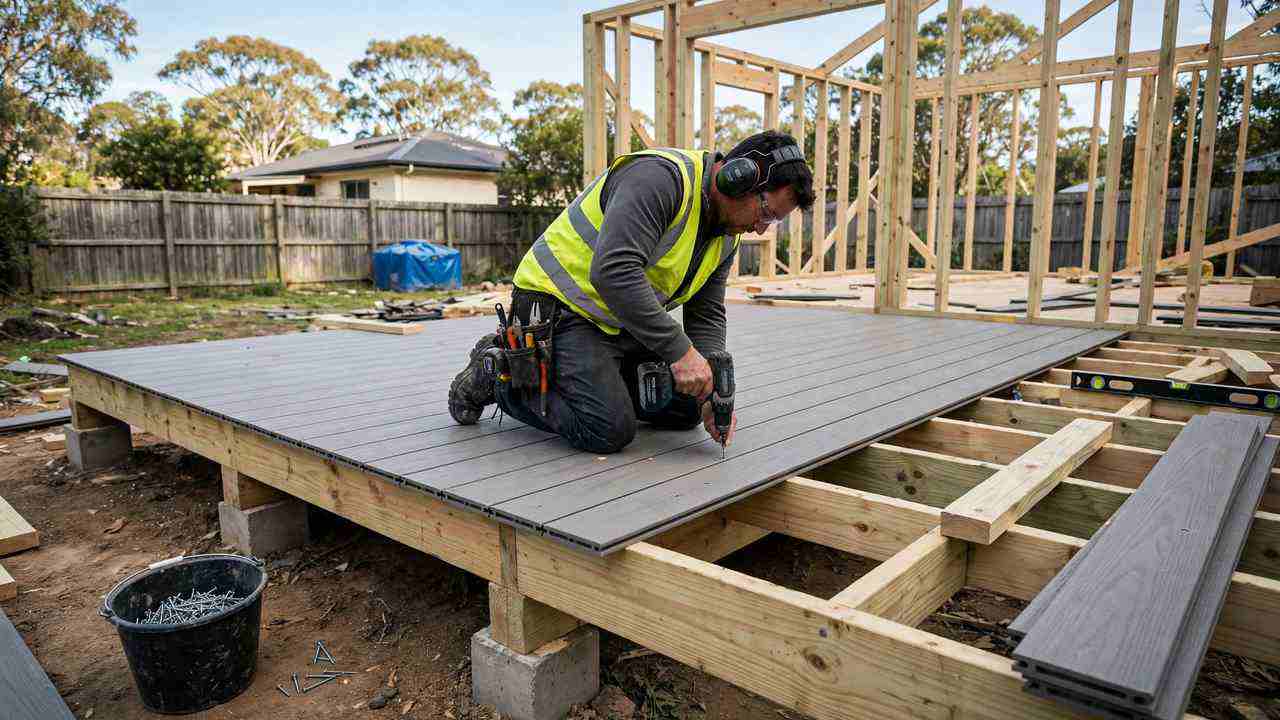
Decking is one of the more DIY-accessible trades. A competent DIYer can save the labour component — roughly $80–$180/m² — on a low, ground-level treated pine or composite deck with standard fixings. Clip-system composite boards are particularly DIY-friendly.
Hire a professional when the deck is elevated, attached to the house structure, needs council approval, sits in a bushfire zone, or involves stairs and balustrades (fall protection rules apply, and mistakes here are safety issues, not cosmetic ones). As a rule of thumb: if a permit is required, a licensed builder or carpenter should do the work. And if you are tackling it yourself, the most common DIY error is skimping on the subframe — spend the money on framing and fixings; the boards are the part everyone sees, but the frame is the part that matters. If budget blowouts worry you, our guide to renovation mistakes to avoid covers the classic ways outdoor projects go over budget.
Picking your deck: honest recommendations by situation
| Your situation | Best pick | Why |
|---|---|---|
| Tight budget, happy to DIY | Treated pine | Lowest cost per m²; easy to work with |
| Forever home, love real timber | Spotted gum | Best lifespan, beautiful, worth the premium |
| Bushfire-prone block | Merbau or BAL-29 composite | Merbau is naturally BAL-29; rated composite also available |
| Pool surround or barefoot zone | Composite | No splinters, no tannin bleed onto pavers |
| Time-poor, hate maintenance | Composite | Wash-only care; lowest 20-year total |
| Entertaining deck off the kitchen | Hardwood or composite | Looks matter — pair it with our outdoor kitchen ideas for the full setup |
Finally, keep the deck in perspective against the whole project: our renovation cost per square metre guide helps size the deck to the renovation it belongs to.
Frequently asked questions
How much does a timber deck cost per m² in Australia in 2026?
Treated pine $150–$220/m² installed, merbau $220–$320/m², spotted gum $280–$400/m² and composite $250–$450/m². Labour makes up roughly 30–40% of those figures (about $80–$180/m²), and the subframe adds $30–$90/m² depending on material.
Is composite decking cheaper than timber over time?
Often, yes. Composite costs more upfront ($250–$450/m²) but needs only washing, while timber needs $300–$800 a year in oiling. Over 20 years on a 30m² deck, that puts composite at roughly $9,000–$14,000 total versus $14,000–$28,000 for merbau.
How long does a treated pine deck last?
Around 15–20 years with annual oiling and proper treatment (H3/H4 rated). Skipping maintenance shortens that significantly — greying, checking and rot set in faster than most owners expect.
Do I need council approval for a deck in Australia?
It depends on your council. Many councils require approval for decks over roughly one metre high, roofed decks, or decks in bushfire or heritage overlays. Always check with your local council or certifier before building.
Which decking is best for bushfire-prone areas?
Merbau is naturally rated to BAL-29, and BAL-29 rated composite boards are available. Your council’s bushfire mapping decides what is required — confirm it before choosing materials.
What is the biggest hidden cost in a decking quote?
The subframe and stairs. Framing adds $30–$90/m² depending on material, stairs are often priced per step, and balustrades — especially glass or stainless — can add thousands that budget quotes sometimes leave out.
Figures & sources
Installed per-m² rates (treated pine $150–$220, merbau $220–$320, spotted gum $280–$400, composite $250–$450), lifespans, labour share (~$80–$180/m², 30–40%), subframe costs (pine $30–$45/m², hardwood $45–$70/m², steel $60–$90/m²), composite board-only pricing (mid-range capped $100–$150/m², ASA-capped $150–$190/m²), annual timber re-oiling cost (~$300–$800/yr) and the 20-year total-cost comparison (composite ≈ $9,000–$14,000 vs merbau ≈ $14,000–$28,000 on 30m², supplier-derived): published 2026 Australian decking supplier and builder guides. BAL-29 ratings: manufacturer and bushfire-construction guidance. Council approval thresholds: stated as general guidance — rules vary by council; verify locally.