
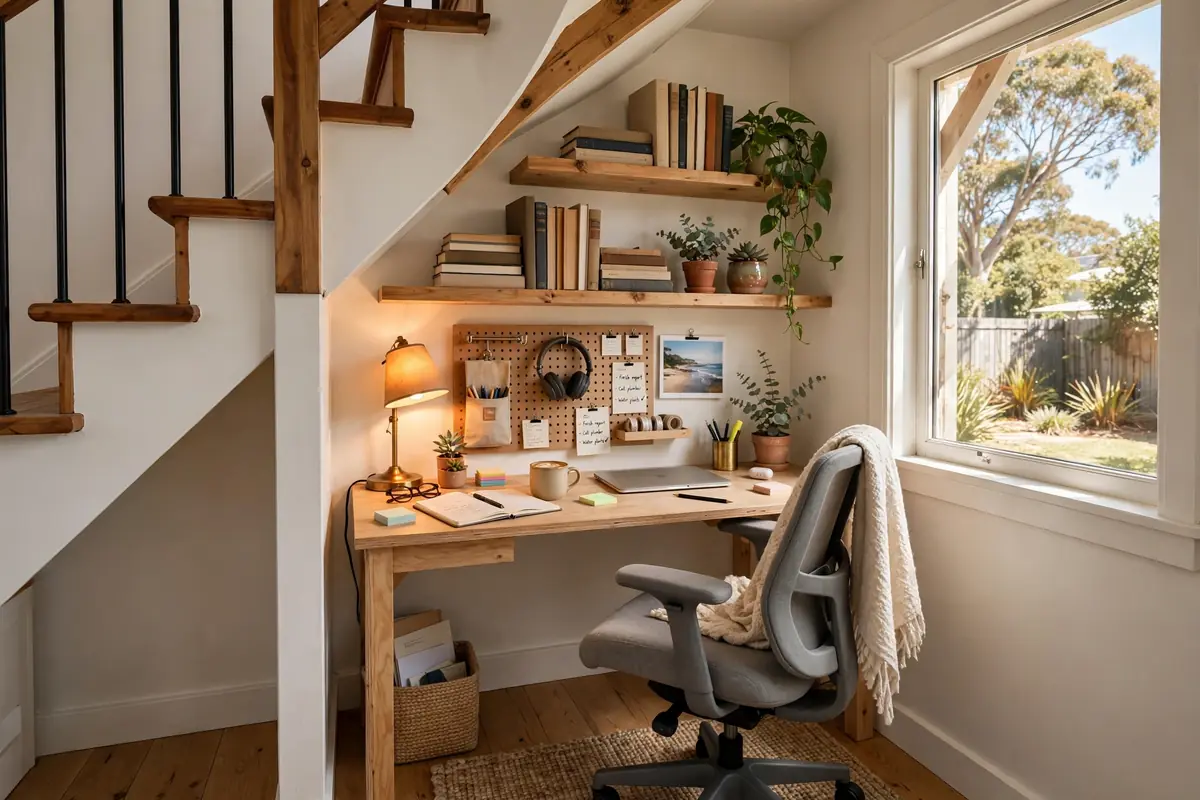
Why Study Nooks Work in Australian Homes
Not every home has room for a dedicated study, but almost every home has an underused corner, an awkward alcove, or a stretch of hallway wall doing nothing. A study nook turns dead space into a functional workspace — perfect for school homework, paying bills, or the occasional work-from-home day.
With Australian homes getting smaller on average and more of us working hybrid schedules in 2026, the study nook has become one of the smartest small-space upgrades you can make. It costs a fraction of a full home office renovation, takes a weekend to set up, and genuinely gets used every day.
This guide covers where to put a study nook, how to design one that actually works (not just looks good on Pinterest), and realistic Australian costs.
Where to Put a Study Nook
The best study nook locations are spaces you’re already walking past:
Under the Stairs
The classic. That triangular dead zone under a staircase fits a compact desk perfectly. Measure the height at the desk position — you need at least 75cm of clear knee space and enough headroom to sit comfortably. Add a wall-mounted shelf above for storage and a picture light for task lighting.
Hallway Nooks and Alcoves
Wide hallways (120cm+) can accommodate a shallow desk (40–45cm deep) against one wall. Look for spots near a window for natural light. A narrow console-style desk keeps the walkway clear.
Bedroom Corners
A quiet bedroom corner works well for homework nooks — away from the living room’s distractions. Position the desk to face the wall rather than the bed to help focus. Our master bedroom design guide has more ideas for making bedrooms work harder.
Living Room Edges
A desk tucked behind a sofa or in a living room corner keeps work visible and social. Use a room divider, open shelving unit or even a tall plant to create a subtle visual boundary between work and relaxation zones.
Wardrobe Conversions
A spare built-in wardrobe (at least 60cm deep) converts brilliantly into a “cloffice” — desk at bench height inside, shelves above, doors that close to hide the mess. This is one of the most popular study nook ideas in Australian apartments.
Kitchen Ends and Laundries
The end of a kitchen bench or a corner of the laundry can host a compact homework station for kids — close enough for supervision while dinner’s cooking. Just keep it separate from food prep areas for hygiene.
Study Nook Dimensions That Actually Work
Ergonomics matter more in a nook than in a full study, because every centimetre counts:
- Desk height: 72–75cm is standard; adjustable options exist but cost more
- Desk depth: minimum 45cm for a laptop, 60cm+ if using a monitor and keyboard
- Desk width: 80cm is workable for one person, 100–120cm is comfortable
- Knee clearance: at least 60cm wide × 70cm high under the desk
- Chair space: allow 60–80cm behind the desk for pulling the chair out
- Monitor distance: screen should be 50–70cm from your eyes to reduce strain
If the nook is for a child, consider an adjustable-height desk ($150–$350) that grows with them — cheaper than replacing furniture every two years.
Essential Elements of a Good Study Nook
1. Task Lighting
Overhead room lighting is never enough for desk work. You need focused light:
- Desk lamp ($30–$120): adjustable arm, warm-white LED (3000K). Look for one with a USB charging port built in.
- Wall-mounted sconce: frees up desk space entirely; great for narrow nooks
- LED strip under a shelf: clean, modern, and cheap ($15–$40 for a USB-powered strip)
Position light to the side of your dominant hand to avoid shadows while writing.
2. Power Access
A laptop, phone charger and lamp need at least three outlets. If your nook spot has only one:
- Use a slim power board with surge protection ($25–$50)
- Consider a desk with built-in power and USB ($200–$400 for compact models)
- Cable management clips or a cable tray keep things tidy ($10–$25)
3. Storage
Clutter kills focus. Even a tiny nook needs a home for papers, chargers and supplies:
- Wall shelves: two or three floating shelves above the desk ($30–$100)
- Pegboard: endlessly customisable, very on-trend, $25–$60
- Rolling cart: a three-tier trolley tucks beside or under the desk ($40–$90)
- Desk organisers: trays, pen holders and drawer dividers ($15–$40 total)
4. A Proper Chair
This is where most study nooks fail. A dining chair works for 20 minutes; for real work you need support. Compact ergonomic chairs start around $150–$300 in Australia. If space is extremely tight, a good-quality stool with a footrest is better than a bad chair.
5. Acoustic Comfort
Nooks in open-plan areas cop noise. A pair of decent noise-cancelling headphones ($150–$400) is often cheaper than any physical soundproofing. A rug under the desk also dampens echo in hard-floor rooms.
Study Nook Ideas for Kids
Homework nooks have slightly different priorities:
- Location: somewhere supervisable — kitchen end, hallway near living areas, not isolated bedrooms for younger kids
- Durability: laminate or timber-look desks handle spills and scratches better than white gloss
- Pinboard space: cork tiles or a magnetic board for timetables and artwork ($20–$50)
- Good light: non-negotiable for growing eyes; natural light plus a quality desk lamp
- Minimal distractions: face the desk toward a wall, not toward the TV or a window with street action
Study Nook Ideas for Adults Working From Home
If you’re doing full workdays from a nook (not just occasional admin), ergonomics become critical:
- Invest in a monitor arm to free desk space and get the screen to eye level ($50–$150)
- A separate keyboard and mouse with a laptop stand beats hunching over a laptop ($80–$200 total)
- Consider a sit-stand converter if you’ll be there 6+ hours ($250–$500)
- Background matters for video calls — a tidy shelf or simple artwork behind you looks professional
For more on setting up productive workspaces, see our energy-efficient home design guide for tips on lighting and comfort that apply to workspaces too.
What Does a Study Nook Cost in Australia?
- Budget nook ($150–$400): basic desk, secondhand chair, desk lamp, floating shelf — perfectly functional
- Mid-range nook ($400–$1,000): quality compact desk, ergonomic chair, good lighting, wall storage, cable management
- Custom built-in nook ($1,500–$4,000+): cabinetmaker-built desk and shelving fitted to an alcove or under-stair space, integrated lighting and power
Custom joinery is worth it for awkward spaces where off-the-shelf furniture won’t fit — a cabinetmaker can use every centimetre. Get two to three quotes; prices vary significantly between Sydney/Melbourne and regional areas.
Common Study Nook Mistakes
- Desk too small — a 60cm-wide desk sounds fine until you add a laptop, notebook and coffee
- Bad chair — the number one regret; budget for seating properly
- No lighting plan — relying on the room’s ceiling light guarantees eye strain
- Facing distractions — desk facing the TV or main walkway destroys focus
- Zero storage — without a home for things, the nook becomes a dumping ground within a week
- Ignoring power — discovering there’s no outlet nearby after you’ve set everything up
Frequently Asked Questions
How much space do I need for a study nook?
A functional single-person nook needs roughly 1–1.5 square metres: a desk 80–100cm wide and 45–60cm deep, plus 60–80cm behind it for the chair. Under-stair spaces, hallway alcoves and wardrobe conversions all work within this footprint.
What is the best desk size for a small study nook?
80cm wide × 50cm deep is the practical minimum for laptop work. If you use an external monitor, go 100–120cm wide × 60cm deep. Wall-mounted fold-down desks are excellent when floor space is extremely limited.
How do I get good lighting in a study nook with no window?
Layer your lighting: a quality adjustable desk lamp (warm-white LED, 3000K) for task light, plus an LED strip under a shelf for ambient fill. This combination works well even in windowless alcoves and under-stair spaces.
Can I put a study nook in a bedroom?
Yes — bedroom corners are popular for homework nooks. Face the desk toward the wall (not the bed) to help focus, and use a rug or screen to visually separate work from rest if space allows.
How much does a custom built-in study nook cost in Australia?
Expect $1,500–$4,000+ for cabinetmaker-built desk and shelving fitted to your space, including integrated lighting and power. Off-the-shelf setups run $150–$1,000 depending on furniture quality.
What chair is best for a small study nook?
A compact ergonomic task chair ($150–$300) is the best investment. Avoid dining chairs for anything beyond short sessions. If space is extremely tight, a quality adjustable stool with a footrest is a workable compromise.