
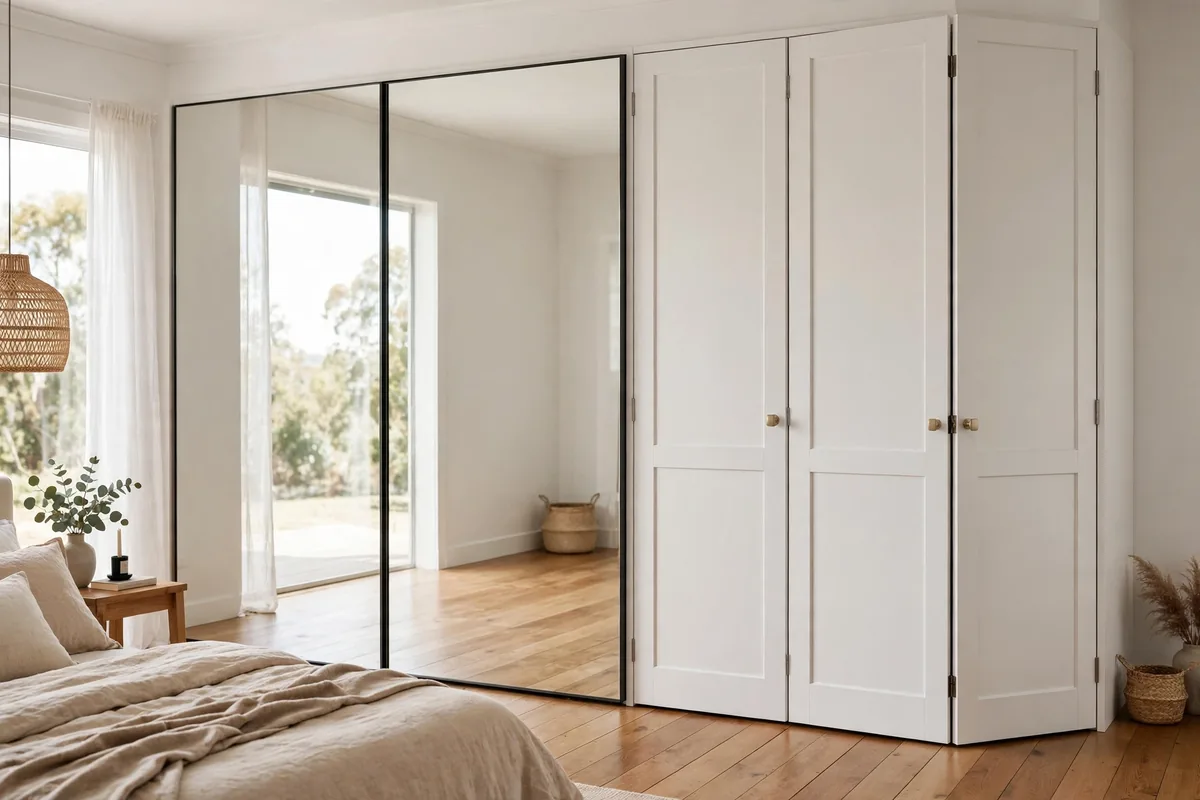
Sliding vs Hinged vs Bi-Fold: Which Wardrobe Doors Are Right for You?
Wardrobe doors seem like a small decision until you live with the wrong ones. Doors that swing into a narrow bedroom, sliders that jump their tracks, or bi-folds that never quite close properly — these daily annoyances add up. Choose well, and you barely notice your wardrobe doors at all, which is exactly the point.
In Australian homes in 2026, the three main options remain sliding, hinged and bi-fold doors, each with distinct advantages depending on your room size, budget and how you use the space. This guide compares them honestly — costs, pros, cons and which rooms suit each type.
Sliding Wardrobe Doors
Sliding doors run on tracks, with panels that glide past each other. They’re the default choice in most new Australian apartments and a popular retrofit for older homes.
Pros
- Space-saving — no swing arc means they work in the tightest bedrooms; you can place furniture right up against them
- Modern look — large uninterrupted panels suit contemporary interiors
- Mirrored options — mirrored sliders double as a full-length mirror, saving wall space and brightening the room
- Wide range — from budget aluminium-framed to premium frameless glass
Cons
- Only half accessible at once — you can never see or reach the full wardrobe interior simultaneously
- Track maintenance — tracks collect dust and need periodic cleaning; cheap rollers wear out and jump
- Less airtight — the overlap gap lets in more dust than hinged doors
Cost in Australia (2026)
- Budget aluminium-framed: $400–$900 for a standard 2-door robe
- Mid-range: $900–$2,000 — better rollers, thicker panels, mirrored or coloured glass options
- Premium frameless: $2,000–$4,500+ — minimal frames, soft-close, custom finishes
Installation is typically included in these ranges for standard openings. Custom sizes and non-standard heights cost more.
Best For
Small bedrooms, apartments, and anywhere floor space is tight. Also ideal when you want mirrored doors without sacrificing wall space. For more small-bedroom strategies, see our master bedroom design ideas.
Hinged Wardrobe Doors
The traditional choice — doors on hinges that swing open. Common in character homes, custom joinery and walk-in robes.
Pros
- Full access — open all doors and see everything at once; the best option for walk-in robes and wide wardrobes
- Better seal — closes tighter than sliders, keeping dust out
- Design flexibility — panelled, Shaker-style, or flat profiles; easiest to match to existing joinery
- Simple hardware — hinges are cheap to replace and rarely fail catastrophically
- Quiet — soft-close hinges are standard on quality installations and nearly silent
Cons
- Needs swing space — each door needs 45–60cm of clear floor in front; a problem in narrow rooms
- More expensive in custom sizes — multiple doors and quality hinges add up
- Can feel dated — basic hinged doors read as “1980s rental” unless the profile and handles are well chosen
Cost in Australia (2026)
- Flat-pack (IKEA PAX style): $300–$800 for doors alone on a standard robe
- Custom laminate: $1,200–$3,000 — made-to-measure, quality hinges, range of finishes
- Premium timber/polyurethane: $3,000–$6,000+ — solid timber or 2-pack polyurethane, soft-close everything
Best For
Walk-in robes, large bedrooms with space to spare, and heritage or Hamptons-style interiors where panelled doors suit the aesthetic. The superior choice when you want to see your whole wardrobe at a glance.
Bi-Fold Wardrobe Doors
Bi-fold doors concertina back in pairs. Once hugely popular in 1990s Australian homes, they’re less common now but still have their place.
Pros
- Wide opening — folds back to reveal most of the wardrobe, better access than sliders
- Compact swing — needs less clearance than full hinged doors
- Budget-friendly — among the cheapest options for wide openings
Cons
- Hardware wears out — the pivot and guide mechanisms are the weak point; cheap bi-folds sag and stick within a few years
- Never fully flat — folded panels protrude into the room and the wardrobe
- Looks dated — strongly associated with 90s renovations; can cheapen a modern interior
- Flimsy feel — lightweight panels flex and rattle compared to solid hinged or sliding doors
Cost in Australia (2026)
- Standard: $250–$700 for a typical opening — the cheapest way to cover a wide robe
- Better quality: $700–$1,500 — heavier panels, decent hardware, longer lifespan
Best For
Budget renovations, rental properties, and laundries or linen cupboards where the doors aren’t a design feature. For a primary bedroom, sliding or hinged doors are usually worth the extra investment.
Head-to-Head Comparison
- Smallest rooms: Sliding wins — zero swing space needed
- Best access: Hinged wins — full wardrobe visible at once
- Lowest cost: Bi-fold wins — cheapest for wide openings
- Best longevity: Hinged wins — simplest hardware, easiest to repair
- Modern look: Sliding wins — clean, minimal lines
- Heritage/Hamptons style: Hinged wins — panelled profiles suit the aesthetic
- Rental properties: Bi-fold or budget sliding — functional without overcapitalising
Materials and Finishes
Regardless of door type, your finish choice affects both look and durability:
- Melamine/laminate ($): the workhorse — affordable, huge colour range, handles daily use well. Quality varies; look for high-pressure laminate on edges.
- 2-pack polyurethane ($$): smooth, premium feel; available in matte or gloss. Chips can be touched up but not invisibly.
- Timber veneer ($$–$$$): real timber look without solid timber cost. Beautiful but needs care with moisture.
- Mirrored ($$): classic for sliders; makes rooms feel twice as big. Shows fingerprints — keep a microfibre cloth handy.
- Glass — frosted or tinted ($$–$$$): modern and light, but contents must stay tidy since they’re partially visible.
Measuring and Installation Tips
- Measure twice: width at top, middle and bottom (walls are rarely straight); height at both sides. Use the smallest measurements.
- Allow for tracks: sliding doors need 65–80mm of depth for double tracks; check your robe frame accommodates this.
- Floor level matters: significant slope needs packers or a custom solution — flag it with your installer upfront.
- DIY vs professional: flat-pack hinged doors are very DIY-friendly. Sliding doors are moderate DIY if the opening is square. Custom work and anything over 2.4m high is best left to professionals.
- Lead times: custom wardrobe doors in Australia typically take 3–6 weeks from measure to install in 2026. Don’t plan around faster timelines.
Common Mistakes to Avoid
- Choosing on price alone — the cheapest sliders have the worst rollers, and you’ll curse them daily
- Forgetting the swing arc — hinged doors that hit the bed are a classic renovation regret
- Mirrored doors facing the bed — some people find this unsettling; consider placement carefully
- Ignoring the interior — beautiful doors on a chaotic interior is lipstick on a pig; budget for internal fitout too
- Wrong scale — oversized panels on a small robe look clumsy; keep proportions in mind
Frequently Asked Questions
Are sliding wardrobe doors better than hinged?
Neither is universally better — it depends on your room. Sliding doors win in small bedrooms where swing space is limited. Hinged doors win for full access, better dust sealing and longevity. For walk-in robes, hinged is usually the better choice.
How much do wardrobe doors cost in Australia?
Budget options run $250–$900 (bi-fold or basic sliding), mid-range $900–$2,500, and premium custom $2,500–$6,000+ depending on type, size, materials and finishes. Installation is usually included for standard openings.
Can I replace bi-fold doors with sliding doors?
Yes, in most cases. You’ll need to remove the bi-fold tracks and install sliding door tracks, which need 65–80mm of depth. The opening may need minor adjustment. Budget $500–$2,000 for the conversion depending on door quality.
Do mirrored wardrobe doors make a room look bigger?
Yes — they’re one of the most effective tricks for small bedrooms. Full-height mirrored sliders reflect light and create an illusion of doubled space. They do show fingerprints, so keep a microfibre cloth handy.
How long do wardrobe doors last?
Quality hinged doors last 20+ years with minimal maintenance. Good sliding doors last 10–15 years before rollers need replacing. Budget bi-folds often need hardware attention within 5 years. The hardware quality matters more than the panel material for longevity.
Should wardrobe doors go to the ceiling?
Floor-to-ceiling doors look premium and eliminate the dust-collecting gap above standard robes. They cost 20–40% more than standard height and need precise installation, but the visual payoff is significant — especially with sliding doors.