
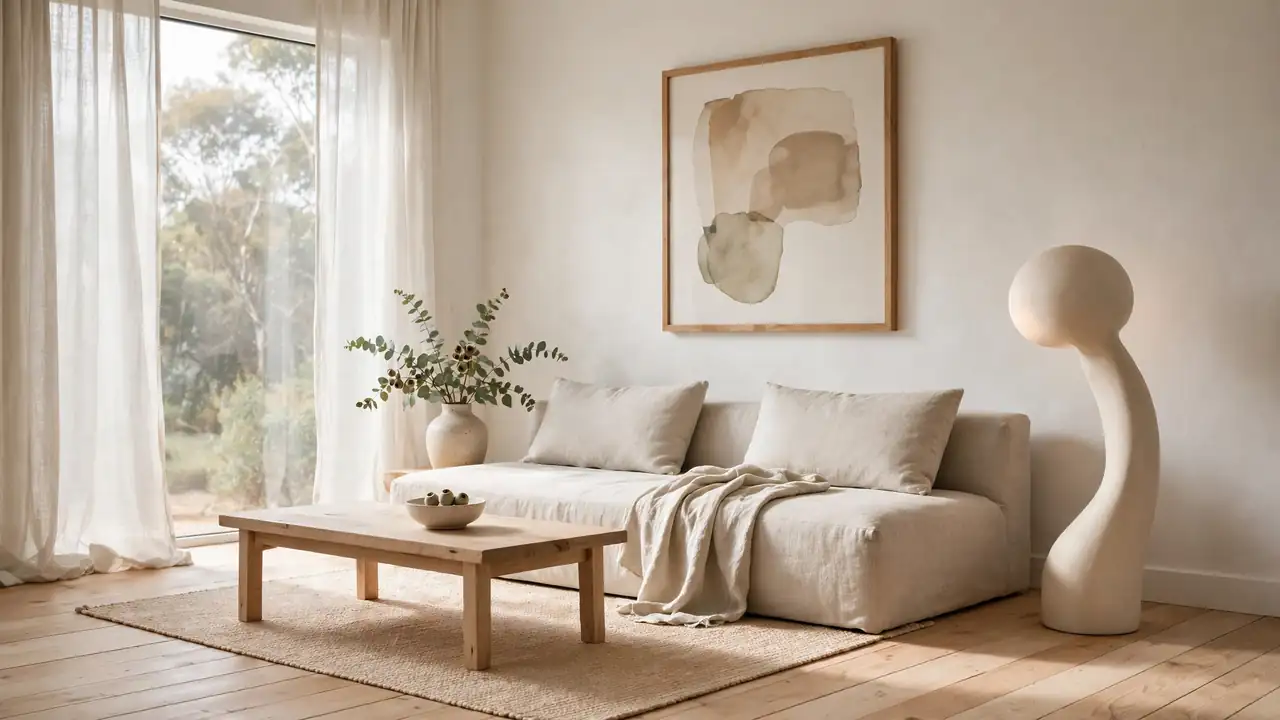
Minimalist interior design Australia is building in 2026 is not the cold white gallery. Most people picture that gallery when they hear the word. It is warm minimalism. It keeps the same restraint and the same uncluttered rooms. But it uses clay and oatmeal instead of stark white, blackbutt and spotted gum instead of pale birch. And texture does the work that colour used to do. The difference matters. A European minimalist room copied straight into an Australian home fights the light and the heat. It also fights the way the house is actually lived in. This guide covers the warm version: the palette, the materials, the room-by-room choices and what each part costs from live Australian sources. It also shows where it parts company with Scandinavian style.
Minimalist Interior Design Australia: Warm, Not Cold
In fact, the shift is visible across every 2026 Australian trend round-up. Buildana’s Sydney luxury trends guide calls warm minimalism the dominant residential design language of the mid-2020s. In short, it describes it plainly: edited, not empty. Overall, every element serves a purpose. But unlike stark minimalism, warm minimalism allows comfort, texture and personality. For example, think of a generous linen sofa, a single striking artwork and warm timber flooring — and nothing else in the room. Ansel Homes’ Melbourne trends list opens with the same move. For instance, it names warm minimalism and earthy colour palettes. Meanwhile, cool greys and stark whites step aside in favour of soft clays, terracotta, olive, sandstone and creamy neutrals.
Three things separate the warm version from the cold one. First, the palette has undertones. In fact, warm whites carry yellow or pink warmth. Instead, greige, mushroom, sand and clay replace blue-white and cool grey. Second, the materials are natural and visibly so. For example, timber grain you can see, stone with variation, linen with a slub, wool with a nap. Instead, that replaces the flat lacquer and polished chrome of gallery minimalism. Third, the rooms are designed for Australian light and heat. For example, north-facing glass has eaves that shade the summer sun. Meanwhile, thermal mass steadies the temperature. Finally, indoor-outdoor flow replaces a sealed white box.
The Palette: Warm Whites and Earth Tones
First, start with the walls, because they are the largest surface and the cheapest decision. The warm whites that recur across the 2026 Australian guides are Dulux Natural White, Dulux Lexicon Quarter and Dulux Whisper White. These whites carry warmth in them, never blue-white. Buildana’s guide is explicit. For example, walls go in warm whites with undertones, such as Dulux Natural White or Lexicon Quarter. Never blue-white. Dulux’s own colour forecast for 2026 leans the same way. Specifically, it names warm earth-based neutrals, burnt oranges and caramels alongside sage, moss and spearmint greens. The practical test is simple. First, paint a large board and pin it to the wall. Look at it at 8am, at midday and at 5pm. However, a white that looks clean in the morning can look harsh or yellow by afternoon under Australian sun.
Once the walls are set, the accent colours come from the landscape. Think clay, sand, oatmeal, terracotta, sage and eucalyptus green, tobacco and deep brown. Use them in small doses. A clay feature wall, sage joinery, terracotta cushions, an ochre throw. And keep the large surfaces pale. The ratio that works is roughly 60 per cent light neutrals and 30 per cent mid-tone timber and textiles. Accent colour takes the last 10 per cent. Paint is the cheapest square metre of transformation in the house. A 10-litre can of Dulux Wash & Wear low sheen interior paint lists at $239 at Bunnings. DX Living’s 2026 planning ranges put a repaint in a warm neutral scheme at $1,500 to $4,000 for a living room, professionally done.

Minimalist Interior Design Australia: Texture Does the Work
In a quiet palette, texture carries the interest. In fact, this is where spending money makes the biggest difference. The materials that define Australian warm minimalism are timber, stone, linen, wool and plaster. Each is chosen for how it feels as much as how it looks. Timber is the backbone. Buildana names European oak, blackbutt and spotted gum flooring in wide planks of 180mm or more. Timber feature walls, stair treads and joinery match it. At retail, Bunnings lists Pentarch engineered blackbutt flooring at $148.36 per square metre. Spotted gum lists at $159.51 per square metre. Both come as 2.455 square metre packs.
Next, stone is the second material, and it works hardest in kitchens and bathrooms. Travertine, limestone and honed granite are the 2026 choices for kitchen islands, bathroom walls and feature walls. Unfilled travertine is having a particular moment. The point of stone in a minimalist room is variation. A honed travertine benchtop has pits and veins that change across its length. That variation is what stops a pale room from looking flat. Textured plaster and lime wash do the same job on walls. DX Living prices a lime wash or textured plaster finish at $90 to $200 per square metre. Textiles are the third layer — linen curtains, wool throws, bouclé upholstery and a flat-weave cotton or wool rug. Layer three textures in every room: one smooth, one fibrous, one hard and warm.
Room by Room: Living, Kitchen, Bedroom, Bathroom
The living room is the test of the style. One generous linen sofa in oatmeal or natural. A low timber coffee table. A single large artwork. A sculptural floor lamp. And a rug large enough that the front legs of every seat sit on it. That is the room. Storage is what makes this possible. The uncluttered look requires somewhere for the clutter to go. So plan concealed storage before buying furniture. Our Scandinavian interior design guide makes the same point for its own style. The discipline is identical. The difference between the two styles is in the materials, not the tidiness.
The kitchen is flat-front, handleless or discreetly handled. It has pale cabinetry and a stone benchtop. And one open shelf of everyday ceramics at most. Joinery in natural timber or hand-painted in warm tones is the 2026 direction. Sage, putty and mushroom lead the way. A joinery wall with concealed media runs $8,000 to $30,000 in DX Living’s planning ranges. The bedroom should be the calmest room in the house. It needs a low-profile timber bed frame, crisp linen or cotton bedding in a neutral tone, one wool throw, and a single piece of simple artwork. Layered warm lighting sits on dimmers, with globes around 2700K. Our master bedroom ideas guide covers the same ground in detail. Finally, the bathroom follows the same logic: pale large-format tiles, a timber-look vanity and matte black tapware.
Minimalist Interior Design Australia: What It Costs
| Scope | Typical cost (AUD) | What is included |
|---|---|---|
| Single-room refresh | $1,500–$4,000 | Repaint in a warm neutral, new textiles, lighting swap, styling |
| Textured plaster or lime wash | $90–$200 per m² | Feature walls or whole room, depth without pattern |
| Australian hardwood flooring | $120–$250 per m² installed | Blackbutt or spotted gum, supply and install |
| Layered lighting | $6,000–$20,000 | Rewire and fittings, pendants, lamps, dimmers |
| Joinery wall, concealed media | $8,000–$30,000 | Custom joinery, hidden television, storage |
| Full apartment refresh | $8,000–$18,000 | Paint throughout, key furniture, lighting, textiles |
| Full home restyle | $20,000–$45,000+ | Furniture, flooring updates, window treatments, styling |
In fact, the ranges above come from DX Living’s 2026 planning figures and Bunnings retail pricing, both checked in November 2026. Overall, the most cost-effective move is almost always paint plus textiles. Then, if the budget is tight, spend it in this order: paint, rug, lighting, then furniture. And if the project involves layout changes, joinery or a designer, budget for design properly. Our interior designer cost guide puts most independent Australian designers at $150 to $300 an hour in 2026. A single paid consultation at $300 to $600 can prevent a five-figure mistake in flooring or joinery.

Minimalist vs Scandinavian: The Difference That Matters
In practice, readers often ask whether warm minimalism is just Scandinavian style under a new name. It is not. Scandinavian design is built for weak northern light. It uses pale timber, white walls and light textiles. That brightness compensates for dark winters. Warm Australian minimalism is built for strong southern light. It uses deeper timber tones like blackbutt and spotted gum, clay and oatmeal instead of white. Thermal mass steadies the house through hot days and cool nights. The Australian Government’s Your Home guide to thermal mass explains the physics behind that last point. Concrete, brick and stone absorb heat during the day and release it at night.
The practical differences follow from the climate. Scandinavian rooms use heavy layered curtains and sheepskins. Australian minimalist rooms use sheer linen, light-filtering blinds and flat-weave cotton rugs that breathe. They are inward-looking, arranged around a fireplace and a sofa. Australian rooms open outward, with stacker doors, level thresholds and the same floor running to the alfresco. Pale walls help them catch every scrap of daylight. Australian rooms can afford depth: a clay feature wall, a dark timber floor, a travertine island. The light is strong enough to carry it.
Minimalist Interior Design Australia: Mistakes to Avoid
First, the most common mistake is going too white. An all-white room with no texture reads as sterile, not minimalist. Australian sun makes it worse by washing the room out by midday. The second mistake is ignoring storage. The uncluttered look requires somewhere for the clutter to go. A minimalist room without planned storage lasts about a week. The third is buying the cheapest flat-pack everything. The style values honest materials. So a few solid timber pieces mixed with affordable basics look far better than a whole room of particleboard. The fourth is forgetting warmth in the lighting: cool daylight globes belong in a laundry, not a living room. The fifth is copying a European gallery room literally. A room designed for Copenhagen will not survive a Brisbane summer without adaptation.
Frequently Asked Questions
What is minimalist interior design in Australia?
Minimalist interior design in Australia in 2026 is warm minimalism: restrained, uncluttered rooms in warm whites, clay, sand and oatmeal, with natural materials such as blackbutt timber, travertine and linen. It keeps the calm and simplicity of minimalism while adding the warmth and texture that Australian light and climate demand.
What colours suit minimalist interiors in Australia?
Warm whites with undertones, such as Dulux Natural White and Lexicon Quarter, with accents drawn from the landscape: clay, terracotta, sage, eucalyptus green and ochre. Keep accent colours to about 10 per cent of the room, with roughly 60 per cent light neutrals and 30 per cent mid-tone timber and textiles.
How much does a minimalist makeover cost in Australia?
A single-room refresh runs $1,500 to $4,000, a full apartment refresh $8,000 to $18,000, and a full home restyle $20,000 to $45,000 or more. Australian hardwood flooring runs $120 to $250 per square metre installed, and a textured plaster or lime wash finish runs $90 to $200 per square metre.
How is minimalist design different from Scandinavian design?
Scandinavian design is built for weak northern light, with pale timber, white walls and light textiles. Warm Australian minimalism uses deeper timber tones such as blackbutt and spotted gum, clay and oatmeal palettes, thermal mass and indoor-outdoor flow, and is designed for strong sun, heat and the way Australian homes are lived in.
Can minimalism work in a family home?
Yes, when the storage is planned first. Concealed storage, durable surfaces, washable linen slipcovers and flat-weave rugs are what let a minimalist room survive children and pets. If the household cannot maintain clear benchtops and closed cupboards, a warmer style is the better choice.
Warm minimalism is restraint with a pulse. Fewer pieces, better materials. And a room that stays calm because everything in it earns its place. Set the palette, let texture do the work, and plan the storage before the furniture.