
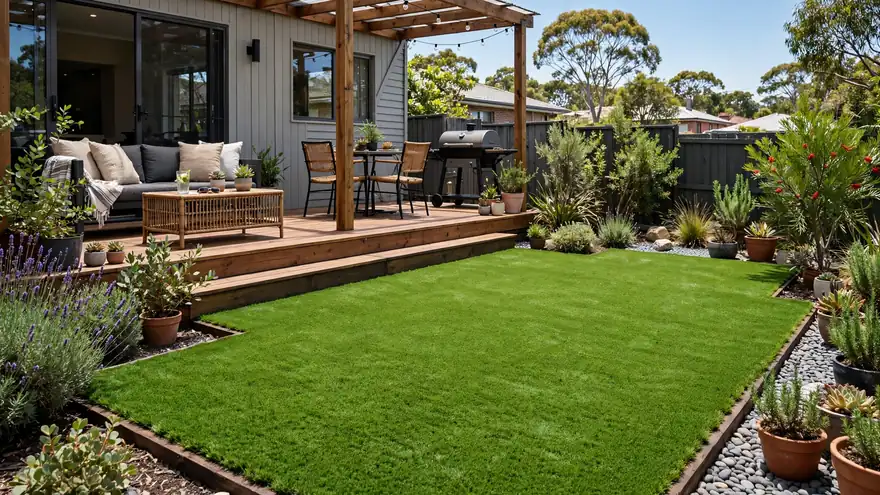
Artificial grass costs between $50 and $140 per square metre professionally installed in Australia in 2026 — so a typical 50m² backyard lands somewhere around $4,000–$7,000. If you’re buying turf only and installing it yourself, prices start from about $13/m² for budget mats at Bunnings and run to $75/m² for premium installer-grade grass. This guide breaks down the artificial grass cost per square metre in Australia by quality tier, separates supply from installation so you can see what a quote actually covers, and works through real project examples — so you know what a fair price looks like before an installer visits your home.
✓ Prices verified: October 2026. All ranges in this guide were researched from Australian suppliers, trade-quote platforms, and installer price guides.
Artificial Grass Cost Per Square Metre Australia (2026)
There is no single national price because the turf itself varies enormously — a $13/m² economy mat and a $75/m² premium synthetic lawn are barely the same product. Across Australian supplier guides, trade-quote platforms, and installer price lists, the 2026 picture is consistent:
- National typical range, installed: $50–$140 per m²
- Supply-only turf: $13–$75 per m²
- Installation labour component: roughly $20–$25 per m²
- Site preparation: $5–$10 per m²
- Edging: $5–$10 per linear metre
Most homeowners choose mid-range turf professionally installed and end up around $80–$110 per m². Brisbane and south-east Queensland installer quotes skew higher — one long-running Brisbane installer publishes a fully-installed range of $150–$330/m² for complex sites and premium products, while Sydney guides cluster around $50–$100/m² with premium projects up to $120/m². Small jobs attract minimum charges (machinery, delivery, and a crew have to turn up regardless), so per-metre rates are always best on jobs of 30m² or more.
The honest caveat: no single 2026 national survey of artificial grass pricing exists. The figures below are compiled from Australian supplier price guides, trade-quote platforms such as ServiceTasker, installer price lists, and published homeowner quotes. Treat them as indicative ranges — and always get at least three written quotes for your specific site.
Artificial Grass Cost by Quality Tier: Supply vs Installed
The tier of turf you choose is the single biggest lever on price. Budget turf is thinner, shorter, and harder underfoot; premium turf has taller pile, denser fibres, better UV stabilisation, and more natural multi-tone colouring. Here’s what each tier costs in 2026:
| Quality tier | Supply-only (per m²) | Professionally installed (per m²) | Best for |
|---|---|---|---|
| Budget / entry | $13–$30 | $50–$80 | Balconies, low-traffic corners, rental quick-fixes, areas you don’t look at closely |
| Mid-range | $30–$50 | $80–$110 | Most family backyards — the sweet spot of looks, comfort, and durability |
| Premium | $50–$75 | $110–$140 | Front lawns, entertaining areas, heavy family or pet use, homes where the lawn is on show |
| Specialty (pet / sport) | $50–$75+ | $100–$180 | Pet runs needing permeable backing and odour control; sports and playground surfaces |
A quick rule of thumb from installer guides: a decent residential roll sits around $20–$40/m² for the turf alone, while thicker UV-protected blends run $50–$70/m². Pile height matters too — medium pile (30–40mm) is what most backyards use; long pile (40mm+) looks lusher but adds roughly $5–$10/m².
Our take: mid-range is where the value is. Budget turf fades, flattens, and feels harsh underfoot — and because installation labour costs roughly the same regardless of turf quality, saving $15/m² on cheap grass while paying full installation rates is false economy. Go premium only where the lawn is genuinely on display.
Full Project Cost Examples (2026)
Per-metre rates only become meaningful when you multiply them by your actual area. These examples use mid-range turf professionally installed on a reasonably straightforward site:
| Project | Area | Typical installed cost (2026) |
|---|---|---|
| Small courtyard / townhouse backyard | 20m² | $1,500–$2,500 |
| Medium family backyard | 50m² | $4,000–$6,000 |
| Large suburban lawn | 100m² | $7,000–$12,000 |
A few things to keep in mind when you read these. First, small jobs feel expensive per metre because of minimum charges — the site preparation equipment, delivery, and crew mobilisation cost nearly as much for 15m² as for 40m². Second, large jobs benefit from economies of scale: a 100m² lawn at the budget end of mid-range turf can dip below $80/m². Third, premium turf on a large area adds up fast — 100m² at $140/m² is $14,000 before any drainage surprises. One Sydney installer’s rule of thumb: most family homes invest somewhere between $5,000 and $15,000 all-in.
Artificial Grass Cost: Supply vs Installation — What’s in Your Quote?
A proper quote should itemise at least the turf, the labour, and the site preparation. These component ranges, compiled from Australian trade-quote platforms, show where the money goes:
| Component | Indicative cost (2026) | Notes |
|---|---|---|
| Turf supply | $20–$50 per m² | Entry to mid-range residential turf; premium $50–$75/m² |
| Installation labour | $20–$25 per m² | Laying, cutting, joining seams, securing edges |
| Site preparation | $5–$10 per m² | Removing old grass, levelling; more on clay or sloped blocks |
| Crushed rock / sand base | $5–$10 per m² | The compacted sub-base that keeps the lawn flat and draining |
| Edging | $5–$10 per linear metre | Aluminium, treated timber, or stone edging to hold the turf |
| Infill (silica sand) | Usually bundled | Brushed into the pile to hold fibres upright; specialty pet infills cost extra |
The biggest takeaway: installation is roughly half the job cost. The turf itself is only part of the story — the base preparation is what determines whether your lawn still looks flat and professional in five years. Installers who quote suspiciously cheap are almost always cutting corners on the sub-base, not on the grass.
6 Cost Factors That Move Your Quote
Two neighbours with identical backyard sizes can receive quotes thousands of dollars apart. Here’s what installers actually adjust for:
1. Base preparation and drainage
The single biggest variable. Flat, well-draining soil on an existing lawn might need only standard preparation ($5–$10/m²). Heavy clay soils — common across Brisbane, western Sydney, and Melbourne — often need extra drainage work, and removing concrete or old paving adds demolition cost. Sloped blocks need retaining and deeper bases. If your yard holds water after rain, budget extra.
2. Access
Everything for an artificial lawn arrives by the truckload: crushed rock, sand, and turf rolls. A wide side gate with ute or bobcat access keeps costs normal. Narrow access, stairs, or no side access at all means materials get wheelbarrowed by hand — and labour is priced accordingly.
3. Edging and borders
Every turf installation needs a fixed edge to hold it in place. Aluminium edging is the standard; stone, treated timber, or concrete edging costs more but can look better against garden beds. Long, fiddly perimeters (curved garden beds, paths weaving through the lawn) push the edging bill up.
4. Pile height and density
Short pile (20–30mm) is firm and cheap — fine for balconies and walkways. Medium pile (30–40mm) feels most like a real lawn and suits most backyards. Long pile (40mm+) looks lush but adds roughly $5–$10/m² and shows wear faster in high-traffic areas. Higher fibre density generally means longer life.
5. Pet and specialty requirements
Pet areas need high-permeability backing so urine drains through, plus antimicrobial infill to control odour — installer guides price pet areas at $100–$145/m² installed. Sports surfaces need shock padding and specialised yarns ($110–$180/m²).
6. Your city
Sydney quotes cluster around $50–$100/m² installed. Brisbane installer price lists run higher at the top end ($150–$330/m² for complex or premium jobs). Melbourne and Perth generally sit between these. Labour rates, soil types, and local competition all play a part — another reason to get three local quotes rather than trusting a national average.
Artificial vs Natural Grass: An Honest Comparison
Artificial grass is marketed hard, so here’s the balanced version — including the downsides the brochures skip.
| Factor | Artificial grass | Natural grass |
|---|---|---|
| Upfront cost | $50–$140/m² installed ($4,000–$6,000 for a typical backyard) | $1,000–$3,000 for a new lawn (soil prep + turf rolls at roughly $10–$25/m² supplied and laid) |
| Ongoing cost | Very low — brushing, leaf clearing, the occasional hose-down | Mowing, watering, fertilising, weeding — a steady bill for decades |
| Water use | None for the lawn itself | A thirsty lawn can use hundreds of litres a week in summer |
| Appearance | Green all year, but never changes; can look flat in harsh sunlight | Varies with seasons and care — stunning when healthy, patchy when neglected |
| Heat | Gets hot under direct summer sun — uncomfortable for bare feet | Stays cooler; living grass actively cools its surroundings |
| Environment | Fossil-fuel product; no biodiversity or urban cooling benefit | Supports soil life and insects; absorbs carbon — but needs water and fertiliser |
| Lifespan | 12–20 years, then it must be replaced | Indefinite with ongoing care |
Two points deserve emphasis because they’re routinely glossed over. First, heat: synthetic turf absorbs and radiates heat, and on a 35°C day the surface can be uncomfortably hot for kids and pets — the NSW Government’s synthetic turf study flags heat impacts as a key concern. Second, the environmental ledger is genuinely mixed: the Australian Government’s YourHome guide notes that synthetic grass products are an inappropriate choice for sustainable landscapes — they don’t support biodiversity, don’t cool the surrounding air, and are manufactured from fossil fuels. The honest reason to choose artificial grass is convenience and water savings, not environmental virtue.
Our take: artificial grass wins when mowing, watering, and patchy grass are ruining your enjoyment of the yard — think water restrictions, shaded blocks where real grass won’t grow, rental properties, and busy households with pets. If you love gardening, have a shaded cool-climate block, or the budget only stretches to budget-tier turf, natural grass (or drought-tolerant natives) is the better call.
Maintenance Costs of Artificial Grass
“No maintenance” is an exaggeration; “very little maintenance” is accurate. Here’s what an artificial lawn actually needs, and what it costs:
- Monthly brushing — a stiff broom or power brush keeps fibres upright, especially in high-traffic areas. Free if you do it yourself; a power brush is a one-off purchase.
- Leaf and debris clearing — a leaf blower does the job in minutes. Letting organic matter rot on the turf is the main cause of weeds and smells.
- Occasional hose-down — dust and pet areas benefit from a rinse every few weeks in dry weather. This costs you nothing but a few litres of water.
- Pet deodoriser — enzyme-based turf cleaners for pet areas; used as needed.
- Professional deep clean — most installers offer annual service plans (power brushing, infill top-up, sanitising). Ask for a quote with your installation — prices vary by lawn size, and it’s worth pricing once a year rather than guessing.
The real long-term cost isn’t maintenance — it’s replacement. Budget turf on a sunny, high-traffic lawn can look tired in 8–10 years; quality turf lasts 15–20. When comparing quotes, divide the installed price by the realistic lifespan: a $6,000 mid-range lawn lasting 15 years costs about $400 a year — usually less than the mowing service alone on natural grass.
Lifespan and Warranty: What to Expect in Australia
Australian UV is brutal, so buy for it. Realistic lifespans for 2026 products:
- Budget turf: 8–12 years before fading and flattening show
- Mid-range turf: 12–18 years with basic care
- Premium turf: 15–20+ years
On warranties, expect two parts. The manufacturer’s product warranty — commonly 7–10 years against UV degradation and manufacturing defects on quality turf — is the one that matters. The installation warranty covers workmanship (joins, edges, base settlement); one Sydney installer, for example, advertises an 18-month installation warranty alongside an 8-year product warranty, which is a reasonable benchmark. Get both in writing, and check that the product warranty is backed by the manufacturer — not just the installer, who may not be around in a decade.
Frequently Asked Questions
How much does artificial grass cost per square metre in Australia in 2026?
Expect $50–$140 per m² professionally installed, with most homeowners paying $80–$110/m² for mid-range turf. Supply-only turf runs $13–$75/m² if you’re installing it yourself. A typical 50m² backyard costs $4,000–$6,000 installed.
Is it cheaper to install artificial grass myself?
The turf is cheaper — supply-only starts around $13–$30/m² for budget grass — but professional installation adds roughly $20–$25/m² in labour plus $5–$10/m² for base preparation. DIY saves meaningfully only on small, simple areas; the base preparation is skilled work, and a lumpy DIY lawn can’t be fixed later. Most installers recommend professional installation for anything over 20m².
Does artificial grass need drainage?
Yes — drainage is one of the main cost factors. The turf itself is permeable, but water needs somewhere to go: a compacted crushed-rock sub-base with proper fall, and sometimes agi drains on clay soils. Skipping drainage is the most common cause of failed installations, so make sure it’s itemised in your quote.
How long does artificial grass last in Australian conditions?
Budget turf lasts 8–12 years; mid-range 12–18 years; premium 15–20+ years. Australian UV is the main enemy — buy turf with proper UV stabilisation and a 7–10-year manufacturer warranty, and get both the product and installation warranties in writing.
Will artificial grass save me money long term?
Often yes, on running costs. A $6,000 mid-range lawn lasting 15 years works out to about $400 a year — usually less than mowing, watering, and fertilising natural grass over the same period. But the upfront cost is far higher than natural turf, and you’ll pay for a full replacement at end of life. It saves money if you’d otherwise pay for lawn care; it doesn’t if you mow your own lawn for free.
Do I need council approval to install artificial grass?
Not usually for a residential backyard — it’s landscaping, not building work. Exceptions exist: some councils have rules about synthetic turf on nature strips or in heritage areas, and strata or body corporate by-laws may restrict it on balconies and common areas. Check before you book an installer, not after.
Is Artificial Grass Worth It? Our Verdict
For most Australian households, the decision comes down to how much your current lawn costs you — in money, water, or weekends. If you’re paying for mowing, watching the lawn brown every summer under water restrictions, or dealing with pets and kids destroying natural turf, a $4,000–$6,000 mid-range artificial lawn that lasts 15 years is genuinely good value. If you enjoy gardening, have a shaded block where quality natural grass thrives, or can only afford budget-tier turf, spend the money on soil improvement and a drought-tolerant natural lawn instead.
Either way, the rules are the same: get three written quotes, make sure drainage and base preparation are itemised (not “included”), buy mid-range turf or better, and get both warranties in writing. Do that, and whichever way you go, you’ll get a lawn that earns its keep.
Plan Your Outdoor Budget
Artificial grass is usually one part of a bigger outdoor project. Our deck cost guide pairs naturally with turf pricing if you’re redoing the whole backyard, and the Australian Renovation Cost Index puts your landscaping spend in context against every other renovation. For structural work inside the house, see our house renovation cost per square metre guide.
Prices in this guide are indicative 2026 ranges compiled from Australian supplier price guides, trade-quote platforms, and installer price lists. Every site is different — get at least three written quotes from reputable installers in your area before committing.
Last updated: October 2026